


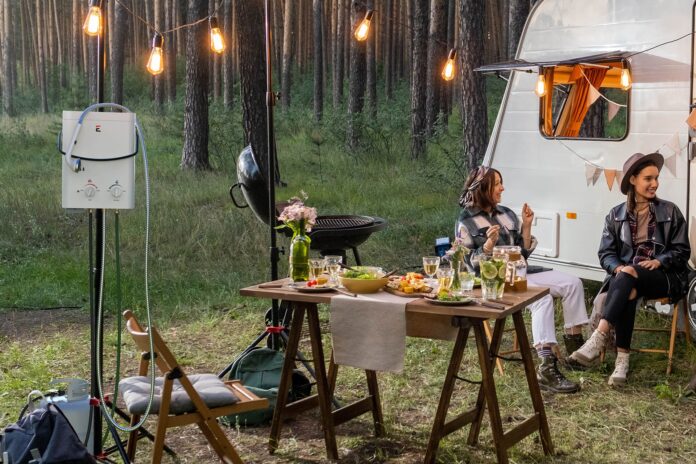
Quick Facts:
- Topic: How to size a propane tankless water heater for camp showers and dishes.
- Core formula: Input BTU per hour equals GPM x 60 x temperature rise x 8.34, divided by 0.8.
- Propane energy: About 21,600 BTU per pound, or roughly 432,000 BTU in a 20 lb tank.
- Fuel per shower: At a 60 degree rise, about 4 eight-gallon showers per 1 lb canister and about 86 per 20 lb tank.
- Startup pressure: 3.0 to 3.6 psi for the Camplux models listed, 20 psi for the Eccotemp L5.
- Best for: Vehicle campers who want hot water for showers and dishes without hookups.
8 min read
In This Guide
- Propane Tankless Water Heater Overview.
- Key Specs of Four Camp Heaters.
- Temperature Rise and Flow Rate.
- Propane Burn: Showers per 1 lb and 20 lb.
- Water Pressure, Pumps, and Mounting.
- Cold Weather, Altitude, and Freeze Protection.
- Propane Tankless Water Heater Safety Rules.
- Propane Tankless vs. Other Camp Hot Water.
- Final Thoughts.
- Frequently Asked Questions.
Propane Tankless Water Heater Overview
A propane tankless water heater gives you hot water at camp without a tank, a power cord or a wait. You connect a water source and a propane supply, then open the tap. A flow sensor lights the burner, and water leaves hot for as long as fuel and water last.
Most listings lead with one number, the rated flow in gallons per minute (GPM). However, the rating holds only at a modest temperature rise. Cold inlet water cuts the flow you get at shower temperature. This guide compares four units and shows the math for flow, pump and fuel before you buy.
For me, the strongest reason to carry one is hot dish water and a hot rinse after a muddy day, not the shower itself. Pair the heater with the enclosure and rinse gear from our ultimate camp shower setup, and you have a complete wash station.
The guide covers outdoor-only units, sold as a portable propane water heater or a camping water heater.
Key Specs of Four Camp Heaters
Pressure and burner size split these four camp units. Eccotemp publishes the L5 figures on its L5 product page, and Camplux publishes the AY132 figures on its AY132 product page. The BW158 and BW264 figures come from their Amazon listings. Also, the L5 page lists input as a range of 25,000 to 37,500 BTU, so the table shows the top of the range.
| Heater | Rated flow | Maximum input | Startup pressure |
|---|---|---|---|
| Eccotemp L5 | 1.5 GPM | 37,500 BTU/hr | 20 psi |
| Camplux AY132 | 1.32 GPM | 34,000 BTU/hr | 3.0 psi |
| Camplux BW158 | 1.58 GPM | 41,000 BTU/hr | 3.0 psi |
| Camplux BW264 | 2.64 GPM | 68,000 BTU/hr | 3.6 psi |
Maximum input sets how much heat the burner makes, and startup pressure decides whether your water source lights it at all. Because specs change between production runs, check the manual of the unit you buy.
The three Camplux units in the table start on 3.0 to 3.6 psi, so a small pump runs them. The grid below lists the AY132, BW158 and BW264.
Camplux portable propane heaters in this guide


Temperature Rise and Flow Rate
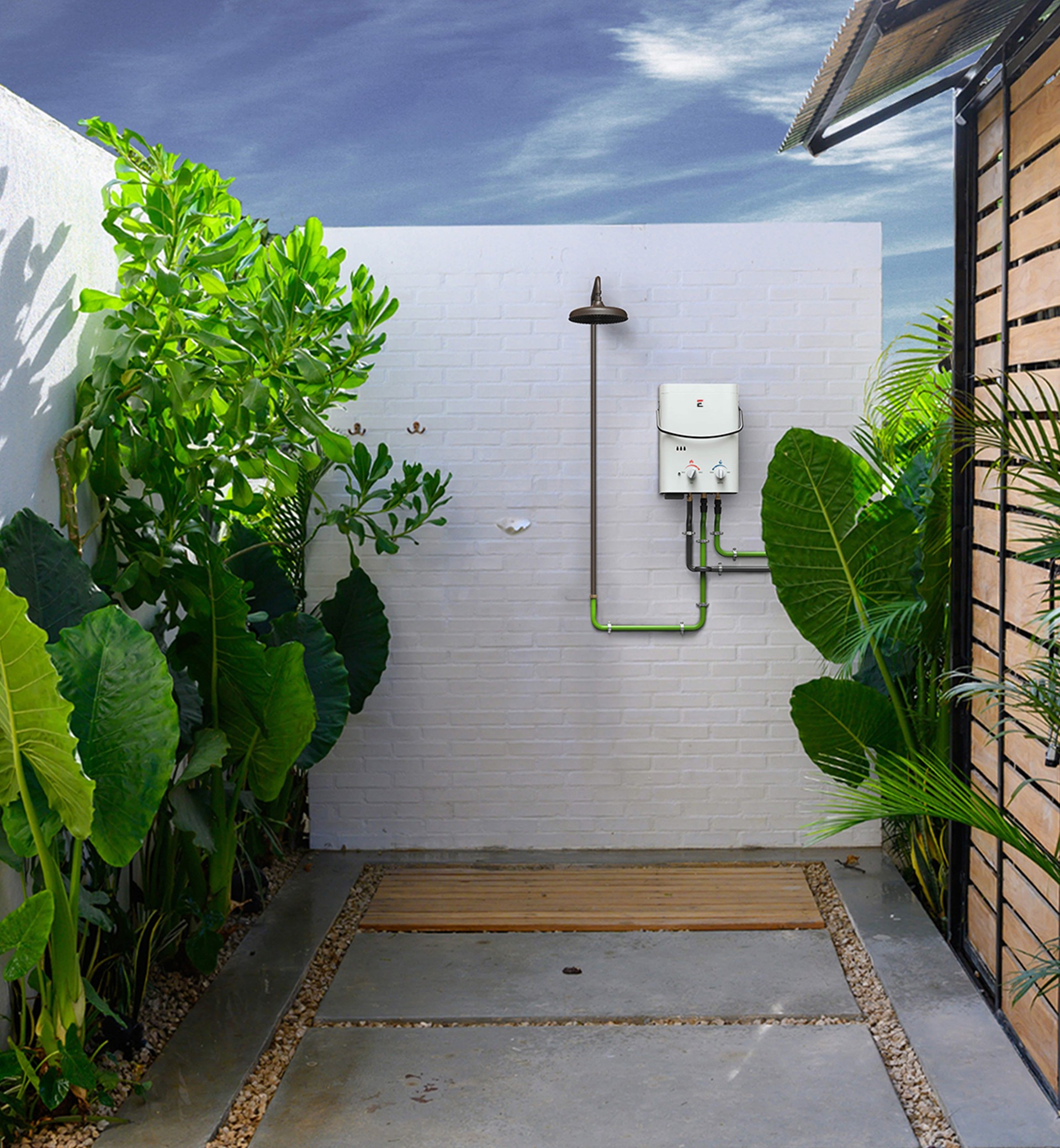
Cold inlet water cuts your flow because each degree of rise costs 8.34 BTU per gallon. Therefore, the heat you need follows one formula: BTU per hour equals GPM times 60 times the temperature rise times 8.34. Rise means the shower temperature minus the inlet temperature.
For example, take 45 degree inlet water and a 105 degree shower. Then the rise is 60 degrees. At 1.5 GPM, the water needs about 45,000 BTU per hour of delivered heat. Because we assume 80 percent efficiency, a common figure for non-condensing units, the burner must take in about 56,300 BTU per hour. Three of the four heaters above top out under 56,300 BTU.
| Heater | Heat delivered at 80% | Rise at rated flow | Flow at 60 degree rise |
|---|---|---|---|
| Eccotemp L5 | 30,000 BTU/hr | 40 degrees | 1.00 GPM |
| Camplux AY132 | 27,200 BTU/hr | 41 degrees | 0.91 GPM |
| Camplux BW158 | 32,800 BTU/hr | 41 degrees | 1.09 GPM |
| Camplux BW264 | 54,400 BTU/hr | 41 degrees | 1.81 GPM |
Notably, each rated flow matches a rise near 40 degrees by this math. A 40 degree rise means 65 degree water in and 105 degrees out, so you meet the rating only with mild inlet water. However, with 45 degree water the rise grows to 60 degrees, and flow drops by one third.
Owners describe the same rule from the other side: less flow means hotter water, and too little flow stops the burner from lighting.
Propane Burn: Showers per 1 lb and 20 lb
The U.S. Energy Information Administration lists 91,452 BTU in a gallon of propane. At about 4.23 pounds per gallon, one pound holds roughly 21,600 BTU, and a 20 lb tank holds about 432,000 BTU.
Next, count the fuel per gallon of hot water. At a 60 degree rise and 80 percent efficiency, each gallon needs 625 BTU of input (60 x 8.34 / 0.8). One pound of propane therefore heats about 35 gallons of water (21,600 / 625).
| Water through the heater | Input per shower (gallons x 625) | Showers per 1 lb | Showers per 20 lb |
|---|---|---|---|
| 3 gallons | 1,875 BTU | 11.5 | 230 |
| 5 gallons | 3,125 BTU | 6.9 | 138 |
| 8 gallons | 5,000 BTU | 4.3 | 86 |
| 15 gallons | 9,375 BTU | 2.3 | 46 |
For example, a three-gallon navy shower, with the water off while you soap, stretches a 1 lb canister to more than 11 showers. In contrast, a fifteen-gallon shower, roughly 10 minutes at 1.5 GPM, gets only 2.
Treat these figures as a starting point. Warm-up, wind, pauses and a tank shared with a stove all cost fuel. Owners disagree on real numbers: one forum estimate is about 6 showers per pound, while another is 10 to 20 short showers per pound. If your 20 lb tank also feeds a stove, our camp cooking fuel compared guide covers propane against butane and isobutane, plus carbon monoxide basics.
Also, both makers include a regulator for a 20 lb tank, and the L5 adds a gas hose. A 1 lb canister needs an adapter hose, which owners report works for weeks of casual use. However, owners say water is the tighter limit. One owner notes a 10 minute shower uses about 16 gallons, against about 3 for a navy shower.
Water Pressure, Pumps, and Mounting
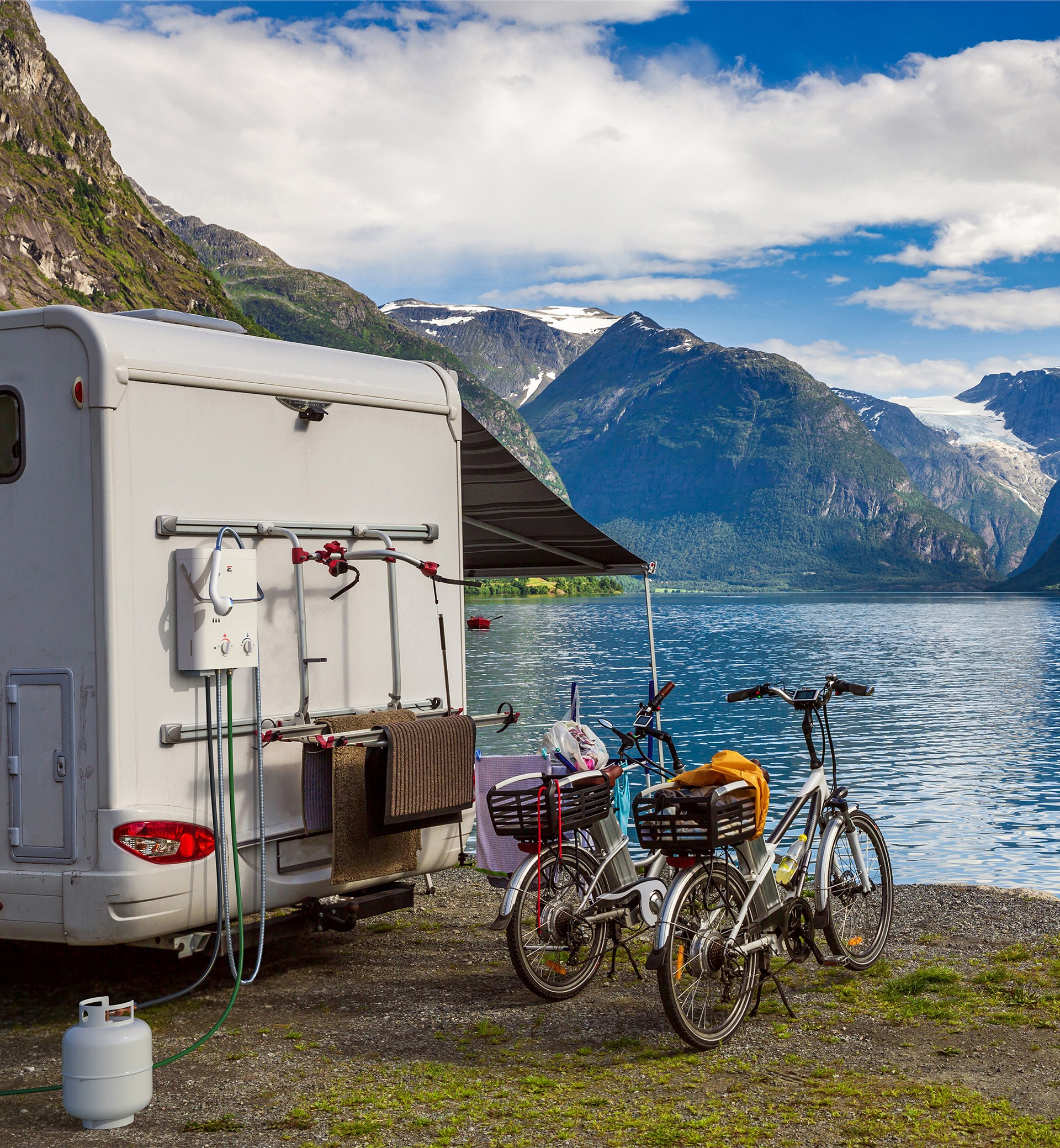
Because a campsite has no hose bib, water pressure decides which heater works. Camplux lists a 3.0 psi startup for the AY132 and BW158. Eccotemp lists 20 psi activation and a 20 to 80 psi ideal operating range for the L5. Therefore, the L5 needs a pump or a pressurized tank. Camplux says the AY132 also needs a pressurized source and points buyers to a 12V pump pack. A raised tank adds 0.433 psi per foot, so 3.0 psi takes about 7 feet of height and 20 psi about 46.
Owners run RV-style 12V diaphragm pumps in the 2.5 to 3 GPM class, fed from a jerry jug, a shower tank or a creek. Shurflo and Seaflo-style pumps are the names owners mention. A stronger pump helps the burner light, while the water knob on the heater still sets the flow.
Owners often report wind blowing out the flame, even on mild days. Mount any outdoor tankless water heater on a rack, a door or a spare tire carrier, outside any shower tent, and shield it with a baffle. Keep the baffle clear of the vents so the burner still gets air.
Owners repeat three install tips: add a shutoff valve on the water inlet and another on the gas line, fit quick-connects, and add a drain valve. Also remove the ignition batteries for transit, so the unit cannot fire in a bumper box.
Cold Weather, Altitude, and Freeze Protection
Cold inlet water widens the rise, so any portable tankless water heater loses flow. At 40 degree inlet water and a 105 degree shower, the rise is 65 degrees, and the L5 delivers about 0.92 GPM by our math.
However, propane boils near -44 degrees F, so a 20 lb tank gives vapor at most camps, although output drops below 0 degrees F. Our guide on how cold is too cold shows what fails at each temperature, butane included.
Water left in the heat exchanger freezes and cracks the unit. One owner lost a heater twice because it drained slowly. Camplux lists the routine: remove the batteries, disconnect every water line, and open the drain plug counterclockwise. I would drain the unit on any night the forecast nears 32 degrees.
Altitude also cuts input. Eccotemp tests the L5 for use up to 2,000 feet and cautions about efficiency and performance higher up. Mechanical code practice trims gas input 4 percent for each 1,000 feet above sea level once you pass 2,000 feet. At 8,000 feet, a 37,500 BTU burner drops to about 25,500 BTU per hour of input, or about 0.68 GPM at a 60 degree rise by our math, down from 1.00. Owners report using L5 and Camplux units between 5,000 and 9,000 feet, with occasional cut-outs. Therefore, favor the larger burner when you shower high and cold.
A 12V diaphragm pump supplies the pressure, and the Shurflo 4008-101-E65 lists 3.0 GPM. For a shower stall, a pop-up privacy tent such as the Wakeman Pop Up Pod works. Keep the heater outside the tent.
Pump and privacy tent for a camp shower

PENTAIR SHURFLO Revolution 4008-101-E65 RV Fresh Water Pump 12V 3.0…


Propane Tankless Water Heater Safety Rules
Run any outdoor tankless water heater in open air. The Camplux AY132 page says not to use it in enclosed or poorly ventilated spaces.
Safety note: Never run the heater inside a tent, van, camper or enclosed awning. Exhaust carries carbon monoxide, which has no odor. Keep the unit in open air, away from tent walls and windows, and run a carbon monoxide alarm in any space where you sleep.
Our propane heater carbon monoxide safety guide covers alarm placement and ventilation for propane heaters. Likewise, keep a water heater exhaust well away from any sleeping space.
Check every gas fitting for leaks before each use, as the Camplux BW264 listing advises. Then test the water with your hand before you step in. Owners report scalding water with restricted flow, and the AY132 and BW264 listings state an overheat shutoff at 176 degrees F, which still scalds. Finally, the L5 shuts off when tilted more than 45 degrees, so keep it upright.
Propane Tankless vs. Other Camp Hot Water
Propane is not the only way to get warm water. Solar shower bags use no fuel but need sun and time. Stove-heated buckets work anywhere you carry a stove. Some overlanders also run engine coolant through a heat exchanger. Many owners prefer these for simplicity and save the propane unit for groups or families.
For dishes only, our portable camp sink hot water setups roundup lists two propane picks, the Kakadu Outback Shower and the Joolca HOTTIE. If water is scarce, a sponge bath uses a few ounces per wipe-down, and our guide to staying clean without a shower covers the kit.
Final Thoughts
Size a propane tankless water heater by the coldest inlet water you expect, not by the GPM on the box. First, subtract the inlet temperature from 105. Then, if the answer tops 40, plan on less than rated flow.
If your water source is a pump or a raised tank, favor low startup pressure. By the makers’ numbers, Camplux starts at 3.0 to 3.6 psi and the L5 at 20 psi. For most trips, the BW158 balances burner size and startup pressure. If you shower in near-freezing water or above 5,000 feet, step up to the BW264, although its listing gives the weight as 18 to 23 pounds.
Pack about 1 lb of propane for every 3 eight-gallon showers. Carry a drain plan, a carbon monoxide alarm and a wind baffle, and keep the unit outdoors. However, if you shower weekly and have sun, a solar bag costs less in fuel and gear. A portable propane water heater or camping water heater earns its place with groups, dishes and cold mornings.
Frequently Asked Questions
How much propane does a tankless water heater use?
At full burn, the 37,500 BTU per hour input of the L5 uses about 1.7 pounds of propane per hour, so a 20 lb tank gives about 11.5 hours of burner time. Showers use far less, since one pound heats about 35 gallons of water at a 60 degree rise.
What size tankless water heater do I need for camp showers?
Input BTU per hour equals GPM times 60 times rise times 8.34, divided by 0.8. For one 1.5 GPM shower at a 40 degree rise, you need about 37,500 BTU per hour of input. At a 60 degree rise, you need about 56,300.
How many showers does a 1 lb propane canister give?
A 1 lb canister gives more than 11 three-gallon showers, 4 eight-gallon showers or 2 fifteen-gallon showers at a 60 degree rise. Owner estimates run from about 6 to 20 short showers per pound, depending on shower length.
Will a portable tankless water heater freeze overnight?
It does if water stays inside, because ice cracks the heat exchanger. One owner lost a unit twice this way. Remove the batteries, disconnect every water line and open the drain plug before any night near freezing.
Is it safe to run a propane water heater near a tent or van?
No. Run it outdoors in open air, well away from tent walls, vehicle doors and awnings, because exhaust carries carbon monoxide. The Camplux AY132 page says not to use it in enclosed or poorly ventilated spaces, and a carbon monoxide alarm belongs in every sleeping space.