



Quick Facts:
- Topic: Trailer tire pressure for off-road and overland trailers, set apart from the tow rig.
- Short answer: Air down light trailers on LT tires for dirt and sand; go easy on ST tires.
- What sets the number: Weight per tire, tire type, load range, and suspension.
- Typical trail range: Owners of light LT-tired trailers report 12 to 25 PSI on dirt.
- Tools needed: Tire gauge, deflators or a multi-tire hose kit, and a 12V compressor.
- Biggest risk: Towing on pavement while the trailer still sits at trail pressure.
- Best for: Owners of tub, teardrop, and overland trailers on off-road trailer tires.
13 min read
In This Guide
- Trailer Tire Pressure Off-Road: The Short Answer
- Key Facts: Trailer Tire Pressure at a Glance
- Trailer Tires vs. Tow Vehicle Tires on the Trail
- When to Air Down a Trailer, and When to Skip It
- How Load, Tire Type, and Load Range Set Trailer Tire Pressure
- How Trailer Suspension and Tongue Weight Change the Answer
- How to Air Down All Six Tires at Once
- How to Air the Trailer Back Up Before Pavement
- Final Thoughts
- FAQ
Trailer Tire Pressure Off-Road: The Short Answer
Off the pavement, trailer tire pressure deserves its own plan, separate from the numbers on your tow rig. For most light off-road trailers on LT tires, the answer is yes. Air down for dirt, sand, and washboard, then air back up before the highway. In contrast, a camper on ST tires needs a gentler approach, because Carlisle, a major ST tire maker, calls for full sidewall pressure.
Owners have argued this question for years. In an Overland Bound forum poll, 17 of 27 voters said they air down their trailers. The reasons repeat across Overland Bound, Expedition Portal, and Reddit. Owners cite less bounce, calmer cargo, and better float in sand. However, a few experienced towers disagree, especially about sand.
I’ve built my own rigs over the years, and I’ve watched plenty of other builds on the trail. My take is simple: treat the trailer as its own vehicle when you set pressures. Its tires carry a different load and do a different job. As a result, they follow different rules from the tires on your truck.
This guide covers when to air a trailer down and how far to go. Next, it explains how load, tire type, suspension, and tongue weight change the number. Finally, it walks through airing six tires at once and airing back up. For the tow vehicle side, start with our complete guide to airing down by terrain.
Key Facts: Trailer Tire Pressure at a Glance
Use this table as a quick map. After it, each section explains one line with the load tables and owner reports behind it.
| Question | Answer |
|---|---|
| Who should air down | Light tub, teardrop, and overland trailers on LT tires. |
| Who should go easy | Campers and travel trailers on ST tires. |
| Starting method | Weight per tire, checked against the tire’s load table. |
| Speed when aired down | Under about 35 mph. |
| Highway towing speed | Carlisle recommends 60 mph or less. |
| Before pavement | Air back up; ST tires go to the sidewall maximum. |
| Six tires at once | A multi-tire hose kit with two trailer leads. |
Trailer Air Gear to Start With
Two sets of pressures, one for the truck and one for the trailer, call for better air gear than a single gauge. The table below compares four MORRFlate pieces built to work together: two compressors, a manifold, and a deflator. Specifically, the TenSix PSI Pro adds a set-pressure auto stop, while the Stubby Manifold, paired with MORRFlate hoses, and the Single Tire Deflator handle the air-down side.
| Best Value Compressor | Top Pick | Best for Four Tires | Best for Spot Checks | |
|---|---|---|---|---|
| Product |  MORRFlate TenSix MORRFlate TenSix | TOP PICK MORRFlate TenSix PSI Pro MORRFlate TenSix PSI Pro |  MORRFlate Stubby Manifold MORRFlate Stubby Manifold |  MORRFlate Single Tire Deflator MORRFlate Single Tire Deflator |
| Rating | ★★★★★ 4.9 71 ratings | ★★★★★ 4.7 68 ratings | ★★★★★ 5.0 4 ratings | ★★★★☆ 4.4 4 ratings |
| Job | Air up | Air up with auto stop | Air down four tires | Air down one tire |
| Key spec | 10.6 CFM at 0 PSI | 10.6 CFM at 0 PSI | Rated 22 CFM, 140 PSI | 1-150 PSI digital gauge |
| Price | $230.00 as of Oct 16, 1:01 pm | $325.00 as of Oct 16, 5:32 am | $75.00 as of Oct 16, 1:01 pm | $49.99 as of Oct 16, 2:56 pm |
| Check Price → | Check Price → | Check Price → | Check Price → |
Trailer Tires vs. Tow Vehicle Tires on the Trail

The biggest difference is simple. Your truck’s tires drive, while your trailer’s tires follow. You air down the tow vehicle mostly for traction, since a longer footprint grips loose ground. The trailer needs no drive traction at all. Instead, its tires need float to avoid digging in, plus enough give to stop the box from bouncing.
Weight per tire differs too. A loaded midsize truck puts far more weight on each tire than a light tub trailer does. Because of this, the same trailer tire pressure feels firm on the truck and harsh on the trailer. A lightly loaded tire barely flexes. Every rut then goes straight into the frame, the hitch, and the gear inside.
Owner numbers back this up. For example, a dune test by Mario of Adventure Trailers, shared on Expedition Portal used a 4,250-pound truck and a 1,400-pound trailer. Both ran 285/75R16 load range E tires. The rig bogged at 20 PSI on the truck and 15 on the trailer. After several drops, it climbed the dune at 10 PSI front, 12 rear, and 8 on the trailer.
Not everyone agrees, though. One Expedition Portal member never airs his trailer down in sand, since he wants the least drag. Still, he does air down on washboard roads. His view makes a useful point: the right trailer tire PSI depends on the surface and the load, never on habit.
When to Air Down a Trailer, and When to Skip It
Air down when the trailer starts working against you. Washboard, rocky two-track, deep sand, and soft mud all reward a softer trailer tire. On washboard, a firm tire hops from ridge to ridge. Meanwhile, the load inside takes every hit. For example, one Overland Bound member lists bounce control as a core reason he airs down. He notes he has had his trailer up on one wheel a couple of times.
Sand is the other clear case. A hard trailer tire sinks and plows, so the tow vehicle drags it through every soft patch. Lower pressure lets the trailer float instead. This way, the truck spends its traction moving forward rather than fighting drag. Similarly, soft mud rewards a wider footprint on every axle you pull through it.
Skip it, or keep the drop small, in these situations:
- Short gravel stretches between paved sections, since you would air back up minutes later.
- Heavy campers near their tire’s load limit, because they have little capacity to spare.
- Trailers on ST tires driven above a crawl, since Carlisle calls for full sidewall pressure.
- Any trip without a way to air back up before the highway.
Before you decide, ask what the trailer carries and how far the dirt runs. A light gear trailer on a long washboard road gains the most. In contrast, a heavy camper on a short gravel driveway gains almost nothing. Plus, it carries more risk at lower trailer tire pressure. Whatever you choose, keep speed down on aired-down tires. RNR Tire Express advises staying under 35 mph at reduced pressure.
How Load, Tire Type, and Load Range Set Trailer Tire Pressure

Three facts decide how far a trailer tire goes down. First comes the weight on it, then its construction, and finally its load range. Get those right, and the number follows.
Find Your Trailer’s Weight per Tire
Start at a scale. Weigh the trailer loaded for a trip, then weigh the tongue at the hitch. Next, subtract the tongue weight from the total. On a single-axle trailer, divide the rest by two to get the load on each tire. Our payload capacity guide covers scale weighing in more detail.
Here is a worked example. A 2,000-pound loaded trailer with 12 percent tongue weight puts 240 pounds on the hitch. Therefore, the axle carries 1,760 pounds, or 880 pounds per tire.
Next, open the tire’s load and inflation table. Take Goodyear’s table for the Endurance ST225/75R15 as an example. It lists 1,430 pounds of capacity at 25 PSI. At its 80 PSI maximum, capacity climbs to 2,830 pounds. In other words, even the lowest pressure on the chart carries 880 pounds with room to spare.
Light trailers sit far below the loads these tables cover. For this reason, a tire at full pressure rides hard on them. The tables have a floor, though. Goodyear’s ST chart starts at 25 PSI, while Falken’s LT chart starts at 35 PSI. Both charts cover road use.
Anything below the lowest listed pressure becomes a low-speed trail setting. You choose it by feel and by the footprint in the dirt. Across Expedition Portal and Overland Bound, owners of LT-tired trailers commonly land between 12 and 25 PSI on dirt.
Trailer Tires: LT vs. ST
ST stands for Special Trailer. These tires carry more load than an LT tire of the same size. Also, their tread tracks straight behind the tow vehicle. The RV Safety and Education Foundation gives a clear 225/75R15 example of the gap:
- A P225/75R15 passenger tire carries 1,874 pounds.
- An LT225/75R15 load range D tire carries 2,205 pounds.
- An ST225/75R15 load range D tire carries 2,540 pounds.
Still, ST tires earn their capacity in a specific way. Carlisle tells owners to keep ST tires at the maximum PSI on the sidewall. An underinflated ST tire flexes more and builds heat. On a long highway run, heat leads to failure.
LT tires give an off-road trailer more room to work. Their sidewalls handle the flex of a driven vehicle. Moreover, many off-road trailer tires match the LT all-terrains on the tow rig, so one spare fits both. If your trailer came with ST tires, keep the drop modest and the speed low.
Load Range Changes the Starting Point
Load range tells you the pressure and load a tire’s casing supports. In turn, it tells you how stiff the tire rides at a given PSI. For example, the load range E Endurance above reaches its 2,830-pound rating at 80 PSI, so at full pressure it rides harsh under an 880-pound load.
Owner reports show the spread. One Overland Bound owner runs his trailer at 12 to 14 PSI on load range E tires. Meanwhile, he keeps his tow rig at 17 PSI, since anything higher still bounced. Another runs a D-rated trailer at 20 PSI behind a Jeep at 15.
The lesson runs both ways. A higher load range on a light trailer usually needs a deeper drop to soften the ride. On the other hand, a lower load range on a heavy trailer leaves less room to drop at all. Use the trailer tire pressure chart for your exact size and load range, never a generic forum number.
Read the Trailer’s Footprint, Then Adjust
Once you have a starting number, look at the tire on the ground. For road pressure, Expedition Portal owners describe a chalk test. Draw a chalk line across the tread, then roll the trailer forward. Afterward, adjust until the full width wears evenly.
On the trail, aim for a long, even footprint without a sidewall bulging past the rim. In sand, Mario of Adventure Trailers aimed for a clean tread imprint and no wheel spin from the tow rig. Once the footprint looks right, write down the trailer tire pressure and reuse it next trip.
How Trailer Suspension and Tongue Weight Change the Answer

Your trailer’s suspension decides how much cushioning the tire has to add. Our rundown of off-road trailer suspension types covers each design in depth. Below, you’ll see how each one shifts trailer tire pressure on the trail.
Single-Axle Leaf and Torsion Trailers
Many small off-road trailers ride on a single axle, so two tires carry the whole axle load. Owners on Overland Bound and Expedition Portal raise the same problem. On a lightly loaded trailer, stiff leaf or torsion springs barely flex. Consequently, the tires end up doing much of the suspension work. For instance, one Expedition Portal owner runs leaf springs with no shocks. He settled on 25 PSI for some sidewall give.
Axleless and Timbren Trailer Setups
Axleless suspensions, such as Timbren, use rubber springs at each wheel instead of a through-axle. Timbren sizes these units with a margin. First, add 20 percent to the loaded trailer weight. Then pick the next capacity up. For example, a 2,600-pound trailer becomes 3,120 pounds, which calls for a 3,500-pound suspension.
On its axle-less product pages, Timbren also says these units perform best between 60 and 80 percent of rated load. A trailer running well below this band asks more of its tires for cushioning. For these trailers, a lighter trail pressure helps. Our Timbren axleless suspension explained article covers the hardware side.
Tongue Weight Moves Load to the Tow Rig
Tongue weight usually runs 10 to 15 percent of gross trailer weight, according to hitch maker CURT. This load sits on the tow vehicle’s rear axle. In other words, the truck’s rear tires carry more than they do solo. Run the tow rig’s rear tires a few PSI higher than the fronts, the same pattern the dune test showed.
The trailer side works in reverse. Every pound on the hitch comes off the trailer’s tires. In turn, a tongue-heavy trailer needs less pressure than its total weight suggests. After you move water, fuel, or a fridge, recheck both ends, since heavy items shift the balance.
How to Air Down All Six Tires at Once
Airing down six tires one valve at a time takes a while. Hose reach adds a second headache. For instance, one Overland Bound owner said he would have to unhook to air up, because his hose would not reach the trailer. A multi-tire hose kit with trailer leads fixes both problems.
MORRFlate built its Braided 6 Tire Modular Trailer Kit for this job. The kit pairs a Quad+ four-tire hose set with two trailer leads. MORRFlate rates the Quad+ for wheelbases up to 155 inches, and the leads come in 15-foot or 24-foot lengths. Between trips, the leads unplug and store with the trailer. MORRFlate lists the kit at $325, with a lifetime warranty on the hoses. As of mid-October 2026, MORRFlate shows its hose kits on pre-order, with stock due by mid-November.
The key feature is the closed-flow air chuck. With these chucks, you run all six tires to one pressure from a single hookup. Alternatively, you set the truck to one number and the trailer to another. Air Hub owners get a matching option in the Braided Air Hub 6 Tire Modular Trailer Hoses at $259. MORRFlate builds those hoses for its Air Hub controller or a Stubby Manifold.
Set-Pressure Control for Six Tires
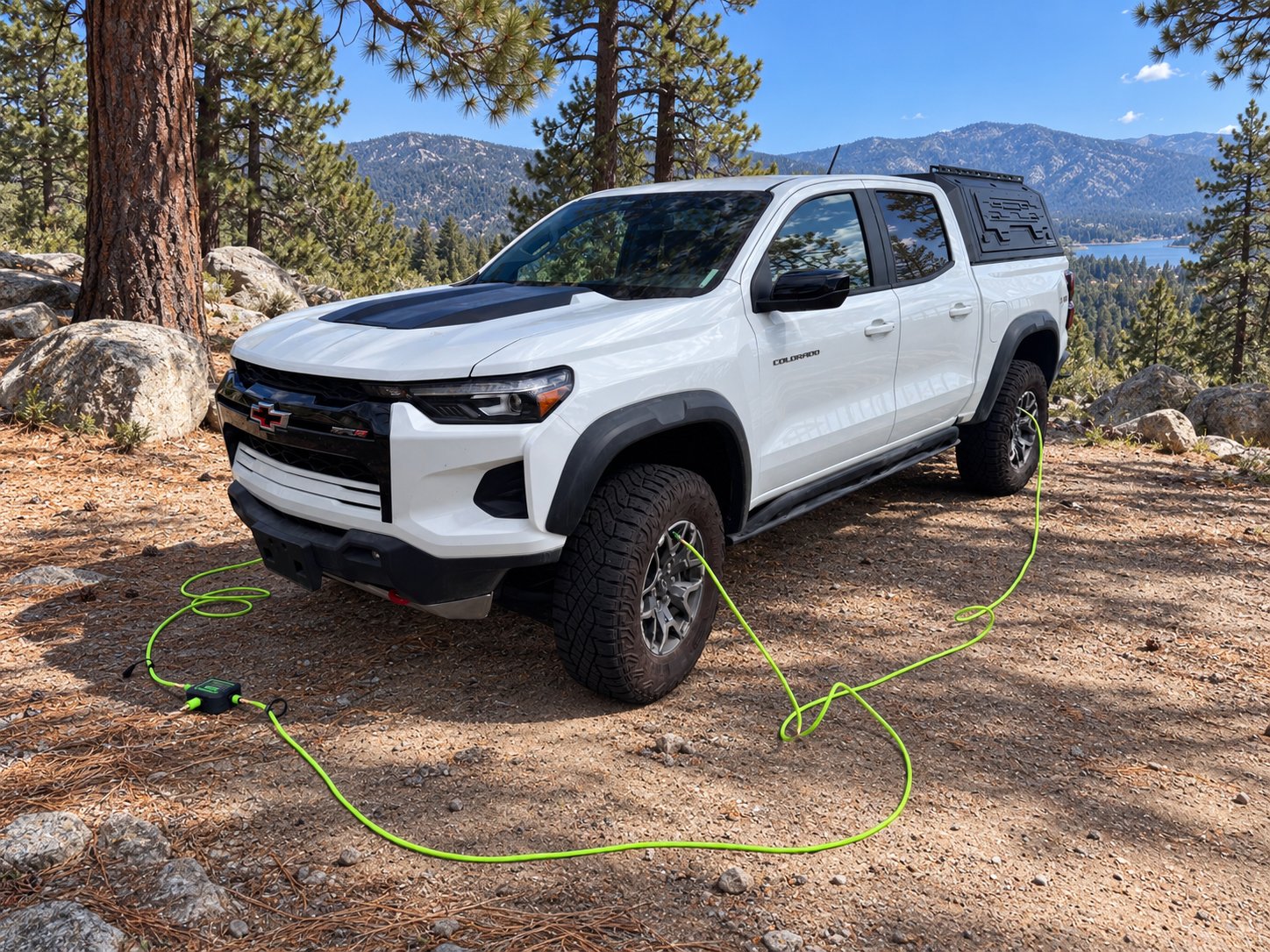
I tested the MORRFlate Air Hub for a couple of months in fall 2026. For me, its set-your-PSI control is the feature to want with six tires in the loop. You dial in a number from 2 to 125 PSI. Then the Hub inflates or deflates to it on its own and signals when it finishes. Our MORRFlate Air Hub review covers the details.

MORRFlate Air Hub Automatic Tire Inflation Deflation System Controller
Digital air controller built to stop at the pressure you set, on one tire or a full multi-tire hose kit.
- Set a target from 2 to 125 PSI and walk away
- Inflates and deflates on its own, then signals when done
- Included Retro Fit Kit adapts an existing MORRFlate hose kit
- USB-C rechargeable lithium battery
- Hoses sold separately
- Needs a separate air source such as a 12V compressor
Six Trailer and Truck Tires, Two Pressures, One Hookup
- Decide which set runs higher, truck or trailer, using your load table and footprint.
- Connect all six chucks and deflate everything to the higher of the two numbers.
- Close the chucks on the set already at its target pressure.
- Keep deflating the remaining tires down to the lower number.
- Spot-check one tire per axle with a handheld gauge before you roll.
- Look at the footprints after the first mile, then fine-tune.
How to Air the Trailer Back Up Before Pavement
Never tow on pavement at trail pressure. Instead, plan your air-up stop where the dirt ends, before the first stretch of highway. Give yourself time to do all six tires right, rather than rushing the last two.
Safety note: Underinflated trailer tires flex and build heat at highway speed. Carlisle names underinflation the number one cause of trailer tire failure. Air back up before pavement, and inspect any tire with a bulging sidewall or a bead off the rim edge.
Know Your Road Trailer Tire Pressure
Set your road targets before the trip. For ST tires, the road trailer tire pressure is the maximum cold pressure on the sidewall, per Carlisle. On LT tires, use the trailer tire psi your load table lists for the weight per tire. Alternatively, use the trailer’s placard. Write both numbers on tape inside the tongue box, so nobody guesses at dusk.
Hot tires read high. According to Carlisle’s trailer tire service guideline, add 4 PSI above the cold target when you set hot tires. Then recheck once they cool at your next stop.
Size the Compressor for Six Tires
Compressor airflow matters more with six tires. Six tires of one size need 50 percent more air than four. I’ve run a MORRFlate TenSix for the better part of four or five years. For a trailer rig, I’d put airflow at the top of the spec sheet.
The TenSix Gen2 lists 10.6 CFM at 0 PSI and 6.5 CFM at 30 PSI. It also carries an 80 percent duty cycle. The PSI Pro version adds a set-pressure auto stop. According to MORRFlate, it airs four 35-inch tires from 10 to 40 PSI in under five minutes with a four-tire hose kit.
With trailer leads attached, plan on a longer fill for six tires. Also, keep the engine running while the compressor works, since the TenSix draws about 50 amps once running. Before you pull onto pavement, check the trailer tire pressure on both sides with a handheld gauge.
Final Thoughts
If you tow a light off-road trailer on LT tires, airing it down ranks among the simplest ride upgrades you have. Your gear takes less of a beating. Plus, the trailer stops hopping on washboard, and the tow rig drags less through sand. The process needs a scale ticket, a load table, and a look at the footprint after the first mile.
Still, the trade-offs deserve respect. ST tires on a heavy camper leave little room to drop. Also, a trailer at trail pressure has no business on the highway. If your trailer runs ST tires and rarely leaves gravel, keep trailer tire pressure close to the sidewall number and slow down instead. Owners who air down trailer tires often should consider LT tires matched to the tow rig.
For the hardware, I’d point you to MORRFlate. The brand keeps pushing the ceiling higher on off-road air gear. In particular, its six-tire trailer kit answers the hose-reach complaint trailer owners raise on the forums, and it lets the truck and trailer run separate pressures. If a full kit is more than you need, start smaller. A set of four Coyote Vortex automatic deflators lists at $80 and covers four tires from 8 to 65 PSI. Add a handheld deflator with a gauge for the last two trailer tires.
FAQ
Should you air down trailer tires on dirt roads?
Yes, for most light off-road trailers on LT tires. Lower pressure cuts bounce on washboard and helps the trailer float in sand. However, keep the drop modest on ST tires, and air back up before pavement.
Should trailer tire pressure match the tow vehicle?
No. The tow vehicle airs down for traction, while the trailer airs down for float and a softer ride. Because weight per tire differs, each set needs its own number from its own load table. Owners report trailers running both above and below their tow rigs.
How fast should you tow a trailer on aired-down tires?
Keep it slow. RNR Tire Express advises staying under 35 mph at reduced pressure. On the highway, Carlisle recommends towing at 60 mph or less, even at full pressure.
Do axleless trailers need lower tire pressure off-road?
Often, yes, when the trailer runs light. Timbren says its axle-less units perform best at 60 to 80 percent of rated load. As a result, a lightly loaded trailer leans on its tires for cushioning. Start from your load table, then adjust by footprint.
Is it safe to air down ST trailer tires?
Only a modest amount, at low speed, and with care. Carlisle tells owners to run ST tires at the sidewall maximum, so air them back up before pavement. If you air down often, LT tires suit the job better.