


Last updated: April 2026 | 18 min read
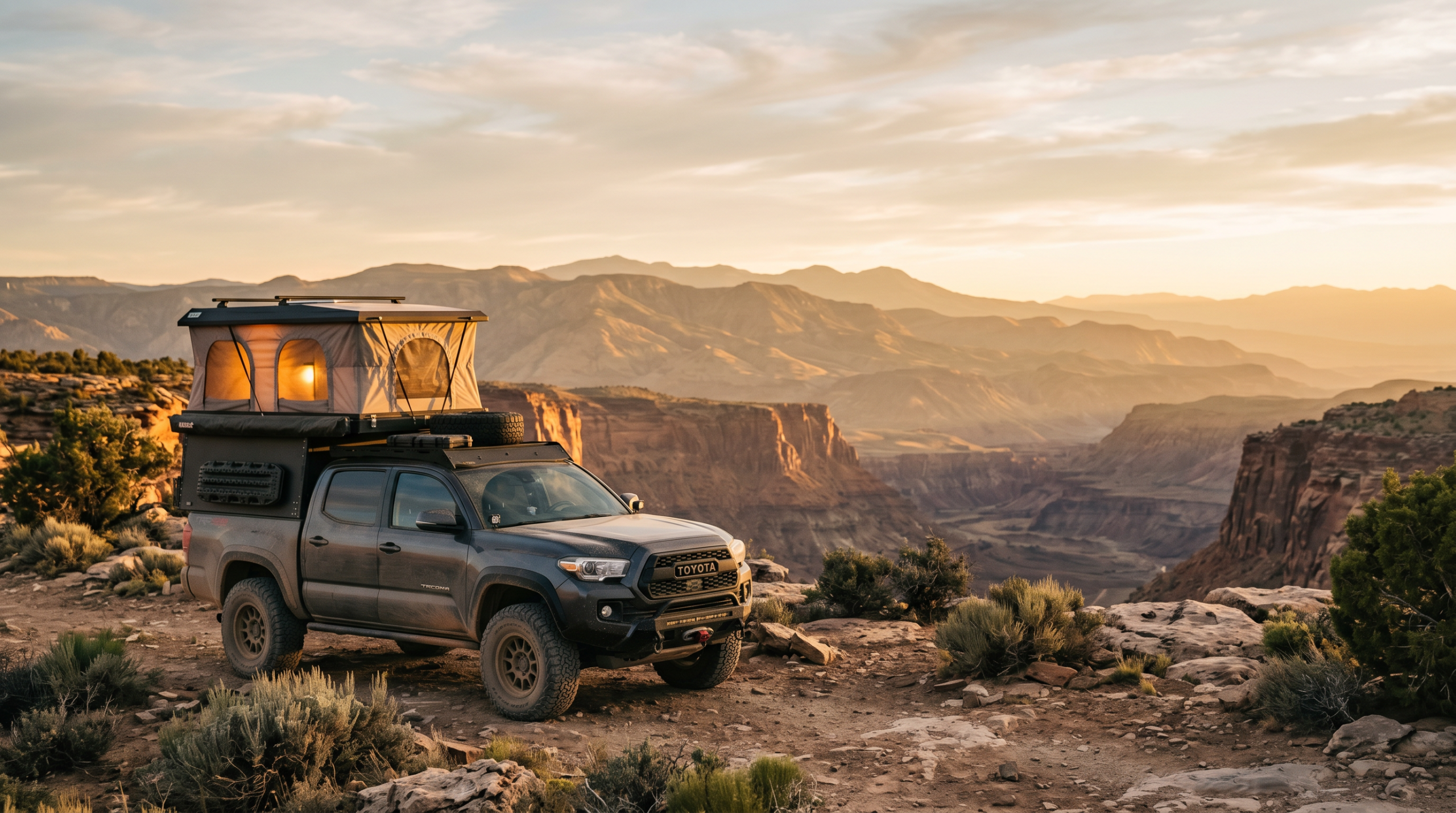
Quick Verdict: A truck bed camper is a self-contained RV designed to load into the bed of a pickup, giving you off-road freedom without towing anything. Pop-up models weigh 360 to 1,600 lbs and suit mid-size trucks. In contrast, hard-side models run 1,100 to 3,500+ lbs and need a three-quarter-ton or larger. After years of testing, I have learned the buying decision comes down to three numbers: your truck’s payload sticker, your climate, and your trail profile.
In This Guide
- What Is a Truck Bed Camper?
- The 4 Main Types
- How Much Do They Weigh?
- How to Match a Camper to Your Truck’s Payload
- Best Options for Mid-Size Trucks
- Pop-Up vs. Hard-Side: Which One Should You Buy?
- What I Look For in a Quality Rig
- Best Models of 2026 (Comparison Table)
- How to Load and Secure Your Rig
- Slide-In vs. Travel Trailer vs. Rooftop Tent
- Should You Buy Used?
- Registration Requirements by State
- Frequently Asked Questions
What Is a Truck Bed Camper?
A truck bed camper is a self-contained living unit designed to load into the cargo bed of a pickup truck. It goes by several names: slide-in truck camper, pickup camper, and demountable camper. Unlike a travel trailer or fifth wheel, the rig rides on your truck and needs no separate tow vehicle, which is why off-road travelers pick it over almost every other RV format.
Over the years I have tested and reviewed a wide range of these rigs across manufacturer facilities, Overland Expo shows, and real trails in places like Anza Borrego, Big Bear, and Joshua Tree. The more units I have measured, loaded, and slept in, the clearer the buying framework becomes. As a result, this guide pulls those lessons into one place so you do not repeat the mistakes most first-time buyers make.
For overlanders and off-road travelers, this format unlocks access a travel trailer never will. You also keep your ability to tow a boat, a utility trailer, or a Jeep behind the loaded rig. If you are weighing formats, start with our truck camper vs. rooftop tent comparison and the best truck campers of 2025 roundup to see how the category has matured.

The 4 Main Types of Truck Bed Campers
These rigs fall into four distinct categories: soft-side pop-up, hard-side slide-in, hard-side pop-up (hybrid), and flatbed or specialty. Each type has a specific weight profile, truck requirement, and use case. Notably, picking the wrong type is the single biggest mistake I see buyers make, so get this right before you shop models.
| Type | Dry Weight | Truck Needed | 4-Season | Price Range | Best For |
|---|---|---|---|---|---|
| Soft-side pop-up | 360–1,600 lbs | Mid-size or half-ton | No | $12,000–$35,000 | Off-road, daily driving, mid-size trucks |
| Hard-side slide-in | 1,100–3,500+ lbs | 3/4-ton or 1-ton | Sometimes | $19,000–$75,000+ | Full-time living, extended trips |
| Hard-side pop-up | 1,500–2,800 lbs | Half-ton to 3/4-ton | Yes (Alaskan) | $50,000–$70,000+ | 4-season use, garage clearance |
| Flatbed / specialty | 800–2,500 lbs | Varies by model | Yes (some) | $20,000–$50,000 | Custom builds, expedition rigs |
Pop-Up Truck Camper (Soft-Side)
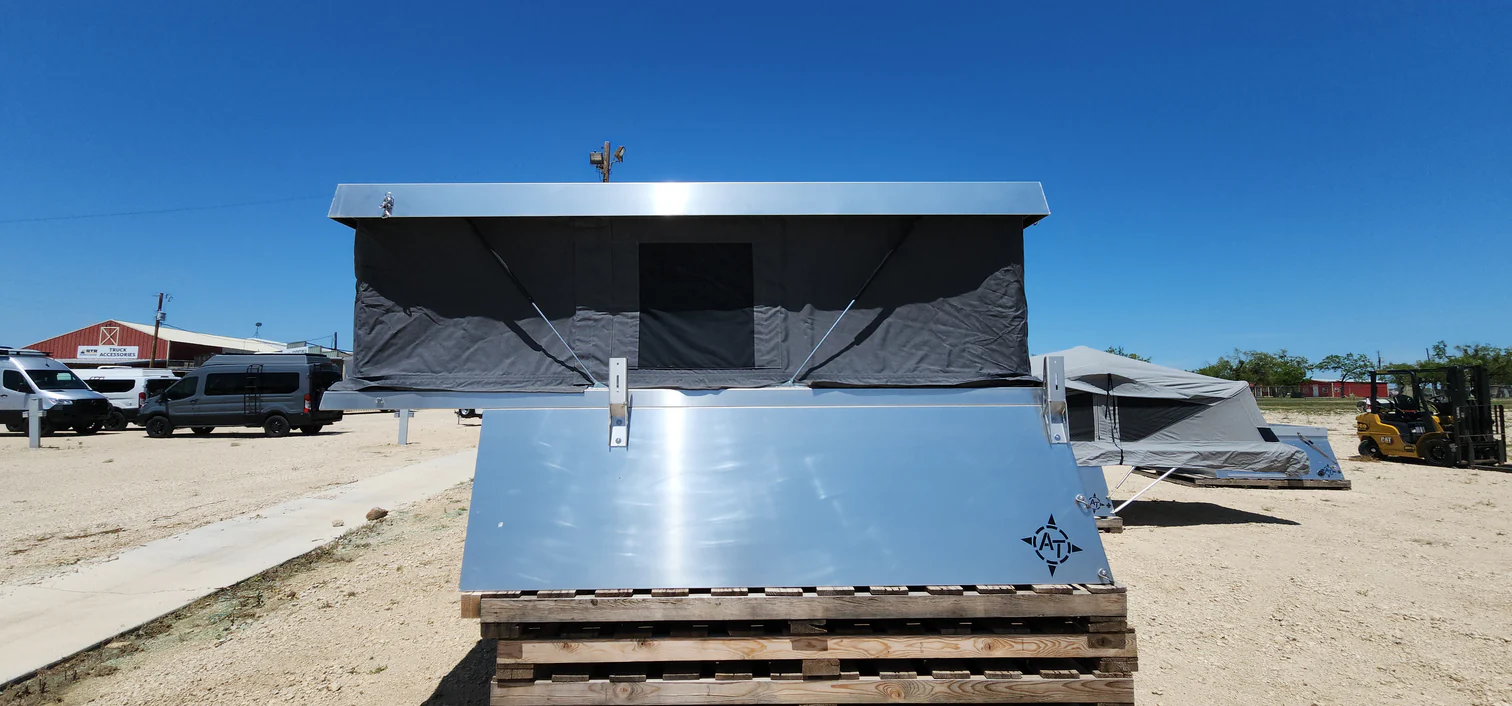
The pop-up truck camper uses hard aluminum or composite shells with canvas or vinyl soft walls raising when parked. They sit low while driving, which keeps wind resistance and garage clearance in check. The dominant brands in this space include Four Wheel Campers (the Hawk, Fleet, and ultralight Project M), AT Overland Atlas, and Palomino Backpack.
When I closed the Atlas for the first time, it sat nearly flush with the cab. Such a low profile matters if you park in a standard garage or spend long days on highway miles. For overlanders on mid-size trucks, a soft-side pop-up truck camper is often the only format fitting the payload budget.
Hard-Side Slide-In Truck Camper
A hard-side slide-in truck camper has rigid walls, a permanent roof, and usually a wet or dry bath inside. Names worth knowing include Lance, Arctic Fox, Northern Lite, Capri Retreat, and the nuCamp Cirrus 620. These rigs weigh 1,500 to 3,500+ lbs loaded, so a three-quarter-ton truck is the minimum and a one-ton dually is safer for the heavier models. The Skinny Guy Camper is an unusually low-profile example in this category.
You get real insulation, a real kitchen, and usually a real bathroom. In exchange, you give up garage clearance and some fuel economy. However, for trips longer than a week or cold-weather use, the trade-off is worth it.
Hard-Side Pop-Up (Hybrid)
Hard-side pop-up campers combine rigid side walls with a mechanical top raising and lowering. Alaskan Camper has been building this style since 1958 using a hydraulic telescoping system to drop the entire roof for driving. The OEV Back Country is another strong example in the Western overlanding scene.
This hybrid format earns its place for two reasons: four-season insulation and low driving height. If you camp in snow and also need to clear a residential garage, a hard-side pop-up is the honest answer.
Flatbed and Specialty Truck Campers
Flatbed campers sit on a flatbed conversion rather than a standard pickup bed, which opens up more interior volume. Brands in this niche include the Four Wheel Hawk+ Flatbed, Bundutec flatbed builds, and AT Overland Summit flatbed configurations. Similarly, the Campluxe Cabovers rig I toured in Anza Borrego lives in this specialty category. Expect to pay more for the flatbed conversion itself, but you also gain exterior storage and a cleaner mounting system.
How Much Does a Truck Bed Camper Weigh?
A truck bed camper typically weighs between 360 and 3,500+ lbs dry, with loaded weight often running 700 to 1,000 lbs above dry. For example, pop-up models range from 360 lbs (AT Overland Atlas) to 1,580 lbs (Palomino SS-550). In contrast, hard-side slide-in models start around 1,100 lbs (Capri Retreat short bed) and top 3,500 lbs for fully optioned Arctic Fox and Northern Lite builds.
The three weight numbers you will see are dry, wet, and loaded. First, dry weight is the camper off the factory floor, empty. Next, wet weight adds full fresh water at 8.34 lbs per gallon, a full water heater, full propane, a house battery, and a cargo allowance. Finally, Truck Camper Magazine uses a standard formula adding about 500 lbs of gear to wet weight to estimate real-world loaded weight.
My rule of thumb after loading dozens of rigs: add 1,000 lbs to the published dry weight to get a realistic loaded estimate. Such a buffer covers water, propane, batteries, gear, food, and the passengers you forget to subtract from payload. Underestimating loaded weight is how people end up over payload without realizing it, and it shows up in tire sidewall flex and sluggish braking before it shows up in a broken leaf spring.
| Model | Type | Dry Weight | Est. Wet Weight |
|---|---|---|---|
| AT Overland Atlas | Pop-up topper | ~360 lbs | Not verified |
| FWC Fleet | Pop-up (mid-size) | 1,050 lbs | ~1,803 lbs |
| FWC Hawk | Pop-up (full-size) | 1,200 lbs | ~1,953 lbs |
| Lance 650 | Hard-side | 1,694 lbs | ~2,485 lbs |
| Arctic Fox 811 | Hard-side | 2,873 lbs | ~4,569 lbs |
| Northern Lite 8-11 EX LE | Hard-side, 4-season | 3,050 lbs | ~4,045 lbs |
How to Match a Truck Bed Camper to Your Truck’s Payload
Matching a truck bed camper to your truck starts with your payload rating, not your towing capacity. Payload is printed on a yellow-and-white sticker inside your driver-side door jamb. First, subtract passengers and gear from the sticker number, then pick a rig whose wet weight fits what remains with a 10 to 15 percent safety buffer. Skip this math and you will burn through tires, brakes, and suspension components fast.

Step 1: Find Your Truck’s Payload Sticker
Open the driver’s door and look at the B-pillar where the door latches. The yellow-and-white sticker reads something like “The combined weight of occupants and cargo should never exceed XXX kg or XXX lbs.” The pound figure is your payload. Ignore the brochure number for your trim level, because options like a sunroof, 4WD, and a crew cab each reduce your real payload by 50 to 300 lbs.
Step 2: Subtract Passengers and Gear
Count 150 lbs per adult riding in the truck while the rig is loaded. Also add your roof rack, bumpers, winch, recovery gear, and any fixed accessories. What is left is the weight you have available for the camper, its water, its propane, and its cargo.
Step 3: Pick a Camper Whose Wet Weight Fits
Take the number from step 2, subtract another 10 to 15 percent as a safety buffer, and shop only rigs whose loaded wet weight fits underneath. For example, a Ford F-150 with 1,800 lbs of available payload after two passengers should target a camper under about 1,550 lbs wet. As a result, this rules out most full-bath hard-side models and narrows the field to pop-ups or lightweight hard-sides like the Capri Retreat short bed.
| Truck | Max Payload (lbs) | Realistic Camper Target |
|---|---|---|
| Toyota Tacoma | 1,050–1,685 | Under 900 lbs wet |
| Ford F-150 | Up to 3,325 | Under 2,800 lbs wet |
| Ram 1500 | 1,700–2,370 | Under 2,000 lbs wet |
| Ford F-250 | 3,700–4,300 | Under 3,700 lbs wet |
| Ram 2500 | 3,900–4,600 | Under 4,000 lbs wet |
| Ford F-350 DRW | 7,000+ | Any production camper |
Payload figures above are per manufacturer sticker ranges and Truck Camper Adventure research. Always verify against your specific door-jamb sticker before buying.
Best Options for Mid-Size Trucks (Tacoma, Ranger, Colorado)
Mid-size truck owners face the tightest truck camper payload budget in the market, which is why the honest answer for a truck camper for Tacoma is a pop-up under 1,100 lbs dry. Tacomas range from roughly 1,050 to 1,685 lbs of factory payload depending on trim, cab, and drivetrain. After two people and recovery gear, most owners have 700 to 1,100 lbs of usable capacity, so most hard-side rigs are immediately off the table.
My go-to answer when a Tacoma owner asks what to buy is the Four Wheel Fleet. At 1,050 lbs dry with a 6’4″ interior when raised, it was purpose-built for mid-size trucks. The tradeoff is a fully outfitted Fleet runs about $29,495 before options. For lighter or cheaper options, the AT Overland Atlas comes in around 360 lbs at $14,300, and the FWC Project M starts at $12,395 as a bolt-on topper style shell.
Kimbo also targets this segment with the Kimbo 6, spanning 830 lbs in the bare Builder Platform up to 1,080 lbs in the Ready-to-Camp trim. Pricing starts at $19,990 for the Builder Platform and climbs to $27,990 for the fully finished Ready-to-Camp model, which puts a hardwall overland truck camper in reach of Tacoma owners who want insulated walls without pop-up canvas.
Ranger and Colorado owners face nearly identical truck camper payload arithmetic to Tacoma drivers. For a 2024+ Ford Ranger, the FWC Fleet or Project M remain the top picks; Chevy Colorado and GMC Canyon owners lean toward the Atlas, Project M, or the Kimbo 6 Builder Platform depending on budget. Shorter beds on these trucks mean you should confirm bed-length compatibility with the manufacturer before ordering.
Once a Tacoma, Ranger, or Colorado owner has settled on a sub-1,100 lb target, the next decision flips the conversation from truck to format: pop-up or hard-side. The same fork matters even more for half-ton and 3/4-ton buyers, where the weight budget finally opens up and real trade-offs appear.
Pop-Up vs. Hard-Side: Which One Should You Buy?
A pop-up truck camper wins on weight, garage clearance, off-road agility, and fuel economy. In contrast, a hard-side truck camper wins on insulation, amenities, interior space, and four-season use. The decision usually collapses to one question: will you camp in below-freezing weather for more than a long weekend? If yes, buy hard-side. Otherwise, pop-up gets the nod for almost every other priority.
Pop-ups typically cost you 2 to 4 MPG at highway speed, while hard-sides cost 3 to 6 MPG because of their taller profile. Over a season of driving, the difference is real money. On the flip side, pop-up canvas walls will not hold heat below about 20°F without serious thermal liners, while a well-built hard-side like the Northern Lite 8-11 EX holds temperature comfortably in snow.
A test I ran at Overland West Expo in Flagstaff a couple of years back put a low-profile hard-side Skinny Guy Camper through a serious storm: heavy rain, strong wind, sleet, and snow. To my surprise, the rig stayed warm, dry, and comfortable. Meanwhile, several pop-up owners packed up and drove home. Those are the kinds of trips telling you which format is right for your style of camping.
| If you… | Buy this format |
|---|---|
| Own a Tacoma, Ranger, or Colorado | Soft-side pop-up under 1,100 lbs |
| Want to keep using the truck daily | Removable pop-up with jack system |
| Camp in snow or below-freezing weather | 4-season hard-side (Northern Lite, Kimbo 8) |
| Need an enclosed bathroom | Hard-side slide-in 1,500+ lbs |
| Travel solo or as a couple for weekends | Lightweight pop-up, 400–900 lbs |
| Live full-time in the rig | Hard-side with slide-out, 1-ton truck |
What I Look For in a Quality Rig
After years of testing these rigs at expos, on trails, and during manufacturer facility visits, I have stopped focusing on brochure specs and started focusing on four things: build quality, insulation performance, off-grid systems, and daily-driver compatibility. Specifically, the models I come back to recommend all deliver on these four, regardless of price tier.
Build Quality and Frame Construction
Aluminum frames with composite or fiberglass-reinforced polymer walls last longer than traditional wood-framed rigs. Wood rots when sealant fails, and sealant always fails eventually. On a recent trip to Missouri, I toured the Freedom Camper facility and walked through their shop. Seeing how the aluminum skeleton is assembled made it obvious why their rigs hold up on gusty highways and uneven terrain. Similarly, Campluxe uses fiberglass-reinforced polymer with aluminum cabinetry, which resists moisture intrusion over years of use.
Insulation and Four-Season Rating
A manufacturer claiming “four-season” means nothing without a backing specification. Look for R-values in the walls (R-7 or higher), a heated basement or heated tanks, dual-pane thermal windows, and a furnace sized for the camper’s cubic feet. Notably, Northern Lite’s 8-11 EX is one of the few models carrying a certified Four Season Package as standard. The Alaskan 1000 SI includes a 20,000 BTU furnace and R-13 spray foam, which is why Alaskan owners camp in Canadian winters without drama.
Off-Grid Power, Water, and Solar Capacity
The off-grid specs mattering most are fresh water capacity, battery amp-hours, and solar wattage. During my Skinny Guy Camper review, the combination of a 36-gallon water tank, 190W of solar on the roof, and dual batteries delivered 4 to 7 days of comfortable off-grid camping depending on usage. Consequently, this is the benchmark to measure any serious overland rig against. If a rig advertises less than 30 gallons of water or under 150W of solar, assume you will run out mid-trip.
Removability and Daily-Driver Compatibility
If you use your truck for work, hauling gear, or running kids around, the jack system matters as much as the camper itself. The best jack systems let one person remove and reinstall the rig in under 30 minutes. Look for electric jacks or hydraulic systems over manual scissor jacks. Also check the driving height: a pop-up or hard-side pop-up clearing a standard 7-foot residential garage is a meaningful feature, not a marketing point.
With those four filters in mind, here are the 12 rigs I currently recommend across every truck class and budget tier for 2026.
Best Truck Bed Campers in 2026
The 12 models below represent the serious end of the 2026 market across pop-up, hard-side, and specialty categories. Pricing reflects manufacturer MSRPs or Truck Camper Magazine 2026 Buyers Guide data. Dry weights come from manufacturer spec sheets where published.
| Model | Type | Dry Weight | MSRP | Best Truck | 4-Season | Bath |
|---|---|---|---|---|---|---|
| AT Overland Atlas | Pop-up topper | ~360 lbs | $14,300 | Mid/full-size | No | None |
| FWC Project M | Pop-up topper | 425–500 lbs | $12,395 | Most trucks | No | None |
| Kimbo 6 | Hardwall | 980–1,080 lbs | $27,990 | Mid-size | No | None |
| FWC Fleet | Pop-up slide-in | 1,050 lbs | $29,495 | Mid-size | No | Optional |
| Scout Olympic pop-up | Pop-up | 1,145 lbs | $23,990 | Full-size SB | No | Optional |
| Capri Retreat LB | Hard-side | 1,170–1,740 lbs | $18,995 | Full-size LB | No | Wet (opt.) |
| FWC Hawk | Pop-up slide-in | 1,200 lbs | $29,495 | Full-size SB | No | Optional |
| Kimbo 8 | Hardwall 4-season | 1,275 lbs | $42,990 | Full-size | Yes | Wet |
| Scout Kenai pop-up | Pop-up | 1,336 lbs | $26,990 | Full-size LB | No | Cassette |
| Cirrus 620 | Hard-side | 1,565 lbs | $44,950 | Half-ton | No | Cassette |
| Lance 650 | Hard-side | 1,694 lbs | $30,443 | Half-ton SB | No | Wet |
| Northern Lite 8-11 EX LE | Hard-side 4-season | 3,050 lbs | $73,150 | 3/4 or 1-ton | Yes | Dry or wet |
Best Ultralight: AT Overland Atlas
At roughly 360 lbs and $14,300, the Atlas is the lightest serious option I have tested. It fits 5-foot, 6-foot, and 8-foot beds on everything from a Tacoma to an F-250. Notably, the walkable sleeping platform supports up to 500 lbs and the open roof takes 100 lbs, which makes the Atlas a credible base for solar, awnings, and gear boxes.
Best for Tacoma: FWC Fleet
The Fleet is purpose-built for mid-size trucks and carries the off-road pedigree Four Wheel Campers has built since 1972. At 1,050 lbs and $29,495, it hits the sweet spot for Tacoma owners who want a real rig and not a shell.
Best Budget Fully Enclosed: Capri Retreat
Capri sells direct from their Yakima, Washington factory and keeps prices honest. The Retreat starts at $18,995 with short-bed, long-bed, and mid-size variants. Although it lacks the amenities of a Lance or Cirrus, the build quality holds up and the price leaves room to upgrade to a ¾-ton truck.
Best Four-Season: Northern Lite 8-11 EX LE
The Limited Edition at $73,150 USD ships with a certified Four Season Package as standard: heated basement, heated holding tanks, dual-pane acrylic thermal windows, and a Heki thermal skylight. Consequently, it is the only model in this roundup earning the four-season label without caveats.
Best Hard-Side Pop-Up: Alaskan 1000 SI
Alaskan has been building hydraulic telescoping rigs since 1958, and the 1000 SI ($55,850) is the current flagship. The hard-side pop-up design drops driving height below most hard-sides while retaining true insulated walls. For winter overlanders who also need garage clearance, nothing else combines these traits as cleanly.
Best Overlanding: Four Wheel Hawk
The Hawk is the full-size pop-up truck camper model building Four Wheel Campers’ reputation on the overlanding scene. At 1,200 lbs and $29,495, it balances weight, amenities, and off-road agility better than any hard-side in its price range. Pair it with a half-ton truck and a decent suspension, and you have the default overland platform in the Western US.

How to Load and Secure Your Rig
A loaded camper attaches to your truck through four anchor points, typically two at the front frame and two at the rear bed. Turnbuckles connect tie-down brackets to truck-mounted frame or bed anchors. Loading takes 15 to 30 minutes once practiced, and the order matters: first, extend camper jacks; next, back the truck in; then lower the rig onto the bed, attach turnbuckles, and finally check tension.
Frame-Mount vs. Bed-Mount Tie-Downs
Frame-mount tie-downs (Torklift is the dominant brand) bolt directly to the truck frame and transfer loads through the chassis. In contrast, bed-mount tie-downs attach to the bed itself and are lower cost but transfer load through sheet metal, which flexes over time. For any rig above 1,500 lbs wet, frame-mount is the only safe answer. However, for ultralight pop-ups under 1,000 lbs, bed-mount is acceptable on modern trucks with factory tie-down cleats.
Turnbuckle Types
Spring-loaded turnbuckles like the Torklift FastGun absorb road shock and prevent the camper from pounding the truck on rough surfaces. Static turnbuckles cost less and transfer every bump directly to the truck frame and the rig structure. Therefore, spend the money on spring-loaded units if you run washboard dirt roads or overlanding terrain.
Common Loading Mistakes
The three mistakes I see over and over: first, over-tensioning the turnbuckles (which torques the camper frame); second, skipping the front tie-downs because “the camper is not going anywhere” (it is); and third, using the wrong turnbuckle length, which kinks the mount when the truck articulates. Tension turnbuckles by hand plus a quarter turn with a wrench, not cranked until the spring is fully compressed.

Slide-In vs. Travel Trailer vs. Rooftop Tent
The three most common overlanding and weekend camping formats each solve a different problem. First, a slide-in rig puts the living space on your truck for maximum off-road access. Second, a travel trailer puts it behind your truck for maximum living space. Third, a rooftop tent puts it on top of your truck for the lowest cost and fastest setup. Which one is right depends on trip length, climate, and terrain.
| Factor | Truck Bed Camper | Travel Trailer | Rooftop Tent |
|---|---|---|---|
| Off-road access | Excellent | Limited | Excellent |
| Living space | Medium | Large | Small |
| Setup time | 5–15 min | 15–30 min | 2–5 min |
| Cost range | $12K–$75K | $15K–$100K+ | $1.5K–$5K |
| MPG penalty | 2–6 MPG | 4–8 MPG | 1–2 MPG |
| Tow other gear | Yes | No | Yes |
| 4-season capable | Yes (hard-side) | Yes | Rarely |
| Best use case | Trips 3+ days, mixed terrain | Basecamp, long stays | Weekend trips, warm weather |
For a deeper breakdown on the first two, see our overland truck camper vs. rooftop tent comparison. For most 4wdTalk readers who run weekend Big Bear trips plus a week in Utah each year, this format lands in the middle as the versatile answer.
Should You Buy a Used Rig?
Buying used is a strong path if you know how to inspect a rig and you have patience. A well-maintained 5-year-old hard-side model often sells for 50 to 70 percent of MSRP, and pop-up models hold value slightly better because of the small-batch overland truck camper market. Notably, RV Trader, Facebook Marketplace, and brand-specific forums are the best hunting grounds, followed by dealer used lots.
A couple of years ago I helped a 4wdTalk reader walk away from a clean-looking 2018 Lance 650 listed $5,000 under market. From the driveway it looked fine. Once we pulled the cabover mattress and ran a moisture meter along the front wall, the numbers spiked in three spots and a section of the floor flexed under a boot heel. The seller had pressure-washed the roof the morning of the showing, which dried the surface but did nothing for the rot underneath. Walking away saved him $18,000 in repairs, and it reset my rule: always inspect with a meter and a flashlight, never with your eyes alone.
Start by inspecting the roof sealant, then the window frames. Both are where water finds a way in, and once a rig has water damage, repair costs usually exceed the unit’s value. Check for soft floor spots by pressing hard around the entry door and under the dinette. Next, pull back cabinet trim to look for tank corrosion, and test every electrical circuit including the 12V refrigerator.
Red Flags to Walk Away From
Missing maintenance records, obvious soft spots in the floor, mismatched manufacturer decals, delaminated fiberglass on the exterior walls, and a pop-up mechanism binding or squealing when raised. Any of these on their own is a deal-breaker. Moreover, two or more and you are looking at a rebuild project, not a used rig.
Questions to Ask the Seller
Has the camper ever been over payload? Has it been stored outside or in a garage? What is the maintenance history on the seals, tanks, and pop-up mechanism? When was the last time the propane system was pressure-tested? In particular, sellers who have solid answers to all four are usually the ones selling solid rigs.
Registration Requirements by State
In most US states, a truck bed camper does not require separate registration because it is considered cargo rather than a vehicle. Specifically, the truck itself is registered, and the rig rides along as a payload item. According to Truck Camper Adventure’s 50-state research, eight states do require separate registration: Idaho, Indiana, Mississippi, Nebraska, Oregon, Rhode Island, Utah, and Washington.
California, where many 4wdTalk readers live, does not require separate registration. Your existing auto insurance policy usually covers the rig as personal property, but coverage for contents and liability while camping often requires a specialty RV rider. For example, Progressive, Good Sam, and National General all offer truck-camper-specific policies, typically in the $150 to $400 per year range depending on camper value.
Frequently Asked Questions
What is a truck bed camper?
A truck bed camper is a self-contained RV designed to load into the cargo bed of a pickup truck. Also called a slide-in truck camper, pickup camper, or demountable camper, it rides on the truck instead of towing behind it. Models range from 360 lb ultralight pop-ups to 3,500+ lb hard-side rigs with full kitchens and bathrooms.
How much does a truck bed camper weigh?
Truck bed campers weigh between 360 and 3,500+ lbs dry, with loaded weight often 700 to 1,000 lbs higher. Pop-up models typically run 360 to 1,600 lbs dry. Hard-side slide-in models typically run 1,100 to 3,500+ lbs. Always compare a rig’s wet weight (not dry) against your truck’s payload rating.
Will a half-ton truck carry a truck bed camper?
Yes, but only within payload limits. For example, a Ford F-150 with max payload options handles rigs up to about 2,800 lbs wet. In contrast, a Ram 1500 or Tundra typically tops out around 1,800 to 2,000 lbs wet. Always verify against your truck’s door-jamb payload sticker and subtract passengers before shopping.
What is the best truck bed camper for a Toyota Tacoma?
The Four Wheel Campers Fleet is the purpose-built truck camper for Tacoma owners at 1,050 lbs dry and $29,495. For lighter or lower-cost Tacoma-compatible options, look at the AT Overland Atlas (~360 lbs, $14,300), the FWC Project M ($12,395), and the Kimbo 6 Builder Platform (from $19,990). Stay under 1,100 lbs dry.
What is the difference between a pop-up and hard-side truck camper?
Pop-up truck campers have hard shells with canvas or vinyl soft walls raising when parked. They weigh less, drive lower, and cost less, but insulate poorly. In contrast, hard-side truck campers have rigid walls throughout, insulate better, carry more amenities, and support four-season use, but weigh more and need a larger truck.
How much does a truck bed camper cost?
Prices range from about $12,000 for a bolt-on topper shell to over $75,000 for a fully loaded four-season hard-side. Most serious buyers spend $25,000 to $45,000 for a quality new unit. Used models typically sell at 50 to 70 percent of original MSRP depending on age and condition.
What should I buy first, the truck or the camper?
Buy the camper’s weight requirement first, then match a truck to it. Shoppers who buy a truck first often end up outside the weight range they need and have to upgrade either the truck suspension or the camper choice. If you already own a truck, start with your door-jamb payload sticker and shop rigs fitting underneath.
Do truck bed campers fit short beds?
Yes. Most major manufacturers build short-bed versions alongside long-bed models. For instance, Lance offers the 650 and 825 for short beds. Similarly, Capri Retreat ships in short-bed, long-bed, and mid-size trims. For a 6-foot or shorter bed, verify the rig is designated “short bed” by the manufacturer since cabover overhang and weight distribution differ.
Are truck bed campers good for winter camping?
Hard-side rigs with a certified four-season package handle winter camping well. For example, Northern Lite’s 8-11 EX, the Kimbo 8, and Alaskan 1000 SI all include heated tanks, thick insulation, and thermal windows. However, pop-up canvas campers lose heat quickly below about 20°F and are generally not suited for sustained sub-freezing use.
Will I be able to tow a trailer behind a truck with a camper on it?
Yes, and this is one of the truck bed camper’s biggest advantages over travel trailers. Because the camper loads onto the truck, your hitch is free for a boat, a utility trailer, or a Jeep. However, loaded camper payload does reduce your truck’s rated tow capacity, so calculate combined GVWR before adding a trailer.
Picking the Right Rig
The right truck bed camper for you depends on three things and nothing else: your truck’s payload sticker, the climates where you camp, and the trail profile you want to run. Figure those out, and the buying field narrows from 100+ models to a shortlist of three or four. Therefore, skip this math and you will own the wrong rig within a year.
Mid-size owners running a Tacoma, Ranger, or Colorado on mostly dry-weather weekends should shortlist the FWC Fleet, AT Overland Atlas, and Kimbo 6 Builder Platform as their best truck camper for Tacoma and similar payload budgets. Half-ton drivers on mixed terrain with the occasional snow trip should step up to the FWC Hawk, Capri Retreat, or Lance 650. Moreover, anyone camping above 8,000 feet in winter or running Alaska and northern Canada should look only at the Northern Lite 8-11 EX LE, Kimbo 8, and Alaskan 1000 SI, since those are the only rigs handling sustained below-zero nights without drama. Match the rig to the trail profile first, the climate second, and the brochure gloss last.
For more depth on individual models, see our reviews of the Skinny Guy Camper, OEV Back Country, and AT Overland Atlas. If you are choosing between this category and a rooftop tent, the truck camper vs. rooftop tent comparison is a good next read. Questions or a rig you want me to test? Drop by the 4wdTalk forum and start a thread.