


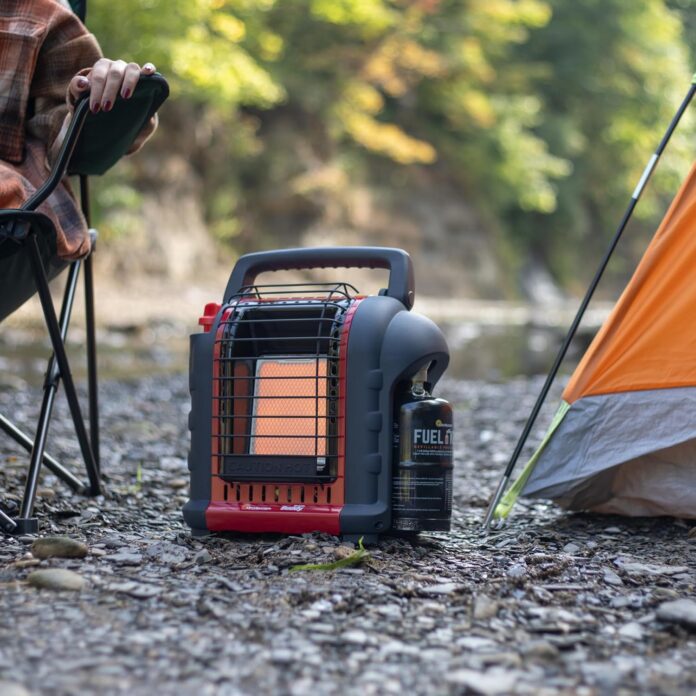
Quick Facts:
- Short answer: Safe while you are awake and ventilating. Never while you sleep.
- Topic: Buddy heater in tent use, checked against the manual and the code.
- Manufacturer position: Tents are listed as an approved enclosure.
- Same manual, in capitals: “NEVER OPERATE THE HEATER WHILE SLEEPING!”
- Oxygen sensor: Code permits it to wait until 18% oxygen. It reads oxygen, never carbon monoxide.
- Altitude ceiling: 7,000 feet.
- Code volume rule: 20 BTU/hr per cubic foot, so 9,000 BTU needs 450 cubic feet.
- CPSC 2022 estimate: 43 LP gas heating deaths, about 70% from portable propane camping heaters.
- Non-negotiable gear: A battery CO alarm at head height.
- Best for: Campers, hunters and ice anglers deciding whether to run propane heat overnight.
12 min read
In This Guide
- Buddy Heater in Tent Use: Is It Safe?
- What Mr. Heater’s Own Manual Says
- The Oxygen Sensor Does Not Detect Carbon Monoxide
- Carbon Monoxide Deaths and Exposure Levels
- Ventilation, Volume and Clearance
- Seven Rules for Running a Buddy Heater in a Tent
- Safer Alternatives to a Propane Tent Heater
- Final Verdict on a Buddy Heater in a Tent
- Buddy Heater in Tent FAQ
Buddy Heater in Tent Use: Is It Safe?
Short answer: a buddy heater in a tent is safe enough while you are awake, ventilating and watching it. It is never safe while you sleep. Mr. Heater lists tents as an approved enclosure in its own owner’s manuals. However, the same manuals tell you in capital letters never to operate the heater while sleeping. Both statements are true, and the gap between them is where people get hurt.
The internet argument runs in two directions. For example, one camp reports years of use without incident, while the other says you will die. Neither position helps you decide, because the real answer depends on numbers. Specifically: how much air your tent holds, how much you ventilate, whether you sleep with it lit, and whether you own a carbon monoxide alarm.
Almost every rule below traces to a Mr. Heater manual, a US government publication, or fuel gas code, and anything estimated is labeled as an estimate. Where the marketing copy and the manual disagree, both appear. Start with the three models and the space each one legally needs. For the wider category, see our guide to putting a heater in a tent.
| Model | Output | Required vent area | Code minimum volume |
|---|---|---|---|
| Little Buddy MH4B | 3,800 BTU/hr fixed | 4 sq in | 190 cu ft |
| Portable Buddy MH9BX, low | 4,000 BTU/hr | 9 sq in | 200 cu ft |
| Portable Buddy MH9BX, high | 9,000 BTU/hr | 9 sq in | 450 cu ft |
| Big Buddy MH18B, medium | 9,000 BTU/hr | 18 sq in | 450 cu ft |
| Big Buddy MH18B, high | 18,000 BTU/hr | 18 sq in | 900 cu ft |
The Three Buddy Heaters in the Table Above



What Mr. Heater’s Own Manual Says
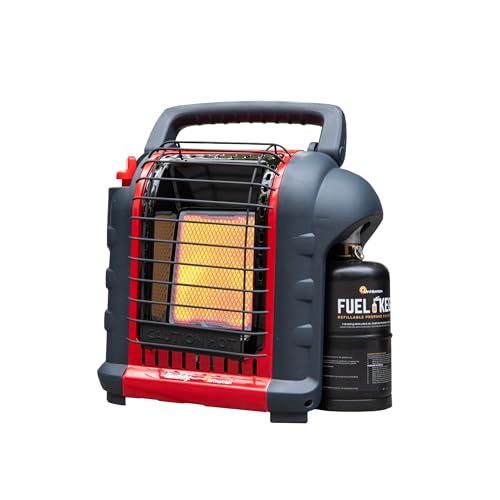
All three models carry the same approval in near-identical wording. The Portable Buddy manual puts it this way, verbatim: “This heater is safe for indoor use in small recreational enclosures having means for providing combustion air and ventilation, such as enclosed porches, cabins, fishing huts, trailers, tent trailers, tents, truck caps and vans.” Notably, the sentence hangs entirely on the qualifier about combustion air and ventilation.
So tent use is approved. However, the same document adds a warning in capitals, and the tip-over switch does not replace it: “DO NOT LEAVE HEATER UNATTENDED… NEVER OPERATE THE HEATER WHILE SLEEPING!” Page after page, the Portable Buddy manual repeats the running header “NEVER LEAVE THE HEATER UNATTENDED WHILE BURNING!” The same manual, in its permissible settings table, lists bedroom use on high or low. Mr. Heater contradicts itself inside one document.
Where Marketing and the Manual Part Ways
Marketing goes further than engineering. For instance, the little buddy heater product page calls the unit “the perfect solution for heating small enclosed spaces like tents up to 95 sq. ft.” Similarly, both product pages list tents second in the use field. Neither marketing page repeats the sleeping prohibition with the manual’s emphasis.
Federal guidance lands in the same place from the other direction. CPSC permits fuel-burning camping equipment indoors only where it is “specifically designed for use in an enclosed space.” A Buddy passes the first test. However, CPSC then adds an unconditional rule with no product exemption: “Never operate unvented fuel-burning appliances in any room where people are sleeping.” Consequently the regulator and the manufacturer reach the same instruction. Heat the tent, then shut the heater off before you sleep.
Safety note: Mr. Heater states a maximum operating elevation of 7,000 feet for the Buddy line. Above it, per the manual, the flame might burn dimmer, the unit might shut off, and it might refuse to relight. Elk camp and much of western hunting country sits above the ceiling.
The Oxygen Sensor Does Not Detect Carbon Monoxide
Almost every reassuring article about propane heat in tents points at the low-oxygen shutoff, or ODS, as proof of safety. Here is what the sensor physically does. Specifically, an ODS is a modified pilot burner watching a thermocouple. It measures oxygen concentration, nothing else, and it is permitted to wait until oxygen falls to 18%. Fuel gas code section G2445.6 lets the manufacturer pick the shutoff point, though it forbids anything below 18 percent. ASHRAE describes these sensors as designed to cut the gas at 18% or lower, and Mr. Heater publishes no set point for the Buddy line. So 18% is the worst case you are entitled to assume.
Three consequences follow, and together they undo the reassurance.
First, 18% oxygen already sits below OSHA’s own oxygen-deficiency threshold of 19.5%, defined in 29 CFR 1910.134(b). OSHA treats oxygen-deficient atmospheres as immediately dangerous to life or health, subject only to a narrow altitude-based exception in 29 CFR 1910.134(d)(2)(iii). Therefore your sensor is permitted to let the tent reach an OSHA-defined hazard before it acts.
Second, and more important, carbon monoxide comes from incomplete combustion rather than from missing oxygen. A dirty burner, a knob left between detents, contaminated fuel, wind, or a cold surface near the flame all generate carbon monoxide. Crucially, they do it at a perfectly normal 20.9% oxygen. Notably, Mr. Heater’s own manual warns about knob position, because a control left between settings produces poor combustion and higher carbon monoxide output. The ODS has no input registering any of it.
The Scale Problem
Third, the scale gap is enormous. For example, CPSC states death is possible above sustained levels of 150 to 200 parts per million, or roughly 0.02% of the air. In effect, you are asking a 2.9 percentage point oxygen switch to protect you from a 0.02% poison. Minnesota’s Department of Natural Resources puts it plainly for ice shelters: “Do not rely on your ventilation system or ‘low oxygen shut-off’ sensors to work properly.”
Carbon Monoxide Deaths and Exposure Levels
Numbers beat opinions here. For example, the CPSC 2022 annual estimates, published in 2026, record 182 reported incidents and an estimated 274 unintentional non-fire carbon monoxide deaths from consumer products. An estimated 76 involved heating appliances, and an estimated 43 involved LP gas heating.
Then comes the sentence this article exists for. Specifically, CPSC reports about 70 percent of those 43 LP gas heating deaths involved “unvented portable propane heaters.” Those heaters, in CPSC’s words, are “intended as camping heaters or heaters for other temporary spaces.” Roughly 30 deaths in one year, from this exact product category. Moreover, CPSC found a statistically significant upward trend from 2012 through 2022.
| Carbon monoxide level | Effect | Source |
|---|---|---|
| 1 to 70 ppm | Most people show no symptoms. Heart patients may notice chest pain. | CPSC |
| 35 ppm | NIOSH recommended limit, 10-hour average. | NIOSH |
| Above 70 ppm sustained | Headache, fatigue, nausea. | CPSC |
| Above 150 to 200 ppm sustained | Disorientation, unconsciousness and death are possible. | CPSC |
| 400 ppm | 60-minute emergency exposure guidance level. | NRC |
| 200 ppm / 1,200 ppm | NIOSH ceiling limit, and the level immediately dangerous to life or health. | NIOSH |
What the Case Report Shows
The case literature matters as much as the statistics. For instance, a CDC report published in August 1999 describes four deaths inside a zipped 10 by 14 foot two-room tent in Georgia. A propane stove had been brought inside for warmth. Postmortem carboxyhemoglobin levels reached 50%, 63%, 69% and 63%. Note the tent size, because a large two-room family tent still killed everyone inside it.
CDC’s recommendation is unambiguous: fuel-burning camping equipment “should never be used inside a tent, camper, or other enclosed shelter. Opening tent flaps, doors, or windows is insufficient to prevent build-up of CO concentrations from these devices.” CDC also notes the danger rises for sleepers, “who are unable to recognize the early symptoms of CO poisoning.”
Safety note: Do not count on waking up with a headache. CPSC warns of rapid high-level exposures in which victims become mentally confused and lose muscle control without first experiencing milder symptoms. Symptom recognition is not a safety system.
Ventilation, Volume and Clearance
Mr. Heater specifies vent area by model: 4 square inches for the little buddy heater, 9 for the Portable Buddy, and 18 for the Big Buddy. Notably, the pattern works out to one square inch per 1,000 BTU. Moreover, the Portable Buddy manual requires an opening at the ceiling and another at floor level, because cross-flow is what clears the air.
Volume is the stricter constraint, although almost nobody mentions it. Specifically, fuel gas code section G2445.5 caps unvented appliances at 20 BTU per hour per cubic foot of room volume. Rearranged, minimum volume equals BTU divided by 20. Therefore a Portable Buddy on high requires 450 cubic feet.
Compare the code figure to real tents. These next numbers are worked examples rather than measurements, so measure your own shelter. A 2-person backpacking tent runs on the order of 70 to 100 cubic feet, while a 4-person dome holds about 200. Step up to a 6-person cabin tent with near-vertical walls and you get roughly 500 cubic feet, or about 800 in an 8-person. So a Portable Buddy on high needs more air than a 4-person tent contains. Similarly, a Big Buddy on high needs 900 cubic feet, which exceeds nearly every consumer tent sold. The code was written for rooms in houses, and most tents never qualify.
Clearance and Condensation
Clearances disqualify many tents before combustion enters the discussion. Specifically, the manuals require 30 inches above, 24 inches in front, 6 inches to each side and zero behind. Because a Portable Buddy stands 15 inches tall, it needs 45 inches of clear height. Measure your tent before you assume it fits.
Then there is water. Burning propane produces 1.63 pounds of water vapor per pound of fuel. For example, a Portable Buddy on high pushes roughly 2.5 liters of water into your tent across eight hours. A Big Buddy adds nearly 5 liters. Consequently sleeping bags come out damp and the inner wall rains at dawn. Our cold weather camping safety checklist covers the moisture management side.
Seven Rules for Running a Buddy Heater in a Tent
If you run a Buddy heater in a tent anyway, these seven rules come straight from the manual, the code and CPSC. Every one of them is load-bearing, so treat the list as a single procedure.
- Never sleep with it lit, and never leave it burning unattended. Both instructions come from the manual, and CPSC backs the first without qualification. Heat the tent, then shut it off.
- Run a battery-powered low-level CO monitor. Carbon monoxide has a relative gas density of 0.97 and mixes evenly through a small space, so height is not what protects you. Put it near your head so you will hear it, clear of bags and gear.
- Vent top and bottom. A low opening within a foot of the ground feeds combustion air, and a high opening lets exhaust escape. One cracked door does neither reliably.
- Check the volume, not the floor area. Multiply length by width by average height, never peak height, since a dome tapers hard. Then divide your heater’s BTU setting by 20 to get the code minimum. Under 190 cubic feet, run nothing. From 190, a Little Buddy qualifies; from 200, a Portable Buddy on low; from 450, a Portable Buddy on high or a Big Buddy on medium; and only from 900 does a Big Buddy on high qualify.
- Hold the clearances. 30 inches above, 24 in front, 6 to each side. Sleeping bags and jackets creep into the danger zone overnight.
- Never set the knob between detents. Mr. Heater warns this produces poor combustion and higher carbon monoxide.
- Stay below 7,000 feet. Mr. Heater rates the line to that elevation and reports dim flames, shutdowns and relight failures above it.
Mr. Heater’s own operation walkthrough for the Portable Buddy. Note that it covers lighting, the ODS and the tip-over switch, and it does not address overnight use.
Why a Hardware-Store Alarm Is the Wrong Alarm
The UL 2034 standard requires residential carbon monoxide alarms not to sound below 30 ppm, and permits silence at 70 ppm for up to four hours. Nuisance reduction inside a house is the design goal. However, levels climb fast in a small volume. Therefore a low-level monitor alarming near 5 to 35 ppm gives far earlier warning than a hardware-store alarm does.
If the Alarm Sounds
Act on the alarm, or on symptoms, whichever comes first. Headache, nausea, dizziness or confusion in more than one person is reason enough, since a residential alarm stays silent at 70 ppm for up to four hours. Get everyone out into fresh air before investigating anything. Leave the door open behind you and shut the fuel off at the cylinder if reaching it costs you no time. Then call 911, because carboxyhemoglobin needs oxygen therapy rather than fresh air alone. Nobody re-enters until the alarm clears and stays clear, and the heater stays off until a technician inspects it.
Safer Alternatives to a Propane Tent Heater
The category difference worth understanding is vented versus unvented combustion. A Buddy burns fuel in your air and exhausts into your air. By contrast, a diesel air heater draws intake air from outside and burns it inside a sealed chamber. Exhaust routes outside, and only clean heated air circulates through the shelter. Nothing from the flame enters your breathing space while the system is intact. However, a cracked exhaust, a blocked pipe or an outlet routed under a skirt lets exhaust back in, which is why manufacturers still warn about it. In other words, it is a different machine rather than a safer version of the same one.
| Option | Combustion in your air? | Adds moisture? | Practical note |
|---|---|---|---|
| Mr. Heater Buddy | Yes, unvented | Yes, about 2.5 L per night on high | Cheapest heat, strictest rules, no sleeping |
| Diesel air heater | No, sealed and vented outside | No | Needs 12V power, ducting, an exhaust route clear of the shelter, and a CO monitor |
| Hot tent with wood stove | Partly. It draws tent air and exhausts through the flue, so draft matters | No, it dries the tent | Needs a stove jack and fire-rated fabric, and still needs a CO monitor |
| Electric heat from a power station | None | No | A 1,000Wh unit runs 500W for about two hours |
| Bag, pad and hot water bottle | None | No | Pad R-value matters more than bag rating below freezing |
What Each Alternative Costs
Each alternative costs something. A budget diesel air heater runs roughly $115 to $235 and needs 12V power, an exhaust route and a mounting spot. Meanwhile a hot tent with a stove jack is a whole shelter purchase. A power station large enough for meaningful electric heat costs more than either. Meanwhile CDC reaches the same conclusion from the medical side, advising campers to “leave home with adequate bedding and clothing” rather than relying on fuel-burning appliances for heat.
For overnight warmth without combustion, our guide on how to stay warm in a tent covers pads, bags and layering. If you want heat running while you sleep, sealed combustion is the honest answer. Our roundup of the best diesel heaters we tested compares the units worth buying.

BougeRV 5KW Diesel Heater, 5L All-in-One Portable Air Diesel Parking Heater
Sealed combustion keeps the flame and its exhaust out of the air you breathe, which is the one thing an unvented propane heater cannot do.
- Sealed combustion draws intake air from outside and vents exhaust outside
- All-in-one case with the tank built in, so there is no separate fuel line to plumb
- Runs on 12V or 110V, so a camp battery or shore power both work
- Rated 0.18 to 0.53 L/hr, giving 11 to 27 hours on the 5L tank
- Still needs an exhaust route clear of the shelter and a CO monitor running
- Heavier than a Buddy and it needs a power source, so it suits a truck camp more than a backpack camp
Where a Buddy Heater Earns Its Place
- Warming a tent for 20 minutes before bed, then off.
- Morning warm-up while you are awake and dressing.
- Large canvas wall tents above 450 cubic feet with real vents.
- Day use in a hunting blind or ice shelter with the flaps open.
- Cheapest entry cost in the category, listed at $117.26 to $240.26 in August 2026.
- No electrical system, ducting or install work required.
Where a Buddy Heater Does Not Belong
- Any tent where people sleep with it burning.
- Any tent smaller than the code volume for your setting, which rules out most 2 and 4-person tents.
- Shelters without both a floor-level and a ceiling-level vent.
- Tents where 30 inches of overhead clearance is impossible.
- Trips where nobody brought a carbon monoxide alarm.
Final Verdict on a Buddy Heater in a Tent
A buddy heater in a tent is sold for the purpose, and its maker approves the use in writing. It earns its keep taking the chill off a shelter while you are awake in it. Used with vents open and an alarm running, it is a reasonable piece of camp gear. The failure mode is not the product. Instead, the failure mode is the overnight run.
The evidence against sleeping with one lit is unusually consistent. Mr. Heater prints the prohibition in capitals, and CPSC states the same rule for all unvented appliances. CDC’s case report describes four people dying in a zipped two-room tent with a propane stove burning for warmth. CPSC’s most recent estimate puts 43 US deaths in a single year on LP gas heating. About 70 percent of those involved unvented portable propane heaters, which works out to roughly 30 on CPSC’s own two figures.
The Cost per Hour of Approved Use
On value, the arithmetic is less favorable than it looks. A Portable Buddy costs about $155, and Mr. Heater rates a 1 lb cylinder at three hours on high. However, a 1 lb cylinder holds about 21,600 BTU, so 9,000 BTU per hour caps it nearer two and a half. Run it only while awake, as directed, and you are buying an hour or two of comfort per canister.
The same unit earns its money elsewhere. A buddy heater indoors, in a cabin or a garage with real windows and real volume, gets the ventilation the manual assumes. Tents rarely do, which is the whole argument in one sentence.
Buy one for what it does well: fast warmth in a ventilated shelter while somebody is awake to watch it. Then solve the overnight problem separately, for instance with a sealed-combustion heater, a wood stove and stove jack, or better bedding. Run a CO monitor with the first two as well, since a cracked exhaust or a poor flue draft puts you back in the same chemistry. Our roundup of the best heater for tent camping compares the options side by side.
Buddy Heater in Tent FAQ
Can you use a buddy heater in a tent?
Yes, Mr. Heater lists tents among approved enclosures in its owner’s manuals. The same manuals prohibit operating it while sleeping. They also require vent openings at floor and ceiling level, plus 30 inches of overhead clearance.
Is a buddy heater safe to use indoors?
A buddy heater indoors is rated for ventilated recreational spaces. The practical limit is volume. Fuel gas code allows 20 BTU per hour per cubic foot, so 9,000 BTU needs 450 cubic feet. Never run it in a room where anyone sleeps.
Does a Mr. Heater Buddy produce carbon monoxide?
Yes. Complete propane combustion produces carbon dioxide and water, though incomplete combustion produces carbon monoxide. A dirty burner, a knob left between settings, or restricted air all increase output. The oxygen sensor does not detect it.
Will the low oxygen sensor protect me?
Only from oxygen depletion, and code permits it to wait until oxygen drops to 18%, below OSHA’s 19.5% deficiency threshold. Carbon monoxide reaches lethal levels near 0.02% of the air while oxygen still reads normal. Minnesota’s DNR advises against relying on these sensors.
Is a little buddy heater safe in a small tent?
The Little Buddy makes 3,800 BTU, so code calls for 190 cubic feet. For instance, a 2-person backpacking tent measures roughly 70 to 100 cubic feet, well short of the requirement. Its 4 square inches of required venting and 30 inch top clearance rarely fit either.