


Quick Facts:
- Vehicle: Scout Traveler, a body-on-frame SUV from Scout Motors
- Concepts shown: Mountainside and a trail-ready build, both on the production Traveler body
- Powertrains: All-electric, plus Harvester with an onboard gas generator
- Range targets: About 350 miles on electric power, more than 500 miles with Harvester
- Price target: Under $60,000 to start, with refundable $100 reservations open
- Timeline: Scout targets initial production in 2027, with customer deliveries after that
9 min read
In This Article
- What the Scout Traveler Concept Pair Shows
- Scout Traveler Concept Specs at a Glance
- Mountainside: Quiet Luxury on 35-Inch Tires
- The Trail-Ready Build: Beadlocks, Winch, Metal Bumpers
- Harvester Range Extender, Range, and Payload
- Production Timeline, Reservations, and the Direct Sales Fight
- Scout Traveler vs Bronco, Wrangler, Defender, and R1S
- Final Verdict: What Reaches the Production Truck
- Scout Traveler Concept FAQ
What the Scout Traveler Concept Pair Shows
Scout Motors parked two versions of the same SUV at the Jazz Aspen Snowmass Labor Day Experience from September 4 to 6, and the gap between them is the story. One Scout Traveler concept wears 22-inch wheels, semi-aniline leather, and a paint color tuned to catch sunrise. The other wears beadlocks, rock rails, and a winch bolted into the front bumper. Same body, same frame, two different owners in mind.
Neither build reaches a showroom. Chief Design Officer Chris Benjamin called them two vastly different expressions of the same authentic Scout character. Scout calls both design studies, and says the production Traveler will likely land between them. What sits underneath both shells reaches production in 2027, with targets of more than 7,000 pounds of towing, over 12 inches of ground clearance, and a start under $60,000. Those targets aim at the Ford Bronco and the Jeep Wrangler, not at a crossover with a lift kit.
The pairing follows a pattern. Scout used an earlier Scout Traveler concept, the Spirit of ’26, the same way. Because Scout sells direct, the feedback shapes the trim mix before the line starts. Motor1 first detailed the two Aspen builds.
Two questions follow the reveal. First, which trail hardware survives the jump to production? Second, does the timeline hold? Scout hints at the first answer already, since it plans to sell parts and accessories direct through its own Scout Workshops. Meanwhile the recovery gear on the trail build ships from Amazon today, for any rig you already own.
| Top Pick | Best for Group Trail Days | Most Versatile | |
|---|---|---|---|
| Product | TOP PICK WARN VR EVO 10-S WARN VR EVO 10-S |  X-BULL Traction Boards X-BULL Traction Boards |  Rhino USA Kinetic Rope Rhino USA Kinetic Rope |
| Rating | ★★★★★ 4.7 665 ratings | ★★★★☆ 4.6 348 ratings | ★★★★★ 4.8 1,200 ratings |
| Recovery Method | Powered winch pull | Traction ramps under tire | Kinetic stretch-rope pull |
| Requires a Second Vehicle | No | No | Yes |
| Price | $699.99 as of Oct 24, 12:50 am | $77.89 as of Oct 23, 4:55 pm | $199.90 as of Oct 24, 1:00 am |
| Check Price → | Check Price → | Check Price → |
Scout Traveler Concept Specs at a Glance
Two lists are in play here, and mixing them is how concept coverage goes wrong. The table below separates targets for the production Scout Traveler SUV from hardware shown on the two builds. Scout labels the performance figures as targets, so treat them as goals rather than certified numbers.
| Specification | Details |
|---|---|
| Mountainside wheels | 22-inch Vault wheels in anodized black, 35-inch tires |
| Trail-ready wheels | 18-inch black beadlock wheels, 35-inch off-road tires |
| Trail-ready hardware | Metal bumpers, rock rails, integrated winch, roof rack, spare and jerrycan carrier, trailer hitch |
| Towing target | More than 7,000 pounds |
| Ground clearance target | More than 12 inches |
| Plant | Blythewood, South Carolina, up to 200,000 vehicles a year |
Mountainside: Quiet Luxury on 35-Inch Tires
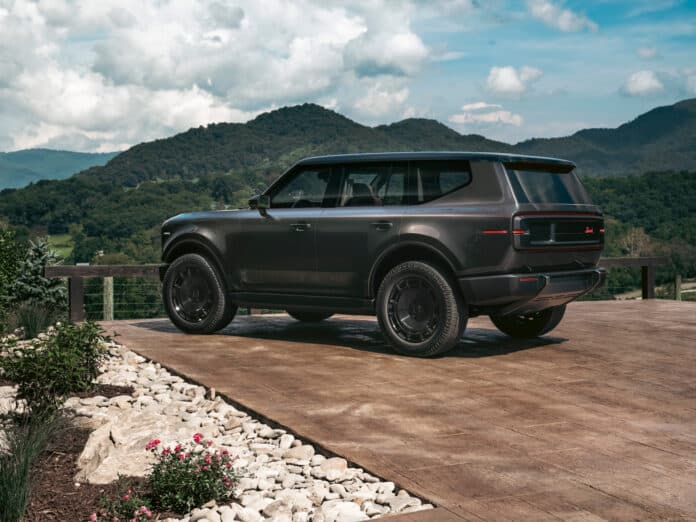
Designer Peyton Sullivan called the Mountainside theme a softer side of Scout built around family use. The paint says it first: Morning Dusk, a charcoal brown with gold metallic flake tuned to catch early light. Scout also deleted the roof rack and the rear spare carrier, and a panoramic sunroof opens the cabin overhead.
Inside, the Alpine District cabin mixes semi-aniline leather with a gray plaid fabric pulled from historic Scout interiors. Houndstooth trim runs across the headliner, and recycled walnut accents finish the rest. Next to the trail build’s materials, this list reads like a lodge rather than a garage.
What the Luxury Build Signals for Buyers
Follow the reservation data and the choice makes sense. Scout CEO Scott Keogh has said roughly 85 percent of the company’s 150,000-plus reservations are for the Harvester rather than a pure electric version. A warm cabin riding on 35-inch tires sells to exactly those people. Yet a 35-inch tire on a 22-inch wheel leaves little sidewall to work with once you air down. Trim names matter less than clearance and tire size, though. Weekend rock crawlers will want the smaller wheel and the taller rubber.
The Trail-Ready Build: Beadlocks, Winch, Metal Bumpers
The second build spends the money underneath. Full metal bumpers replace the painted units, and rock rails run the length of the body. An integrated winch sits up front, while an elevated roof rack carries trail lights. Around back, an exterior carrier holds a full-size spare and a jerrycan on Harvester-equipped rigs, and the rear bumper carries a trailer hitch. Galvanized Steel paint with a canvas roof finishes the look, and a Denim District interior in brick-red leather takes the abuse.
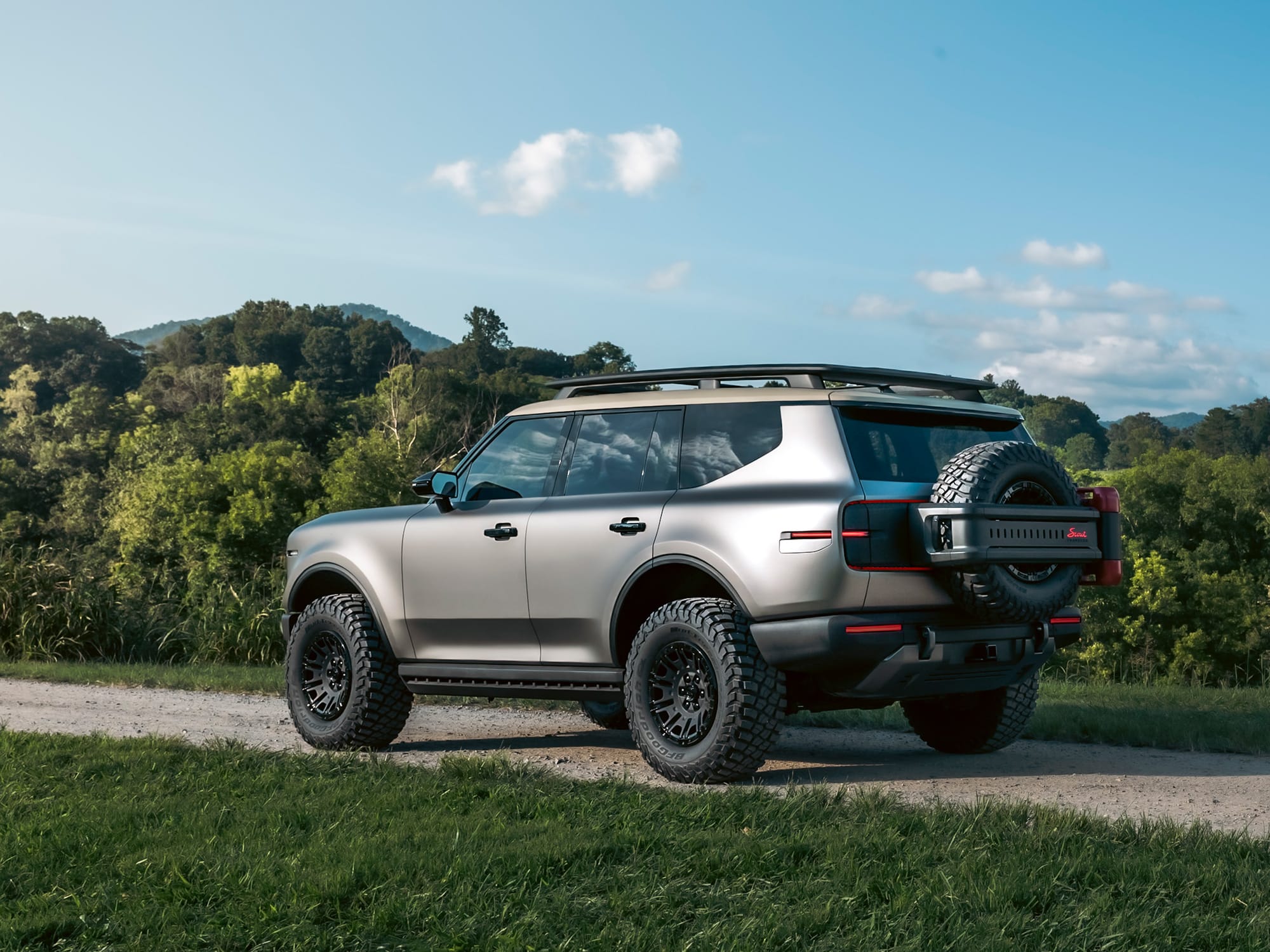
The wheel choice tells the real story. This build sits on 18-inch black beadlock wheels wrapped in 35-inch off-road tires. Compared to the 22-inch Mountainside wheel, the 18-inch setup adds roughly two inches of sidewall. The extra rubber absorbs impacts, holds low air pressure, and cuts pinch-flat risk on sharp rock.
Beadlocks matter for the same reason. A beadlock ring clamps the tire bead to the wheel, so a driver airs down to 10 psi or lower without rolling the tire off the rim. Street-legal beadlocks stay rare and expensive, and most factory rigs skip them. Ford sells beadlock-capable wheels on the Bronco Badlands, not true beadlocks.
Winch, Recovery Gear, and What Buyers Add Anyway
An integrated winch reads as a concept flourish, yet it answers a real gap. Most new off-road SUVs leave the factory without recovery gear, so owners add it in the first year. The first purchase splits two ways, traction boards or a winch, decided by terrain and whether you travel alone. Solo desert runs favor a winch, while group trail days favor boards.
Air management belongs on the same list. A beadlock setup pays off only when you air down and then air back up, so a compressor and a deflator ride along with anyone running low pressure. Tire size drives the rest of the build. Anyone weighing what 35-inch tires deliver will also weigh gearing and brakes.
Harvester Range Extender, Range, and Payload
Scout will sell the Traveler with two energy systems. The all-electric version targets about 350 miles from the larger of the two battery packs, although Scout has not published a size for it. Meanwhile, the Harvester version adds an onboard gas generator and pushes projected total range past 500 miles.
The generator never drives the wheels. Instead, it charges the pack, so the truck keeps its electric feel. A 500-mile range covers a Utah loop with no charger between towns, while a 350-mile electric SUV asks you to plan around charging stops.
Our reporting on electric off-road overlanding rigs lands on the same point. Battery range drops at low speed under load, in cold weather, and with a trailer behind you. Therefore, the range extender solves the trip planning problem rather than the towing physics problem. Towing 7,000 pounds will still cut range hard, gas generator or not.
Payload belongs in the same argument, because battery weight eats into it. A Harvester pack runs smaller than a full electric pack, so the generator version should carry more gear and tongue weight. Scout has published no payload figure for either version. Anyone planning a rooftop tent, a fridge, and four passengers should treat it as an open question.
Scout has also said customer demand puts the Harvester first when Traveler production opens. Harvester first also simplifies the ramp at a plant with no production history.
Production Timeline, Reservations, and the Direct Sales Fight
Scout will build the Traveler at its new plant in Blythewood, South Carolina, north of Columbia. At full capacity the site targets up to 200,000 vehicles a year, roughly 40 an hour. The company pushed back publicly on reports of a slip to the 2028 to 2030 window. Instead, it points to initial production in 2027, with customer deliveries beginning later.
Read the wording carefully, since Scout has not named a delivery year. Car and Driver and Edmunds both already list the Traveler as a 2028 model-year vehicle, and a 2027 line start with 2028 deliveries matches how other new plants ramp.
Direct sales add a second variable. Scout plans to sell without franchised dealers, and the California New Car Dealers Association has sued Volkswagen and Scout over the model in federal court, where a judge let the core claims proceed. The outcome will not change the hardware, though it changes how and where you buy. Service coverage in rural areas stays an open question too.
Reservations cost $100 and stay fully refundable, and Scout uses the pool to gauge trim demand. Reserve early and treat the deposit as a queue ticket.
Whatever you drive until 2028, it leaves the factory without recovery gear, and so will a Traveler.
Trail Gear for Airing Down and Recovery


ARB ARB505 Deflator Kit 10-60 PSI Tire Pressure Gauge Rapid Air Dow…

Bubba Rope 176745-PROBB Heavy Duty 7/16" Synthetic Soft Shackle Gat…
Scout Traveler vs Bronco, Wrangler, Defender, and R1S
Towing is where the Scout Traveler vs Bronco comparison separates. Scout targets more than 7,000 pounds. Most Ford Bronco trims tow 3,500 pounds, and the Raptor reaches 4,500. A four-door Wrangler Rubicon with the automatic tows 5,000 pounds. For a buyer pulling a teardrop, a boat, or a two-horse trailer, one spec line reshapes the shopping list.
Price keeps it honest. A Bronco Badlands starts at $48,890 and a four-door Wrangler Rubicon at $50,535 before destination, while options push either past $55,000 quickly. Therefore a sub-$60,000 Traveler lands inside the same conversation. What Scout lacks is aftermarket support, since bumpers, lift kits, and armor for a Bronco ship next day from a dozen vendors.
Volume sets the stakes. Bronco and Wrangler sales numbers ran to 146,007 and 167,322 in 2025, with the 4Runner at 98,804. Against a pool so deep, a newcomer needs only a sliver. Scout does not have to beat Jeep, since winning a steady slice does the job.
The Land Rover Defender sits closest on concept. A Defender 110 starts at $65,000 before destination, so a Traveler holding its entry target undercuts it, although Scout has not priced a loaded version. The Rivian R1S flips the trade instead, beating the Traveler and the Defender on straight-line speed while losing on refueling flexibility.
So where does the Scout Traveler vs Bronco fight land for overlanders? Not on fuel access, since both fill a tank in minutes. It lands on whether a first-year truck from a new plant earns trust against a proven Bronco.
Final Verdict: What Reaches the Production Truck
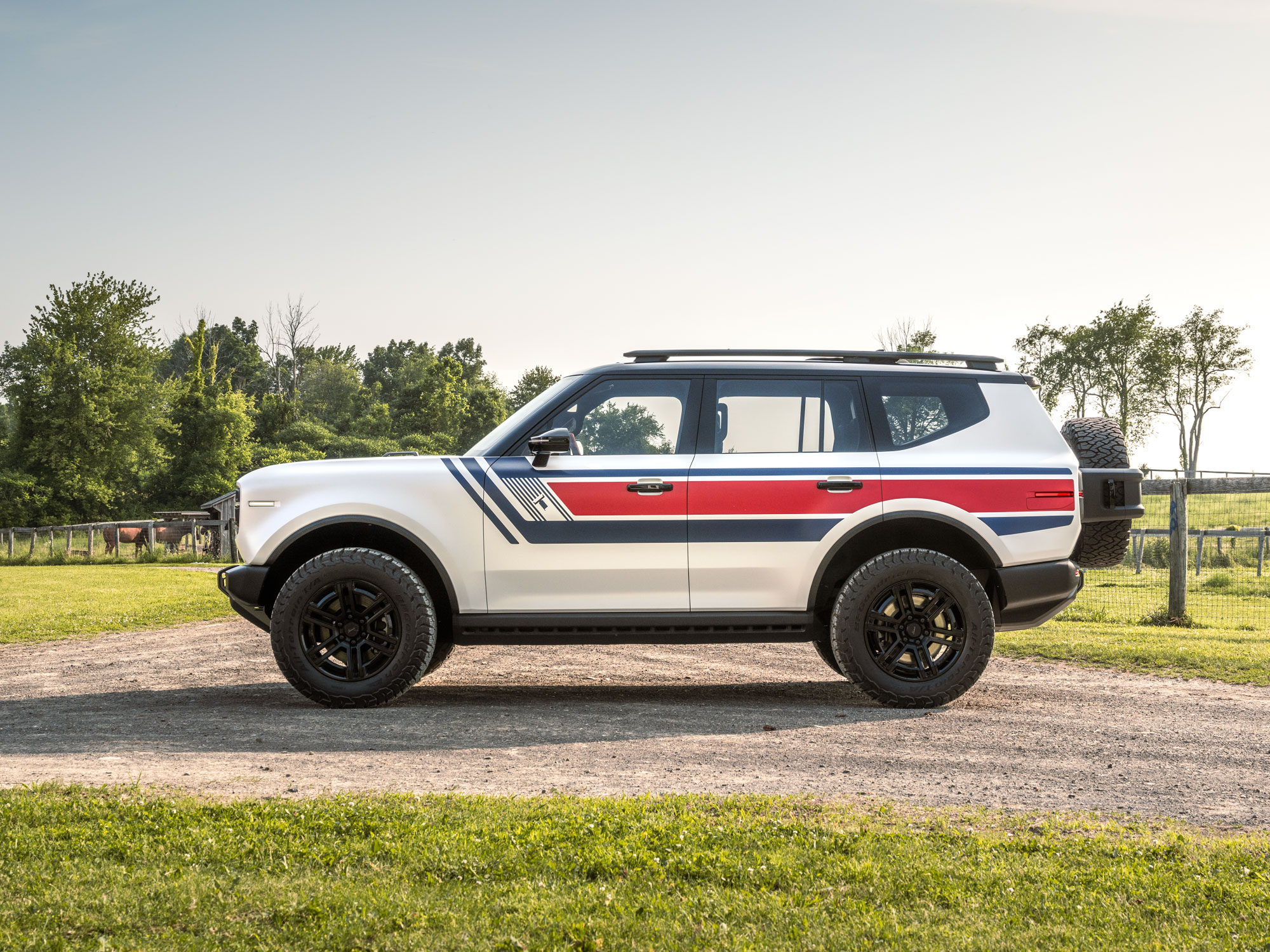
Read the concept coverage for the design language, not the parts list. The production Scout Traveler SUV will carry the body, the proportions, and the general interior themes. Metal bumpers, beadlock wheels, and an integrated winch belong to an accessory catalog if they appear at all.
The stronger signal sits in the numbers Scout keeps repeating. Towing above 7,000 pounds, clearance above 12 inches, and a sub-$60,000 start describe a truck aimed at Bronco and Wrangler shoppers. Price is the target most likely to move.
Slippage sits at the top of the risk list. A 2027 line start leaves plenty of room to drift, and Scout has never delivered a customer vehicle. Volkswagen Group backing reduces the funding worry, while a new brand, a new plant, and a thin service network stay real risks. The direct sales fight adds friction no established rival absorbs. Buyers who need a rig next season should shop the Bronco, the Wrangler, or a used Defender.
Watching the Harvester powertrain reach production matters more than watching concept accessories. If Scout ships 500-plus miles of range in a body-on-frame SUV under $60,000, it takes the slice it needs and forces Ford to answer on range. Should the launch slip to 2029, the Bronco keeps the buyers it has.
Scout Traveler Concept FAQ
Will Scout build the Traveler concepts?
No. Scout showed both as design studies. The production Traveler carries the same body and proportions, while the beadlocks, bumpers, and winch belong to an accessory catalog or nowhere.
When will the Scout Traveler go on sale?
Scout targets initial production in 2027 at its Blythewood, South Carolina, plant, and says customer deliveries follow later. Outlets covering the launch expect a 2028 arrival. Treat both dates as targets, since Scout labels its timelines as subject to change.
How much will the Scout Traveler SUV cost?
Scout targets a base price under $60,000 before options, taxes, and fees. Reservations cost $100 and stay fully refundable.
What is the Harvester range extender?
The Harvester range extender pairs the electric drivetrain with an onboard gas generator. Its engine charges the battery instead of driving the wheels. Scout projects more than 500 miles of total range with it, compared to about 350 miles for the all-electric version.
How much will the Scout Traveler tow?
The company targets more than 7,000 pounds of towing for the production SUV. Towing cuts electric range sharply, so the Harvester setup suits trailer duty better.
Is the Scout Traveler better off road than a Ford Bronco?
No production Scout Traveler exists yet, so no honest comparison holds up. On paper, targets of 12-plus inches of clearance and 35-inch tires beat the figures of a stock Bronco Badlands, which runs 10.5 inches of clearance on 33-inch tires. Real answers wait for production hardware.