


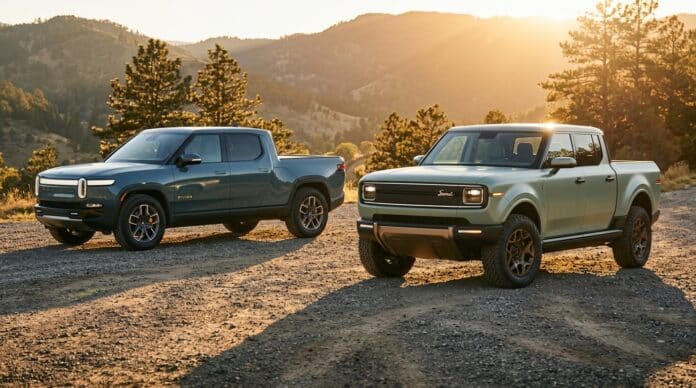

Quick Verdict: In the Scout vs Rivian R1T fight, the Rivian R1T is here today with up to 420 miles of range, 11,000 pounds of towing, and 14.9 inches of adjustable ground clearance starting around $72,885. The Scout Terra arrives in late 2027 with body-on-frame construction, a solid rear axle, sway-bar disconnects, and a 500-mile gas-extended Harvester option starting near $60,000. Pick Rivian for tech, speed, and immediacy. Conversely, choose Scout if you want a traditional truck architecture with a built-in gas backup for the backcountry.
Last updated: May 2026 | 12 min read
In This Review
- Scout vs Rivian R1T Overview
- Key Specs at a Glance
- Powertrain and Range Comparison
- Off-Road Capability Compared
- Towing, Payload, and Bed Size
- Pricing and Availability
- Tech, Charging, and Cabin
- Heritage and Why Scout Matters
- Scout Terra vs Rivian R1T: Which Should You Pick?
- Pros and Cons
- Final Verdict
- Frequently Asked Questions
Scout vs Rivian R1T Overview: Two Different Routes to the Same Trailhead
The Scout vs Rivian R1T conversation pits a brand-new product, the Rivian R1T, against a heritage nameplate reborn under Volkswagen Group ownership. Rivian shipped its first R1T in September 2021 and has spent five model years refining range, towing, and off-road performance. Meanwhile, Scout Motors revealed the Terra pickup and Traveler SUV concepts in October 2024, with production targeted for late 2027 at a new South Carolina plant.
Before going further, here is some personal context. My father owned an original International Scout when I was growing up. Specifically, the first time he let me ride shotgun through a muddy two-track, I understood why people loved the old workhorse. It carried no nonsense, a rugged ladder frame, and the kind of mechanical honesty modern crossovers traded away decades ago. So when Volkswagen revived the Scout name with body-on-frame construction and locking differentials, my interest was personal as well as professional.
For off-road buyers, the comparison comes down to architecture. The Rivian R1T uses an independent front and rear suspension, an air system lifting the body up to 14.9 inches, and a hydraulic kinetic roll-control setup replacing traditional anti-roll bars. Conversely, Scout’s Terra goes the other way with body-on-frame construction, a solid rear axle, mechanical locking differentials front and rear, and disconnecting sway bars for extra wheel travel.
Pricing also separates them notably. The 2026 R1T lineup starts at $72,885 and tops out near $121,885 for the Quad Max. Scout has confirmed an entry price near $60,000 for the Terra before incentives, with reservations open for $100. Both trucks target the same buyer, however, they answer the question of capability with fundamentally different engineering bets.
Key Specs at a Glance
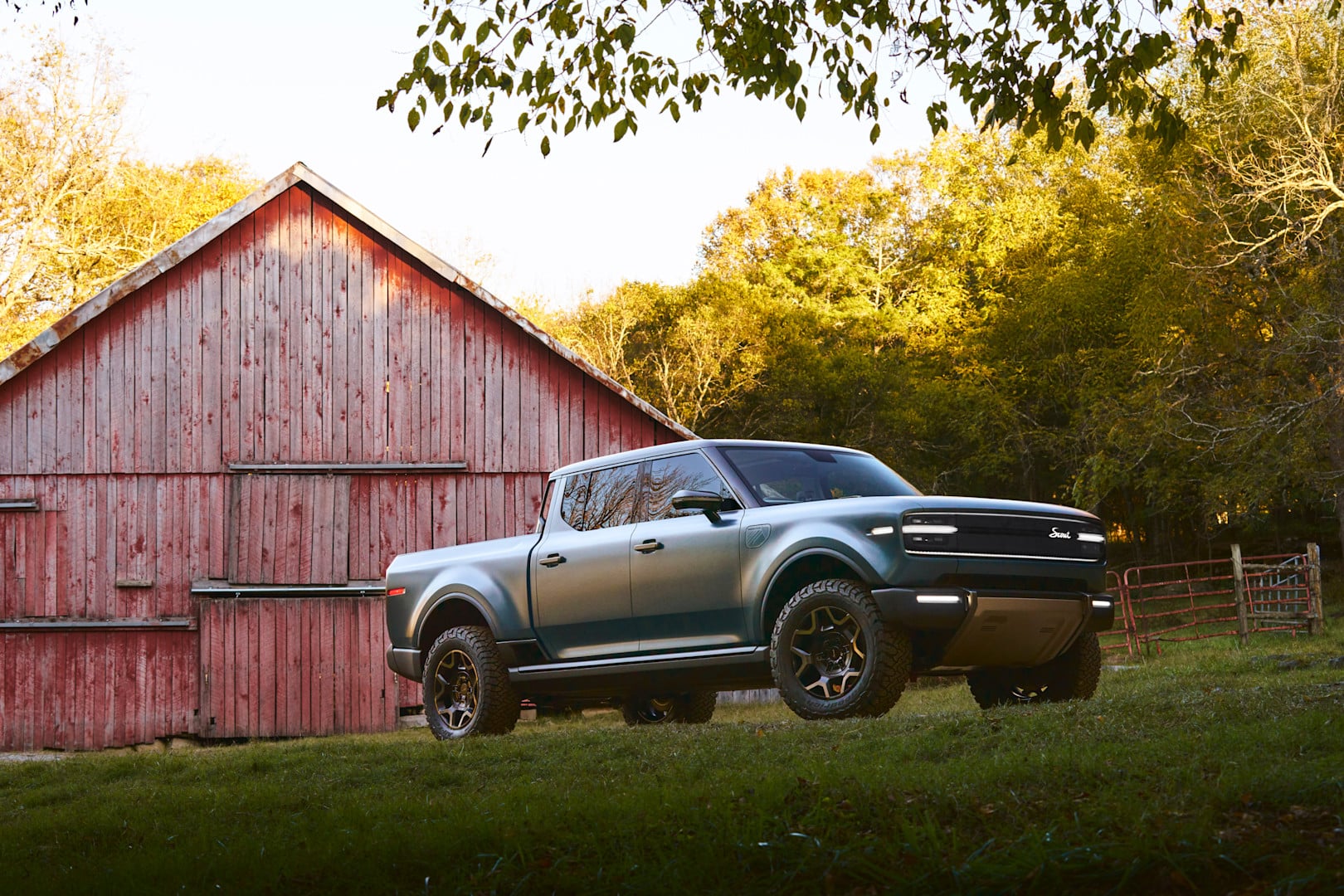
Here is where the two platforms diverge on the numbers. Some Scout figures are confirmed targets from the 2024 reveal and updated through 2026 disclosures, while Rivian numbers reflect the production 2026 model year.
| Specification | Scout Terra | Rivian R1T (2026) |
|---|---|---|
| Starting Price | ~$60,000 (target) | $72,885 |
| Top Trim Price | TBD | $121,885 (Quad Max) |
| Production Status | Late 2027 (2028 MY) | Available now |
| Powertrain | BEV or EREV (Harvester) | BEV only |
| Range (BEV) | Up to 350 miles | 270 / 329 / 420 miles |
| Range (EREV) | 500+ miles | N/A |
| Max Towing | 10,000+ lb | 11,000 lb (Max pack) |
| Payload | ~2,000 lb | Up to 2,317 lb |
| 0-60 mph | As quick as 3.5 sec | 2.5 sec (Quad) |
| Architecture | Body-on-frame | Skateboard platform, IFS/IRS |
| Rear Axle | Solid axle | Independent |
| Locking Diffs | Front and rear (mechanical) | Electronic torque vectoring |
| Ground Clearance | 12+ inches | Up to 14.9 inches |
| Wading Depth | ~36 inches (target) | 42.7 inches |
| Length | 229.2 inches | 217.1 inches |
| Bed Length | 5.5 ft | 4.5 ft |
| Charging Port | TBD (NACS expected) | Native NACS (Tesla Supercharger access) |
Reserve the Scout Terra
Lock in Your Build for $100 Refundable
Scout has logged more than 160,000 reservations as of early 2026. Place a refundable hold to keep your spot in line.
Powertrain and Range Comparison
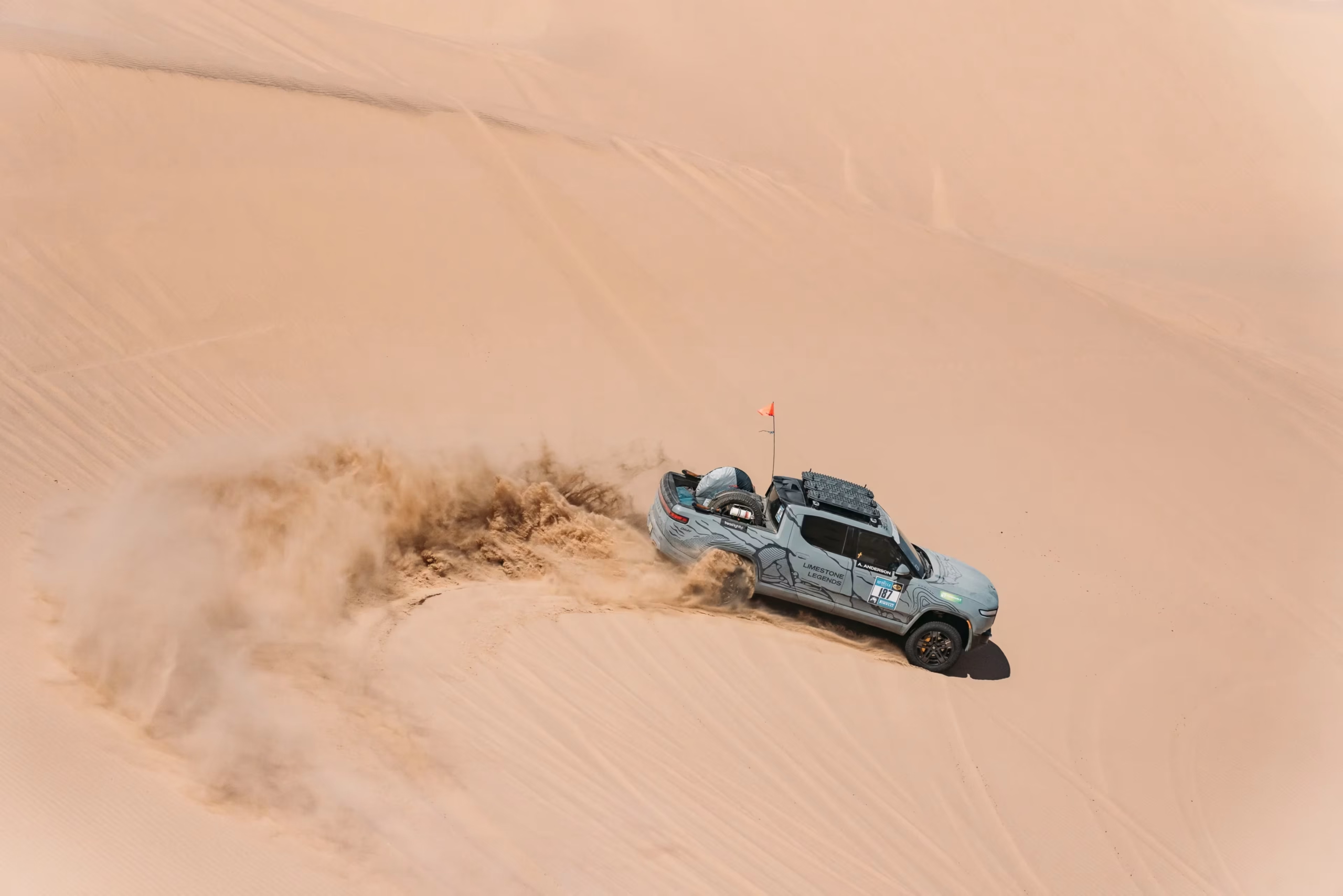
This is where the Scout vs Rivian R1T story splits into two philosophies. Rivian goes pure electric across every trim and battery pack. Conversely, Scout offers buyers a choice between a battery-only Terra and the Harvester EREV with a small four-cylinder gasoline generator on board.
The R1T comes with three battery sizes for 2026. Specifically, the 92.5 kWh Standard pack delivers 270 miles of range, the 108.5 kWh Large pack pushes it to 329 miles, and the flagship 140 kWh Max pack stretches range to 420 miles. Motor configurations include Dual, Tri, and Quad layouts. The Quad Motor variant uses Rivian-developed in-house motors and runs zero to 60 mph in 2.5 seconds, according to Rivian.
By comparison, the Scout Terra targets up to 350 miles in pure-electric form and roughly 1,000 lb-ft of torque from its dual motors. Acceleration of zero to 60 mph in as little as 3.5 seconds places it ahead of the Dual Motor R1T, although behind the Tri and Quad variants.
However, the Harvester EREV is where Scout plays a different hand. It pairs a 60 to 70 kWh battery with a four-cylinder gas generator sourced from Volkswagen, producing roughly 150 miles of pure-electric range and a total range above 500 miles when the gas tank is full. Scout CEO Scott Keogh has confirmed 87% of early reservations chose the Harvester over the battery-only Terra. For overlanders worried about charger deserts in the West, this becomes a major selling point.
Range tells the story of their different bets:
| Configuration | Battery | Range |
|---|---|---|
| R1T Dual Standard | 92.5 kWh | 270 miles |
| R1T Dual Large | 108.5 kWh | 329 miles |
| R1T Max (Dual/Tri/Quad) | 140 kWh | Up to 420 miles |
| Scout Terra BEV | ~120 kWh (estimated) | Up to 350 miles |
| Scout Terra Harvester (EREV) | 60-70 kWh + gas | 500+ miles total |
Off-Road Capability Compared
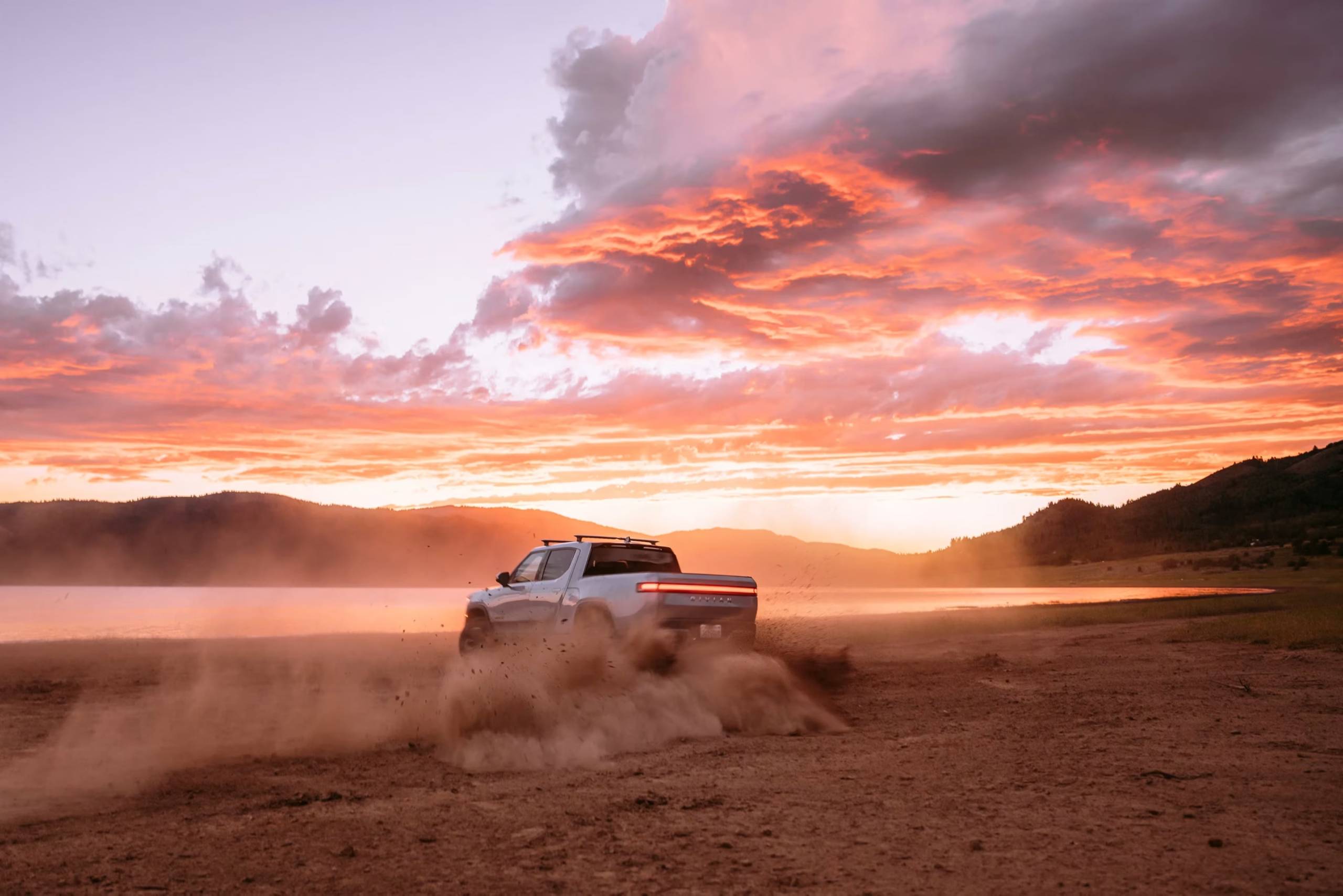
For trail buyers, the Scout vs Rivian R1T debate hinges on three things: ground clearance, articulation, and how predictable the truck behaves on rocks and ruts. Both trucks are serious off-roaders, however, each one gets there with fundamentally different hardware.
The Rivian R1T leans on adjustable air suspension. Specifically, ground clearance ranges from 7.9 inches in low mode to 14.9 inches at maximum lift, depending on wheel and tire choice. In off-road mode, the R1T fords 42.7 inches of water, similar to chest-deep on a six-foot adult. Approach angle measures 34.8 degrees, while departure measures 34.3 degrees. The independent rear suspension keeps the body composed at speed, and the kinetic roll-control system lets the truck flex without unsettling on-road handling.
By contrast, the Scout Terra targets a different style of trail performance. Ground clearance starts above 12 inches with steel-sprung suspension, while wading depth lands around 36 inches. The solid rear axle delivers more frame-twisting articulation than an independent setup, and Scout has confirmed mechanical front and rear locking differentials along with a sway-bar disconnect for further wheel travel. For low-speed crawling on broken rock, this combination is closer to what a serious Wrangler or Bronco Raptor delivers than what the R1T offers.
Edmunds reported in November 2024 the Terra and Traveler are likely to outperform Rivian on technical off-road sections precisely because of this body-on-frame plus solid-axle approach. Compared to the R1T, Scout’s setup also tends to be simpler and more rebuildable in the field. Air suspensions are wonderful until a rock cuts an air line. Conversely, steel coils keep working.
| Off-Road Spec | Scout Terra | Rivian R1T |
|---|---|---|
| Suspension Type | Steel coils, body-on-frame | Air, independent F/R |
| Rear Axle | Solid axle | Independent |
| Lockers | Mechanical front + rear | Electronic torque vectoring |
| Sway Bar Disconnect | Yes | No (kinetic roll control) |
| Ground Clearance | 12+ inches | Up to 14.9 inches (air) |
| Wading Depth | ~36 inches | 42.7 inches |
| 240V Onboard Outlet | Yes | Yes (120V/240V) |
Towing, Payload, and Bed Size
For a working truck, the Scout vs Rivian R1T match-up has to address payload, towing, and bed dimensions. Both trucks land in the half-ton-plus class, however, the Scout Terra carries an extra foot of length translating into useful real estate behind the cab.
The Rivian R1T tows up to 11,000 pounds, although only with the 140 kWh Max battery pack on Dual Max, Tri Max, or Quad Max trims. As a result, Standard and Large packs are now capped at 7,700 pounds for 2026. Payload reaches 2,317 pounds when properly equipped. However, bed length is 4.5 feet, smaller than what most traditional half-ton buyers expect.
By comparison, the Scout Terra targets a tow rating above 10,000 pounds and a payload around 2,000 pounds. Bed length stretches to 5.5 feet, which gives owners room for a full-size dirt bike laid sideways or a stack of building materials without a bed extender. For overall footprint, the Terra measures 229.2 inches versus the R1T’s 217.1 inches.
One open question is how the Harvester EREV handles heavy towing. Scout CEO Scott Keogh has stated the company has a solution to keep tow capacity from being cut in half when the gas generator runs, since combustion engines historically lose efficiency under sustained load. Specifics will arrive closer to launch. Until then, buyers planning to tow a 9,000-pound travel trailer through Wyoming should keep this caveat in mind.
Pricing and Availability
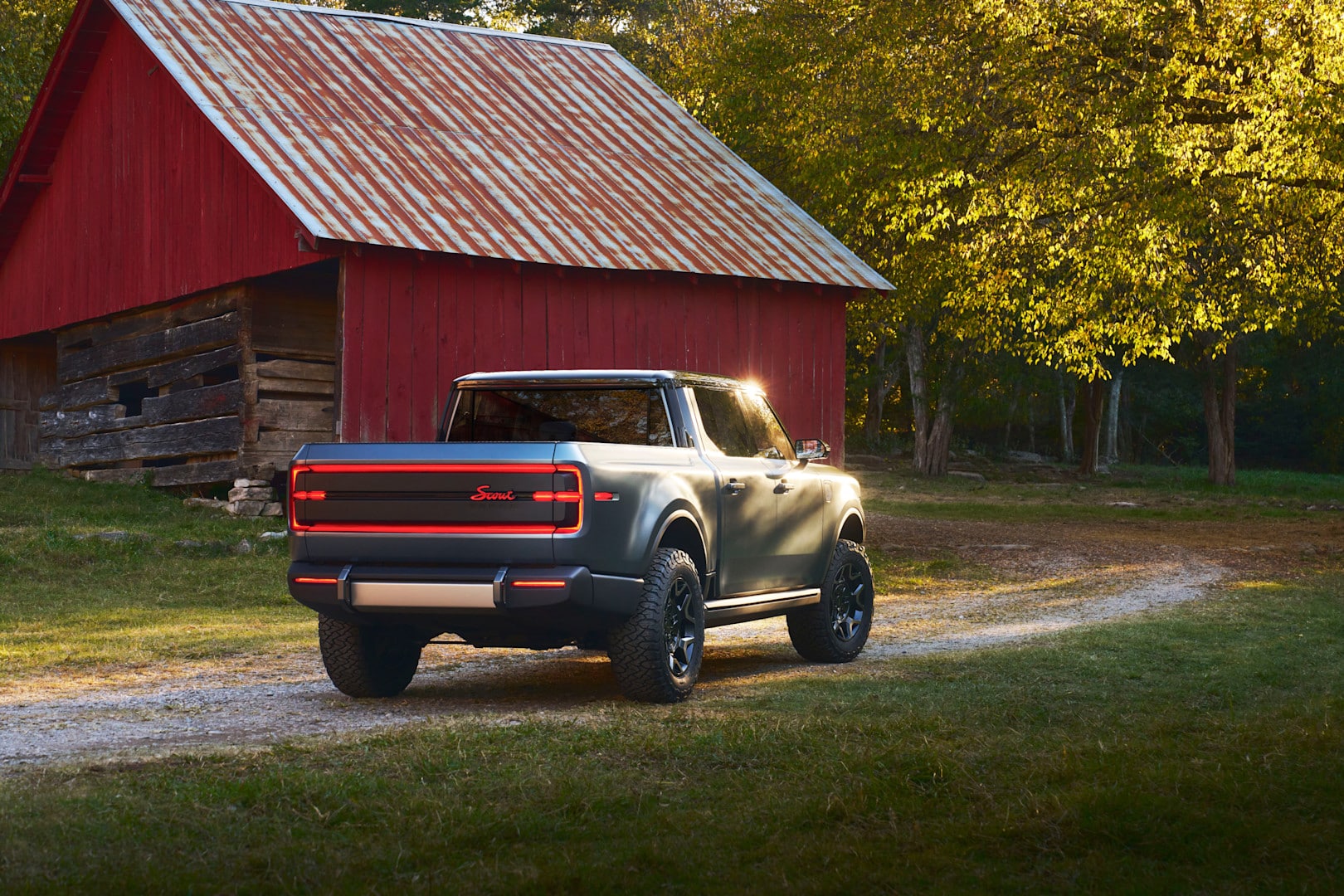
Scout vs Rivian R1T also comes down to time and money. The R1T is shipping today from Rivian’s Normal, Illinois plant. However, the Terra remains roughly 18 months from start of production at the time of writing.
Currently, the 2026 Rivian R1T starts at $72,885 for the Dual Standard with the 92.5 kWh pack. From there, prices climb through Dual, Tri Motor, and Quad Motor configurations. At the top, the Quad Max stickers near $121,885. With the federal EV tax credit in flux for higher-priced trucks, buyers should check eligibility against the latest IRS guidance before signing.
Scout Motors has confirmed a target entry price near $60,000 for the Terra before incentives. CEO Scott Keogh has referenced an estimated $50,000 to $51,000 net price for buyers who qualify for the federal credit. Reservations are open at scoutmotors.com for $100 refundable. As of early 2026, Scout has logged over 160,000 reservations across the Terra and Traveler.
For shoppers comparing total cost of ownership, the Harvester EREV introduces a wrinkle. The gas generator adds maintenance items like oil changes and coolant service. Pure-electric R1T owners avoid those entirely. On the other hand, Harvester owners avoid the public charging tax in remote regions where DC fast chargers are 60 to 100 miles apart.
Build a Rivian R1T
Configure Yours from $72,885
Choose Dual, Tri, or Quad motors and a 270, 329, or 420-mile battery pack. Native NACS port included for 2026 model year.
Tech, Charging, and Cabin
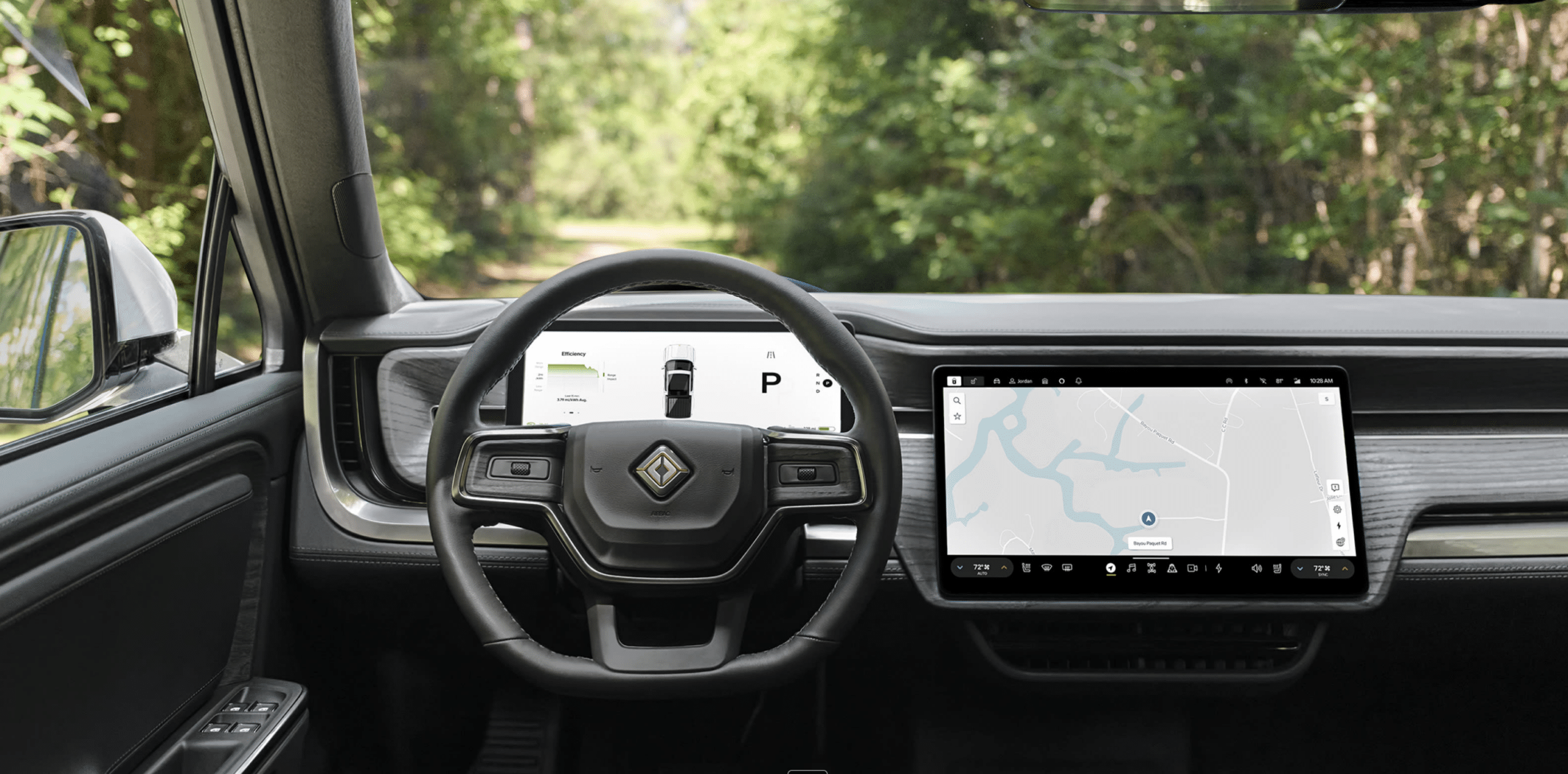
Rivian has a five-year head start on the Scout Terra when it comes to refining onboard tech. Specifically, the R1T runs Rivian’s in-house operating system on a 16-inch landscape touchscreen and a 12.3-inch driver display. Since launch, over-the-air updates have brought new features and tuning, including expanded off-road modes and tow assistance. For 2026 model year, the R1T ships with a native NACS charge port, giving owners plug-and-charge access to over 21,500 Tesla Superchargers.
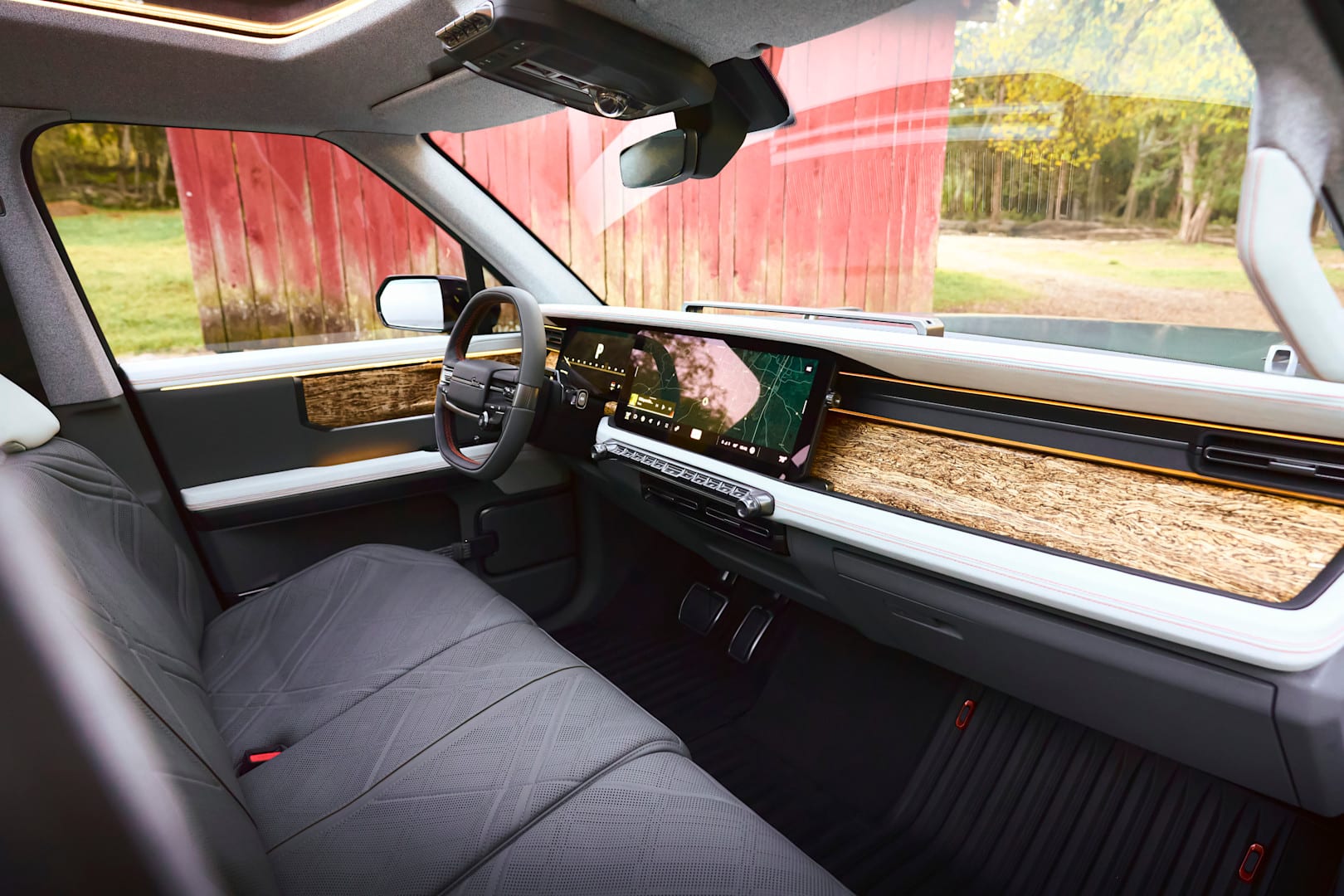
Scout has shown camera-monitor mirrors, a center steering yoke option, and a full-width front bench seat bringing back the spirit of older trucks. Specifics on the operating system, charge curve, and over-the-air update strategy are still emerging. Volkswagen Group’s recent investment in Rivian software through their joint venture suggests Scout will benefit from shared engineering, although confirmation will arrive at launch. Both trucks include a 240V outlet for jobsite tools and trail accessories.
One thing worth noting: the R1T’s hydraulic kinetic roll-control system is genuinely clever and contributes to its on-pavement composure, especially with a load in the bed. The Scout’s mechanical sway bars and disconnect are simpler and easier to service in a small-town shop. Trail repairs in the field favor the Scout’s hardware. Highway road manners with a 7,000-pound trailer favor the Rivian.
Heritage and Why Scout Matters
Heritage is part of why the Scout vs Rivian R1T conversation feels different from a Ford F-150 Lightning vs Silverado EV debate. Rivian is a startup, founded in 2009, with no historical baggage. By contrast, Scout traces back to 1961, when International Harvester launched the original Scout 80 as a competitor to the Jeep CJ-5. From 1961 to 1980, the Scout earned a reputation for ladder-frame durability, simple mechanicals, and trail capability ahead of its time.
My father’s original Scout was a workhorse. For example, door panels rattled, the heater worked when it felt like working, and you needed real upper-body strength to turn the wheel at low speed. However, the old truck went anywhere we pointed it, including a few places we should not have tried. The new Scout Terra is a clean-sheet electric design, although Volkswagen has clearly studied the original.
Body-on-frame construction, a solid rear axle, and mechanical lockers were all hallmarks of the 1971 Scout II. Scout’s design team has spoken about wanting the Terra to feel “honest” in a way modern crossovers do not. When Volkswagen announced ladder-frame architecture for the new truck, I recognized the same engineering DNA my father trusted on washed-out logging roads. For buyers who grew up around Broncos, Wranglers, and original Scouts, the Terra aims to scratch the same itch with a modern powertrain.
Scout Terra vs Rivian R1T: Which Should You Pick?
The shortest version of this comparison: pick the Rivian R1T if you want the truck today and value range, on-road manners, and tech polish. Pick the Scout Terra if your timeline reaches 2028, prefer traditional truck architecture, and want a gas backup for long backcountry runs.
For overlanders crossing Nevada and Utah on dirt with no charging infrastructure, the Harvester EREV is a genuine differentiator and a strong contender for any list of best overland vehicles. The 500-mile total range and the ability to refuel at any gas station eliminate the range anxiety even a 420-mile R1T fails to solve when towing a trailer through the Owyhees. Conversely, for someone who lives in California, Arizona, or the Pacific Northwest with reliable Supercharger access, the R1T’s 11,000-pound tow rating and 14.9-inch ride height are hard to beat.
Pricing tilts toward Scout if its sub-$60,000 entry target holds. For example, a loaded R1T Tri Max sits closer to $100,000 once options pile up. However, Rivian buyers get years of refined software, a known dealer and service network, and an OTA update history. Scout buyers are betting on a production launch still 18 months away. Both bets carry risk, and both trucks deserve a long test drive before signing.
Pros and Cons
Scout Terra Pros
- Body-on-frame design with solid rear axle for serious off-road articulation
- Mechanical front and rear locking differentials
- Sway-bar disconnect adds wheel travel on technical trails
- Harvester EREV option delivers 500+ miles of total range
- Target starting price near $60,000 undercuts the R1T by roughly $13,000
- 5.5-foot bed beats the R1T by a full foot
- 240V outlet and 2,000-pound payload capacity
Scout Terra Cons
- Production does not begin until late 2027
- Approach and departure angles still officially undisclosed
- Harvester EREV adds maintenance items vs pure EV
- Service network has yet to be built out
- Software platform unproven compared to Rivian’s five-year track record
Rivian R1T Pros
- Available now with five years of production refinement
- Up to 420 miles of range on the Max battery pack
- 11,000-pound tow rating with the Max pack
- Native NACS port for 2026 unlocks Tesla Supercharger access
- Air suspension delivers 14.9 inches of clearance and 42.7 inches of fording
- 2.5-second zero to 60 mph time on the Quad Motor
- Mature OTA update history and 16-inch infotainment screen
Rivian R1T Cons
- Starting price of $72,885 is roughly $13,000 above Scout’s target
- Bed length of 4.5 feet feels short for a full-size truck
- Standard and Large packs now capped at 7,700-pound towing
- No range-extender option for remote travel
- Independent rear suspension articulates less than a solid axle
- Air suspension is harder to service in a remote shop
Final Verdict
For buyers shopping today, the Rivian R1T is the answer. It is in showrooms, it has 420 miles of range with the Max pack, it tows 11,000 pounds, and it now charges natively at Tesla Superchargers. Five model years of OTA updates have ironed out most of the early software bugs. If you need a truck this weekend, the R1T earns the win in the Scout vs Rivian R1T comparison.
However, for buyers willing to wait, the Scout Terra looks like the more interesting truck. Body-on-frame construction with a solid rear axle and mechanical lockers will outclimb the R1T on technical trail. The Harvester EREV solves the long-distance overlanding problem in a way no pure-electric truck currently does. A starting price near $60,000 also gives Scout a real value advantage.
From a pure value perspective, the math depends on use case. A buyer who tows a 5,000-pound boat 20 miles to the lake on weekends gets more from the R1T because it works today. Conversely, a buyer who plans a two-week trip through Big Bend or the Maze District in Utah gets more from the Harvester Terra because it removes the charge-station planning burden entirely.
The honest recommendation is to drive a Rivian R1T now if your timeline is short, then put $100 down on a Scout Terra reservation as insurance against a 2028 truck purchase. If the Terra delivers on its targets, you have first-batch access. Should it slip or disappoint, you walk away with your deposit returned. The original Scout earned its reputation on rugged simplicity, and the Terra is built to honor the legacy. Meanwhile, Rivian’s R1T remains the proven option today. Speaking personally, if the Terra ships on time and honors what made the original Scout honest, I would lean there for the same reason my father kept his keys for two decades. Both trucks deserve a serious test drive before you commit.
Ready to Decide?
Configure or Reserve Today
Compare both trucks on the manufacturer sites. Rivian ships now. Scout reservations are refundable.
Frequently Asked Questions
When does the Scout Terra go on sale?
Scout Motors has targeted production for late 2027 at its South Carolina plant, with first customer deliveries arriving as 2028 model-year trucks. Pricing details and trim configurations will firm up roughly 12 to 18 months before launch.
Is the Scout Terra better off-road than the Rivian R1T?
Likely yes on slow technical trails, because the Scout uses body-on-frame construction with a solid rear axle, mechanical front and rear lockers, and a sway-bar disconnect. The Rivian R1T wins on ride height with 14.9 inches of air suspension clearance and 42.7 inches of fording depth. Each truck favors a different style of off-roading.
What is the Scout Harvester EREV?
The Harvester is Scout’s extended-range electric vehicle option. It pairs a smaller 60 to 70 kWh battery with a four-cylinder gas generator sourced from Volkswagen. Total range tops 500 miles, and the gas tank refills at any pump. Scout reports 87% of early reservations chose the Harvester over the pure-electric Terra.
How does Scout vs Rivian R1T compare on price?
The Rivian R1T starts at $72,885 for 2026 and climbs to $121,885 for the Quad Max. Scout has targeted a starting price near $60,000 for the Terra before incentives, with an estimated post-incentive price near $51,000 if the federal credit applies.
Does the Rivian R1T charge at Tesla Superchargers?
Yes. The 2026 Rivian R1T ships with a native NACS charge port, giving owners plug-and-charge access to more than 21,500 Tesla Superchargers across North America. Earlier model years use an NACS adapter, which Rivian provides.
How much will the Rivian R1T tow?
The 2026 R1T tows up to 11,000 pounds, although only with the 140 kWh Max battery pack on Dual Max, Tri Max, or Quad Max configurations. However, the Dual Standard and Dual Large trims cap at 7,700 pounds. Payload reaches 2,317 pounds when properly equipped.
Does the Scout Terra have locking differentials?
Yes. Scout has confirmed mechanical locking differentials at both the front and rear axles, plus a four-wheel drive system and disconnecting sway bars to increase wheel travel. Ground clearance starts above 12 inches.