


Quick Facts:
- Topic: The best hiking poles for overlanders and basecamp day hikers
- Top pick: Black Diamond Trail Cork, $129.95, 17.4 oz per pair
- Picks covered: 8 pairs, each with a live Amazon listing
- Price range: $49.99 to $229.95 per pair at MSRP
- Weight range: 9.3 oz to 23.3 oz per pair
- Packed length range: 14.25 in to 26.4 in
- Shaft materials: 3K and Kevlar-reinforced carbon, 7075 aluminum, HTS 6.5 aluminum
- Lock types: External lever (FlickLock, SpeedLock, DynaLock) and Z-fold
- Best for: Drivers who park at a trailhead, hike four to twelve miles, then stow poles in a drawer
15 min read
In This Guide
- Why Overlanders Buy Poles Differently
- How We Picked the Best Hiking Poles
- Best Hiking Poles: Key Specs at a Glance
- The 8 Best Hiking Poles for Overlanders
- Carbon vs. Aluminum for Vehicle-Based Hiking
- Storing Poles in a Hot Rig
- Poles as Camp and Crossing Hardware
- Final Verdict on the Best Hiking Poles
- Frequently Asked Questions
Why Overlanders Buy Poles Differently
The best hiking poles for overlanders solve a problem pure backpackers never face. Your poles sit in a hot vehicle for weeks between uses, so heat cycling, dust ingress, and drawer geometry matter as much as swing weight. Also, you rarely carry them from dawn to dusk. Instead, you grab them at a trailhead you drove to, walk six or eight miles, then stow them again before dinner.
Those conditions flip the usual buying advice. Most “best trekking poles” roundups are written for thru-hikers. Ultralight forums obsess over shaving two ounces per pole, because a thru-hiker feels every gram across 2,650 miles. You do not. Your weight budget lives in the truck, not on your back. Therefore, packed length, lock reliability, and shaft toughness deserve more attention than the number on the scale. Collapsible hiking poles win here on geometry alone.
What the Trail Data Shows
Adoption data explains why poles are worth the drawer space at all. In the 2025 Halfway Anywhere Pacific Crest Trail survey of 790 hikers, 97.9 percent used trekking poles. The Black Diamond Alpine Carbon Cork was the most common model, though the survey publishes rank rather than share. While a PCT thru-hike differs from a day hike off a forest road, the durability signal still transfers. If you are pairing off-roading with backpacking, these are the same poles carrying people through granite and lava rock.
Poles also earn their keep on the descent. Schwameder and colleagues measured knee joint force reductions of 12 to 25 percent during downhill walking with poles. The test used a 25-degree ramp and eight subjects. Their work ran in the Journal of Sports Sciences in 1999. Notably, later work by Jensen found no comparable unloading on level ground. The benefit concentrates on steep grades, which is exactly where a loose scree trail below a ridgeline campsite hurts.
How We Picked the Best Hiking Poles
No pole in this roundup was hands-on tested by our staff, and pretending otherwise would waste your time. Our shortlist of the best hiking poles came from three sources: manufacturer spec sheets loaded and checked for a live 200 response, published warranty documents read in full, and 36 structured search passes across hiking forums.
Those passes covered r/Ultralight, r/hiking, r/backpacking, r/AppalachianTrail, and r/PacificCrestTrail. Black Diamond appeared in 52 distinct threads, Cascade Mountain Tech in 27, and Leki in 25. Those counts measure share of voice inside our sample rather than Reddit-wide totals, so treat them as a shortlist filter instead of a ranking.
Each finalist then cleared two hard gates. First, a manufacturer spec page returning HTTP 200 with real published figures. Second, a live Amazon listing whose ASIN resolved to the exact product named. Two well-reviewed poles got cut at the second gate, because their only listings came from third-party sellers at above MSRP, and both brands limit warranty coverage on unauthorized sellers.
4wdTalk earns a commission on purchases made through the Amazon links below, at no extra cost to you.
Best Hiking Poles: Key Specs at a Glance
Every weight in the comparison below is per pair. Black Diamond and MSR publish pair weights directly. Leki, Cascade Mountain Tech, Trekology, and TrailBuddy publish per-pole figures, so those numbers are doubled. Getting the convention wrong produces a two-times error, which is how competing “best hiking poles” roundups end up listing a 9-ounce aluminum pole.
| Best Overall | Best for Rough Ground | Highest Rated | Best Budget Carbon | Lightest Packable | |
|---|---|---|---|---|---|
| Product |  BD Trail Cork BD Trail Cork |  MSR DynaLock Ascent MSR DynaLock Ascent | TOP PICK BD Alpine Carbon Cork BD Alpine Carbon Cork | 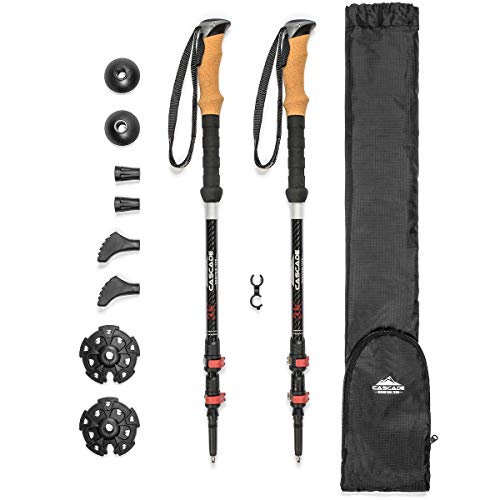 Cascade Mountain Tech 3K Cascade Mountain Tech 3K |  BD Distance Carbon Z BD Distance Carbon Z |
| Rating | ★★★★☆ 3.8 7 ratings | ★★★★☆ 4.4 200 ratings | ★★★★☆ 4.6 400 ratings | ★★★★☆ 4.5 1,100 ratings | ★★★★★ 4.7 44 ratings |
| Weight/pair | 17.4 oz | 16.6 oz | 17.1 oz | 16 oz | 9.3 oz |
| Packed length | 25.5 in | 14.25 in | 24 in | 26 in | 14.6 in |
| Shaft | 7075 aluminum | Kevlar carbon | Carbon | 3K carbon | Carbon |
| Price | $129.95 as of Oct 28, 1:18 am | $186.99 as of Oct 28, 1:18 am | $229.95 as of Oct 28, 1:18 am | $59.99 as of Oct 28, 1:18 am | $199.95 as of Oct 28, 1:18 am |
| Check Price → | Check Price → | Check Price → | Check Price → | Check Price → |
One footnote on the MSR figure. Its spec table lists both “1 lb 0 oz” and “0.47 kg,” and those two numbers disagree by half an ounce. REI lists 17 oz. We use 16.6 oz, converted from the metric figure.
The 8 Best Hiking Poles for Overlanders
1. Black Diamond Trail Cork: Best Overall for Overlanders
The Trail Cork replaced the Trail Ergo Cork, a model Reddit still recommends constantly despite its removal from Black Diamond’s catalog. Its 7075 aluminum shafts and dual FlickLock levers cost $100 less than the carbon Alpine Carbon Cork, and the weight penalty is 0.3 ounces per pair. Cork grips under $150 is the headline.
Foam grips soak up sweat, then dry stiff and crack after a season in a hot cab. Cork instead ages into a better grip. Meanwhile, rubber grips draw the harshest forum criticism of any grip material, producing stained hands and torn edges. If you drive to trailheads in Utah or Arizona, where day hikes worth the drive start in triple-digit heat, cork earns the upgrade.
Two caveats before you buy. At 25.5 inches collapsed, this pair will not lie flat in a 24-inch drawer, so measure first. Also, Black Diamond restricts shipment of certain products to California, New York, and Colorado under state PFAS rules, so confirm your address clears at checkout.
2. MSR DynaLock Ascent Carbon: Best Carbon for Rough Ground
MSR builds these shafts from Kevlar-reinforced carbon. Therefore, the shafts raise the sideways load a pole takes before it fails, which answers the loudest complaint about carbon in every forum thread we read. Carbon breaks when a tip wedges in a rock crack and the hiker keeps moving sideways.
The DynaLock lever adds length adjustment on top of a Z-fold body, so you get a 14.25-inch packed length alongside a usable range. Nothing else here combines both. At 16.6 ounces per pair the weight sits mid-pack. Still, this is the pole for a loose talus descent or a spring snow start above a high camp.
Two practical notes. Powder baskets sell separately for most sizes, so order them alongside the poles rather than the week before a trip. Also, the lever opens with gloves on, which matters at 5 a.m. when a twist lock refuses to break loose. Amazon carries two size options, so check your height against the size before ordering.
3. Black Diamond Alpine Carbon Cork: Best for High-Mileage Hikers
If you also thru-hike, fastpack, or put in 15-mile days regularly, the extra $100 buys a lighter carbon pole with a decade of trail evidence behind it. Since 790 PCT hikers reported their gear in 2025, and this model topped the list, the sample dwarfs any single reviewer’s opinion.
Three telescoping sections collapse to 24 inches. FlickLock Pro levers, built with aluminum and stainless hardware, adjust by hand without tools. The Trail Cork uses a standard nylon-bodied FlickLock instead, which is the real difference between the two beyond shaft material. Natural cork grips break in to match your palm and shed sweat better than foam in desert heat.
One rumor deserves correcting. A widely shared Reddit thread claims this model was discontinued, and the claim is wrong. Dead product links trace to a Black Diamond storefront migration affecting every product URL on the site. Warranty coverage runs two years, not for life. Black Diamond also reserves the right to reject claims on units bought from unauthorized sellers, so buy the listing sold and shipped by Black Diamond Equipment itself. As with the Trail Cork, Black Diamond restricts shipment of certain products to California, New York, and Colorado under state PFAS rules, so confirm your address clears at checkout.
4. Cascade Mountain Tech 3K Carbon: Best Budget Carbon
No other entry on this best hiking poles list costs less per carbon ounce. Known across hiking forums as “the Costco poles,” Cascade Mountain Tech appeared in 27 separate threads during research, second only to Black Diamond. Sixteen ounces of 3K carbon for $74.99 undercuts the next-cheapest carbon pair here by roughly $115. Amazon sells this listing first-party, which removes the third-party warranty problem attached to several premium models.
Quick Lock external levers work well when new. However, budget brands draw one recurring complaint: lock slippage after a season or two. The Cascade levers are no exception. Tighten the lock screws with a hex key before a big trip, then re-check them mid-season. For a set living permanently in the rig and used two dozen times a year, the value math is hard to beat.
5. Black Diamond Distance Carbon Z: Lightest Packable
No other pair here weighs less, at 9.3 ounces. These are the lightest trekking poles in the roundup and the second-most compact, folding down to 14.6 inches. Among the collapsible hiking poles here, only the MSR folds smaller. Consequently, a pair rides in a door pocket, a seat-back organizer, or a MOLLE panel without displacing anything else.
Folding trekking poles work differently from telescoping ones. Three carbon segments snap together on an internal cord, like a tent pole. One catch decides whether this pole fits you: it is fixed-length. You choose a size at purchase, with no on-trail adjustment. For steep out-and-back day hikes the compromise stings, since most hikers shorten poles on climbs. For fast rolling terrain and for shelter support duty, however, the fixed geometry is a feature. Snow baskets sell separately if you plan on winter use.
6. Leki Makalu Lite AS: Best Aluminum Warranty
Leki covers aluminum shafts for life against breakage, while carbon shafts get one year. For a pole loaned to whoever rides along, the distinction carries real money. Read the exclusions first, though. Leki’s lifetime term covers breakage, not bending, and aluminum bends far more often than it snaps. Coverage also excludes purchases from unauthorized sellers, so confirm the seller before ordering.
HTS 6.5 alloy and SpeedLock+ external levers put this pole in workhorse territory at 17.9 ounces per pair. Its 26.4-inch collapsed length is the longest here, so measure your drawer before committing. The AS designation marks Leki’s Dynamic Suspension System, an antishock elastomer rather than a spring. Forum sentiment on antishock stays split, so treat it as a preference instead of an upgrade.
7. Trekology Trek-Z Cork: Smallest Packed Length Under $60
Fifteen inches collapsed for $51.99 is the cheapest route into folding trekking poles. The BD Distance Carbon Z costs $219.95 to reach 14.6 inches. Meanwhile, the Trek-Z gets within an inch for a quarter of the price. Aluminum Z-fold construction plus a flip lock gives you compactness and length adjustment together, and cork-blend grips are unusual at this price.
Weight is the trade. At 23.3 ounces per pair, these are the heaviest poles in the roundup, roughly two and a half times the Distance Carbon Z. On a vehicle-based trip nobody notices. On a 15-mile day with 4,000 feet of gain, your shoulders will. Buy these as the pair stored in the center console for unplanned stops, not as your primary set.
8. TrailBuddy: Best Spare Set for Passengers
Every rig carrying more than one person needs a loaner pair. Guests show up in cotton and sneakers, then borrow whatever you have. TrailBuddy poles use 7075 aluminum with lever locks at $49.99. They appeared in five distinct Reddit threads as a functional budget option, which is more than most sub-$50 poles manage.
Nineteen point four ounces per pair and 24.5 inches collapsed sit in normal aluminum territory. Cork-blend grips, wrist straps, and a tip set come in the box. Expect the locks to need periodic tightening, similar to the Cascade set. Because a borrowed pole gets treated worse than an owned one, aluminum is the correct material for this slot. They also make a reasonable gift for someone starting out.
Carbon vs. Aluminum for Vehicle-Based Hiking
Shaft material decides which of the best hiking poles suit your rig. Start with the strongest evidence available, which comes from a manufacturer betting its own money. Leki covers aluminum shafts for life against breakage and carbon shafts for one year. A brand willing to price the asymmetry into a warranty knows something worth hearing. Most “best trekking poles” guides skip the point entirely.
Forum experience matches. Roughly a dozen dedicated Reddit threads covered the question during research, more than any other pole topic, and the consensus is blunt: aluminum bends, carbon snaps. Neither failure comes from downward load during normal walking. Instead, both happen laterally. A tip jams between rocks, then body weight torques the shaft sideways.
The weight argument for carbon is weaker than most roundups admit. Compare the closest pair in this guide: the carbon Alpine Carbon Cork at 17.1 ounces against the aluminum Trail Cork at 17.4 ounces. The gap is 0.3 ounces for $100. Across comparable models here the spread runs from 0.3 to 3.4 ounces per pair. The lightest trekking poles do earn their premium, since carbon buys real savings in designs built around low mass. The 9.3-ounce Distance Carbon Z is the example here.
Repairability settles it. Aluminum sections often straighten in the field with steady hand pressure against a rock, which gets you back to the truck. Carbon repairs need a splint, and a splinted shaft never returns to full strength. Since your rig absorbs the weight penalty anyway, aluminum makes more sense for a primary set. Choose carbon deliberately for packability or for high daily mileage, rather than by default.
Storing Poles in a Hot Rig
Nobody publishes durability data on the best hiking poles after months at 140 degrees Fahrenheit in a closed vehicle, so treat the following as risk management rather than tested fact. Carbon shafts rely on epoxy resin, and resins soften with sustained heat. Consequently, a black drawer baking in Arizona sun treats carbon worse than an upright spot behind a seat.
Dust is the more certain enemy. Fine desert silt migrates into lock mechanisms and telescoping joints. There it acts as a grinding paste. Rinse the lower shafts with clean water after any sandy trail. Next, dry them fully and store the poles extended rather than collapsed, since collapsed storage traps grit at every joint.
Tips wear on the same schedule. Carbide tips are finished once the point goes ball-shaped, and replacements are inexpensive. Rubber tip covers ship with the Cascade, Trekology, TrailBuddy, and Distance Carbon Z sets. Black Diamond sells them separately for the Trail Cork and Alpine Carbon Cork at $14.95, and Leki does the same, so budget for a set with those picks.
Measure before you buy. A 26.4-inch Leki Makalu Lite AS will not lie flat in a 24-inch drawer, whereas a 14.25-inch MSR DynaLock Ascent fits almost anywhere. Packed length is the spec most often ignored and least often fixable. Therefore, check it against your storage before adding a pair to the cart.
Poles as Camp and Crossing Hardware
Tarp and Awning Support
The best hiking poles do a second job at camp, and trail-focused reviews skip it. Tarp and awning support comes first. A pair of adjustable poles props a sagging vehicle awning corner in wind, raises a rain fly over a camp kitchen, or holds a tarp wall against blowing sand. Adjustable telescoping poles suit tarps best, because you dial the exact height the terrain demands. Fixed-length Z-fold poles instead shine as dedicated shelter supports, since several ultralight tents are designed around a specific pole length. Our roundup of American-made tents covers models pitching this way.
Creek Crossings and Trail Etiquette
Water crossings are the safety case. Our guide to probing a creek crossing on foot recommends a pole for checking depth and bottom firmness before you drive or wade. A pole planted upstream also gives you a third point of contact against current, which matters more than any spec on this page.
Trail etiquette closes the list. Carbide tips chew through soft tread and leave visible pockmarks on slickrock, so fit rubber covers on maintained trails and slick surfaces, then pull them for loose scree and mud. Following Leave No Trace principles costs nothing here beyond swapping two rubber caps.
Final Verdict on the Best Hiking Poles
Among the best hiking poles reviewed here, the Black Diamond Trail Cork at $129.95 suits most overlanders. It delivers FlickLock levers and cork grips like the $229.95 Alpine Carbon Cork. Also, it weighs 0.3 ounces more per pair and shrugs off the abuse a shared vehicle set absorbs. Spending the extra $100 buys weight savings you never carry far enough to feel.
Choose differently in three cases. If storage space is genuinely tight, the MSR DynaLock Ascent packs to 14.25 inches with Kevlar-reinforced shafts and real length adjustment. Thru-hikers and fastpackers should step up to the Alpine Carbon Cork, since its PCT track record justifies the price. On a strict budget, the Cascade Mountain Tech 3K Carbon gives you 16-ounce carbon for $74.99, with periodic lock maintenance as the trade.
Skip carbon entirely if your poles get loaned out, thrown in a truck bed, or handed to people who have never walked with poles before. Aluminum absorbs the abuse. Leki’s lifetime aluminum-shaft warranty makes the Makalu Lite AS the low-risk pick for shared gear. Confirm its 26.4-inch collapsed length fits your storage first, and confirm the seller, because Leki excludes unauthorized resellers.
Whichever of these best hiking poles you pick, buy two sets over time rather than one perfect set. A compact pair lives in the cab for unplanned trailheads, and a full-size adjustable pair rides in the drawer for planned hikes. The Trekology Trek-Z at $51.99 fills the first slot cheaply, and any of the other three aluminum options fills the second. Pair your set with a packable UPF sun hat and an insulated bottle for hot trails, and your day-hike kit is essentially set.
More poles from this guide

LEKI Makalu Lite AS Trekking Poles-Greenblue Light-Greenblue Dark-1…


Frequently Asked Questions
Are hiking poles allowed on a plane?
Yes, with a condition most outdoor blogs get wrong. TSA lists blunt-tipped hiking poles as permitted in both carry-on and checked baggage. Sharp-tipped poles are prohibited from carry-on. Ski poles are prohibited from carry-on outright, and canes fall under a separate entry with no tip condition. Screening officers hold final discretion. Therefore, checked luggage remains the low-friction choice on travel days.
Carbon fiber or aluminum trekking poles: which lasts longer?
Aluminum, for almost anyone hiking out of a vehicle. Aluminum bends under lateral load and often straightens in the field with hand pressure against a rock. Carbon snaps and stays broken, and a splinted shaft never returns to full strength. Leki prices the difference into its own warranty, covering aluminum shafts for life against breakage and carbon shafts for one year. Carbon earns its place in designs built around low mass, such as a 9.3-ounce folding pair. In a conventional telescoping design the gap shrinks to roughly three ounces or less, and sometimes to a third of an ounce.
What size hiking poles do you need?
Two sizing rules circulate for the best hiking poles. Black Diamond prints the first on its product pages: set pole length so your elbow bends 90 degrees with the tip on flat ground. The second, common on hiking forums, multiplies your height in inches by 0.68. Both land in the same range for most people. Adjustable poles remove the decision entirely. Fixed-length Z-fold models therefore require careful sizing at purchase.
Do hiking poles help your knees?
On descents, measurably. Schwameder and colleagues recorded knee joint force reductions of 12 to 25 percent while walking downhill with poles. The 1999 Journal of Sports Sciences study used a 25-degree ramp and eight subjects. The range spans four measured variables rather than a single headline figure. Later research by Jensen found no equivalent unloading on level ground. The benefit concentrates where the grade turns steep.
How do you attach hiking poles to a backpack?
Most day packs include a lower loop and an upper compression strap or bungee for exactly this. Slide the tips down through the loop. Then cinch the shafts against the pack with the upper strap. Collapse telescoping poles fully first, so the tips sit below your shoulder line. Z-fold poles stow faster, because they break into short segments in a few seconds.
Are flick locks better than twist locks?
External lever locks, sold as FlickLock, SpeedLock, DynaLock, and Quick Lock, are more reliable than internal twist locks. Lock slippage under load is the most-reported pole failure across forum threads. Twist mechanisms slip more often, and levers also adjust with cold or gloved hands. Every pole in this roundup uses an external lever or a Z-fold system for this reason.