


Quick Facts:
- Topic: Choosing a lithium jump starter and a smart charger for a truck or SUV with two batteries.
- Pack sizing: NOCO rates each Boost pack by engine displacement. The GB40 covers 6.0 L gas or 3.0 L diesel. Step up to the GB150 for 9.0 L gas or 7.0 L diesel.
- Pack temperature range: -4 F to 122 F for use and storage, per NOCO.
- Recharge interval: Between 32 F and 104 F, at least every 4 to 6 months.
- Lithium auxiliary battery: NOCO says a Boost pack does not jump start lithium batteries and warns of extreme danger.
- Charger rule: Match the charger mode to each battery, and avoid charging lithium below 32 F.
- Best for: Owners of dual-battery trucks, SUVs and Jeeps who camp or wheel far from help.
8 min read
In This Guide
- Two Tools, Two Jobs for a Dual-Battery Rig
- How to Size a Lithium Jump Starter
- Using a Lithium Jump Starter on a Dual-Battery Rig
- Lithium Jump Starter Heat, Cold and Storage Limits
- Choosing a Smart Battery Charger
- Lithium Jump Starter vs. Smart Charger: Which to Buy First
- Final Thoughts
- Lithium Jump Starter FAQ
Two Tools, Two Jobs for a Dual-Battery Rig
A lithium jump starter rescues a dead starter battery when no second vehicle is around. Meanwhile, a smart charger does a different job, because it keeps both batteries healthy so the rescue is rarely needed. A dual-battery rig adds a complication, since the starter battery and the auxiliary battery often use different chemistry.
Most buying advice treats the two tools as rivals. Instead, think of them as a sequence. The pack handles the moment at the trailhead, while the charger handles the weeks before and after. Forum owners praise a jump pack for solo self-rescue, yet some also report a pack dead or failing when they needed it. Both stories come down to upkeep.
This guide covers pack sizing by engine, jump starting through a two-battery setup, temperature limits and charger modes. If your starter battery keeps draining at camp, fix the cause first with our guide to keep your battery from dying at camp.
Below are four NOCO packs: Boost Plus GB40, Boost X GBX55, Boost HD GB70 and Boost Pro GB150. They run from smaller gas engines to heavy diesel trucks. Match one to your engine with the sizing steps in the next section.
Lithium jump starter packs by engine size
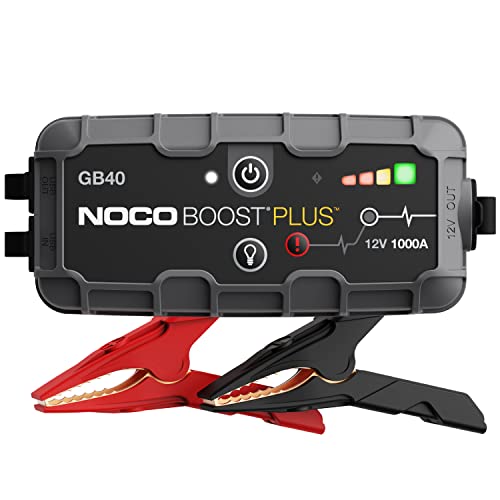
NOCO Boost GB40 12V 1000A UltraSafe Portable Lithium Jump Starter |…


How to Size a Lithium Jump Starter
Start with your engine, not the amp number on the box. NOCO sizes its Boost packs by engine displacement and tells buyers to look up their engine size first. The company also labels its amp figures as peak, and it publishes no separate cranking figure.
Brands do not rate packs the same way. Antigravity, for example, lists its XP-10 Gen 2 at 600 A starting current and 3,000 A peak. A battery’s cold cranking rating also uses a 30-second test at 0 F, according to Optima, so neither pack number compares directly with the rating on your battery. Compare engine ratings across brands instead.
NOCO publishes these engine ratings for four of its Boost models.
| NOCO Model | Peak Amps | Gas Engines | Diesel Engines |
|---|---|---|---|
| Boost Plus GB40 | 1,000 A | Up to 6.0 L | Up to 3.0 L |
| Boost X GBX55 | 1,750 A | Up to 7.5 L | Up to 5.0 L |
| Boost HD GB70 | 2,000 A | Up to 8.0 L | Up to 6.0 L |
| Boost Pro GB150 | 3,000 A | Up to 9.0 L | Up to 7.0 L |
In plain terms, a gas V8 up to 6.0 L sits inside the GB40 rating. A 6.7 L diesel pickup falls outside the GB40, GBX55 and GB70 ratings, but inside the GB150 rating for diesels up to 7.0 L.
Some truck owners distrust the rated amps and say to ignore the amp number. For me, the safer pick is one step above your engine rating, especially for diesels or cold climates. A 6.7 L diesel already tops out at the GB150, the largest pack in this table.
Using a Lithium Jump Starter on a Dual-Battery Rig
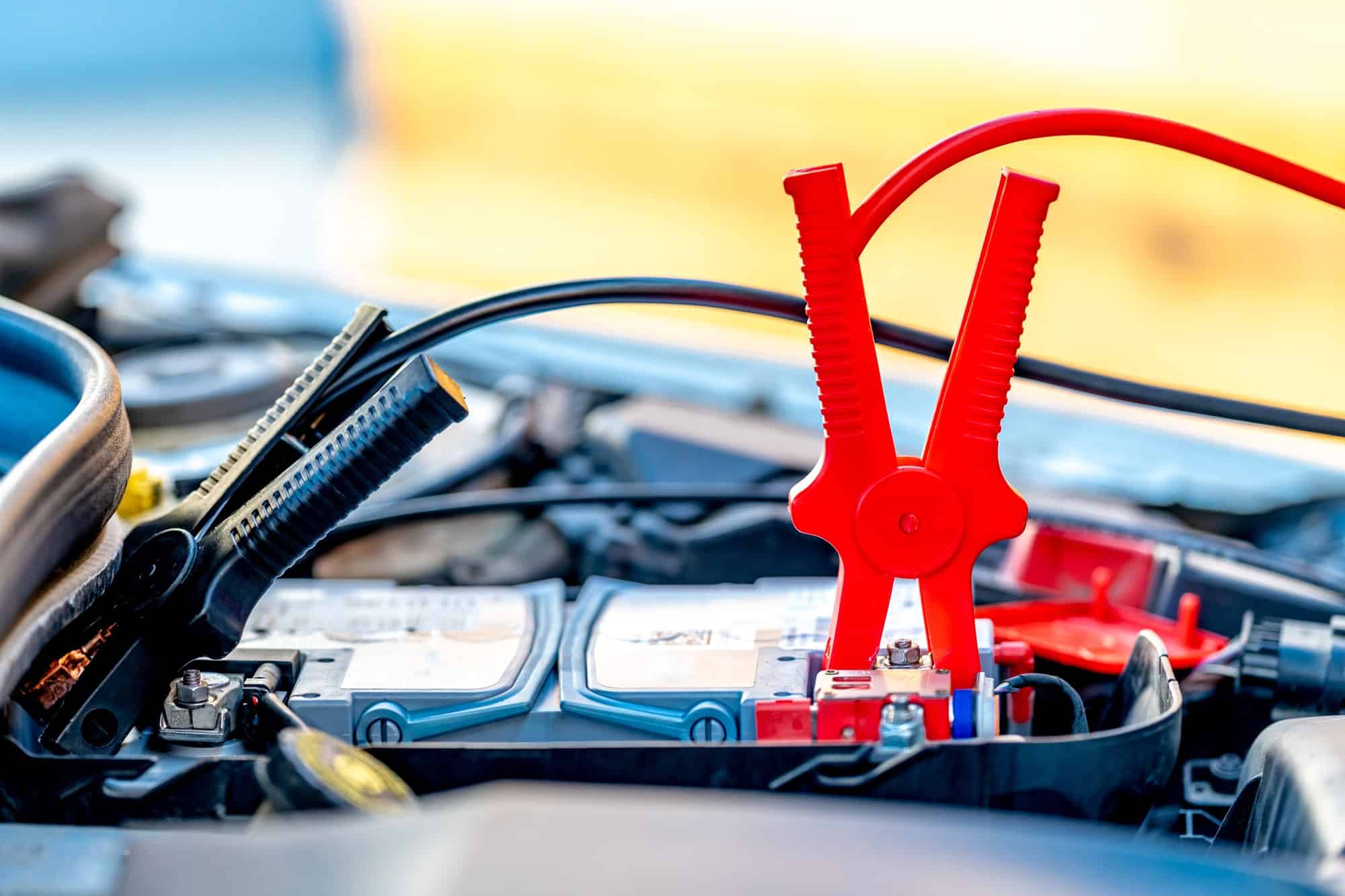
Adding a second battery changes where you clamp. NOCO tells owners of dual-battery vehicles to connect both clamps to the battery closest to the starter. Parallel batteries allow two Boost packs to double the starting power, according to NOCO. For batteries wired in series, NOCO says no 12V pack works and a 24V jump starter is required.
Chemistry matters as much as wiring. NOCO states a Boost pack jump starts only 12V lead-acid batteries. Its FAQ answers no on lithium and warns of extreme danger. If your auxiliary battery is lithium iron phosphate, never clamp a pack across it.
A dual battery isolator adds another variable. REDARC, which makes isolators, says its Smart Battery Isolator supports jump starting a truck from the auxiliary battery. Our dual battery charging setup tips add related background. Check what your own dual battery isolator does during a jump before you need it. Keep the clamp rule the same: both clamps on the battery closest to the starter.
Some packs refuse to engage on a deeply discharged battery. NOCO detects 12V lead-acid batteries down to 2 volts on GB packs and 3 volts on Boost X packs. Below those levels, you need manual override, which NOCO’s override guide says disables both spark-proof and reverse polarity protection. Override suits 12V lead-acid batteries only. Check positive and negative twice, because the safety protections are off. Read the guide before the trip.
Lithium Jump Starter Heat, Cold and Storage Limits
A pack has temperature limits too. NOCO rates its packs for -4 F to 122 F, both in use and in storage. Built-in thermal sensors stop the pack from operating outside this range. The Boost X GBX45 guide describes a flashing cold light, and the pack will not jump start until it warms up.
A parked vehicle in summer sits near the upper limit. NOCO says the temperature inside a car climbs to as high as 122 F within 10 minutes, and it tells owners not to leave a pack in direct sunlight. Antigravity sets a lower line in its older XP-10 manual: keep the pack away from places above 110 F, because swelling is possible.
Owners worry about heat, and some cite swelling on older units. My advice is to store the pack in a shaded bag under a seat, not on the dash. On the hottest days, carry it with you.
Cold limits recharging more than it limits use. NOCO says to recharge its packs between 32 F and 104 F, so bring a cold pack indoors first. For more cold-weather prep, see how cold affects your battery.
Recharge on a schedule, too. NOCO says its packs hold 70 percent of rated capacity for up to one year, yet it recommends charging at least every 4 to 6 months. Antigravity’s older XP-10 manual suggests checking the charge at least every 3 to 4 months. NOCO’s pages differ on one detail. The GB40 FAQ allows a pack to stay on a charger, yet the GB40 and GBX45 user guides say to avoid charging for more than a week. Follow the manual for your model.
Choosing a Smart Battery Charger
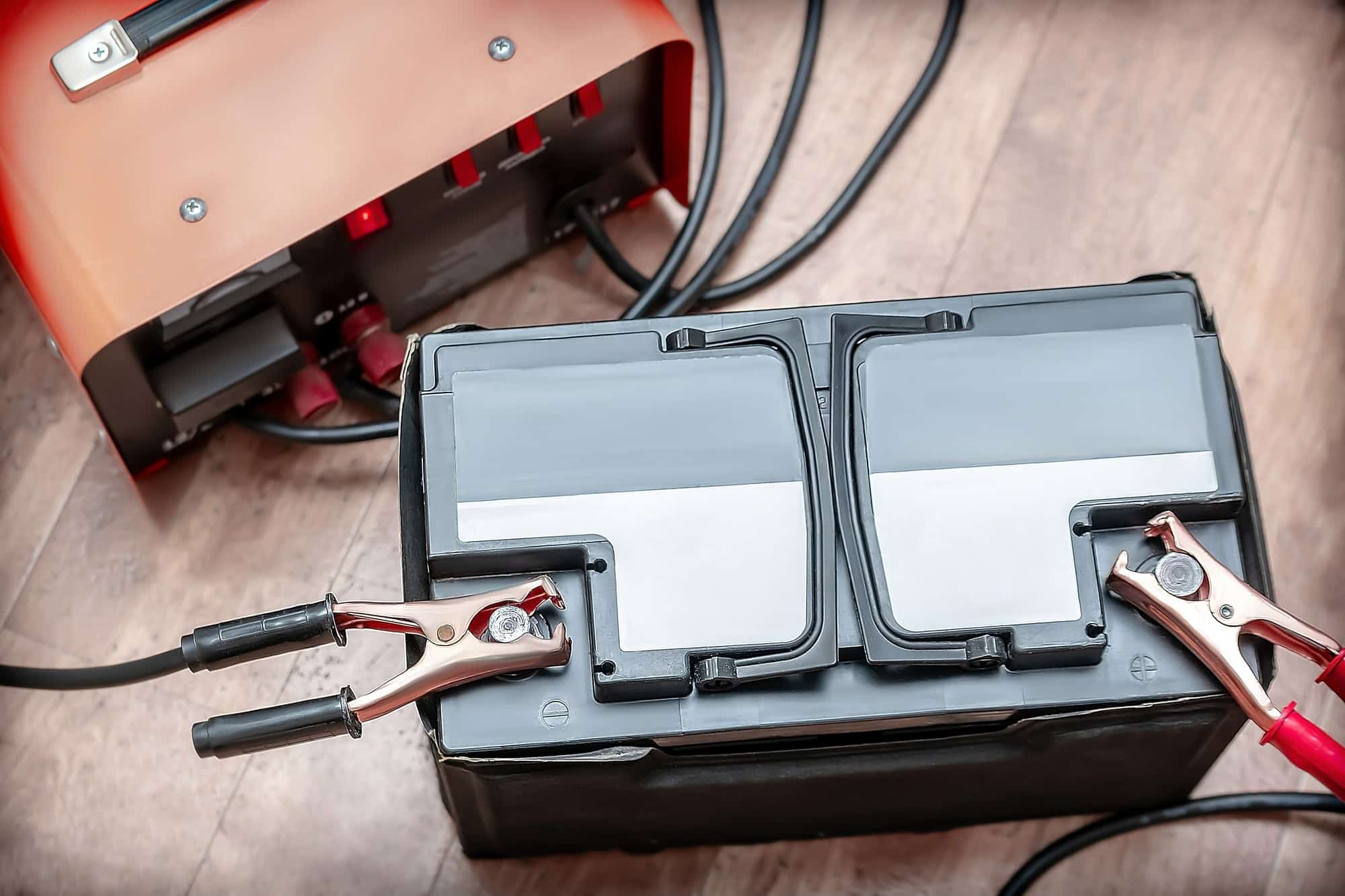
A jump pack is not a charger. NOCO says so directly: a Boost pack starts the engine but does not recharge your battery. A smart battery charger fills this role by charging in stages and then holding the battery at a safe voltage.
Lead-Acid and Lithium Charging Modes
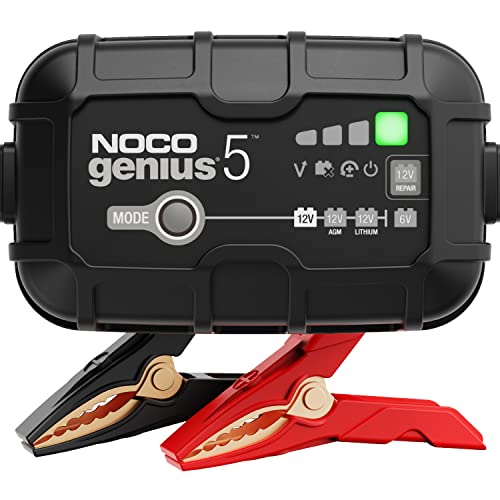
Chemistry decides the charge profile. NOCO’s Genius5 charges wet batteries at 14.5 V, AGM at 14.8 V and lithium at 14.6 V. Victron’s 12V Blue Smart IP65 models use 14.4 V absorption for normal lead-acid and 14.2 V for lithium-ion. Battery University warns a lithium iron phosphate battery in a regular charger suffers overcharge, and REDARC warns a lead-acid charger might damage a deep cycle lithium battery.
Match the mode to the battery. NOCO limits its lithium mode to batteries with a built-in management system, so check your auxiliary battery manual first. Cold also limits charging. REDARC says to avoid charging a LiFePO4 battery below 32 F because lithium plating permanently reduces capacity, and the Victron Smart Lithium battery sets its default charge minimum at 41 F. NOCO says never to charge a frozen battery, so charge the lithium battery in a warm space.
Here is how four chargers compare on output, battery size and lithium support.
| Charger | Output | Battery Size | Lithium Mode |
|---|---|---|---|
| NOCO Genius5 | 5 A | Up to 120 Ah | Yes |
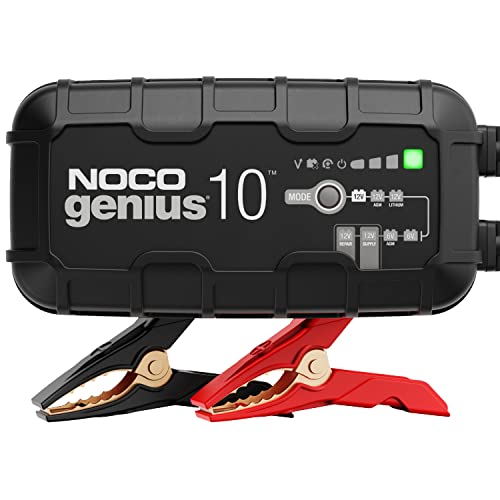
| NOCO Genius10 | 10 A | Up to 230 Ah | Yes |
| Battery Tender Plus | 1.25 A | 14 to 80 Ah | No |
| CTEK MXS 5.0 | 4.3 A | 1.2 to 110 Ah | No |
Recovering a Deeply Discharged Battery
Some chargers refuse a deeply drained battery. A Genius charger will not detect a battery whose voltage is too low, and NOCO’s fix is Force Mode. On the Genius5, you hold the button for 5 seconds; NOCO says Force Mode suits batteries below 1 V and runs for 5 minutes. Our look at the Wrangler auxiliary battery explained shows how a small AGM battery responds to a maintainer.
Matching Charger Size to Battery Size
Battery Tender rates the 1.25 A Plus for 14 to 80 Ah and points larger batteries to a bigger charger. An Odyssey Extreme 31-PC2150 battery holds 100 Ah, which is above this range. NOCO rates both the Genius5 and the Genius10 for it, and the 10 A unit has twice the output.
My take: the smart charger is the tool you set once and stop thinking about. This works only when the mode matches each battery and lithium stays above 32 F. Battery Tender says its Plus maintainer extends battery life from 2 to 3 years to 5 years or more.
The four chargers below are the NOCO Genius5, NOCO Genius10, Battery Tender Plus and CTEK MXS 5.0. Of these, only the two NOCO models offer a lithium mode.
Smart chargers and maintainers for starter and auxiliary batteries

Battery Tender Plus 12V 1.25 AMP Car & Motorcycle Battery Charger a…


Lithium Jump Starter vs. Smart Charger: Which to Buy First
Buy the pack first if you drive alone, camp far from help or run a diesel. Without a second vehicle, a dead battery at a trailhead leaves few fixes besides a pack. Our roundup of best jumper cables covers the cheap option, but cables cannot help when nobody else is there.
Buy the charger first if your truck sits for weeks between trips. A maintainer helps prevent the dead battery the pack would rescue you from. Likewise, a rig with a lithium auxiliary battery and a dual battery isolator needs a charger with a lithium mode.
Neither tool replaces the other. The pack cannot charge anything, and the charger cannot start a stranded engine.
Final Thoughts
Here is how I would set up a dual-battery rig. Start with a lithium jump starter sized one step above your engine, keep it out of the sun, and recharge it every few months. Clamp it to the battery closest to the starter, never across a lithium auxiliary battery. Then add a charger matched to the chemistry of each battery. Leave it connected between trips, unless a lithium battery sits below 32 F.
Heat, cold and neglect appear in many owner complaints, and a little planning covers each one. If you drive alone or camp far from help, buy the pack first. When your truck sits for weeks between trips, buy the charger first. Either way, read the manual for your exact model, because even the manufacturer pages differ on some details. Your next trailhead start should be the boring part of the trip.
Lithium Jump Starter FAQ
How do you use a lithium jump starter?
Connect the clamps to the positive and negative terminals of the starter battery, then turn the pack on. Try starting the vehicle. NOCO Boost X packs time out after 60 seconds and need a power cycle. After the engine runs, power off the pack before you remove the clamps.
Are lithium jump starters worth it?
For most solo drivers, yes. NOCO lists its Boost packs from $99.95 for the GB40 to $299.95 for the GB150, and a pack restarts your engine without a second vehicle. Owners of name-brand packs report a charge lasting months. NOCO says its packs keep 70 percent of rated capacity for up to one year.
Does a lithium jump starter work in cold weather?
Within limits. NOCO rates its packs for use down to -4 F, and thermal sensors stop operation outside the range. Diesels and fully dead dual batteries are harder, so size up.
Is it safe to store a jump starter in a hot truck?
Avoid it on hot days. NOCO says the temperature inside a car climbs to as high as 122 F within 10 minutes, which matches its storage ceiling. Antigravity’s older XP-10 manual sets the line at 110 F.
What size jump starter does a diesel truck need?
Check the diesel rating, not the gas rating. NOCO lists 3.0 L diesel for the GB40, 5.0 L for the GBX55, 6.0 L for the GB70 and 7.0 L for the GB150. Match your engine displacement, then step up one size where a larger model exists.
Does a lithium auxiliary battery need a special charger?
Yes. REDARC warns a regular lead-acid charger might not suit a deep-cycle lithium battery and might damage it. Use a charger with a lithium mode, such as the NOCO Genius5 or Genius10, and charge above freezing.
Related Reading