



Quick Facts:
- What size solar panel for overlanding: 200 watts for most rigs in summer, 400 watts for heavy loads or shoulder seasons
- Method: Daily watt-hours ÷ peak sun hours ÷ derate factor
- Realistic derate: 79% of nameplate at peak, in clean unshaded midday sun
- Measured range: 56% to 91% of claimed watts across 12 bench-tested panels
- Typical rig: 800 Wh per day covers a fridge, Starlink Mini, roof fan, laptop, and pump
- Seasonal swing: 2.8x in Phoenix, 6.7x in Seattle, same panel
- Degradation: 0.5% per year median for crystalline silicon
- Best for: Anyone sizing a first array, or wondering why their build underperforms
14 min read
In This Guide
- Why Your 400W Array Never Makes 400 Watts
- What the Nameplate Number Measures
- Step 1: Work Out What Your Rig Uses Each Day
- Step 2: What Peak Sun Hours Your Region Delivers
- Step 3: Apply the Derate Stack
- What Size Solar Panel for Overlanding Fits Your Rig
- Rigid, Folding, and Flexible Panels Compared
- How Panels Lose Output Over the Years
- Matching Panel Watts to Battery and Alternator
- What Size Solar Panel for Overlanding to Buy
- Frequently Asked Questions
Why Your 400W Array Never Makes 400 Watts
Working out what size solar panel for overlanding suits your build starts with an uncomfortable fact. The number printed on the panel is a laboratory result, not a field result. Lift a 400-watt folding kit onto your rack on a cloudless July afternoon, and the controller reports something closer to 316 watts. Nothing is broken. Instead, the gap is physics, and every buyer pays it.
Most sizing advice skips this entirely. Older guides tell you a 100-watt panel yields roughly 30 amp-hours per day, then stop. However, an unqualified figure ignores season, latitude, panel angle, cell temperature, and controller type. Depending on where and when you camp, real output swings by a factor of six against the same hardware.
This guide replaces the guess with arithmetic. First you total your daily watt-hours. Next you look up the peak sun hours where you travel. Then you divide by a derate factor grounded in manufacturer datasheets and independent bench tests. The result is a nameplate wattage you buy with confidence rather than hope.
What Makes an Overlanding Solar Panel Harder to Size
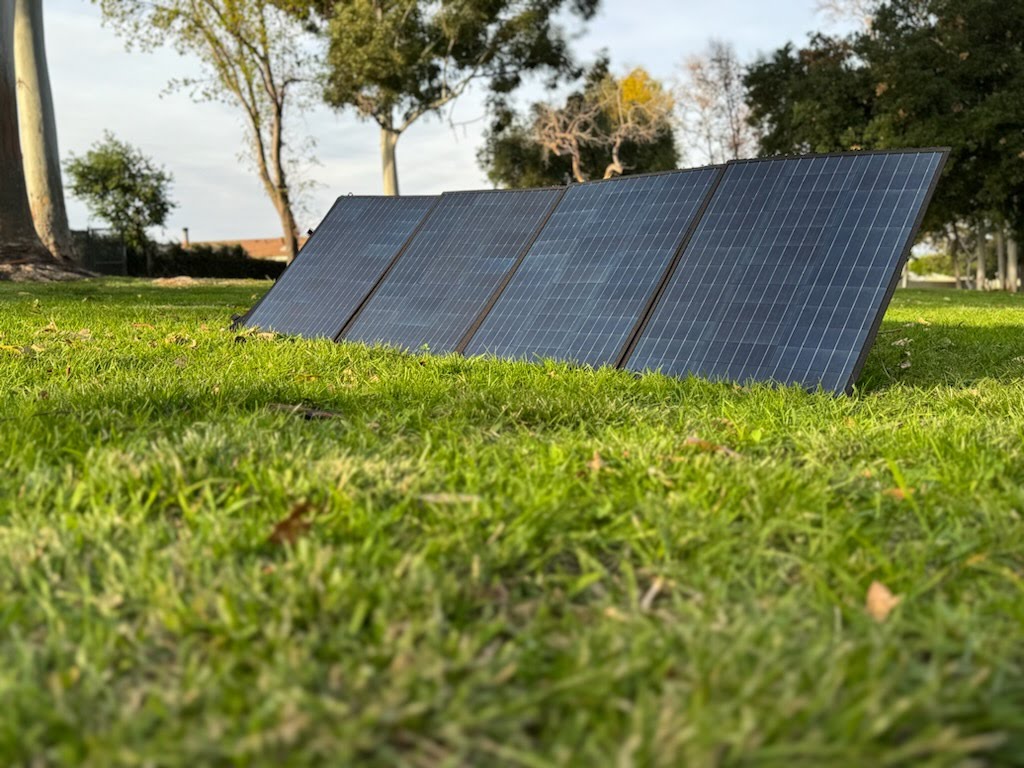
Overlanders sit in a harder spot than homeowners. Your array lies flat on a rack instead of angled at a roof pitch. It also collects dust on every fire road, bakes well above the test temperature, and goes wherever the trail leads. Because of those conditions, generic residential math overstates your real yield.
Vehicle solar panel sizing therefore needs its own inputs. Specifically: load figures from your own kit, sun-hour data for the months you travel, and a loss factor built for a hot, dusty, flat-mounted array.
What the Nameplate Number Measures
Every panel sold carries a rating measured at Standard Test Conditions. NREL’s PVWatts documentation defines STC as 1,000 watts per square meter of irradiance at a cell temperature of 25°C. The governing IEC standard adds an air mass of 1.5. Notably, the middle term does the damage. A panel reaching 25°C cell temperature in direct summer sun is rare, and every degree above costs you output.
Manufacturers publish the penalty as a temperature coefficient of Pmax. Real datasheets from four Renogy panels list values between −0.37% and −0.42% per °C, while Victron’s engineering whitepaper works its examples at −0.45%. Applied to a 400-watt array at 60°C (140°F) cell temperature, the loss runs 13% to 16%. Your 400 watts becomes 336 to 348 watts before a single other loss is counted.
Heat builds faster than most people expect. Victron’s thermal model puts a free-standing panel in 35°C (95°F) air with no wind at 85°C. A panel with a fully insulated back side, it states, routinely exceeds 100°C. As a result, a flexible panel bonded flat to a roof skin sits in the worst thermal position available.
| Rating Condition | Details |
|---|---|
| STC (the nameplate) | 1,000 W/m², 25°C cell temperature, air mass 1.5 |
| NOCT (the honest one) | 800 W/m², 20°C ambient, 1 m/s wind, open back, no load |
| Temperature coefficient | −0.37% to −0.45% of rated power per °C above 25°C |
| Loss per 10°C rise | Roughly 4.5% of rated power |
| 400W array at 60°C cell | 336 to 348 watts, from heat alone |
What Bench-Tested Panels Measured Against Their Claims
Independent testing backs the theory up. OutdoorGearLab bought 12 portable panels, wired each to an identical power station, and logged input every 30 minutes on a clear day. Measured output landed between 56% and 91% of the claimed rating, with a median near 83%.
Established brands clustered at the top. A JJN bifacial rigid panel led the field at 91%. Renogy and EcoFlow followed at 88%, Jackery at 86%, then Anker, BougeRV, and Goal Zero at 83%. Those results sit where the physics predicts, once you allow for the cool 55°F to 65°F test air.
The bottom of the table tells a different story. Grecell delivered 56% of its claim, Marbero 67%, and ZOUPW 72%. Because physics explains a drop to roughly 80% and no further, a result near 56% points at rating inflation on the cheapest listings. Price per measured watt therefore beats price per claimed watt every time.
Portable Panels Referenced in This Guide
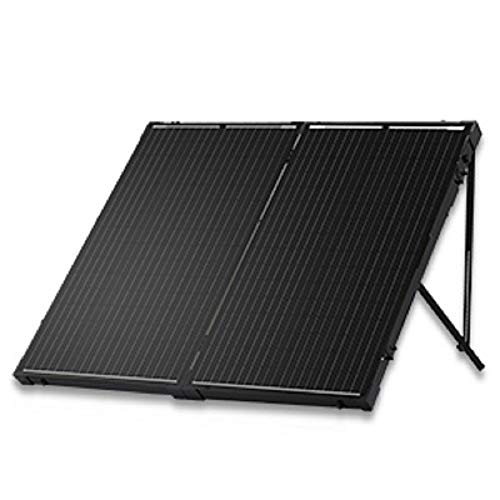
Renogy 200W 12V Portable Solar Panels Suitcase with Waterproof 20A …
Step 1: Work Out What Your Rig Uses Each Day

Sizing runs backward from consumption. First, work in watt-hours rather than amp-hours. Watt-hours survive the jump between 12V loads and USB loads without conversion errors. Next, multiply each device’s draw in watts by the hours it runs, then total the column.
Use published manufacturer figures instead of guesses. An ARB Zero 63-quart single-zone fridge draws 0.8 amps at a 41°F setpoint in 90°F ambient, which works out to roughly 230 Wh per day. Starlink Mini averages 20 to 40 watts with a 15-watt idle. A Webasto Air Top 2000 diesel heater pulls 14 to 29 watts while running, since the fuel does the heating and the electricity only moves air.
| Load | Draw Used | Watt-Hours Per Day |
|---|---|---|
| 12V fridge, 63 qt, 90°F ambient | 0.8 A average, 24 h (published) | 230 |
| Starlink Mini, 8 h use | 30 W average (published) | 240 |
| Roof fan, 8 h overnight | 2.5 A assumed, mid speed | 240 |
| Laptop, one full charge | 53.8 Wh battery (published) | 65 |
| Water pump, 15 min | 7.5 A maximum (published) | 23 |
| Daily total | Five loads above | 798 |
One caution on the fan row. MaxxAir publishes a 5-amp minimum circuit requirement rather than a per-speed draw. Therefore 2.5 amps at mid speed is a working assumption, not a manufacturer figure. Measure your own if you want it exact. A diesel heater adds a further 176 Wh across an eight-hour night at 22 watts.
What the Fridge Row Depends On
Ambient temperature drives the fridge number harder than any other variable. A rig parked in Moab in August therefore lands well above one in the Cascades in spring. Our what size overland fridge guide breaks down how draw scales with capacity. For connectivity budgeting, the measured figures in our Starlink Mini power consumption breakdown replace the marketing range with runtime tables.
Add the five rows and a common overland kit lands near 800 Wh per day. Small loads deserve counting too, since camp lighting and phone charging accumulate quietly across a week.
Step 2: What Peak Sun Hours Your Region Delivers
A peak sun hour equals one hour of irradiance at 1,000 watts per square meter, precisely the STC benchmark. Consequently, a site receiving 5.0 kWh/m² per day receives exactly 5.0 peak sun hours, whether the energy arrives as five brilliant hours or twelve weak ones. Daylight hours are a useless input here.
The figures below come from NASA POWER’s 20-year monthly climatology for a flat horizontal surface, which mirrors a panel lying on a roof rack. Seasonal spread decides your array size, not annual average. After all, a system sized for July leaves you dead in December. For coordinates of your own, run them through NREL’s PVWatts calculator.
| Region | June | December | Annual |
|---|---|---|---|
| Southwest desert (Phoenix) | 8.50 | 3.08 | 5.85 |
| Rockies (Denver) | 7.22 | 2.29 | 4.85 |
| Southeast (Atlanta) | 6.19 | 2.37 | 4.51 |
| Midwest (Chicago) | 6.10 | 1.41 | 3.84 |
| Northeast (Boston) | 5.72 | 1.49 | 3.81 |
| Pacific Northwest (Seattle) | 5.73 | 0.85 | 3.42 |
Read the December column twice. Seattle drops to 0.85 peak sun hours, a 6.7-fold collapse against June. By comparison, Phoenix holds up better at a 2.8-fold swing. Unlike a house, your rig moves. Size against the worst month you plan to camp, not the annual mean.
Tilting the Panel Is the Cheapest Upgrade You Own

Angle matters most exactly when sunlight is scarcest. For example, propping a panel toward the low winter sun raises December yield by 60% in Phoenix and 93% in Seattle against the same panel lying flat. No purchase beats those numbers.
Aim for a tilt roughly equal to your latitude in winter, steeper still in December, and point the face due south. A folding panel does this in 30 seconds with its supplied legs or a length of scrap tubing. Repositioning it once at midday recovers more again.
Summer flips the logic. In June a flat panel beats a fixed latitude tilt by roughly 15%, because the sun climbs high overhead and a steep panel throws away sky. Note the catch, though: a panel bolted or bonded flat to a roof cannot be tilted at all. Tilt is a portable-panel advantage, so it belongs in the buying decision rather than the install manual.
Step 3: Apply the Derate Stack
Losses multiply rather than add, and NREL’s PVWatts model bundles the non-thermal ones into a 14% default. Critically, PVWatts excludes cell temperature from those defaults, so temperature stacks on top. Below is the full chain for a 400-watt array at 60°C cell temperature feeding an MPPT charge controller.
| Loss Factor | Multiplier |
|---|---|
| Cell temperature at 60°C | 0.870 |
| Soiling (dust, pollen, road film) | 0.98 |
| Cell mismatch | 0.98 |
| Wiring resistance | 0.98 |
| Connectors | 0.995 |
| Nameplate tolerance | 0.99 |
| MPPT conversion | 0.98 |
| Combined | 0.79 |
Multiply through and a 400-watt array peaks near 316 watts into the battery, in clean, unshaded, well-aimed midday sun. Add dust from a week of washboard, one branch shadow, or a poor angle and the figure falls further. Plan on 75% to 80% of nameplate as your best case, never as your average.
Note how neatly the calculation brackets the bench data. Because the reputable brands measured 83% to 88% in cool test air, a 79% hot-weather stack sits exactly where it should. Panels from established brands are priced honestly; the losses are real physics.
Where an MPPT Controller Earns Its Money
Marketing puts the MPPT charge controller advantage over a basic PWM controller at “up to 30%.” Victron’s own engineering whitepaper is blunter. It reports 19% at 25°C, and effectively nil at 75°C cell temperature. Morningstar publishes 10% to 15% instead. Notably, gains climb in cold weather, in low light, under partial shade, and whenever array voltage sits above battery voltage.
Wiring two panels in series instead of parallel captures most of the benefit, because a higher array voltage gives the controller more headroom to convert. In Victron’s hot-panel example at 100°C, two 50-watt panels in series deliver 27% more power than one 100-watt panel through the same controller. Shading behaves differently, though, and a solar panel bypass diode limits how far one shaded cell drags a whole string down.
Safety note: Panel open-circuit voltage rises as temperature falls. A series string sized on a warm afternoon will therefore exceed the controller’s maximum input voltage on a freezing morning and destroy it. Check the panel’s Voc temperature coefficient, calculate the value at your coldest expected temperature, then leave headroom against the controller’s rated limit.
What Size Solar Panel for Overlanding Fits Your Rig

Three inputs size an overlanding solar panel. The formula reads: nameplate watts = daily watt-hours ÷ (peak sun hours × derate factor). Run the 800 Wh kit from Step 1 through it, and the regional spread becomes impossible to ignore.
Phoenix in June: 800 ÷ (8.50 × 0.79) = 119 watts of nameplate. Denver in June: 800 ÷ (7.22 × 0.79) = 140 watts. Chicago in December, though: 800 ÷ (1.41 × 0.79) = 718 watts. Seattle in December reaches 1,191 watts, more panel than any rig carries.
Two practical facts turn 140 calculated watts into a 200-watt purchase. First, nobody sells a 140-watt folding panel, since the market steps 100, 200, then 400. Second, a June figure assumes clear skies, a clean face, and decent aim, none of which survive a real week out. Rounding up one step is therefore the honest move, not an upsell.
How to Handle Winter Without Carrying 1,200 Watts
Winter changes what size solar panel for overlanding you need, which explains why so many builds feel undersized from November onward. The numbers above close the gap, though, and they close it with arithmetic rather than reassurance.
Take the Seattle December case. Tilting the panel lifts 0.85 peak sun hours to 1.64. Meanwhile a realistic winter load drops to roughly 500 Wh, because a fridge in 40°F ambient barely cycles and connectivity use falls with shorter days. Run those revised inputs: 500 ÷ (1.64 × 0.79) = 386 watts. A tilted 400-watt array covers a Pacific Northwest December on clear days after all.
Cloud is the remaining variable, and no panel budget beats a week of overcast. Consequently, most winter builds pair solar with alternator charging rather than scaling the array past 400 watts. Three tiers fall out of the math for summer and shoulder-season travel across most of the country:
- 100W: Weekend trips, lights, phones, a small fridge in mild weather, no heavy loads
- 200W: The common sweet spot. Fridge, lights, devices, and a fan across a week off-grid in summer
- 400W: Fridge plus Starlink plus heater plus laptop, or shoulder-season and winter trips with a tilted panel
Rigid, Folding, and Flexible Panels Compared
Format decides more of your experience than cell technology does. Fraunhofer ISE reports commercial monocrystalline modules now reach nearly 25% efficiency, with production-weighted crystalline silicon averaging 22.7% across an 18.9% to 24.8% range. Polycrystalline is a dead question: the same report states multi-crystalline technology has disappeared from the market, though old stock still turns up in budget kits.
Watch how vendors quote efficiency. Renogy lists “module efficiency 17.8%” on one panel and “cell efficiency 21.0%” on another. Cell efficiency always reads higher, since it excludes frames, gaps, and glass. Comparing one against the other tells you nothing useful.
| Factor | Rigid Glass | Folding Briefcase | Flexible ETFE |
|---|---|---|---|
| Weight per watt | 0.127 to 0.141 lb | 0.071 to 0.095 lb | 0.033 to 0.054 lb |
| Tilts toward the sun | Only on a hinged rack mount | Yes, on built-in legs | No, once bonded down |
| Charges while driving | Yes | No, stowed in transit | Yes |
| Theft exposure at camp | Low, bolted down | High, sits on the ground | Low, bonded down |
| Setup time per campsite | None | 2 to 5 minutes | None |
| Renogy performance warranty | 25 years at 80% | Varies by SKU | 10 years at 90%, no 25-year tier |
Folding briefcase panels win on placement, since you park in shade and put the panel in sun. Rigid roof panels win on convenience, because they work without you doing anything. Shaded campsites decide this trade more often than watts do.
The Flexible Panel Trade-Off Manufacturers Do Not Advertise
Weight savings come at a documented cost. Renogy’s governing Limited Warranty gives rigid glass panels a 5-year 95%, 10-year 90%, and 25-year 80% performance tier. Flexible panels get the first two only, with no 25-year coverage at all. Some flexible datasheets still advertise a “25 Years Power Output Warranty,” which contradicts the warranty document covering those exact part numbers.
Thermal treatment explains the gap. Renogy’s own installation manual asks for at least five inches of spacing between module and roof surface plus proper air circulation. A flexible panel glued flat to sheet metal violates both instructions by design, and the same warranty excludes damage from insufficient ventilation.
Temperature coefficients vary by model rather than by category. Renogy’s 100-watt flexible panel loses more per degree than its rigid sibling, while its 200-watt flexible panel is slightly better than the rigid equivalent. Since a bonded flexible panel runs far hotter, though, the coefficient rarely rescues it.
Flexible solar panels still earn their place on a fiberglass camper roof, a soft top, or any curved surface where rigid mounting is impossible. Treat it as a weight-driven compromise rather than an upgrade. Our guide to the best flexible solar panels covers construction differences in more depth.
| Weekender | Fridge + Basics | Full Build | Curved Roofs | |
|---|---|---|---|---|
| Product |  Renogy 100W Suitcase Renogy 100W Suitcase | TOP PICKRenogy 200W Suitcase | 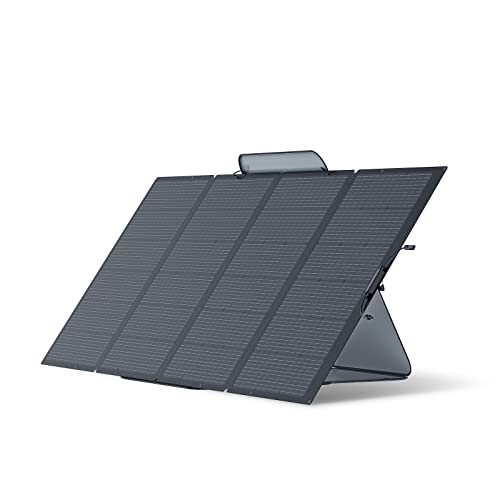 EcoFlow 400W Portable EcoFlow 400W Portable |  Renogy 100W Flexible Renogy 100W Flexible |
| Rating | ★★★★☆ 4.6 1,700 ratings | ★★★★☆ 4.4 1,400 ratings | ★★★★☆ 4.3 300 ratings | ★★★★☆ 4.4 1,000 ratings |
| Nameplate | 100 W | 200 W | 400 W | 100 W |
| Weight | 17.4 lb | 28.5 lb | 35.3 lb | 4.0 lb |
| Charge controller | 20A included | 20A included | Not included | Not included |
| Price | $206.99 as of Sep 23, 4:30 am | $322.99 as of Sep 23, 4:30 am | $699.00 as of Sep 23, 4:30 am | $109.99 as of Sep 23, 4:30 am |
| Check Price → | Check Price → | Check Price → | Check Price → |
How Panels Lose Output Over the Years
Silicon panels fade slowly and predictably. NREL’s Compendium of Photovoltaic Degradation Rates draws on more than 11,000 measured rates across almost 200 studies. For crystalline silicon it found a median around 0.5% to 0.6% per year. Mean degradation ran nearer 0.8% to 0.9%. Those two figures differ because a minority of badly-behaved modules drag the average up. For planning purposes, use the median.
A separate first-year loss arrives faster. Light-induced degradation hits within the first hours of sun exposure. Peer-reviewed work puts it around 4% to 6% relative efficiency for PERC cells, the type in most 12V panels sold today. PVWatts budgets 1.5% for it as a system default. Combining both effects gives an estimate near 89% to 91% of original output after a decade.
Warranty language reflects those curves. Rigid panels commonly guarantee 90% at ten years and 80% at twenty-five. Read the fine print, though. Performance is measured under the manufacturer’s own test conditions, coverage is replacement only, and labor is excluded.
Practical takeaway: size the array against end-of-life output rather than day-one output. Adding roughly 10% to your calculated wattage covers a decade of fade, and costs far less now than retrofitting a second panel later.
Matching Panel Watts to Battery and Alternator
Panel wattage means nothing if the battery refuses to accept it. Specifically, Victron’s AGM datasheet caps charge current at 0.2C. For a 100Ah battery, the ceiling is 20 amps. At a 14-volt absorption voltage, the same bank tops out near 280 watts of useful panel. Anything beyond spills over on a sunny day.
Lithium behaves differently. LiFePO4 accepts high charge rates, skips the float stage, and finishes quickly instead of trickling through a long absorption tail. Extra panel converts close to one-for-one into stored energy until the bank fills. Our comparison of lithium vs AGM batteries covers the usable-capacity differences driving this.
Alternator charging reframes the whole calculation. A Victron Orion XS 50-amp DC-DC charger delivers 700 watts at 98.5% efficiency while the engine runs. Matching the same output from solar demands roughly 890 watts of nameplate panel plus perfect conditions. One hour of driving therefore beats what a 400-watt array collects across two and a half December days in Seattle.
None of this argues against solar. Instead it explains why a solar-only build is a fair-weather build. Most serious rigs run both charging paths, then size the array as the slower of the two.
What Size Solar Panel for Overlanding to Buy
For most rigs running a fridge, lights, devices, and a fan through summer and shoulder seasons, a 200-watt overlanding solar panel is the honest answer. It clears a typical 800 Wh daily load in every June column with room to spare. It also fits one folding case and stays inside the charge acceptance of a modest battery bank.
Step up to 400 watts when Starlink, a diesel heater, or a laptop joins the load list. The same applies whenever you travel outside high summer. The extra capacity buys tolerance for cloud, dust, and bad parking angles rather than surplus energy. Winter travelers should tilt the array and lean on alternator charging through the darkest weeks.
A 100-watt panel remains a legitimate choice, provided your load list matches it: lights, phones, and a small fridge in mild weather. Trouble starts when someone buys 100 watts while running a full fridge-and-connectivity build, then wonders why the battery never recovers.
Two decisions matter more than nameplate wattage. First, pick an established brand. Bench data shows budget listings delivering 56% to 72% of claimed output, while known names hold 83% to 91%. Second, choose a format matching your mounting reality. A flexible panel bonded to a hot flat roof gives up warranty coverage and output together.
Finally, whatever number your worksheet produces, add 10% for a decade of degradation, tilt the panel whenever the sun sits low, and keep the glass clean. Those three habits recover more energy than another 100 watts of hardware. Sound solar panel sizing beats spending more, every time.
Frequently Asked Questions
How many watts of solar do I need for overlanding?
Most rigs running a 12V fridge, lights, devices, and a roof fan need 200 watts for summer and shoulder-season travel. Divide your daily watt-hours by peak sun hours, then divide again by 0.79 for real-world losses. An 800 Wh daily load needs about 119 watts in Phoenix in June and roughly 718 watts in Chicago in December.
Will a 100W solar panel run a 12V fridge?
Yes, in summer, in most of the country. A 63-quart fridge in 90°F ambient uses roughly 230 Wh per day. Meanwhile a 100-watt panel at 5 peak sun hours and a 0.79 derate produces about 395 Wh, covering the fridge with headroom for lights and phones. Winter changes the answer, since at 1.4 peak sun hours the same panel makes only 111 Wh.
What size solar panel to run a 12V fridge plus Starlink?
Budget 470 Wh per day for a 63-quart fridge and eight hours of Starlink Mini. The pairing needs roughly 200 watts in summer across most regions, or 400 watts once cloud, dust, and imperfect panel angles are factored in. Series wiring and an MPPT controller recover a further 10% to 19% in cool conditions.
Why is my 400W solar setup only producing 300 watts?
Nothing is wrong. Cell temperature alone costs 13% to 16% at 60°C, while soiling, mismatch, wiring, connectors, nameplate tolerance, and MPPT conversion multiply out to a further 9%. Combined, the stack lands near 79% of nameplate, so 316 watts from a 400-watt array is the expected result in clean midday sun.
Do solar panels lose efficiency over time?
Yes, slowly. NREL’s Compendium of Photovoltaic Degradation Rates, covering more than 11,000 measured rates, puts median degradation at 0.5% to 0.6% per year for crystalline silicon. A separate first-year light-induced loss of roughly 4% to 6% relative efficiency affects PERC cells. Size your array against end-of-life output by adding about 10% to the calculated wattage.
Flexible or rigid solar panels for overlanding?
Rigid glass panels carry the longer warranties. Renogy, for example, covers its rigid panels for 25 years at 80% output while capping flexible panels at 10 years and 90%. Flexible panels weigh roughly a third as much per watt, which earns them a spot on curved or soft roofs. Bonding one flat to a metal roof runs it far hotter than the manufacturer’s own five-inch spacing requirement allows.