



Every off-roader I know has made the same mistake: overpacking in the early years and then slowly learning, one trip at a time, what earned its space and what was occupying space. I’ve run trails across the U.S. for years, and my current off-road packing list is shorter than it was five years ago, not because I’ve become careless, but because I’ve gotten precise. Knowing what to bring off-roading at this level of precision took years to develop. The gear I bring now either saves the trip when something goes wrong or makes a measurable difference to how the day runs. Everything else stayed home.
I founded 4WD Talk after years of overlanding and trail running, and I write about gear from the perspective of someone who has used it in the field, and this guide reflects the off-road truck setup decisions I’ve refined across years of trips, not someone reviewing spec sheets. The MORRFlate TenSix PSI Pro Gen 2 has been my exclusive air compressor for several years, and it’s one of the clearest examples of a piece of gear with an obvious answer: it goes in the truck every single time. This guide runs through every category on my off-road packing list, explains the reasoning behind each decision, and names the specific items I’ve stopped bringing because they weren’t earning their weight.
Quick Facts:
- Topic: Off-road packing list: essential vs. non-essential gear decisions
- Trip Types Covered: Single-day trail runs and multi-day overlanding trips
- Skill Level: Beginner to intermediate packer
- Featured Air System: MORRFlate TenSix PSI Pro Gen 2 ($325) + Quad hose kit ($215–$255)
- Framework: Always in / Situational / Never again; applied to each gear category
- Best For: Anyone rebuilding their kit after overpacking, or new to off-road who wants a clear starting point
8 min read
In This Article
- The Framework: Always In, Situational, Never Again
- Air System: The Non-Negotiable
- Recovery Gear: What Stays, What Goes
- Tools and Spares: The Useful vs. the Optimistic
- Navigation and Communication
- Food, Water, and Camp Supplies
- Clothing and Comfort Gear
- What Stays Home and Why
- Off-Road Packing List at a Glance
- Pros and Cons of a Disciplined Packing List
- Final Verdict
- Frequently Asked Questions
The Framework: Always In, Situational, Never Again
Before walking through categories, the framework matters. I sort every piece of gear into one of three buckets: Always In, Situational, and Never Again. Always In means the item goes on every trip regardless of distance, difficulty, or duration. Situational means the item earns its spot based on the specific trip: terrain type, distance from services, group size, or season. Never Again means the item tried the truck once and didn’t prove its value.
The Always In list is short by design. It contains the gear with no substitute when things go wrong on a remote trail. Every pound on this list is justified by a specific failure mode it addresses. The Situational list is where most packing decisions live, and where most overpacking happens. New off-roaders load the Situational list as if every trip is a worst-case scenario. Experienced wheelers calibrate it to the actual trip. The Never Again list grows over time as gear proves it doesn’t earn its space.
The honest version of any off-road packing list also acknowledges the difference between a day run and a multi-day overlanding trip. A day run on a trail an hour from home has significantly different risk exposure than a five-day route through the Great Basin. The framework stays the same (Always In, Situational, Never Again) but the Situational list expands significantly for multi-day trips. Throughout this guide, I’ll note where an item shifts from situational on a day run to always-in on a multi-day route.
Air System: The Non-Negotiable on Any Off-Road Packing List

The air system is the clearest Always In item on my off-road packing list. It goes in the truck before I think about anything else. A working compressor and the ability to manage tire pressure across terrain types is not optional gear on any off-road trip, full stop. Every terrain type you encounter requires different pressure: highway driving, hard-packed dirt, rocky technical terrain, and soft sand each have different targets, and without a reliable air system you’re either running highway pressure everywhere (bad for traction and ride quality) or airing down without a way to air back up (dangerous on the highway home).
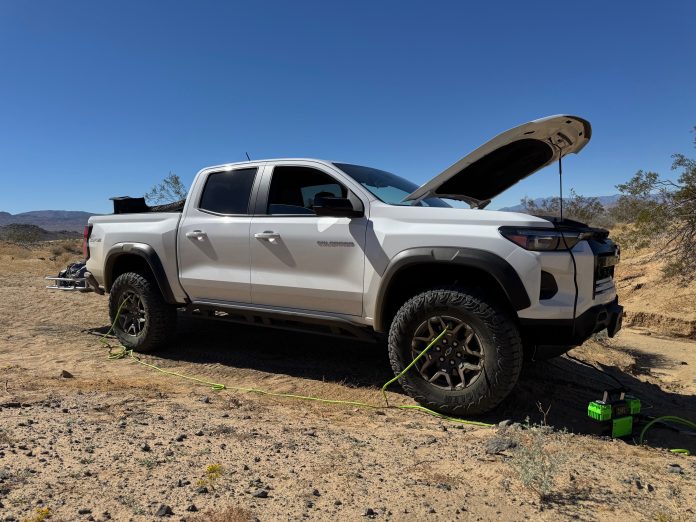
My kit is the TenSix PSI Pro Gen 2 with the Quad hose kit. It has been in my truck on every single trail day for several years. The PSI Pro controller lets me set a target, connect four hoses, and walk away. The compressor shuts off when all four tires hit the target. On group runs, I move vehicle to vehicle and do the same thing for each rig, which is why the 80% duty cycle and the 6-to-8-vehicle session capacity matter in a real-world packing decision: one compressor handles the whole group without a forced cooldown stop. For a detailed breakdown of how this system performs across three years of real desert, mountain, and canyon use, the three-year long-term review of the TenSix covers the durability and field performance record.
What stays home on the air system side: the 12V pencil inflator I used in my first year of off-roading. At 1.2 CFM with a 30% duty cycle, it overheated before finishing the third tire on a 35-inch setup. It took three trail days to confirm it wasn’t a one-off. I’ve also stopped carrying a CO2 cartridge kit as my primary inflation source; CO2 is fine for a temporary fix on a tubeless puncture but won’t air up four tires from trail to highway pressure. It’s a trail day supplement, not a replacement compressor. On understanding how tire pressure decisions compound across different terrain, the article on common tire pressure mistakes is worth reading before the first trip.
Buy Direct From MORRFlate
MORRFlate TenSix PSI Pro Gen 2
10.6 CFM, 80% duty cycle, PSI Pro auto-shutoff. Inflates four 35-inch tires from 10 to 40 PSI in under 5 minutes. 3-year No Hassle warranty. Never leaves the truck.
Recovery Gear: What Stays, What Goes
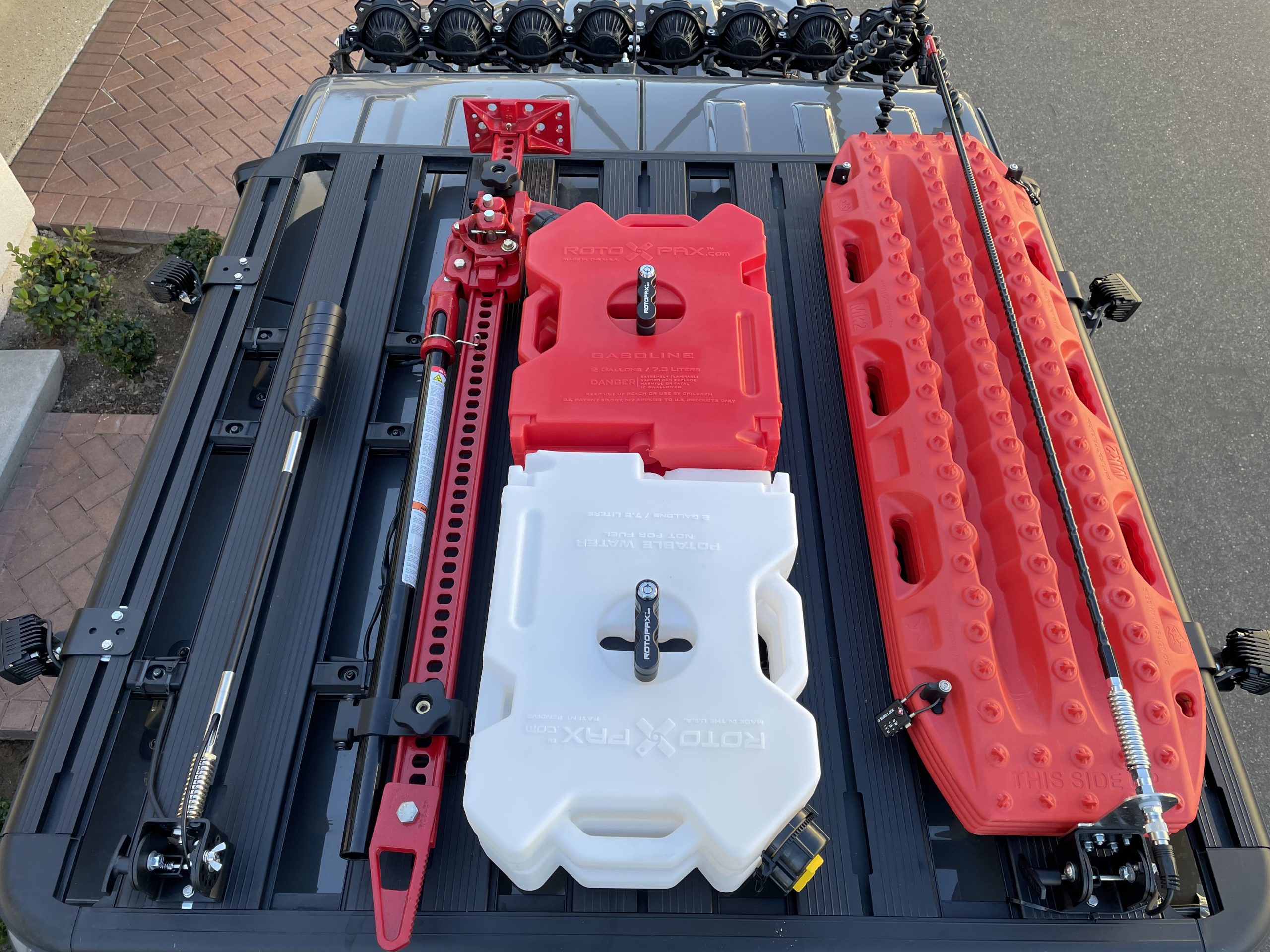
Recovery gear is the most important category on the off-road packing list after the air system, and also the most prone to both under- and over-packing. Under-packing looks like showing up to a technical trail with a tow strap and a floor jack. Over-packing looks like carrying a winch, two kinetic ropes, six traction boards, and a full hi-lift kit for a mellow canyon run an hour from town.
My Always In recovery list for any trail run: one kinetic recovery rope rated to at least twice my vehicle’s weight, two full-size traction boards, a set of D-ring and soft shackles, and a hi-lift jack with a base plate. These four items address the most common recovery scenarios: stuck in mud or sand, high-centering on rock, and needing to lift a corner of the vehicle. Together they weigh about 35 pounds and fit in a single storage bin. They’ve been in the truck on every trip for years.
Situational recovery gear includes a dedicated snatch block for extended winch pulls (only if the route has dense tree cover or anchor points), a full ground anchor kit for sand operations, and a second kinetic rope for group runs where multiple vehicles need simultaneous recovery options. On multi-day trips where I’m 100+ miles from the nearest shop, a portable tire plug kit and a bead seater move from situational to always-in.
What stays home: the factory scissor jack included with the truck. It has insufficient height on a lifted rig, insufficient load rating for a fully loaded overland setup, and provides no stability on uneven terrain. The hi-lift replaced it permanently. I also stopped carrying a chain for recovery work; chains are rigid, don’t absorb the kinetic energy of a pull, and are dangerous when a connection fails. Kinetic rope and rated soft shackles handle the same jobs more safely.
Always In, Every Trip
The Air System That Earns Its Space
10.6 CFM, 80% duty cycle, auto-shutoff precision. Handles the whole group at the trailhead exit. Backed by a 3-year No Hassle warranty.
Tools and Spares: The Useful vs. the Optimistic

The tools category is where optimism does the most damage to an off-road packing list. Early in my wheeling career, I carried a full socket set in both metric and SAE, a torque wrench, brake line tools, and a shop manual for my truck. I used none of it on the trail and used the socket set twice in three years of trips, both times for jobs the four correct sockets handled.
My Always In tool kit for day runs: a compact ratchet set with the 10 most common socket sizes for my specific vehicle, zip ties in three sizes, electrical tape, baling wire, JB Weld, a multi-tool, and a headlamp. These address field fixes for the most common trail problems: loose body panels, broken electrical connections, cracked brackets, and minor plumbing. They weigh under 5 pounds total and live in a small bag behind the driver’s seat.
Situational tools include a torque wrench for wheel reseating after a flat repair, a DC-powered tire bead seater for stubborn tubeless setups, and a breaker bar for stuck lug nuts. On multi-day trips add spare fuses for every circuit in the vehicle, a spare serpentine belt, and the specific fluids (differential, transfer case, engine oil) the drivetrain needs. The rule for spare parts: only carry spares for components with a failure mode likely enough and a consequence serious enough to strand you. A spare serpentine belt qualifies. A spare alternator is optimistic on a truck with under 100,000 miles.
What stays home: the full socket set, torque wrench, and anything requiring more than 30 minutes of field repair time. If a repair takes longer than 30 minutes on the trail, you’re almost always better off strapping down whatever broke, driving out under reduced capability, and fixing it properly at home or a shop. The exceptions are the things making the vehicle undrivable (a flat tire, a failed cooling system component, a failed fuel delivery issue) and those have specific purpose-built solutions already on the list.
Navigation and Communication

Navigation for off-road trips runs on three layers: a primary digital device with offline maps, a backup paper map of the region, and a satellite communicator for emergencies. All three are Always In on any trip leaving cell coverage. The digital layer is onX Offroad or Gaia GPS with maps downloaded for the entire route before departure, not a live internet-dependent app. Downloading only the legs you expect to need coverage on is a planning error; cell coverage on most worthwhile trails is unreliable in ways the map doesn’t predict.
The satellite communicator is non-negotiable on any solo trip or any route more than 30 miles from reliable cell service. The Garmin inReach Mini 2 covers both two-way messaging and SOS on the Iridium network, which covers the entire Earth’s surface. On group runs, at least one vehicle carries one. The $35 to $65 monthly service plan is the cheapest piece of risk mitigation on the entire packing list.
What stays home on the navigation side: a road atlas. Road atlases are useful for interstate travel; they provide inadequate resolution for off-road route planning and offer no overlay of trail conditions, difficulty ratings, or waypoints. A 1:24,000 USGS topo of the specific region replaces it for paper backup navigation. Also eliminated from my kit: a dedicated handheld GPS device. The onX app on a phone with a dedicated power bank does everything a dedicated GPS does at a fraction of the cost and weight, and the phone serves multiple functions rather than one.
Food, Water, and Camp Supplies
Water is the most important Always In item on any multi-day overlanding packing list, and the one most likely to be under-packed. The standard field calculation is one gallon per person per day for drinking alone in moderate temperatures; double it in desert heat or high exertion. On a three-day trip with one person in July, three gallons minimum for drinking means carrying a 5-gallon water can as a buffer. Vehicle water also covers cooling system emergency use: a small radiator leak on a desert trail costs a quart of drinking water to limp out.
Food for day runs is straightforward: high-calorie, no-cook options requiring no refrigeration. Bars, jerky, nuts, and fruit cover a day run without needing a cooler or stove. For multi-day trips, a 12-volt refrigerator replaces the ice cooler entirely. Ice lasts one to two days in a conventional cooler in summer heat; a 12-volt fridge runs indefinitely from the auxiliary battery. The upfront cost is higher, but the operational cost over a season of trips is lower and the convenience is significant.
Camp supply Always In items for multi-day trips: a sleeping bag rated 10 degrees below the lowest overnight temperature forecast, a sleeping pad (ground cold kills sleep quality faster than air temperature does), a headlamp with spare batteries, and a lighter or fire starter. Situational items include a camp stove for routes with no fire restrictions and a camp chair for base camp nights. What stays home: a camp table for day runs, a full camp kitchen setup for routes under three days, and anything requiring more than 10 minutes of setup time for a single overnight stop.
Clothing and Comfort Gear

Clothing on an off-road packing list follows one rule: dress for the worst conditions the route delivers, not the conditions at the trailhead. Wyoming trails in September start at 65°F and finish in a 40°F wind with rain, on the same day. Layering covers the range: a base layer, a mid-layer fleece, a wind- and water-resistant shell, and a pair of work gloves for recovery work. These four items address every weather scenario a trail day delivers in three seasons.
Always In clothing: the layering system above, one pair of sturdy trail boots (not sneakers), and a sun hat for desert routes. Situational clothing includes gaiters for deep mud, insulated pants for winter runs, and a balaclava for alpine conditions. What stays home: a rain suit instead of a shell jacket (too bulky for the protection it adds over a good shell), hiking poles (no trail application on a vehicle-based trip), and any clothing item requiring hand-washing or delicate care on a trip longer than two days.
Work gloves are the most underrated item on most off-road packing lists. Recovery operations without gloves means handling kinetic ropes, shackles, and hi-lift handles with bare hands. A kinetic rope under load is abrasive; a hi-lift handle in a failed lift will lacerate an ungloved palm. Leather or synthetic gloves rated for recovery work cost $20 and weigh 4 ounces. They’re Always In.
What Stays Home and Why
The Never Again list is instructive because the reasons gear lands there follow consistent patterns. Most Never Again items fall into one of four categories: they duplicate something else already in the truck, they weigh more than the problem they solve, they require conditions the trail rarely provides, or they’re optimistic about failure modes unlikely enough not to plan for in the field.
Items I’ve permanently removed from my off-road packing list, and the reason each one went:
A full-size camp chair for day runs: weighs 8 pounds, gets used at the trailhead for 20 minutes, and takes up a quarter of a storage bin. Replaced by a lightweight folding stool I use twice as often at a third of the weight. A hand-crank emergency radio: replaced by the Garmin inReach, which does more with satellite coverage in areas where a hand-crank radio picks up nothing. A full set of jumper cables: replaced by a lithium jump starter weighing 2 pounds, fits in a glove box, and doesn’t require a second vehicle to use. A paper owner’s manual: photographed and stored in the phone’s offline folder; the paper version adds weight and disintegrates in a wet toolbox. A propane lantern: replaced by a USB-rechargeable LED lantern with 200-lumen output; no fuel canisters, no glass globe, and it runs 12 hours on a charge.
The pattern: the Never Again items were replaced by lighter, more capable alternatives or eliminated when honest assessment showed they weren’t being used. The best overlanding packing tips all point the same direction. An off-road packing list gets better the same way a trail rig gets better: by removing what doesn’t earn its space and replacing it with something earning its place. For anyone building out their air system as part of this process, the guide on building a scalable air system covers how to size and choose gear across different build stages.
Off-Road Packing List at a Glance
| Category | Always In | Situational | Never Again |
|---|---|---|---|
| Air System | TenSix PSI Pro Gen 2 + Quad hose kit | CO2 as trail supplement | 1.2 CFM pencil inflator |
| Recovery | Kinetic rope, 2 traction boards, shackles, hi-lift + base plate | Snatch block, ground anchor, second rope | Factory scissor jack, recovery chain |
| Tools | Compact ratchet set, zip ties, tape, multi-tool, headlamp | Torque wrench, bead seater, spare fluids | Full socket set, shop manual |
| Navigation | Phone + onX offline, USGS paper topo, Garmin inReach | Dedicated power bank, extra offline map regions | Road atlas, dedicated handheld GPS |
| Water / Food | 1 gal/person/day + 2 gal buffer (multi-day), no-cook snacks | 12V fridge, camp stove | Ice cooler (3+ day desert trips) |
| Clothing | Layering system, trail boots, work gloves, sun hat | Gaiters, insulated pants, balaclava | Rain suit, hiking poles |
| Camp / Comfort | Sleeping bag, sleeping pad, headlamp, fire starter | Camp stove, lightweight stool | Propane lantern, full-size camp chair |
Pros and Cons of a Disciplined Off-Road Packing List
Pros
- Reducing load weight below the vehicle’s GVWR improves handling, braking distance, and suspension performance on technical terrain.
- A shorter, more precise off-road packing list means faster packing, faster retrieval of specific items on the trail, and less time managing gear at camp.
- Always In items like a quality air compressor and full recovery kit address the failure modes most likely to end a trip early, without the weight penalty of carrying gear for unlikely scenarios.
- Replacing heavy or single-purpose items with lighter multi-function alternatives (lithium jump starter vs. jumper cables, LED lantern vs. propane) frees weight and space for additional water or range-extending fuel.
- A stable, reviewed packing list reduces pre-trip decision fatigue because the framework answers most questions before they’re asked.
Cons
- A strict Always In list requires upfront investment in quality gear for each category; the TenSix PSI Pro Gen 2 plus Quad hose kit runs $540–$580, and the full recovery kit adds another $300–$500.
- Removing Situational gear based on route assessment requires accurate route knowledge; under-assessing difficulty or distance leaves the truck without gear the trip required.
- Discipline around the Never Again list is hard to maintain when gear is already owned; carrying something because it’s paid for is a common trap, even when the weight isn’t justified.
- A minimalist overlanding gear checklist is optimized for the driver who knows the route well; first-time trips to unfamiliar terrain warrant a more conservative, fuller Situational list.
Final Verdict

The off-road packing list problem isn’t about having the right gear; most experienced wheelers have accumulated enough gear to handle almost any situation. The problem is deciding which of it goes in the truck on any given trip. The Always In / Situational / Never Again framework resolves most of those decisions in advance, which means the pre-trip packing process becomes a 20-minute review rather than an hour of second-guessing.
The air system gets its own section in this guide because it’s the clearest example of a gear decision with an obvious correct answer. A quality portable air compressor with multi-tire capability is not a luxury on an off-road packing list; it’s as essential as the recovery rope. The TenSix PSI Pro Gen 2 is the specific answer I’ve landed on after years of testing alternatives, and it’s never left the truck. The combination of 10.6 CFM output, 80% duty cycle, auto-shutoff accuracy, and portability between vehicles makes it the highest-value item in the truck on any trip where tire pressure management matters. On trails requiring airing down at the entrance and back up at the exit, nothing else comes close.
The Never Again list is where the real improvement happens for most overlanders. Every item removed from the truck for the right reason is weight and space recovered for something more valuable. A disciplined off-road packing list isn’t about going light for its own sake; it’s about carrying exactly what the trip needs and nothing failing to earn it. After years of refining the process, the truck is lighter, easier to pack, faster to unpack, and better prepared for the specific scenarios the trail presents rather than the worst-case theoretical ones.
The Air System That Never Leaves the Truck
Check Today’s Price on the TenSix PSI Pro Gen 2
Backed by a 3-year No Hassle warranty. Bundle with a Quad hose kit sized to your wheelbase for complete 4-tire coverage in under 5 minutes.
Frequently Asked Questions
What should every off-road packing list include at minimum?
The minimum off-road packing list for any trail run beyond cell service covers five categories: a working air compressor with the ability to inflate all four tires, a kinetic recovery rope and traction boards, a compact tool kit with zip ties and a multi-tool, a navigation device with offline maps, and sufficient water for the trip duration plus a two-gallon buffer. These five categories address the failure modes most likely to end a trip or create a safety situation. Everything beyond this baseline is calibrated to the specific trip.
How much recovery gear is enough for a solo trail day?
Solo trail day recovery requires full self-recovery capability: a kinetic recovery rope (rated to at least twice your GVWR), two full-size traction boards, a hi-lift jack with a base plate, and a set of D-ring and soft shackles. On routes with dense tree cover or solid anchor points, add a snatch block. On sand-specific routes, add a ground anchor kit. The goal on a solo off-road trip is addressing any recovery scenario without external assistance, because no one is coming to help unless you have a satellite communicator and are willing to use it.
Is a 12V fridge worth the weight on an overlanding packing list?
On any multi-day overlanding trip in temperatures above 75°F, yes. A conventional ice cooler in summer desert heat holds usable ice for roughly 24 to 48 hours, which means daily resupply stops on a multi-day route. A 12-volt fridge runs indefinitely from the auxiliary battery, keeps food at consistent temperature throughout the trip, and eliminates ice logistics entirely. The weight penalty over a comparable ice cooler is about 10 to 15 pounds for a 45-liter unit. The operational advantage across a week-long trip is significant.
What’s the most common thing experienced overlanders remove from their packing list?
The most consistently removed item is the full socket and wrench set. Most trail repairs require between four and eight specific sockets for a given vehicle. Carrying a 50-piece set to use four pieces is a weight and space inefficiency. Experienced overlanders identify the specific fastener sizes for their vehicle’s most likely trail failure points (skid plate bolts, auxiliary light mounts, body panel fasteners) and carry only those. A compact ratchet set with 8 to 10 sockets covers the same ground at a fraction of the weight.
Where does a portable air compressor fit on an off-road packing list?
A portable air compressor belongs in the Always In category on any trail day requiring terrain-specific tire pressure. Airing down for a technical section and being unable to air back up for the highway home is a safety issue, not an inconvenience. The trail day essentials question for air systems isn’t whether to bring one, it’s which one to bring. A high-output compressor with a multi-tire hose kit and auto-shutoff handles both the terrain transition and the trailhead exit efficiently, without requiring manual monitoring at each tire. A low-output single-tire unit handles neither well on larger tires.
A quick heads-up: If you snag something through our affiliate links or check out our sponsored content, we might earn a commission at no extra cost to you. But fear not, we’re all about recommending stuff we’re truly stoked about!