



Quick Facts:
- Sponsor: 4xSolar
- Topic: Keeping your Jeep battery charged at camp with the engine off
- Biggest drain: A 12V compressor fridge, roughly 19Ah to 28Ah per day
- Safe floor: Recharge a resting lead-acid battery at 12.24V (about 50%)
- Skill level: Beginner to intermediate 12V wiring
- Featured fix: Lensun 90W hood panel with a 10A MPPT controller
- Fits: Jeep Gladiator JT, including Sport and Rubicon trims
- Price: $428 with controller at 4xSolar
- Best for: Jeep owners who camp two or more nights without driving
11 min read
In This Guide
- Why Your Jeep Battery Dies at Camp
- Jeep Battery Voltage Chart
- Step 1: Find Your Parasitic Draw and Daily Load
- Step 2: Add a Battery Monitor and Low-Voltage Cutoff
- Step 3: Put Solar on the Hood
- Step 4: Move Big Loads Off the Starter Battery
- Step 5: Carry a Jump Starter as Backup
- What Each Fix Costs
- Hood Solar vs. Portable Solar Panels
- Final Verdict: Keeping Your Jeep Battery Alive at Camp
- Jeep Battery FAQ
Why Your Jeep Battery Dies at Camp

Your Jeep battery wasn’t built to run a campsite. Its main job is cranking the engine, and then the alternator refills it on the drive. At camp, however, the engine stays off. Every light, phone charger, and 12V fridge pulls from the same battery, and nothing puts power back.
The numbers explain the problem. For example, ARB lists its Zero 47-quart fridge at 0.8Ah per hour when set to 41°F in 89.6°F heat. Over 24 hours, this rate adds up to about 19Ah. Similarly, ICECO rates its VL45 at 0.347kWh per 24 hours, or roughly 28Ah per day at 12.5V.
Meanwhile, Optima lists H6 and H7 batteries for the 2021 Wrangler, and Optima’s replacements in those sizes carry 72Ah and 80Ah ratings. Because a starter battery shouldn’t drop much below 50%, you get roughly 36Ah to 40Ah of usable room. As a result, one fridge drains a healthy Jeep battery to its safe floor in about 1.3 to 2 days.
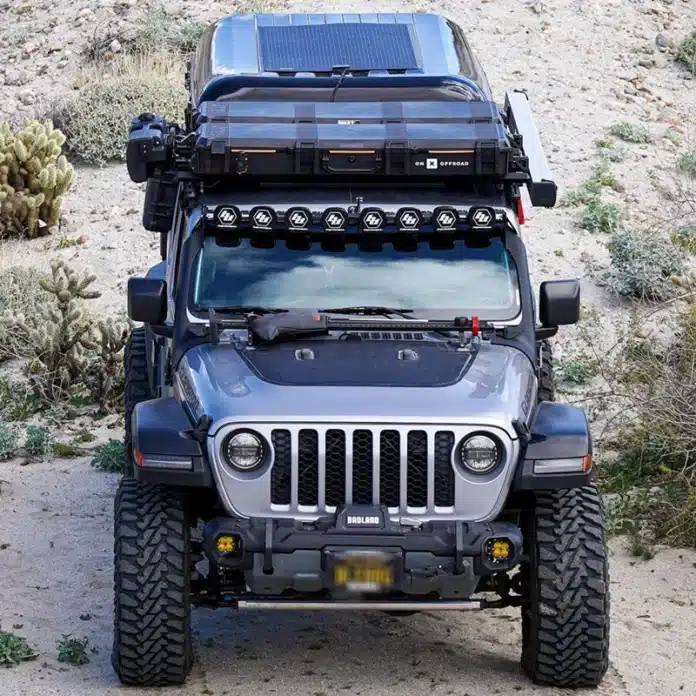
This guide walks through five fixes, from free habits to a dual battery setup. Along the way, it covers the Lensun 90W hood solar panel from 4xSolar, the sponsor of this article. This panel fits the Gladiator JT, and 4xSolar sells hood panels for other trucks and SUVs too. If you’re still planning your build, see our list of overland upgrades to install first.
What You’ll Need for These Fixes
Tools
- Digital multimeter with a 10A DC current setting
- Socket set for the battery terminals
- Plastic trim removal tool
- Heat gun for the optional vinyl decal
- Wire stripper and crimper
Materials
- 1 Lensun 90W hood panel with 10A MPPT controller
- 1 custom-fit vinyl decal (optional)
- 1 roll of 3M double-sided mounting tape
- Isopropyl alcohol wipes
- Adhesive cable tie mounts and zip ties
- 1 tube of silicone sealant for the firewall grommet
- 1 Victron SmartShunt battery monitor (optional)
Jeep Battery Voltage Chart
Voltage tells you how much charge remains, as long as you read it the right way. Battery University’s state-of-charge guide lists these resting figures for 12V lead-acid batteries. Take your reading with the engine off and loads disconnected, because a running fridge pulls the number down.
| Resting Voltage | Details |
|---|---|
| 12.65V | 100% charged |
| 12.45V | 75% charged |
| 12.24V | 50% charged, time to recharge |
| 12.06V | 25% charged, starting at risk |
| 11.89V | 0%, fully discharged |
| Test conditions | Battery at rest for 24 hours at 26°C (79°F) |
In practice, treat 12.2V as your cue to start charging. Also, recharge after every trip, since Battery University warns against storing lead-acid batteries at a low state of charge.
Buy Direct From 4xSolar
Lensun 90W Hood Solar for the Gladiator JT
A 3mm panel plus a pre-wired 10A MPPT controller for $428. It charges your battery with the engine off and the key out.
Step 1: Find Your Parasitic Draw and Daily Load

Start by measuring what drains the battery while you sleep. Parasitic draw is the current your Jeep pulls with the key out, from modules and memory circuits staying awake. According to Universal Technical Institute, normal draw runs 50 to 85 milliamps in newer cars.
At 85 milliamps, a parked Jeep burns about 2Ah per day, which matters little on a weekend. However, a reading well above 85 milliamps points to something else drawing power, such as aftermarket gear wired to constant power. To run the test, set a multimeter to its 10A DC setting. Next, connect the meter in series between the negative post and the negative cable. Then wait for the modules to sleep before you take your reading.
After this, total your camp loads. List each device, its amp draw, and its hours of use per day. For instance, LED camp lights pull far less than a fridge, and our breakdown of campsite lighting power draw covers typical numbers. Also, for a long-term look at one fridge, read our review covering 30 days with a 12V fridge.
Once you know your daily amp-hours, you know how big a gap each fix below has to close. Add a margin of about 20%, since hot days and frequent lid openings push fridge draw up. If you’d rather skip the math, 4xSolar offers a free Mobile Power Audit for sizing your setup.
Step 2: Add a Battery Monitor and Low-Voltage Cutoff
A battery monitor turns guesswork into a number on your phone. The Victron SmartShunt sells for about $100 and measures current in and out through a shunt on the negative cable. As a result, it tracks state of charge, so you see the slide toward 50% hours before it happens.
A low-voltage disconnect adds a hard stop. Victron’s BatteryProtect line runs from about $37 to $120, depending on amp rating, and it cuts power to camp loads at a voltage you choose. Consequently, the fridge shuts off while the battery still holds enough charge to crank.
Most 12V fridges also include a built-in battery protection setting with low, medium, and high cutoffs. However, the fridge reads voltage at its own plug, and thin wiring drops voltage under load. Therefore, pick the highest cutoff whenever the fridge runs off your starter battery.
Step 3: Put Solar on the Hood
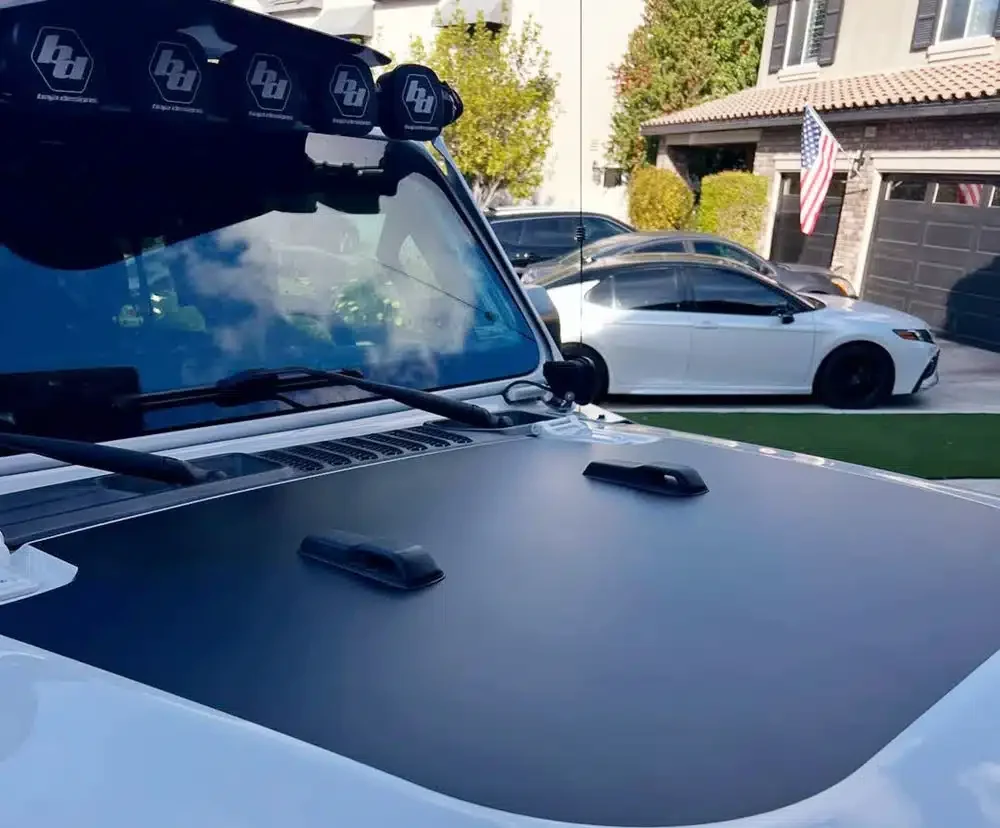
A monitor warns you and a cutoff stops the drain, but solar puts power back. Mounted flat up front, a hood solar panel charges whenever the sun is out, whether you’re parked at camp or driving between sites. Also, it needs no roof rack and takes up zero cargo space.
How Much Power a 90W Panel Makes
Solar output depends on peak sun hours, meaning hours of sunlight at 1,000 watts per square meter. Global Solar Atlas data compiled by Footprint Hero puts Arizona at 5 to 6 peak sun hours per day. By comparison, Wyoming lands at 3.9 to 4.9 hours.
At 5 peak sun hours, a 90W panel produces 450Wh on paper, or about 35Ah at 12.8V. However, a flat hood rarely faces the sun squarely, and panels lose output as they heat up. For example, EnergySage notes panels carry ratings at 25°C (77°F) and lose a fraction of a percent of output for every degree Celsius above it.
As a rough estimate, plan on 20Ah to 28Ah on a clear summer day. In strong sun, this output covers most of one fridge’s daily draw from the top of this guide. At 4 peak sun hours, expect roughly 16Ah to 22Ah instead, so bigger loads still need a second battery. If you camp in the desert, our guide to camping comfortably in extreme heat helps with hot-weather trips.
Lensun 90W Specs and What’s in the Box
The Lensun 90W panel from 4xSolar follows the shape of the Gladiator JT hood. It measures 3mm thick and weighs 6.6 pounds. According to 4xSolar, this makes it 60% lighter than conventional panels. In addition, its ETFE film surface cuts hood glare and resists heat, UV, and corrosion, according to the company.
Electrically, the panel peaks at 90W, with a maximum power voltage of 17V and a current of 5.29A. Its Grade A PERC mono cells carry a 23.5% efficiency rating. The $428 package adds a 10A waterproof MPPT controller with fuses, terminals, and connectors already attached.
According to 4xSolar, the controller works with sealed, AGM, gel, flooded, and lithium-ion batteries. It also guards against reverse polarity and overcharging. Notably, 4xSolar sells an optional custom-fit vinyl decal and recommends it to protect the paint under the panel.
Safety note: Disconnect the negative battery cable before you connect the controller’s battery leads. A starter battery delivers hundreds of amps into a short, enough to burn wires and start a fire. Keep the supplied fuse in the positive lead, and call a 12V shop if any connection leaves you unsure.
How One Owner Installed a Lensun Hood Panel
Owner installs of Lensun hood panels tend to follow the same steps. For example, one 4Runner owner at Trail4Runner cleaned the hood with alcohol wipes, then applied 3M double-sided tape in lines about 6 inches apart. He also ran one strip around the edge, about half an inch in.
Next, he routed the cable down the hood hinge, through the passenger-side firewall grommet, and along the door sill. Finally, the MPPT controller went under the passenger seat, with connections for solar input, battery output, and accessory output. On a Gladiator, the same steps apply, although your routing depends on where you mount the controller.
Before you close up, seal the grommet with silicone. Then secure the cable with adhesive tie mounts so it won’t rub when the hood opens.
Step 4: Move Big Loads Off the Starter Battery

Solar handles a fridge, but a second fridge, a diesel heater, or a laptop station pushes daily use past what 90W replaces. At this point, you need a second battery for camp loads. This way, the battery you start the engine with stays full.
A typical dual battery setup adds a deep-cycle or lithium battery plus a DC-DC charger. For example, Renogy’s 20A and 40A DC-DC chargers start at about $141 and charge the second battery from the alternator while you drive. In addition, the hood panel keeps working in this system, since you wire its controller to whichever battery runs camp loads.
Battery University explains why the split matters. A starter battery survives only 100 to 120 cycles at 50% depth of discharge. In contrast, a deep-cycle battery lasts 400 to 500 cycles at the same depth. Consequently, weekly camping on the starter battery wears it out within a few seasons.
A portable power station offers a simpler route, since it runs camp loads from its own battery. Our look at the pros and cons of solar power stations covers the trade-offs. Also, 4xSolar notes the Lensun panel charges most power stations through adapters sold separately.
Step 5: Carry a Jump Starter as Backup
Even a well-planned system fails sometimes, so pack a lithium jump starter. For instance, the NOCO Boost GB40 lists at $99.95 and delivers 1,000 amps. NOCO rates it for gas engines up to 6.0 liters and diesels up to 3.0 liters, which covers the Gladiator’s 3.6L V6 and the 3.0L EcoDiesel sold from 2021 to 2023.
Charge the pack at home before each trip, and store it in the cab instead of a hot truck bed. Still, a jump pack treats the symptom, while the steps above fix the cause.
What Each Fix Costs
Parts prices below come from 4xSolar, Northern Arizona Wind & Sun, Trek Systems, Renogy, and NOCO. For labor, AAA reports almost half of US repair shops charge $120 to $159 per hour, so the pro column adds this rate to parts.
| Cost Item | DIY | Hiring a Pro |
|---|---|---|
| Multimeter draw test | $0 with your own meter | $120-$159 per labor hour |
| Victron SmartShunt monitor | About $100 | About $100 plus $120-$159 per hour |
| Victron BatteryProtect cutoff | $37-$120 | $37-$120 plus $120-$159 per hour |
| Lensun 90W hood panel with MPPT controller | $428 | $428 plus $120-$159 per hour |
| Renogy 20A or 40A DC-DC charger | From $141, plus a second battery | From $141 plus battery and $120-$159 per hour |
| NOCO Boost GB40 jump starter | $99.95 | No install needed |
A monitor, a cutoff, and a jump pack run about $237 to $320 together. The hood panel adds $428, and it’s the only item here to put power back while you’re parked.
Ready to Stop Dead Batteries?
Put 90 Watts on Your Gladiator’s Hood
Plug-and-play wiring, a 6.6-pound panel, and a controller built for AGM or lithium batteries. $428 at 4xSolar.
Hood Solar vs. Portable Solar Panels
If you’re weighing a hood panel against a folding panel, the biggest difference is setup. A hood panel stays mounted and charges any time light hits it, including on the drive into camp. By contrast, a portable panel rides in your cargo area, and you unfold it, aim it, and pack it up at every stop.
Portable panels win on angle. Because you point them at the sun and move them out of shade, they tend to out-produce a flat panel of the same wattage, especially when the sun sits low. However, they sit on the ground, where they tempt thieves, and they eat space your Gladiator bed or back seat needs for gear.
Pick hood solar if you want set-and-forget charging with zero camp chores. On the other hand, a portable panel suits you better if you park under trees and need to set the panel in a sunny spot away from the Jeep.
Lensun 90W Pros
- Charges with the engine off and the key out
- Enough daily output to cover most of one fridge’s draw in strong sun
- 3mm profile and 6.6-pound weight
- No roof rack or cargo space required
- Pre-wired 10A MPPT controller included in the $428 package
- Controller works with AGM, gel, flooded, sealed, and lithium batteries
- Anti-glare ETFE surface
Lensun 90W Cons
- Flat mount loses output when the sun sits low
- Hood heat trims output by a fraction of a percent per °C above 25°C
- 90W won’t cover a second fridge or heater on its own
- Paint-protecting vinyl decal sold as a separate option
- Fits the Gladiator JT only; other models need their own 4xSolar panel
- Install means routing cable through the firewall
Final Verdict: Keeping Your Jeep Battery Alive at Camp
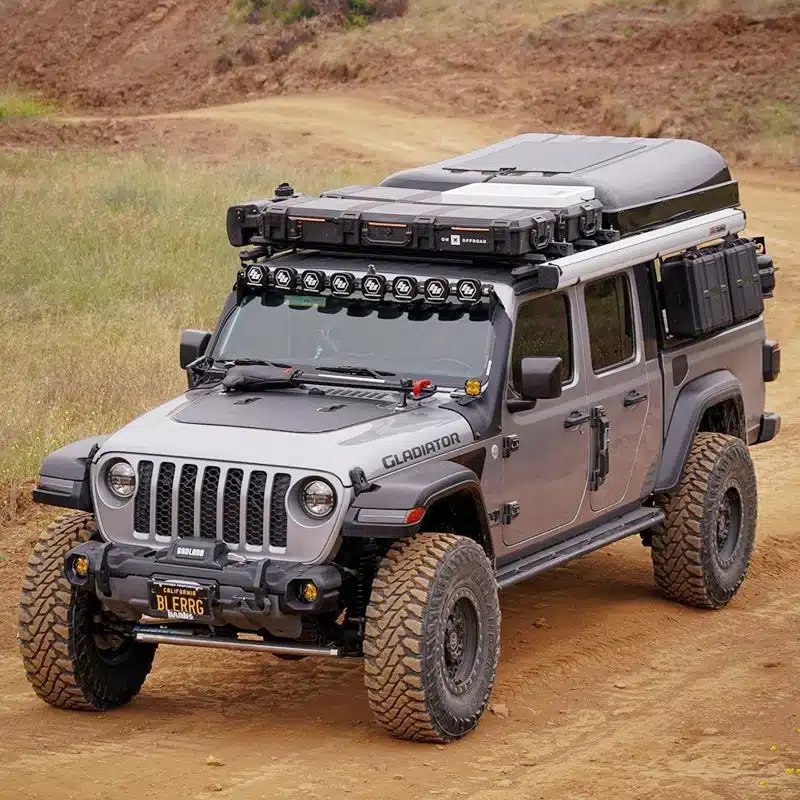
If you camp two or more nights with a 12V fridge, a single starter battery won’t carry you without help. The most useful first step costs nothing: measure your draw and learn the voltage chart. After this, the Lensun 90W panel is the fix with the least daily effort, since it charges whenever the sun is out.
Still, 90 watts has limits. A flat panel on a hot hood produces less than its rating, and loads beyond one fridge need a dual battery setup or a power station. Also, if you camp in shade most of the time, a portable panel you place in the sun suits you better.
At $428 with the controller, the Lensun kit costs more than a monitor or a jump pack. However, those tools only warn you or rescue you, while the panel replaces power every sunny day. For Gladiator owners tired of hauling and aiming portable panels, the price buys a permanent, low-profile charger.
Our recommendation: start with a multimeter and a battery monitor, then add the Lensun 90W panel as your daily charger. If your loads grow past one fridge, pair it with a DC-DC charger and a second battery. Alternatively, step up to a portable power station and keep the panel feeding it.
Built for the Gladiator JT
Keep Your Jeep Battery Topped Off
Get the Lensun 90W hood panel and 10A MPPT controller from 4xSolar, with warehouses in the US, UK, and Germany.
Jeep Battery FAQ
How long will a 12V fridge run on a Jeep battery?
With a 72Ah to 80Ah battery and a 50% safe floor, a fridge drawing 19Ah to 28Ah per day hits the limit in about 1.3 to 2 days. Hot weather and frequent lid openings shorten this window.
Will a hood solar panel keep my Jeep battery charged?
On clear days, a 90W panel returns an estimated 20Ah to 28Ah, which roughly matches one fridge. Clouds, shade, and hood heat cut output, so a battery monitor still earns its place.
What voltage is too low to start a Jeep?
Battery University rates 12.24V as 50% charged and 11.89V as fully discharged. Starting gets less reliable as resting voltage falls toward 12.0V, so recharge once you see 12.2V.
What is normal parasitic draw on a newer vehicle?
Universal Technical Institute puts normal key-off current at 50 to 85 milliamps for newer vehicles. Anything well above this range deserves a check for aftermarket gear on constant power.
Do I need a dual battery setup for overlanding?
Not for weekend trips with one fridge and good sun. A second battery makes sense once daily use tops what your panel returns, or when you run a fridge, a heater, and electronics together.
Does the Jeep Wrangler JL have two batteries?
According to Optima, start-stop Wranglers often carry an auxiliary battery alongside the main one. It supports the start-stop system and isn’t meant to run camp gear.
A quick heads-up: If you snag something through our affiliate links or check out our sponsored content, we might earn a commission at no extra cost to you. But fear not, we’re all about recommending stuff we’re truly stoked about!