



Quick Facts:
- Rule: California Replacement Tire Efficiency Program.
- Adopted: August 17, 2026, by unanimous vote of the California Energy Commission.
- Phase 1: tires manufactured on or after January 1, 2029.
- Phase 2: tires manufactured on or after January 1, 2033.
- Covers: replacement passenger and LT tires sold in California.
- Exempt: tires 34.5 inches or larger with a Q or lower speed rating, tread 18/32 inch or deeper, load index 122 or higher, snow-rated tires.
- State cost estimate: $9.75 per light-truck tire in Phase 2.
- Industry cost estimate: hundreds of dollars per set.
- Most affected: California drivers running 33-inch all-terrain tires without a snowflake marking.
14 min read
In This Article
- What the California Tire Law Changes.
- Key Dates and Limits at a Glance.
- Why Off-Road Tires Struggle With Rolling Resistance Standards.
- Which Off-Road Tires the California Tire Law Exempts.
- The Dead Zone Runs From 31 to 34.4 Inches.
- What the California Tire Law Does to Prices.
- The Fuel Savings Math, Run for a 4×4.
- How to Stretch the Set You Own.
- The Case For and Against the Rule.
- What California Off-Roaders Should Do Now.
- California Tire Law FAQ.
What the California Tire Law Changes
On August 17, 2026, the California Energy Commission voted unanimously to adopt the Replacement Tire Efficiency Program, the first state rule of its kind in the country. The California tire law sets a maximum rolling resistance for replacement tires sold in the state. Phase 1 applies to tires manufactured on or after January 1, 2029. A tighter Phase 2 limit follows for tires manufactured on or after January 1, 2033. Because California standards tend to travel, drivers in other states should read the thresholds too.
Two details matter more than the headlines. First, the trigger is the date of manufacture, not the date of sale. Nothing already mounted on your truck is affected, and nothing on a shelf becomes contraband. Second, LT tires are covered. The commission gave them a slightly looser limit while keeping them inside the rule, over the written objection of the industry’s main trade association.
One figure drives most of the coverage: 70 percent of tires sold today would fail the 2033 limit. The origin is worth knowing. Discount Tire submitted the number to the commission in June 2026, describing the retailer’s own California catalog under an earlier draft. The same letter supported the regulation. Commissioner Nancy Skinner has since put it the other way, saying roughly 30 percent of tires already meet the 2033 target. Her 30 percent and Discount Tire’s 70 percent are the same math from opposite sides.
For off-road drivers, the real question is narrower. The rule carves out several categories of specialty tire, and whether your next set falls inside or outside those carve-outs comes down to four numbers stamped on the sidewall: overall diameter, speed rating, tread depth, and load index.
Key Dates and Limits at a Glance
Rolling resistance is reported in newtons per kilonewton, written N/kN. Because the ratio is force over load, a 7.8 reading equals a rolling resistance coefficient of 0.0078. Lower numbers mean less drag and better fuel economy.
| Item | Detail |
|---|---|
| Program name | Replacement Tire Efficiency Program, docket 26-TIRE-01 |
| Legal authority | AB 844 (2003), Public Resources Code 25770 to 25773 |
| Phase 1 limit, LT tires | 9.0 N/kN, tires built from 2029 |
| Phase 2 limit, LT tires | 7.8 N/kN, tires built from 2033 |
| Phase 2 limit, passenger tires | 7.1 N/kN, a tighter target than the LT figure |
| Second gate | Minimum wet grip index of 1.0 on top of the efficiency limit |
| Enforcement trigger | Date of manufacture stamped on the tire |
| Still pending | Office of Administrative Law review and the final statement of reasons |
The final adopted text has not posted yet. Every figure above comes from the revised express terms published on July 17, 2026. Treat the numbers as firm and the wording as near-final.
The fastest way to see how the four-number test works is to run it on tires people buy. Take three sets moving constantly in California: the Nitto Ridge Grappler and the BFGoodrich All-Terrain T/A KO2 in LT285/70R17, plus the Toyo Open Country A/T III in LT275/70R18. Two of the three already sit outside the rule. The third misses an exemption by a single load-index step. Below, each section explains which is which and why.
The three LT sets used in this worked example
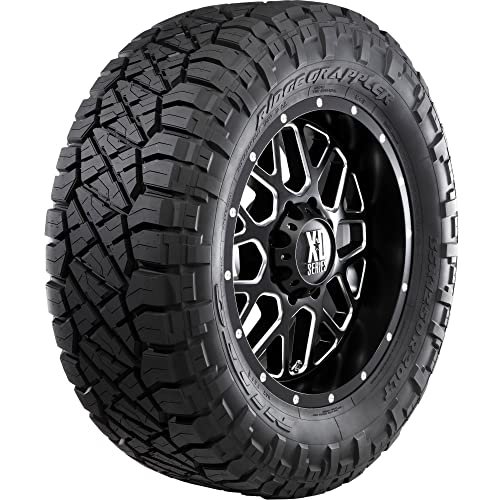
Nitto Ridge Grappler LT285/70R17 121/118Q All Terrain Light Truck Tire

BFGoodrich All Terrain T/A KO2 Radial Car Tire for Light Trucks

Toyo Tires OPEN COUNTRY A/T III LT275/70R18 125/122S E/10 OWL TL
Why Off-Road Tires Struggle With Rolling Resistance Standards
Rolling resistance measures the energy a tire loses to heat as it flexes under load. The commission measures it on a laboratory drum under ISO 28580, the same test method Europe uses for its tire labels.
Everything an off-road tire does well works against a low reading. Deep tread blocks flex more, three-ply sidewalls add mass and stiffness, and aggressive void ratios trade contact patch for bite. As our breakdown of how tread affects fuel economy explains, those traits cost you miles per gallon on pavement.
Weight compounds the problem. Truck-oriented tires ran as heavy as 52 pounds each in the National Academies tire dataset, with most of the segment between 30 and 44 pounds. Common passenger touring sizes started around 14 pounds and mostly stayed under 30. Modern LT tires in load range E sit at the heavy end of the spread or beyond it. Meanwhile the commission’s own testing found replacement tires averaging 8.5 N/kN against 7.1 N/kN for factory-fitted tires. Closing the gap is the entire point of the rolling resistance standards.
A second gate has drawn almost no attention. Alongside the efficiency limit, the rule sets a minimum wet grip index. Because rolling resistance and wet traction pull against each other in compound design, a tire engineer chasing one target gives ground on the other. For a mud-terrain compound, clearing both gates at once is a harder problem than clearing either alone.
Which Off-Road Tires the California Tire Law Exempts
The regulation excludes 15 categories of specialty tire outright, including retreads, spares, and competition rubber. Four of them decide whether your next set is affected, and none of them mention the words “all-terrain” or “mud-terrain” anywhere in the text.
The Large Off-Road Tire Test Has Two Parts
A large off-road tire needs a speed rating of Q or lower, capped at 99 mph. It also needs a minimum diameter of 34.5 inches. Both conditions apply. A 35-inch tire rated S or T fails on speed. A 33-inch tire rated Q fails on size. This off-road tire exemption is narrower than most readers assume, especially since nearly every mainstream all-terrain carries an S or T rating.
The measurement wording adds a wrinkle. Regulators specify the longest distance between two outside edges of the tire on the same side. The figure is therefore actual measured diameter, not the nominal number people quote. Sizes within a fraction of an inch of 34.5 might fall either way depending on the model, and Michelin has asked the commission to switch to a circumference-based measurement instead.
Deep Tread and High Load Index
Two simpler exits exist, such as the one written around tread depth. Any tire with a tread depth of 18/32 inch or greater is excluded as a deep tread tire. A large share of the mud-terrain segment falls out of scope on tread depth alone.
The second exit is load index. Any tire rated 122 or higher sits outside the rule, and the same applies when no load index is marked and the tire is rated above 1,450 kg. Load index 122 means the tire carries 1,500 kg, or roughly 3,300 pounds. The number matters because common LT all-terrains in 33-inch sizes land at 116 to 121, right underneath the line. A Nitto Ridge Grappler in LT285/70R17 is marked 121, one single step short.
The Snow-Rated Loophole
The widest exit is the winter carve-out. Tires meeting the snow traction threshold and carrying the three-peak mountain snowflake symbol face no efficiency requirement whatsoever, because a snow tire trades rolling resistance for cold-weather grip by design. The exemption also overrides every other category in the rule.
Two paths lead through it. Passenger-rated tires with the snowflake are graded under the Uniform Tire Quality Grading system, so the rule treats them as in scope yet exempt from the standards. LT tires are not graded under UTQG at all, so a snow-rated LT all-terrain drops out of the definition of a replacement tire entirely. Plenty of popular all-terrains already carry the symbol, including the BFGoodrich All-Terrain T/A KO2 and the Toyo Open Country A/T III. The Nitto Ridge Grappler does not, since it is marked M+S only.
The Dead Zone Runs From 31 to 34.4 Inches
Three Real Tires Through the Four Tests
Run the four tests together, and a specific gap appears. Most common overlanding fitments are too small for the large off-road category, too shallow for the deep tread exit, and too light for the load index exit. Unless a snowflake saves them, they sit squarely inside the rule. Here are the three worked examples run through all four tests.
| Tire and size | Diameter | Speed / load | Tread | 3PMSF | In scope? |
|---|---|---|---|---|---|
| Nitto Ridge Grappler LT285/70R17 | 32.7 in | Q / 121 | 16.4/32 | No | Yes, fails all four |
| BFGoodrich All-Terrain T/A KO2 LT285/70R17 | 32.7 in | Q / 116 | 15/32 | Yes | No, snowflake only |
| Toyo Open Country A/T III LT275/70R18 | 33.2 in | S / 125 | 16.4/32 | Yes | No, two exits |
Read the middle row carefully, because it is the row people misjudge most often. The KO2 clears nothing on size, tread, or load. Its only exit is the snowflake, which means the marking on the sidewall is doing all the work. Drop the marking in a future compound revision and the same tire lands inside the rule. The Toyo, by contrast, holds two independent exits, since its load index of 125 sits above the 122 cutoff and it also carries the snowflake.
Where Diameter Alone Rules You Out
Diameter alone rules out far more sizes than most builders expect. The table below shows where common fitments land against the 34.5-inch threshold.
| Size | Nominal diameter | Clears the 34.5-inch test? |
|---|---|---|
| LT265/70R17 | 31.6 in | No |
| LT285/70R17 | 32.7 in | No |
| LT275/70R18 | 33.2 in | No |
| 315/70R17 | 34.4 in | Almost certainly no, about an eighth of an inch short |
| 35×12.50R17 | 35.0 in | Yes, if the speed rating is Q or lower |
Look again at the 315/70R17 row. Shops and forums call it a 35, yet the metric math puts it at 34.4 inches, under the cutoff. A flotation-marked 35×12.50R17 clears the same threshold. Two tires the community treats as interchangeable end up on opposite sides of the line. SEMA and the Off-Road Business Association raised the point in writing, asking the commission to widen the definition to 33 inches and an R rating. Their request does not appear in the last text on the record, which keeps 34.5 inches and Q, so treat the narrower version as the working assumption rather than settled fact.
Our long-term notes on four years of testing 35-inch tires cover why so many builds land in this size band. It clears the most obstacles without forcing a regear, and it is also the band the rule reaches.
What the California Tire Law Does to Prices
Here the two sides are not arguing about facts. Instead, they are arguing about what the same dataset implies.
Commission staff put the Phase 2 increase at $6.50 per passenger tire and $9.75 per light-truck tire. For a set of four light-truck tires the total comes to roughly $39, against $26 for a passenger set. Against those costs, staff modeled 39 to 54 gallons of fuel saved over a four-year tire life, worth $179 to $246 at $4.60 per gallon. Consequently payback lands inside eight months on those assumptions. The staff report also concedes it found no published data on light-truck compliance costs, so staff assumed a 50 percent premium over the passenger figure.
Meanwhile the tire coalition ran the same Smithers test data differently. Applying the Phase 2 threshold to the tested base tires removed 102 of 114 models. The surviving models averaged $241 per tire, compared to $150 for the ones eliminated. On the coalition’s reading, the practical cost is about $365 per set, not $39. The coalition also argues the lowest-rolling-resistance compounds give up 20 to 25 percent of tread life.
For low-volume LT sizes, the sharper risk is not price at all. It is discontinuation. Developing a compliant compound for an LT285/70R17 mud-terrain sells far fewer units than the same work on a mass-market passenger size, so some models are likely to leave the California market instead of getting reformulated. There is a release valve, though. When no compliant tire exists in sufficient quantity for a specific vehicle, a manufacturer petitions the commission for a last-resort exemption, and the exempted tire goes on a public list. Our comparison of all-terrain versus mud-terrain tradeoffs is worth revisiting if a favorite model disappears from your local shelf.
The Fuel Savings Math, Run for a 4×4
Every published calculation so far assumes a passenger car. Running it for an overland rig changes the shape of the argument in both directions.
California regular averaged $5.58 per gallon on August 19, 2026, against a national average of $4.09, with diesel at $7.01. The commission modeled savings at $4.60, roughly 18 percent below today’s pump price. Per Grist’s reporting of the adoption meeting, the commission has indicated real savings might run about 25 percent above the modeled figure at this year’s prices. The article’s own two pump figures imply closer to 21 percent. Our rundown of what 2026 fuel prices mean for 4WDs puts the annual figure in context.
Running the Numbers on 12,000 Miles a Year
So run it. A truck covering 12,000 miles a year at 14 mpg burns about 860 gallons annually, or roughly 3,400 gallons across a four-year tire life. Apply the coalition’s own real-world estimate of a 1 to 2 percent gain from improved rolling resistance and you save 34 to 69 gallons over the life of the set. At California’s current $5.58, the saving is $190 to $383 back in your pocket.
Now set the result against the two cost estimates. On the commission’s $39 per set, a 4×4 owner comes out ahead by $150 to $340, a better return than the passenger car gets, because the gallons are bigger. On the coalition’s $365 per set, the same owner lands somewhere between losing $175 and breaking even. The disagreement about cost, not the disagreement about savings, decides whether this rule pays you back.
There is an irony in the design. The heaviest, thirstiest tires are the ones most likely to qualify for an exit, since diameter, tread depth, and load index are each a route out. So the vehicles with the worst fuel economy in the state are the ones the rule reaches least. Whatever you think of the policy, its savings mostly miss the trucks burning the most fuel. One caveat on the savings side: no published study isolates the fuel economy penalty of all-terrain tires against highway tires with a citable number. Treat any precise per-gallon promise from either camp with care.
How to Stretch the Set You Own
Since nobody agrees on what the next set will cost, the one variable you control is how long the current set lasts. Nothing in the rule touches tires already in service. For most owners, correct pressure does most of the work. Underinflation raises rolling resistance and scrubs shoulder tread. Overinflation wears the center and rides hard off pavement.
Four cheap tools cover almost all of it, and together they cost less than one tire. An accurate digital pressure gauge, because the difference between 32 and 36 psi is invisible by eye. A tread depth gauge, which doubles as the tool for checking whether a tire clears the 18/32 inch deep tread exemption. Then a portable compressor rated to air a 35-inch tire back up at the trailhead, sized up if you run bigger. And a deflator you set once and trust for the run in. Against a replacement set the tire coalition puts at $365 more after Phase 2, one extra season out of your current tires pays for all four several times over.
Four tools for stretching a set of off-road tires
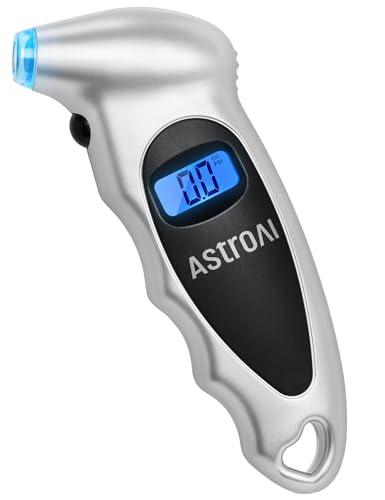


ARB ARB505 Deflator Kit 10-60 PSI Tire Pressure Gauge Rapid Air Dow…
Rotation discipline matters more on heavy LT tires than on passenger rubber, because the mass amplifies uneven wear. Check tread depth every rotation rather than once a season, especially on a rig carrying drawers, water, and a rooftop tent. Our guide to make your current tires last longer walks through intervals and load practices in detail.
The Case For and Against the Rule
On the evidence available today, the rule looks defensible in direction and thin in the specific place off-road drivers care about. For one thing, the efficiency gap it targets is real and measured. The light-truck half of it rests on a much smaller test sample than the passenger half, and the cost figure attached to it was assumed rather than measured.
Pros
- Closes a measured 1.4 N/kN gap between replacement and factory-fitted tires.
- Projected statewide savings of nearly $1 billion per year and 141 million gallons of gasoline.
- Three years of runway before Phase 1 and seven before Phase 2.
- Michelin told the commission the thresholds are challenging but technically feasible.
- Snow-rated, deep tread, and large off-road tires sit outside the rule or are exempt from its standards.
Cons
- The LT standard rests on only 16 tested light-truck tires, per USTMA.
- Staff assumed the LT cost figure rather than measuring it.
- The 34.5-inch threshold splits sizes the market treats as identical.
- Low-volume LT models face discontinuation instead of reformulation.
- Cost estimates differ by roughly ten times between the two sides.
What California Off-Roaders Should Do Now
Start by reading your own sidewall, since every threshold in the rule is stamped there. Write down four things: overall diameter, speed rating, tread depth when new, and load index. Then check for a three-peak mountain snowflake. Those five details decide whether your preferred size sits inside or outside the rule, and gathering them takes about a minute.
If your size clears one of the exits, the practical impact on you is close to zero. Snow-rated all-terrains stay available on the same terms as today. Likewise, mud-terrains at 18/32 inch or deeper are unaffected. So are heavy-duty sizes at load index 122 or above, along with genuine 35-inch tires on a Q rating.
If your size lands in the dead zone, you have until 2029 before Phase 1 and until 2033 before Phase 2, which is one or two full replacement cycles. Buying a set in 2028 gets you tires built under the old rules, though pre-2029 stock stays legal to sell afterward, so the deadline is softer than it looks. Watch the compliance database once the commission publishes it, since several makers are likely to reformulate rather than surrender California volume.
The wider point is the one SEMA made publicly: California rules rarely stay in California. California’s tailpipe standards are now enforced in 17 states and the District of Columbia. Meanwhile Washington and Rhode Island are already weighing tire efficiency rules of their own. Whether you wheel in the Mojave or in Michigan, the thresholds set in this docket are worth understanding now.
California Tire Law FAQ
Will all-terrain tires be banned in California?
No. The rule bans nothing from being used, because it governs manufacture and sale only. It sets a maximum rolling resistance for tires manufactured from 2029 onward, and all-terrain models meeting the limit remain on sale. Snow-rated all-terrains carrying the three-peak mountain snowflake are exempt from the efficiency requirement entirely.
Are mud-terrain tires exempt from the California tire law?
Many are, though not because of the tread pattern. Any tire with a tread depth of 18/32 inch or greater qualifies as a deep tread tire, so it falls outside the rule. Mud-terrain tread depths frequently reach or exceed the figure. Check the published tread depth for your specific model rather than assuming.
When does the California tire law take effect?
Phase 1 applies to tires manufactured on or after January 1, 2029. For Phase 2, the date is January 1, 2033. Because the trigger is the manufacturing date, tires built before those dates stay legal to sell afterward. The rule still needs Office of Administrative Law approval before it becomes enforceable.
Do 35-inch tires qualify for the off-road tire exemption?
Only when they also carry a speed rating of Q or lower. The large off-road tire definition requires a minimum diameter of 34.5 inches and a Q rating together. A metric 315/70R17 measures a nominal 34.4 inches and misses the diameter test, while a flotation 35×12.50R17 clears it.
Does buying tires out of state avoid the California tire law?
In person, yes. The regulation binds manufacturers and retailers rather than drivers. It reaches tires sold or offered for sale for end use in California regardless of the seller’s location, including internet, telephone, and mail-order transactions, so an online order shipped to California is covered. Driving to Reno and buying a set at the counter is not, and no inspection or enforcement regime targets individual drivers.
Does the California tire law apply to tires I already own?
No. Tires already mounted or already in inventory are untouched, and there is no requirement to replace them. The rule governs what manufacturers build and what retailers offer for sale, not what sits on your truck.