


Quick Facts:
- Topic: Why auxiliary lighting makes airborne dust harder to see through
- Real mechanism: Backscatter, governed by beam width and lamp height
- Color effect: Comfort only, because dust scatters every visible wavelength alike
- Best fix: SAE fog lights mounted low, below your eye line
- Fog beam limit: 485 candela maximum on the horizon under UN Regulation 19
- Cutoff standard: Sharpness factor of 0.08, required on both sides of the Atlantic
- Second fix: A separate switch, because switching off beats switching brighter
- Best for: Bronco, Wrangler, Gladiator, Tacoma and 4Runner owners wheeling after dark
10 min read
In This Guide
- Why Your Own Lights Blind You in Dust
- What the Fog Beam Standards Require
- Why Placement Beats Output in Dust
- Why Amber Does Not Cut Through Dust
- Mounting Heights for SAE Fog Lights and Ditch Lights
- What SAE Fog Lights Do Differently
- SAE Fog Lights vs Ditch Lights and Light Bars
- Final Verdict on SAE Fog Lights for Dust
- Frequently Asked Questions
Why Your Own Lights Blind You in Dust
You add a 40-inch bar, roll into a dusty wash after dark, and see less than you did before. The bar works fine. Your problem is backscatter, and SAE fog lights exist because of it. Every dust particle your beam touches throws light in all directions. A share of it returns to your eyes, carrying nothing useful about the trail ahead.
Most owners answer this with color, and they buy lenses when they need brackets.
Two variables govern how much light returns. Beam width decides how much air gets lit, while lamp height relative to your eyes decides whether the lit air sits inside your sightline or below it. Color changes neither. Lumens change neither either, so a brighter lamp in the same place deepens the veil instead of cutting it.
This guide works through the geometry, then converts it into mounting positions and hardware. Expect no magic lens. The answer is a beam shape, a bracket height, and a switch.
| Top Pick | Best Premium | Best Budget | |
|---|---|---|---|
| Product | TOP PICK Rigid D-Series SAE Fog Rigid D-Series SAE Fog |  Rigid D-Series PRO Yellow Rigid D-Series PRO Yellow |  KC HiLiTES Gravity G4 KC HiLiTES Gravity G4 |
| Rating | ★★★★☆ 4.5 101 ratings | ★★★★☆ 4.5 9 ratings | ★★★★☆ 3.7 33 ratings |
| Beam Optic | SAE Fog | SAE Fog PRO | SAE Fog |
| Color Option | White | Selective Yellow | White |
| Mounting | Bumper, low mount | Bumper, low mount | Bumper, low mount |
| Price | $347.08 as of Sep 25, 3:08 pm | $449.00 as of Sep 25, 3:08 pm | $389.99 as of Sep 25, 3:08 pm |
| Check Price → | Check Price → | Check Price → |
What the Fog Beam Standards Require
The figures below define a compliant fog beam. Two regulations do the work: J583 in the United States and UN Regulation 19 internationally, with UN Regulation 48 covering where the lamp bolts on. Later sections explain why each number matters rather than listing it again.
| Specification | Details |
|---|---|
| Minimum output, 2.5 degrees below horizontal | 2,700 candela (UN R19 class F3) |
| Maximum output on the horizon | 485 candela |
| Maximum output 4 degrees above horizontal | 150 candela |
| Cutoff sharpness factor | 0.08 minimum, US and UN standards alike |
| Lateral spread requirement | 450 candela at 35 degrees off-axis |
| Mounting window, cars and light vans (UN R48) | 250 mm to 800 mm, roughly 10 to 31 inches |
| Selective yellow filter penalty | 0.84 photometric multiplier, roughly 16 percent |
| US federal rule for private vehicles | FMVSS 108 sets no fog lamp requirement |
Why Placement Beats Output in Dust
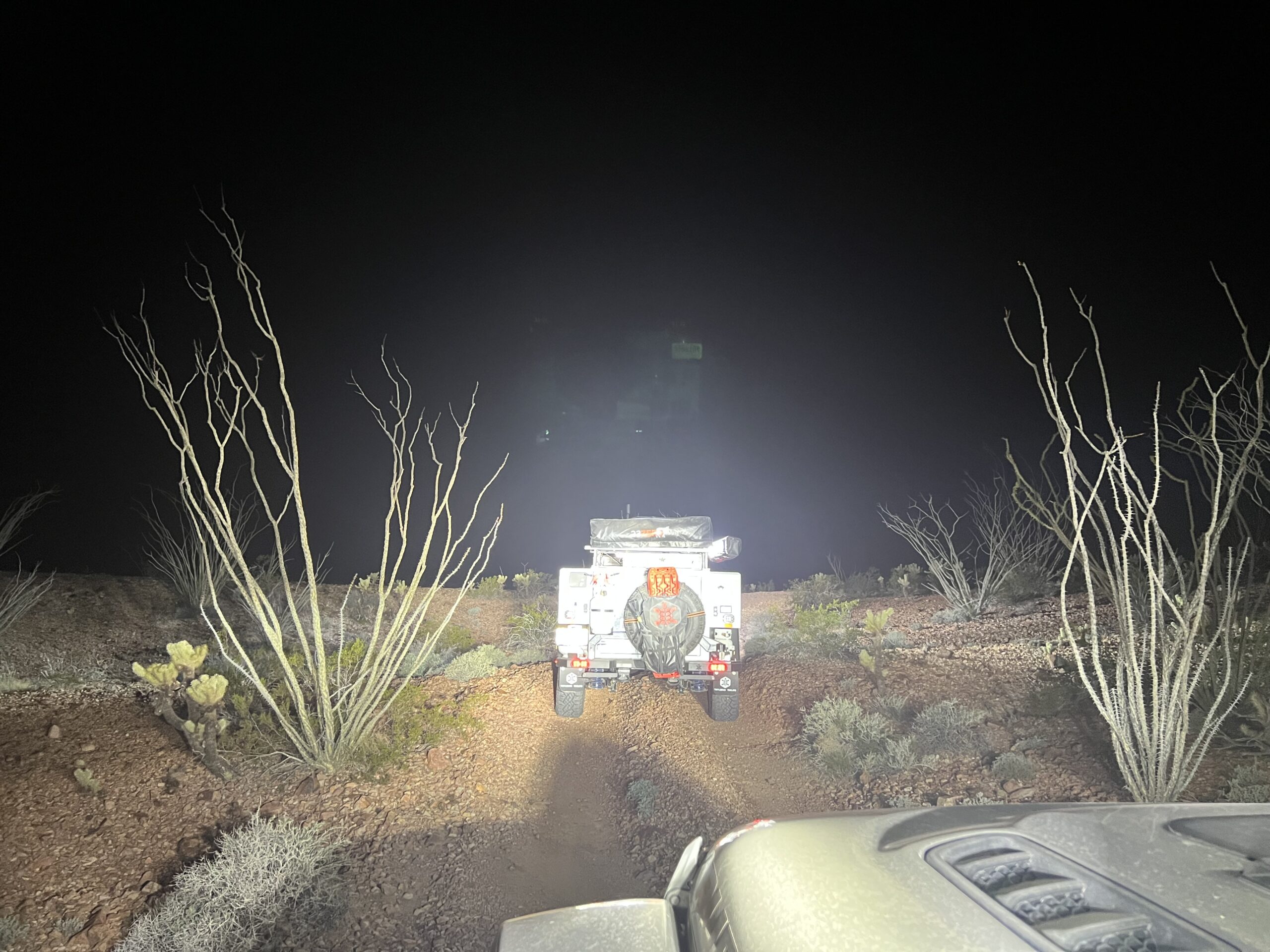
Clean air stays invisible, and air with dust in it becomes a screen your lamps light up. Scatter scales with whatever you put into the air, while the rock you are trying to see reflects only what reaches it. Therefore, past a certain output, you feed the veil faster than you feed the target.
Bullough and Rea measured the reversal. Their modeled high beams at 100,000 candela beat low beams at 30,000 in every fog density they ran except the thickest. There, target contrast came out lower under the high beams than under the low. Dust behaves the same way, so the lesson carries: in bad air, placement outranks output.
Highway researchers reached the same conclusion decades ago. NCHRP Report 95, the Highway Research Board’s 1970 review of driving in fog, relayed a recommendation from Pritchard and Blackwell. Mount headlights as far as possible from the driver’s line of sight, and aim them away from the air directly ahead.
The report names trucks and buses as the design already doing this, lamps near the ground and driver seated high. A lifted rig gives you the same geometry for free. Whether you keep the advantage or spend it depends entirely on where you bolt the next lamp. Understanding how beam patterns work in practice matters more here than any lumen figure on the box.
Why Amber Does Not Cut Through Dust
Two separate claims travel under the word “amber”, and most arguments about yellow lights involve two people defending different ones. The first claim is penetration: yellow reaches the target with less scattering on the way. The second is glare: whatever scatters back bothers your eyes less. Only one of them survives contact with the evidence. Because amber pod lights sell on the first promise, the distinction matters before you spend.
Penetration fails first, on particle size. Rayleigh scattering, the effect making the sky blue, applies only to particles smaller than the wavelength of light. Trail dust and fog droplets run one to two orders of magnitude larger, which is the regime the International Lighting Vocabulary calls non-selective scattering. NCHRP Report 95 put it directly: in most well-developed natural fogs, transmission is essentially independent of wavelength across the visible spectrum. Fog looks white rather than blue for the same reason.
Where the Glare Claim Holds Up
Glare holds up better. A 2023 study in Scientific Reports ran halogen, xenon and LED headlamps through a fog chamber and measured both halves of the argument separately. Xenon transmittance ran 2 to 3 percent higher, so the bluest source won on getting through. Detection, though, was fastest under halogen, which the authors attributed to a white-wall effect in the participants’ eyes. Warmer light did not travel better. Instead, it came back at the driver less.
Eye physiology explains the rest. Blue wavelengths focus slightly in front of the retina and blur edges. Daniel Stern Lighting cites measurements putting bluer headlamps at 46 percent more glaring than yellower ones at matched intensity. Watch what the manufacturers build, too. Baja Designs run 5000K white emitters facing forward and sell amber as a lens over the top. Amber pod lights are therefore a comfort filter rather than a dust cutter. Our amber versus white light comparison covers the color trade-off in depth.
Mounting Heights for SAE Fog Lights and Ditch Lights
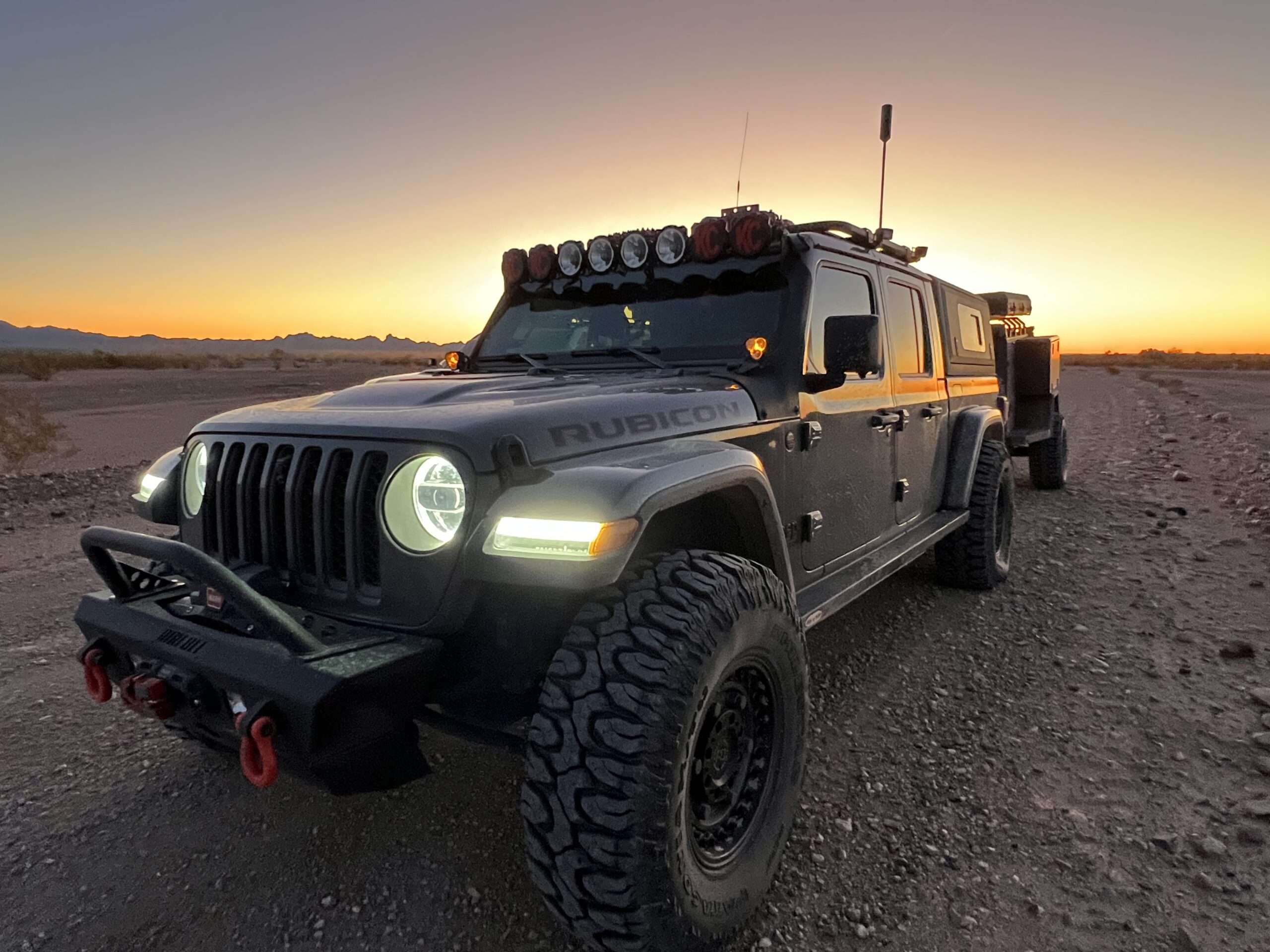
Mounting height is the variable owners change least and the one paying most. Wide beams belong low, under your eye line, so the brightest lit air sits beneath your sightline instead of inside it. UN Regulation 48 writes the principle into law for factory fog lamps. On cars and light vans it sets 250 mm to 800 mm above ground, roughly 10 to 31 inches. The lamp also stays below the top of the low beam.
Narrow beams work the opposite way. A tight spot lights little air, and the thin column it does light stays clear of your eyes until far down the trail. Therefore a spot beam earns its place high, while a flood belongs on the bumper. A roof-mounted flood bar becomes the worst combination available, since it lights the widest column of air at the height closest to your eyes.
Ditch lights sit between the two. In any ditch lights vs light bar comparison, aim decides more than format. Pointed outward and slightly down, they light the trail edge without filling the column ahead, so they survive dust better than a forward bar. Pointed forward, they become two more dust illuminators at windshield height. Many owners get this wrong, which is one reason common LED light bar mistakes keep repeating across builds.
Check your state code before moving anything, because mounting height and auxiliary light color both appear in state vehicle law. Several states set a ceiling near 42 inches for forward auxiliary lamps, and the state light bar mounting rules vary enough to matter on the drive home.
What SAE Fog Lights Do Differently
SAE fog lights are defined by beam shape rather than by color, and the shape is the entire specification. A class F3 lamp must deliver at least 2,700 candela at 2.5 degrees below horizontal. Meanwhile, it emits no more than 485 candela on the horizon itself. Above the horizon the ceiling drops fast: 360 candela at one degree, 245 at two, and 150 at four.
Between those two figures sits the cutoff. Both SAE J583 and UN R19 demand a sharpness factor of at least 0.08. Two standards bodies settled on one number for how hard the edge has to be. Consequently, a compliant lamp lays a wide bar of light on the ground. It throws almost nothing into the air above, which is the behavior dust rewards.
Width matters as much as the cutoff, since the same class requires 450 candela still arriving 35 degrees off to each side. Therefore the beam covers trail edges without reaching upward. Compare this discipline to a typical combo bar, where nothing constrains output above the horizon at all.
Finally, one caution on shopping: SAE compliance is a claim anyone prints on a box. Photometric testing by Calcoast ITL, commissioned and published by lamp maker Morimoto, failed three lamps carrying the marking, all from premium brands. Favor manufacturers publishing test reports, because beam quality decides more than the sticker. Beyond the lamp, dimmable auxiliary lights solve the same problem from the wiring side.
SAE Fog Lights vs Ditch Lights and Light Bars
Three formats answer three different questions, and dust separates them quickly. Driving lights, the fourth term on spec sheets, project a long narrow beam for speed. The fog lights vs driving lights choice therefore comes down to control against reach. Specifically, fog lights buy controlled foreground light with a hard ceiling on upward spill. Ditch lights buy peripheral awareness at the trail edge, so the ditch lights vs light bar debate turns on where you wheel. A bar buys distance on clear, fast, open terrain, where it genuinely outperforms the alternatives.
| Factor | SAE Fog Lights | Ditch Lights | Light Bar |
|---|---|---|---|
| Beam shape | Wide bar, sharp cutoff | Narrow, angled outward | Spot, flood or combo |
| Mount height | Bumper, 10 to 31 inches | Cowl or A-pillar | Roof or bumper |
| Performance in dust | Best, light stays under your sightline | Good when aimed outward | Worst on the roof, wide and high |
| Best terrain | Dust, snow, fog, slow going | Tight, tree-lined trail | Open desert at speed |
| On-road legality | Expressly allowed in many state codes | Varies, height dependent | Often requires a cover or switching off |
| Relative cost | Low to moderate | Moderate | Highest by a wide margin |
What SAE Fog Lights and the Alternatives Cost
Cost tracks capability loosely. A pair of SAE-pattern pods runs similar money to a mid-tier ditch light kit. In contrast, a premium 40-inch bar costs three to five times either one. Spending bar money on a bar you switch off in every dusty mile is the expensive mistake.
For mixed conditions, running all three on separate switches covers the most ground. The bar handles open desert, the fog lamps handle dust and falling snow, and the ditch lights handle tight tree-lined trail. Separate circuits make the combination work, since the correct response to heavy dust is often turning something off.
Pros of Low-Mounted SAE Fog Lights
- Hard ceiling of 485 candela on the horizon limits the lit air in your sightline
- Cutoff sharpness of 0.08 keeps the beam edge crisp instead of hazy
- 450 candela at 35 degrees off-axis lights trail edges without upward spill
- Bumper mounting at 250 mm to 800 mm sits well below your eye line
- Bumper mounting sits inside the height window state codes allow, unlike a roof bar
- Costs a fraction of a premium 40-inch bar
- Works in falling snow and fog, both non-selective scatterers like dust
Cons and Trade-Offs
- Short reach, so distance vision still depends on headlamps
- Amber lensing costs roughly 16 percent of output under the 0.84 multiplier
- SAE markings often go unverified, premium brands included
- Bumper position collects mud and rock strikes
- Bright foreground light constricts your pupils, shortening distance vision
- Wrong on open desert runs, where a spot or bar wins outright
Wiring and mounting hardware for auxiliary lights


Auxbeam 6 Gang Switch Panel BC60 Universal Circuit Control Relay Sy…

Final Verdict on SAE Fog Lights for Dust
Owners wheeling dusty trails after dark get more from a pair of low-mounted SAE fog lights than from a far pricier bar upgrade. Specifically, the strength is the cutoff. A beam capped at 485 candela on the horizon puts light on the ground while the air at eye level stays comparatively dark. Dust rewards exactly this condition.
Reach is the trade-off, because fog beams stay short by design, so distance vision still rides on your headlamps. Anyone running fast on open desert needs a spot beam for the same reason. Amber lensing costs roughly 16 percent of output, buying comfort rather than penetration. Anyone expecting yellow light to punch through a dust cloud should reset the expectation now.
On value the arithmetic favors the smaller purchase. A pair of SAE-pattern pods plus a relay and a dedicated switch costs a fraction of a premium bar. Spending on brackets and wiring first, lumens second, reverses how most builds get ordered.
For a rig seeing genuinely mixed use, run both. Keep a bar for open ground. Then add low-mounted fog lamps for dust and snow, wire them separately, and aim the ditch lights outward. Owners sticking to open desert at speed should skip the fog lamps and buy a quality spot beam. Settle the fog lights vs driving lights question by where you drive rather than by lumens.
Frequently Asked Questions
Does a brighter light bar make dust worse?
Yes, when the bar sits near your eye line. Scatter scales with the light entering the air, while the obstacle ahead reflects only what reaches it. Past a certain output you add more to the glowing veil than to the target. Consequently, an upgrade sometimes leaves you seeing less.
Should I get amber or white ditch lights?
Amber reduces glare discomfort and white delivers more usable output. Neither color penetrates dust better, since dust scatters all visible wavelengths roughly alike. Aim matters more, so point ditch lights outward at the trail edge rather than forward, whichever color you choose.
Do amber lights help in dust?
They help with comfort rather than with seeing through it. Fog chamber testing found warmer sources produced faster target detection, and researchers attributed the result to reduced glare in the eye. Transmission through the fog itself barely moved, and dust scatters all visible wavelengths alike for the same reason.
What does SAE J583 mean on a fog light?
J583 is the SAE standard for front fog lamps, specifying a wide beam with a sharp horizontal cutoff. It requires a cutoff sharpness factor of at least 0.08, matching UN R19. Note also FMVSS 108 sets no fog lamp requirement for private vehicles, so the marking is voluntary.
How high should I mount off-road fog lights?
Low, below your eye line. UN Regulation 48 places factory fog lamps on cars and light vans between 250 mm and 800 mm above ground, roughly 10 to 31 inches. They also sit below the top of the low beam. Bumper height on most trucks lands near the window naturally.
Are amber pod lights legal on the road?
Fog lamp color falls to state vehicle code, because FMVSS 108 does not regulate fog lamps on private vehicles. SAE J578 defines a selective yellow chromaticity region for the purpose. Check your own state rules before running amber pods on pavement.