


Quick Facts:
- Test: Power Wagon drag race, standing quarter mile and 30 mph roll, run by TFLtruck
- Diesel result: 16.17-second quarter mile, 8.4-second 0-60
- Gas result: 17.25-second quarter mile, 9.81-second 0-60
- Diesel engine: 6.7L high-output Cummins, 430 hp, 1,075 lb-ft, 3.42 axle
- Gas engine: 6.4L HEMI V8, 405 hp, 429 lb-ft, 4.10 axle
- Weight gap: Diesel carries 1,000 to 1,300 lb more, per TFL
- Elevation: Roughly one mile above sea level
- Diesel starting price: $89,560, a $12,995 upcharge over the V8
- Notable omission: No factory winch on the diesel
- Best for: Ram HD shoppers weighing the Cummins option
7 min read
In This Article
What Happened on the Airstrip
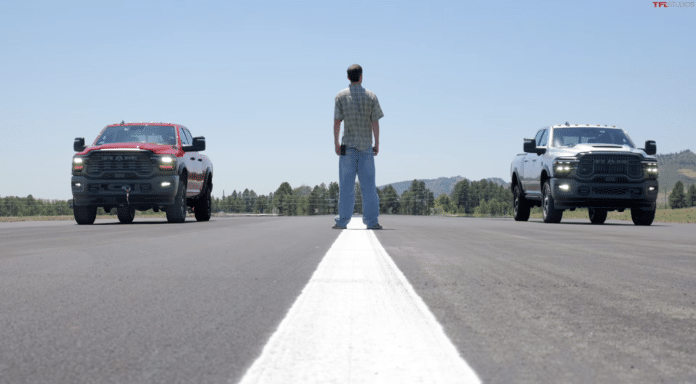
This Power Wagon drag race settles a question Ram owners have argued about since January. Ram spent decades selling the Power Wagon with gas power only. For 2027, the 6.7L high-output Cummins finally became a factory option. TFLtruck lined a loaded diesel against a base-trim gas Power Wagon on an airstrip to see what the swap delivers in practice.
Both trucks ran in two-wheel drive with traction control off, air conditioning off, and sport mode engaged. Elevation matters here, because the test site sits roughly one mile above sea level. Thin air costs a naturally aspirated V8 far more than it costs a turbocharged diesel, so the gap you see below would narrow at sea level.
On paper the setup favored the gas truck. The 6.4L HEMI V8 carries 4.10 rear gears against the diesel’s 3.42. It also weighs less, though by how much depends on your source. TFL’s written report says about 1,000 pounds, while the on-camera figure is 1,300. Short gearing plus less mass usually wins a standing start. The result went the diesel’s way anyway, and it did so from the first foot of travel.
Power Wagon Drag Race Results: Cummins vs HEMI
TFL clocked the diesel at 8.4 seconds to 60 mph and 16.17 seconds through the quarter mile. Meanwhile, the gas truck needed 9.81 seconds to 60 mph and 17.25 seconds for the quarter. The diesel finished more than a full second ahead, and it led from the moment both drivers left the line.
Context helps here. A 16-second quarter mile sounds slow next to a half-ton pickup, yet these are three-quarter-ton off-road trucks on tall all-terrain tires. Heavy-duty trucks trade acceleration for payload, gearing, and cooling capacity. Judge them against each other rather than against lighter pickups.
Neither number is quick by modern standards. However, the margin is what matters. A 1.08-second gap in the quarter mile is decisive for two trucks sharing a chassis, a transmission family, and a body.
| Measurement | 6.7L Cummins | 6.4L HEMI |
|---|---|---|
| Quarter mile | 16.17 sec | 17.25 sec |
| 0-60 mph | 8.4 sec | 9.81 sec |
| Horsepower | 430 hp | 405 hp |
| Torque | 1,075 lb-ft | 429 lb-ft |
| Rear axle ratio | 3.42 | 4.10 |
| Weight difference | 1,000 to 1,300 lb heavier | Lighter |
Margins like this change what owners bolt to the truck afterward. Buyers who pay for the Cummins are usually chasing load capability rather than lap times, so gooseneck hardware and an on-board compressor top the early upgrade list.
What diesel Power Wagon owners add first


ARB CKMTA12 '12V' On-Board Twin High Performance Air Compressor
Watch the full run below, including a third vehicle TFL brought out at the end.
How Torque and Boost Beat the Weight
Torque explains most of the outcome. The Cummins makes 1,075 lb-ft against 429 lb-ft from the gas engine, so the diesel brings roughly two and a half times the twist to the same rear tires. Because peak torque arrives low in the rev range, the diesel converts it into forward motion before the V8 reaches its power band.
Turbocharging explains the rest. On a standing start, a driver brake-boosts the turbocharger and leaves the line with pressure already built. Consequently, the diesel launches hard enough to overcome both the weight penalty and the taller gearing. TFL’s driver noted the Cummins even pulls away in second gear rather than first.
Altitude widened the margin further. A turbocharger compresses thin air back toward sea-level density, while a naturally aspirated engine simply loses output. For context on how much test conditions move these numbers, compare TFL’s mile-high 0-60 testing on other off-road rigs, where the same thin air shaped every result.
None of this makes the 6.4L HEMI V8 a weak engine. Instead, it shows the mismatch between a large naturally aspirated gas V8 and a modern high-output diesel in a truck of this weight.
The Rolling Race Was Much Closer
TFL then ran both trucks from a 30 mph roll, and the story changed. Off the initial throttle stab, the gas truck moved first and opened a small lead. Since the diesel had no chance to pre-build boost, it had to wait for the turbo to spool while the V8 responded instantly.
The Cummins still won, although barely. It reeled the gas truck in gradually and passed it near the end rather than driving away. TFL’s drivers called the rolling result close, which stands in contrast to the definitive standing-start win.
This matters more than it sounds. Real passing situations on a two-lane highway look like the rolling race, not the standing start. Therefore a gas Power Wagon owner towing at highway speed gives up less to the diesel than the quarter-mile numbers suggest.
The 392 Wrangler Beat Both Trucks
For contrast, TFL brought out a Jeep Wrangler 392 as a third entry. Sharing the same 6.4L displacement as the gas truck, the Wrangler makes 470 hp and 470 lb-ft in a far lighter package. It ran the quarter mile in 14.50 seconds and hit 60 mph in 6.15 seconds.
Both Power Wagons lost to it comfortably. The comparison is unfair by design, although it makes a useful point about mass. Moving roughly 3,000 fewer pounds does more for acceleration than any amount of torque. Mass, in other words, is why the rolling race between the two trucks stayed as close as it did.
What the Diesel Adds Beyond the Quarter Mile
Acceleration is the least important thing the Cummins changes. The tested diesel was rated for 2,700 pounds of payload and over 18,000 pounds of towing. By comparison, the gas truck in the test was rated for roughly 1,500 pounds of payload and about 11,000 pounds of towing.
Ram’s published maximums run higher still, at 2,930 pounds of payload and 19,630 pounds of towing for the best-configured diesel. Configuration drives the spread, so verify the door jamb sticker on any specific truck instead of trusting a brochure figure.
Roughly doubling towing capacity reframes the entire purchase. A gas Power Wagon tows a reasonable trailer, while the diesel version pulls a loaded gooseneck. If you plan to run near those limits, our guide to matching payload to a heavy camper covers the math worth doing before ordering.
What the Cummins Costs You Off-Road
Two costs come with the diesel, and neither appears in a drag race. First, the Cummins deletes the factory winch. Ram CEO Tim Kuniskis has said fitment was never the obstacle, since the 6.7L goes into every Ram HD. The winch instead lost a fight for nose real estate against charge air cooler plumbing and front-axle weight. As a result, the most capable Power Wagon ships without the recovery tool its reputation was built on.
Second, a meaningful share of the extra mass sits over the front axle. Additional front weight pushes harder on the front tires in soft sand and mud. Consequently, a heavy truck grows more reluctant to change direction on an off-camber line. The front locker and 34-inch all-terrains remain, so capability stays high, but the diesel is a blunter instrument on tight trails.
Replacing the Winch the Diesel Does Not Come With
Replacing the winch is the first correction most buyers make. We compared the tradeoffs in our breakdown of factory winches against aftermarket units. For a truck in this weight class, 12,000 pounds is the practical floor and 15,000 or more is the by-the-book answer.
| Top Pick | Best Value | Best Premium | |
|---|---|---|---|
| Product | TOP PICK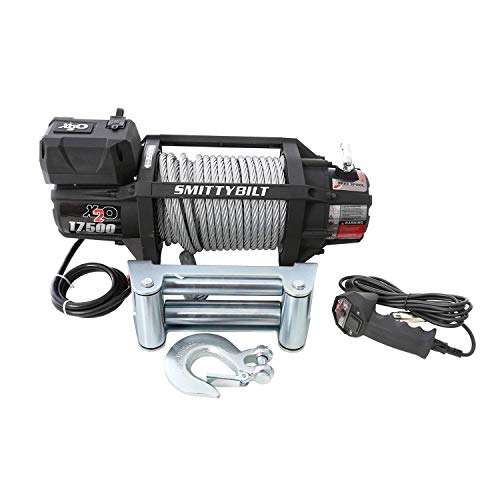 Smittybilt X2O 17.5K Smittybilt X2O 17.5K |  WARN VR EVO 12-S WARN VR EVO 12-S | 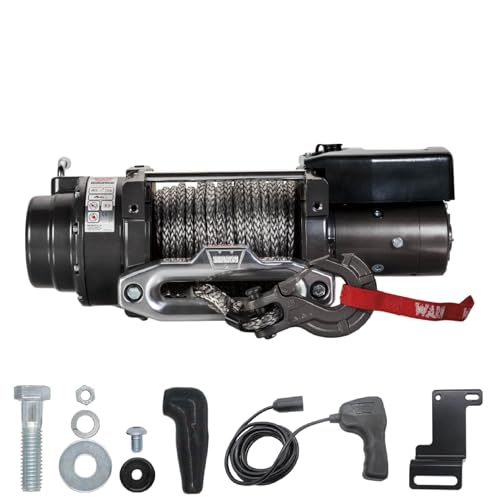 WARN 16.5ti-S WARN 16.5ti-S |
| Rating | ★★★★☆ 4.5 142 ratings | ★★★★★ 4.8 381 ratings | ★★★★☆ 4.6 19 ratings |
| Capacity | 17,500 lb | 12,000 lb | 16,500 lb |
| Rope | Steel | Synthetic | Synthetic |
| Remote | Wireless | Wired | Wired |
| Price | $706.74 as of Oct 14, 11:17 pm | $797.00 as of Oct 14, 8:49 pm | $3,141.59 as of Oct 14, 11:17 pm |
| Check Price → | Check Price → | Check Price → |
Tire pressure management matters more on the diesel. A heavier nose sinks faster in sand, so you will air down further than a gas owner on the same trail. Airing back up then takes longer, which makes an on-board compressor worth the money. Front-end recovery gets harder too, since a stuck diesel Power Wagon gives a strap or winch line more weight to move.
Sizing deserves honesty here. WARN recommends 1.5 times gross vehicle weight rating, and a Power Wagon’s 10,000-pound GVWR puts the arithmetic at 15,000 pounds. Plenty of owners run 12,000-pound units anyway and accept the thinner margin. Decide first how often you plan to be buried to the frame with a trailer behind you.
Power Wagon Drag Race Verdict: Which Engine to Order
The diesel wins the acceleration argument outright. It runs a second quicker through the quarter mile, nearly doubles towing capacity, and adds roughly 1,200 pounds of payload. For anyone who tows near the limit or drives at elevation, the Cummins is the better truck.
Price complicates the recommendation. The Cummins option alone adds $12,995, which lifts the starting price to $89,560. TFL’s tested example stickered slightly over $103,000, roughly $40,000 above the entry-level gas Power Wagon it raced, which TFL described on camera as the most affordable version built. Few buyers need everything separating those two trucks, and much of the spread buys leather and screens rather than capability.
Off-road buyers face the sharper tradeoff. Losing the factory winch and carrying a heavier nose both work against the exact mission the Power Wagon was designed for. A gas Power Wagon with an aftermarket winch remains the more focused trail truck, and it costs far less.
Running costs deserve their own homework. Diesel HD trucks have a reputation for stronger resale, though no published figure covers a truck this new, so treat it as a reasonable expectation rather than a number you bank on. Fuel, DEF, and filter service pull the other way against a gas truck.
Choose the Cummins if towing drives the purchase. Trail-focused buyers should stay with the gas truck. TFL plans off-road, efficiency, and towing tests on both, and those results will tell owners more than a quarter-mile time ever will. Our earlier first look at the diesel Power Wagon covers the launch details and the full option structure.
Frequently Asked Questions
Who won the Power Wagon drag race?
The Cummins diesel won the standing quarter mile decisively, running 16.17 seconds against 17.25 for the gas truck. It also won the 30 mph rolling race, although by a much smaller margin after the gas V8 jumped ahead early.
What is the Power Wagon Cummins 0-60 time?
TFL measured a Power Wagon Cummins 0-60 time of 8.4 seconds at roughly one mile of elevation. The gas truck needed 9.81 seconds under identical conditions. Expect quicker figures from both trucks at sea level.
How much does the 2027 Power Wagon Cummins cost?
Pricing starts at $89,560, which reflects a $12,995 upcharge for the 6.7L Cummins over the standard gas engine. Adding the Level 2 equipment group and towing packages pushes a loaded example past $100,000.
Does the diesel Power Wagon come with a factory winch?
No. Ram dropped it because charge air cooler plumbing and front-axle weight won the fight for space at the nose, not because the engine would not fit. Owners who want recovery capability add an aftermarket winch of at least 12,000 pounds.
How much can the 2027 Power Wagon Cummins tow?
Ram rates the best-configured diesel Power Wagon at 19,630 pounds of towing and 2,930 pounds of payload. The specific truck TFL tested rated over 18,000 pounds of towing and 2,700 pounds of payload.
Is the diesel Power Wagon vs gas Power Wagon gap worth $12,995?
For heavy towing, yes. The diesel Power Wagon vs gas Power Wagon comparison shows roughly double the towing capacity plus a second of quarter-mile advantage. For trail use, the gas truck keeps its factory winch and carries less weight up front.
Related Reading
Full test footage and both drivers’ commentary come from TFLtruck’s published drag race. The reporting on why the factory winch disappeared comes from The Drive’s interview with Ram CEO Tim Kuniskis.