


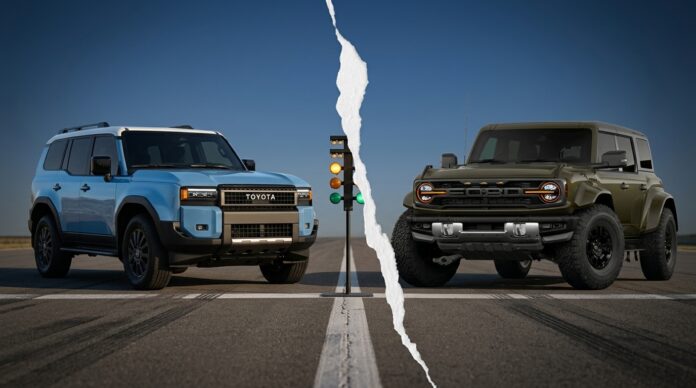

Quick Facts:
- The matchup: Land Cruiser vs Bronco Raptor over a quarter mile
- Who ran it: The Fast Lane Car, published August 7, 2026
- Winner: Bronco Raptor, 15.24 seconds
- Runner-up: Land Cruiser, 17.12 seconds, 9.74 seconds to 60 mph
- Margin: 1.88 seconds
- Conditions: Roughly 5,280 feet of elevation, near 100 degrees
- Torque leader: Toyota, 465 lb-ft against Ford’s 440 lb-ft
- Horsepower leader: Ford, 418 hp against Toyota’s 326 hp
- Price gap: About $22,000 between base stickers
8 min read
In This Article
- The Land Cruiser vs Bronco Raptor Drag Race
- Head-to-Head Specs at a Glance
- Why the Land Cruiser Lost With More Torque
- What Altitude and Heat Cost Both Rigs
- Land Cruiser vs Bronco Raptor Beyond the Drag Strip
- All-Terrain Tires for the Land Cruiser and Bronco Raptor
- Final Verdict
- Frequently Asked Questions
The Land Cruiser vs Bronco Raptor Drag Race
A Land Cruiser vs Bronco Raptor showdown normally happens on a rock ledge or a washed-out forest road, never on a drag strip. On August 7, 2026, The Fast Lane Car lined both rigs up for a quarter mile anyway. One truck brings more torque to the fight. The other brings more horsepower, plus 37-inch tires and a desert-racing suspension.
Credit for the run goes to TFL Studios, which published the clip on the Fast Lane Car channel. One host took the Ford Bronco Raptor. The other drove the Toyota Land Cruiser, selected Sport mode at the line, then watched the Ford shrink. Notably, the whole race happened because exactly one commenter asked for it.
Numbers landed hard. The Raptor stopped the clock at 15.24 seconds. Meanwhile, the Land Cruiser needed 17.12 seconds. TFL’s readout showed 9.74 seconds to 60 mph and a mid-70s trap speed. A 1.88-second gap over 1,320 feet is not a close race. In distance terms, the Toyota sat roughly 200 feet back when the Ford crossed. One host asked if Toyota had built a rare two-cylinder version.
Both rigs paid a tax for the venue. TFL tests near Denver, so the run happened roughly a mile above sea level on a day near 100 degrees. Therefore, neither number represents what either truck does at sea level. At low elevation, the published Bronco Raptor 0-60 figure is 5.6 seconds, while the Toyota needs 8.3 seconds. Both trucks slowed by a similar margin in Colorado, and the altitude section below shows exactly how much.
Video: The Fast Lane Car, August 7, 2026
Head-to-Head Specs at a Glance
Line the two up on paper and the mismatch shows itself before anyone touches a throttle. Toyota wins the torque column and the fuel column. Ford wins horsepower, gearing, tire size, and every off-road angle worth measuring. Both trucks ask for premium fuel, and Ford’s 418 hp rating assumes it.
| Specification | Toyota Land Cruiser (2026) | Ford Bronco Raptor (2026) |
|---|---|---|
| Engine | 2.4L turbo four with i-FORCE MAX hybrid | 3.0L twin-turbo EcoBoost V6 |
| Horsepower | 326 hp at 6,000 rpm | 418 hp (premium fuel) |
| Torque | 465 lb-ft at 1,700 rpm | 440 lb-ft (premium fuel) |
| Transmission | 8-speed automatic | 10-speed automatic |
| Curb weight | 5,541 lb as tested by Edmunds | 5,733 lb per Edmunds (Ford quotes about 5,814 lb) |
| Pounds per horsepower | 17.0 | 13.7 |
| Factory tires | 245/70R18 | 37×12.50R17 all-terrain (BFGoodrich KO2 on tested examples) |
| Ground clearance | 8.3 in | 13.1 in |
| Approach / departure | 30 / 22 degrees (1958 trim) | 47.2 / 40.5 degrees |
| Max water fording | Toyota publishes no figure | 37 in |
| Suspension | Double-wishbone front, multi-link coil rear; sway bar disconnect available on Land Cruiser grade | HOSS 4.0 with FOX Live Valve 3.1 dampers |
| Max towing | 6,000 lb | 4,500 lb |
| EPA combined | 23 mpg | 15 mpg |
| Quarter mile at altitude | 17.12 sec | 15.24 sec |
| Base MSRP | $57,600 (1958 trim) | $79,995 |
Notice the factory tire row. Neither stock choice targets trail grip, so the tire line is where most owners of either truck eventually spend money. Here is how current all-terrain options compare for both fitments.
| Top Pick | Balanced Choice | Most Reviewed | |
|---|---|---|---|
| Product | TOP PICK Falken Wildpeak A/T3W Falken Wildpeak A/T3W |  Toyo Open Country A/T III Toyo Open Country A/T III |  Hankook Dynapro AT2 Hankook Dynapro AT2 |
| Treadwear warranty | 55,000 mi | 65,000 mi (P-metric) | 60,000 mi |
| 3PMSF severe snow | Yes | Yes | Yes on 265/70R17 |
| Load range | E (10-ply) | SL, C and E | SL, E in LT sizes |
| Price | $248.51 as of Sep 26, 7:03 pm | $262.01 as of Sep 26, 7:03 pm | $176.06 as of Aug 27, 10:33 am |
| Check Price → | Check Price → | Check Price → |
Why the Land Cruiser Lost With More Torque
Toyota’s spec sheet promises a knockout. The hybrid four-cylinder makes 465 lb-ft at 1,700 rpm. Therefore it beats the Ford’s torque by 25 lb-ft, and it peaks far earlier. On a rock face, an early torque peak is exactly what you want. Down a drag strip, it counts for almost nothing.
Power to Weight Beats Peak Torque
Acceleration follows horsepower per pound, not torque per pound. Divide curb weight by output and the picture snaps into focus. The Land Cruiser hauls 17.0 pounds for every horsepower. Ford’s rig carries 13.7 pounds per horsepower, a 19 percent advantage. Consequently, the Raptor pulls harder at every speed above walking pace, even while weighing 192 pounds more.
Torque describes twisting force at one moment. Horsepower describes how fast a truck applies force over time, because horsepower equals torque multiplied by engine speed. Toyota’s peak arrives at 1,700 rpm and then fades. Ford’s V6 keeps pulling to redline, and a 10-speed gearbox holds it there.
Gearing and Tire Size Tip the Scales Further
Gearing widens the gap. Ford spreads its power across 10 forward ratios, so each upshift drops the engine into a narrow band near peak output. Toyota works with 8 ratios tuned for towing 6,000 pounds and returning 23 mpg. In addition, the hybrid system adds electric assist off the line, although the battery contribution tapers quickly under sustained load.
Tire size plays a quieter role. The Raptor’s 37-inch rubber raises effective gearing, which normally hurts acceleration, yet Ford compensated with 4.70:1 axle gears. Toyota’s 245/70R18 tires stand about 31.5 inches tall, so the Land Cruiser starts with a mechanical advantage it never converts into speed. Thin air erased what little remained.
What Altitude and Heat Cost Both Rigs
TFL runs its acceleration tests near Denver, where standard air density sits roughly 15 percent below sea level. Add a 100-degree afternoon and the deficit grows toward 24 percent. Both engines wear turbochargers, which recover a large share of the loss, although neither escapes it entirely.
Compare the altitude numbers against published sea-level tests and the symmetry is striking. Car and Driver recorded a 14.4-second quarter mile for the Bronco Raptor at 94 mph. Edmunds measured 16.3 seconds at 85.8 mph for the Toyota. Therefore, the Ford gave up 0.84 seconds in Colorado while the Toyota gave up 0.82 seconds.
In other words, thin air punished both trucks by a similar margin. Treat the comparison as directional rather than exact, since each outlet times runs under its own protocol and rollout convention. The 1.88-second gap is no altitude artifact, though. Move both rigs to sea level and the Ford still wins by roughly 1.9 seconds.
Heat matters for a second reason. Sustained pulls at 100 degrees push intercoolers and transmission fluid toward their limits, especially for a hybrid carrying a battery pack. A Colorado summer run therefore represents a realistic worst case rather than a fluke. Anyone living above 4,000 feet should treat these two times as useful.
Land Cruiser vs Bronco Raptor Beyond the Drag Strip
Flip the surface and the argument flips with it, at least partly. Ford still holds the harder numbers. The Raptor clears 13.1 inches of ground against 8.3 for the Toyota. It also approaches obstacles at 47.2 degrees against 30 degrees, and fords 37 inches of water. Toyota publishes no wading figure at all for the US Land Cruiser.
Where the Land Cruiser answers back is width, towing, and running costs. Ford’s fenders push the Raptor to about 86 inches across the body. Consequently, tight Eastern trails and tree-lined shelf roads become a paint-scraping exercise. Toyota’s rig fits a standard trail corridor and tows 6,000 pounds against Ford’s 4,500-pound rating.
Fuel changes the math on a long trip. At 23 mpg combined against 15, the Toyota travels roughly 53 percent farther on the same gallon. For example, over a 1,200-mile overland loop at $4 per gallon, the difference works out near $110. Moreover, the $22,395 gap between base stickers tilts the ownership case hard toward Toyota before a single trail mile passes.
Long-term ownership deserves a mention too. Our breakdown of Ford Bronco reliability scores puts the nameplate ahead of the Wrangler and behind the 4Runner in current Consumer Reports data. Whichever badge wins your driveway, both trucks meet at the same decision point once the factory rubber wears out.
All-Terrain Tires for the Land Cruiser and Bronco Raptor
Neither rig leaves the factory on a tire built for elapsed times, and neither should. Ford ships 37×12.50R17 all-terrain rubber, and the KO2 version weighs about 71 pounds per corner. Because of the weight, many Raptor owners pair a tire upgrade with a beadlock-capable wheel. Toyota fits a 245/70R18 highway-leaning tire, a size and tread choice consistent with its 23 mpg rating.
For owners of either truck, an all-terrain remains the practical upgrade. All-terrains hold highway manners and add sidewall protection without the drone of a mud-terrain. Most current designs also carry a 3PMSF severe-snow rating. Specifically, we ran the Falken Wildpeak AT3W against the Milestar Patagonia M/T in our all-terrain vs mud-terrain comparison. Budget-minded owners should also read our Milestar Patagonia AT Pro review. It undercuts premium pricing while keeping a winter rating.
For a quick look at all-terrain options sized for either truck, the picks below make a fair starting point.
All-terrain tires featured in this article

Milestar Patagonia A/T Pro 265/70R17 115T SL 17 inch Tire

Yokohama Geolandar X-AT All Terrain 275/65R18 116T XL Light Truck Tire
Falken Wildpeak AT3W all_ Terrain Radial Tire-245/70R17 119S
Size discipline matters more than brand. Going up two sizes on a Land Cruiser without regearing costs acceleration you already lack. The drag-race result shows how little margin the Toyota has. On the Raptor, Ford tuned the FOX dampers around a 37-inch tire, so anything larger deserves a careful fitment check first. Whatever you fit, correct pressure off pavement returns more traction than any tread pattern. Our guide on how to air down your tires covers the numbers.
Final Verdict
The Bronco Raptor won because it deserved to win. Ford built a desert truck with 418 horsepower, 10 gears, and 5,733 pounds to move. A 1.88-second win over a quarter mile is the honest result. Anyone shopping for speed, jump landings, and high-desert whoops has one answer here.
Toyota’s rig loses the sprint and keeps a long list of other arguments. The 465 lb-ft peak still moves a trailer, and the hybrid still returns 23 mpg. Meanwhile, the $57,600 entry price undercuts Ford by more than $22,000. Buyers who stick to forest roads rather than desert washes trade away clearance and angles, although they gain range, a narrower body, and $22,395.
The 9.74-second run to 60 mph deserves a caveat. Edmunds recorded 8.3 seconds at low elevation, so the Toyota is slow rather than broken. Owners above 4,000 feet should still plan passing maneuvers with more room than the spec sheet suggests, especially with a trailer attached.
If speed matters and trail width matters more, look at a Bronco Badlands with the Sasquatch package. It undercuts both trucks on price and measures over six inches narrower across the body than the Raptor. For a Toyota-only shortlist, our 2026 Land Cruiser full comparison against the 4Runner sorts out which one suits your trips.
Frequently Asked Questions
What is the Bronco Raptor 0-60 time?
Car and Driver recorded 5.6 seconds to 60 mph at low elevation, along with a 14.4-second quarter mile at 94 mph. TFL did not publish a 0-60 figure for its Colorado run, though the 15.24-second quarter mile suggests roughly 6.3 seconds under those conditions.
How much horsepower does the Land Cruiser make?
The 2026 model produces 326 combined horsepower at 6,000 rpm from a 2.4-liter turbocharged four-cylinder paired with Toyota’s i-FORCE MAX hybrid system. Peak torque reaches 465 lb-ft at 1,700 rpm, which exceeds the Bronco Raptor’s output by 25 lb-ft.
Why did the Land Cruiser lose with more torque?
Acceleration tracks horsepower per pound rather than peak torque. Ford moves 13.7 pounds per horsepower against Toyota’s 17.0, and a 10-speed transmission keeps the V6 near peak output through every shift. Toyota’s torque peak arrives at 1,700 rpm and fades well before redline.
Is the Land Cruiser better off-road than the Bronco Raptor?
Ford wins the measured numbers with 13.1 inches of clearance, a 47.2-degree approach angle, and 37 inches of fording depth. Toyota wins on trail width, towing capacity, and fuel range. Tight wooded trails favor the Land Cruiser; open desert favors the Raptor.
How much does altitude slow a quarter-mile run?
At roughly 5,280 feet, both trucks lost about 0.8 seconds against their published sea-level times. Turbocharged engines recover much of the deficit. Therefore the penalty stayed far smaller than a naturally aspirated engine would suffer.