


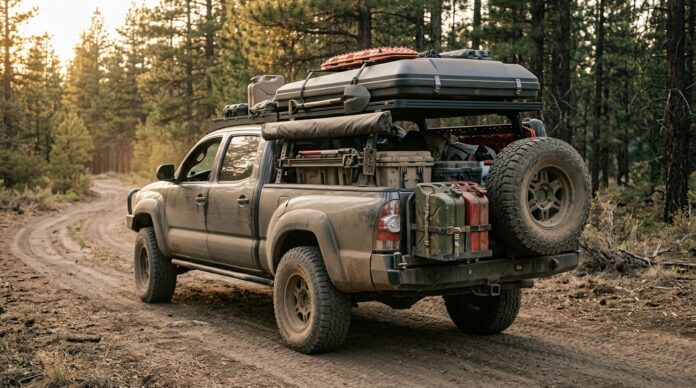
Quick Facts:
- Topic: Finding and fixing an overloaded overland build
- Skill level: Beginner, no tools required for the weigh-in
- Time required: About 30 minutes per visit, two visits
- Cost: $15.25 first weigh, $5.25 reweigh within 24 hours
- Typical finding: Rear axle over its GAWR while gross weight still looks legal
- Worst single offender: The roof, where every mid-size rig here fails a hard-shell tent on paper
- Lowest payload found: 880 lb, on one owner’s 2024 4Runner door jamb
- Best for: Anyone with armor, a winch, a rack or a tent already bolted on
17 min read
In This Guide
- Why an Overloaded Overland Build Feels Fine
- Your Real Payload Sits on the Door Jamb
- Payload by Platform: Five Rigs, Real Numbers
- The Weight Audit: The Parts Behind an Overloaded Rig
- The Roof: Where an Overloaded Overland Build Breaks the Rules
- How to Weigh Your Rig at a CAT Scale
- What an Overloaded Rig Does to Brakes, Bearings and Tires
- How to Fix an Overloaded Overland Build
- Airbags vs. Load-Rated Springs
- Final Verdict
- Frequently Asked Questions
Why an Overloaded Overland Build Feels Fine
An overloaded overland build almost never announces itself. Your truck starts, steers and stops. The rear sits low, so you add a spacer or a set of bags, and the stance looks right again. Nothing squeals. Nothing breaks on the way home. Because the failure mode arrives slowly, most owners drive years past their rating. Instead of one loud moment, you get a long quiet slide.
The numbers tell a harder story. One owner’s 2024 Toyota 4Runner TRD Off-Road left the factory with 880 lb of vehicle capacity weight printed on its door jamb. Two-row 2025 and 2026 trims read 895 lb. Two adults at real American body weights eat 370 to 400 lb of the sticker before any gear goes in. After a steel front bumper and a winch go on, you have burned half the sticker.
Below you get published payload figures trim by trim, real product weights for the parts you bolt on, and a step-by-step trip to a certified scale for the price of two coffees. Each figure is labeled by where it came from: a maker’s spec, a federal rule, or an owner’s scale ticket. Where two official sources disagree, you get both. For the underlying definitions, start with our explainer on payload capacity and GVWR basics, then come back here for the arithmetic.
What You’ll Need
Tools
- Smartphone with the free Weigh My Truck app installed
- Tire pressure gauge reading to at least 80 psi
- A clear photo of your driver’s door-jamb sticker
- Notepad or a notes app for four numbers
Materials
- $15.25 for a first weigh, $5.25 for a reweigh within 24 hours
- A full fuel tank
- Full water containers, as you travel with them
- Every item of gear from a normal trip
- The passengers who normally ride with you
Your Real Payload Sits on the Door Jamb
Marketing payload and legal payload are two different numbers. Toyota prints the distinction in its own brochures: “Payload Capacity is the calculation of GVWR minus curb weight and should be used for comparison purposes only.” Toyota then names the governing figure. It is the Load Carrying Capacity printed on the driver’s door jamb label.
Federal rule sits behind the sticker. FMVSS 110 requires a placard on every light vehicle. It reads “The combined weight of occupants and cargo should never exceed XXX kilograms or XXX pounds.” The same standard sets normal occupant weight at 68 kilograms, or 149.9 lb per seat. CDC data puts the average American adult male at 199 lb and the average adult female at 172 lb. As a result, five real adults run 190 to 250 lb past the federal assumption. For tire compliance, the standard models only three occupants, totaling 449.7 lb.
The Brochure Number and the Sticker Number Differ
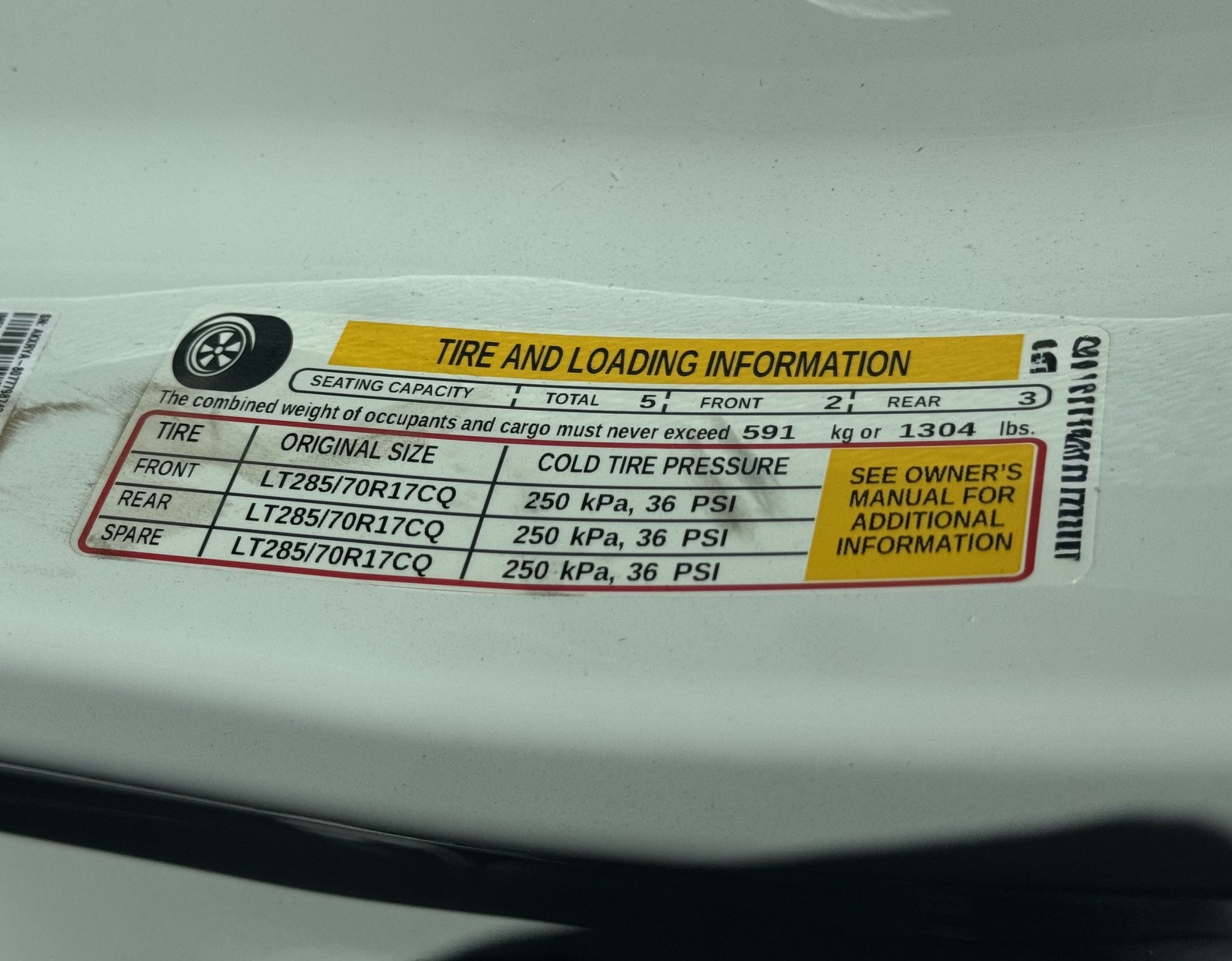
The gap between brochure and sticker runs wide. Owners of 2025 and 2026 4Runners report 895 lb on the label across the two-row trims posted so far. Meanwhile, those same gas trims compute to between 1,390 and 1,550 lb using GVWR minus curb weight. Press units tell the same story. For example, a 2024 Land Cruiser 250 stickered at 957 lb. Similarly, 2024 Tacoma hybrid press trucks came in near 1,200 lb against an advertised 1,705 lb.
Dealer accessories make it worse, and federal rule accounts for them too. FMVSS 110 requires the capacity figure to be corrected, most visibly by a label reading “CAUTION – LOAD CARRYING CAPACITY REDUCED.” The trigger is the lesser of 1.5 percent of GVWR or 100 lb of equipment added before retail sale. On a 5,500 lb GVWR rig it bites at 83 lb. A recent Toyota load-label recall turned on exactly this rule. Our coverage of the load carrying capacity label walks through how the correction works.
| Specification | Details |
|---|---|
| GVWR | Maximum loaded weight of the whole vehicle, set by the maker |
| GAWR front and rear | Maximum weight each axle carries, printed only on the door jamb for Toyota and Nissan |
| Vehicle capacity weight | Occupants plus cargo, the yellow sticker figure, governs your specific truck |
| Curb weight | Factory weight with standard equipment only, stale the moment you modify |
| Federal occupant assumption | 149.9 lb per seat, from 1960s body data |
| Tire compliance assumption | Only three occupants, 449.7 lb total, for a five-seat truck |
Payload by Platform: Five Rigs, Real Numbers
Trim choice moves payload more than most buyers expect. Nissan advertises 1,620 lb of maximum payload on the Frontier. However, a PRO-4X crew cab long bed 4×4 carries 1,100 lb. An SL crew long bed 4×4 carries 1,020 lb. Roughly a third of the headline figure disappears the moment you pick the trim overlanders want.
Trail Essentials Every Overlander Carries

X-BULL New Recovery Traction Tracks Sand Mud Snow Track Tire Ladder…

VIAIR 88P 00088 12V Portable Air Compressor Kit for Car and Truck T…

Tacoma Payload Capacity and the 4Runner Gap
Toyota splits the same way. Tacoma payload capacity peaks at 1,705 lb on the TRD Off-Road i-FORCE MAX double cab. Meanwhile, the SR5 XtraCab 4×4 prints 1,230 lb. The previous generation SR5 double cab 4×4 works out to 1,155 lb by Toyota’s own subtraction. On the SUV side, 4Runner payload capacity is harder to pin down. Toyota publishes no payload row for the model at all.
| Toyota trim | Curb (lb) | GVWR (lb) | Payload (lb) | Basis |
|---|---|---|---|---|
| 2026 Tacoma TRD Off-Road i-FORCE MAX 4×4 | 5,030 | 6,735 | 1,705 | Toyota, published |
| 2026 Tacoma Trailhunter 4×4 | 5,410 | 6,835 | 1,425 | Toyota, published |
| 2026 Tacoma SR5 XtraCab 4×4 | 4,375 | 5,605 | 1,230 | Toyota, published |
| 2023 Tacoma SR5 Double Cab 4×4 V6 | 4,445 | 5,600 | 1,155 | Computed, GVWR minus curb |
| 2026 4Runner TRD Off-Road 4WD | 4,850 | 6,240 | 1,390 | Computed, GVWR minus curb |
| 2026 4Runner Trailhunter | 5,500 | 6,505 | 1,005 | Computed, GVWR minus curb |
| 2025 and 2026 4Runner, two-row trims | varies | varies | 895 | Door-jamb sticker, owner-reported |
| 2024 4Runner TRD Off-Road Premium | 4,675 to 4,805 | 6,300 | 880 | Door-jamb sticker, owner-reported |
The Overland Trims Start With the Least Payload
Factory armor costs real capacity before you buy a single part. A 2026 4Runner Trailhunter computes to 1,005 lb, and a TRD Pro to 1,050 lb. Both are hybrid-only trims carrying steel bumpers, rails, skids and a rack from the line. So 4Runner payload capacity falls hardest at the top of the range. Similarly, a long-bed Tacoma Trailhunter runs 380 lb heavier than a TRD Off-Road hybrid within 100 lb of the same GVWR. For the privilege it gives up 280 lb of payload.
| Jeep, Ford and Nissan trim | Curb (lb) | GVWR (lb) | Payload (lb) | Basis |
|---|---|---|---|---|
| 2026 Gladiator Rubicon | 5,031 | 6,250 | 1,200 on jeep.com, 1,100 in the Stellantis media sheet | Both published, and they disagree |
| 2026 Gladiator Mojave | 5,042 | 6,250 | 1,100 | Maker, published |
| 2026 Gladiator Sport and Willys | 4,695 to 4,860 | 5,800 to 5,950 | 1,025 | Maker, published |
| 2026 Bronco 4-door Badlands 2.3L | 4,919 | 6,160 | 1,177 | Maker, published |
| 2026 Bronco Raptor 4-door | 5,814 | 6,850 | 1,155 | Maker, published |
| 2026 Bronco 2-door Badlands | 4,673 | 5,740 | 1,067 | Maker, published |
| 2025 Frontier PRO-4X crew 5-ft 4×4 | 4,759 | 6,012 | 1,220 | Maker, published |
| 2025 Frontier PRO-4X crew long bed 4×4 | 4,861 | 6,012 | 1,100 | Maker, published |
| 2025 Frontier SL crew long bed 4×4 | 4,928 | 6,012 | 1,020 | Maker, published |
Two details deserve a flag. First, Jeep and Stellantis publish Rubicon payload figures differing by 100 lb off the same 5,031 lb curb weight. Treat the lower one as your working number. Ford, in contrast, publishes curb, GVWR, front and rear GAWR and payload for every trim and engine. As a result, a Bronco is the easiest rig here to budget honestly.
The Weight Audit: The Parts Behind an Overloaded Rig
Armor arrives heavier than the brochure photos suggest. An ARB Summit bull bar for a Tacoma runs 170 lb, and the newer Summit MKII 176 lb. Expedition One’s RangeMax front bumper lists 150 lb. CBI publishes both materials on one product page: 110 lb in steel, 55 lb in aluminum. Coastal Offroad shows the same split at 110 lb versus 54 lb. Therefore aluminum saves close to half the mass, and Coastal’s pair does it at a thicker gauge than the steel it replaces.
Out back, the swing-out is the expensive part. Expedition One rates its plain Tacoma rear bumper at 80 lb. A single swing lists 180 lb, and a dual swing 200 lb. A carrier therefore costs roughly 100 to 120 lb. Worse, all of it hangs behind the rear axle where leverage works against you.
Rope, Steel or Aluminum Changes the Total
Winch weight splits on rope choice. Warn’s own sell sheet lists the VR EVO 10 at 74.74 lb with steel cable. The synthetic-rope VR EVO 10-S lists 55.20 lb. Rope choice alone saves 19.5 lb on the same winch. Sliders and skids follow a similar pattern with different ratios. For instance, aluminum skid sets save 43 to 52 percent across RCI and Talons Garage pairs. Aluminum sliders save only about 19 percent on the one pair a maker publishes, because the legs and mounting plates stay steel.
Consumables Weigh More Than the Hardware
Consumables surprise people most. Water weighs 8.34 lb per gallon, so 20 gallons is 167 lb. Also, our guide to how much water to carry puts a five-day trip for two at 166 lb. A Dometic CFX3 45 weighs 41.2 lb empty and roughly 103 lb packed, since contents outweigh the box about 1.5 to 1.
| Component | Typical weight | Lighter option |
|---|---|---|
| Steel front bumper | 110 to 176 lb | Aluminum, 54 to 55 lb |
| Winch, 10,000 lb class | 74.74 lb with steel cable | 55.20 lb with synthetic rope |
| Rear bumper with dual swing-out | 200 lb | Plain rear plate at 80 lb, or a 65 lb hitch carrier |
| Rock sliders, per pair | About 160 lb steel | 130 lb aluminum |
| Full skid plate set | 120 to 147 lb steel | 65 to 71 lb aluminum |
| Full-length roof rack | 45 to 80 lb | Shorter tray, or a bed rack only |
| Hard-shell rooftop tent | 130 to 220 lb | Ground tent, 2 to 12 lb |
| 45 L fridge, packed | 103 lb | Smaller 20 L unit |
| Water, 20 gallons | 167 lb | Carry less, filter more |
| Steel drawer system | About 200 lb | Plywood build at 75 to 100 lb, or totes |
| 35-inch Load Range E tires and wheels, five corners | Plus 135 lb over stock | Load Range C saves about 30 lb |
| Two adults | 370 to 400 lb at real US averages | No option here |
Add It Up on a Real Tacoma
Run a conservative tally on a Tacoma holding 1,155 lb of payload. Steel front bumper 130 lb, winch 75 lb, rear bumper with carrier 200 lb, sliders 146 lb, skids 128 lb, rack 55 lb, tent 140 lb, fridge packed 103 lb, ten gallons of water 83 lb, drawers 200 lb. Overland build weight from bolt-ons alone reaches 1,260 lb. Nobody has climbed in yet. Now cut the same list to aluminum armor, a synthetic winch, a bed rack and totes. Overland build weight then drops by roughly 400 lb, and the only capability you surrender is the swing-out carrier.
From experience: After years of building my own rigs, and looking closely at other people’s on the trail, I see one pattern repeat. The builds photographing best are usually the ones riding lowest in the rear. Their owners rarely know it, because the change arrived one accessory at a time. Nobody sets out to overload a truck. You add armor for a trip, drawers for organization, a tent for comfort. Each decision looks small on its own. My general observation is simple. People who weigh early build differently from people who weigh late. The ones who never weigh keep explaining away symptoms.
The Roof: Where an Overloaded Overland Build Breaks the Rules
Two ratings govern your roof, although most owners hear about only one. Dynamic rating applies while the vehicle moves, when bumps multiply the load and cornering adds side force. Static rating applies while parked. Thule states the rule plainly: “Always use the dynamic weight limit as your guide when planning your packing.”
Now compare published numbers. Toyota rates the fifth-generation 4Runner roof at 120 lb. The 2025 sixth generation reads 125 lb for 2WD and 135 lb for 4WD. Ford lists 110 lb dynamic on a four-door hardtop Bronco. Jeep allows 100 lb on a Gladiator and spells out the catch: “this includes the weight of the crossbars.”
The Rooftop Tent Weight Limit Nobody Meets
iKamper publishes a minimum requirement for its flagship tent. The Skycamp 3.0 needs a dynamic roof load of 165 lb or more. Its own published weight is 165 lb. Not one mainstream mid-size platform here meets the requirement before a rack goes on. A Gladiator misses it by 65 lb. One mismatch therefore turns a rooftop tent weight limit into the most common paper failure in overlanding. Our honest take on whether rooftop tents are worth it covers the trade you are being asked to make.
Work a real example. A fifth-generation 4Runner allows 120 lb. Its full Prinsu rack lists 65 lb shipping weight. Next, add a Skycamp 3.0 at 165 lb, and you reach 230 lb against a 120 lb limit. Even a lighter Roofnest Falcon at 140 lb exceeds a Bronco’s 110 lb rating on its own, before any rack.
A Stronger Rack Does Not Raise the Vehicle Limit
Rack strength never rescues the arithmetic. Yakima says so directly: “The product load rating… is distinct from the vehicle’s roof load rating. Refer to the owner’s manual to verify vehicle roof load limits. The lowest load rating dictates the maximum load rating.” Yakima then applies a further reduction once you leave sealed roads, up to 33 percent on most mounts and 50 percent on some. Notably, unsealed roads are exactly where overlanders drive.

Gazelle Tents™ T4 Hub Tent, Easy 90 Second Set-Up, Waterproof, UV Resistant, Removable Floor, Ample Storage Options, 4-Person, Alpine Green, 94" x 94" x 78", GT400GR
A ground tent brings your roof load back under the dynamic rating without touching the rack.
- Pitches on the ground, so it never counts against a roof rating
- 90-second pop-up hub design needs no rack upgrade
- Removable floor doubles as a stand-up dressing area
- 30 lb packed versus 130 to 220 lb for a hard-shell tent
- Bulkier to stow than a backpacking tent
- Needs level ground, unlike a rack-mounted shelter
Safety note: Roof weight raises your center of gravity far more than the same weight in the bed. NHTSA rates rollover resistance using a static stability factor built from track width and center of gravity height. Ford puts its own warning in writing. Roof cargo, in Ford’s words, “will tend to make your vehicle more top heavy, causing it to lean more in corners and creating a greater possibility of vehicle rollover.” Move heavy items low and inboard first.
How to Weigh Your Rig at a CAT Scale
Guessing ends here. CAT Scale charges $15.25 for a first weigh and $5.25 for a reweigh within 24 hours. Those figures come from its own FAQ, checked in July 2026. Drivers reported the increase taking effect on 05/01/2026. No appointment is necessary, CAT says so on its own FAQ, and the intercom lane asks for no CDL or DOT number. The official CAT Scale instructions cover a solo pickup explicitly.
Step 1: Load the Rig Exactly as You Travel
Fill the fuel tank. Next, fill the water containers you normally carry. Load every drawer, every recovery item and the fridge with food in it. Then bring the passengers who ride with you. A half-packed weigh-in produces a number with no use whatsoever.
Step 2: Position the Truck Across the Platforms
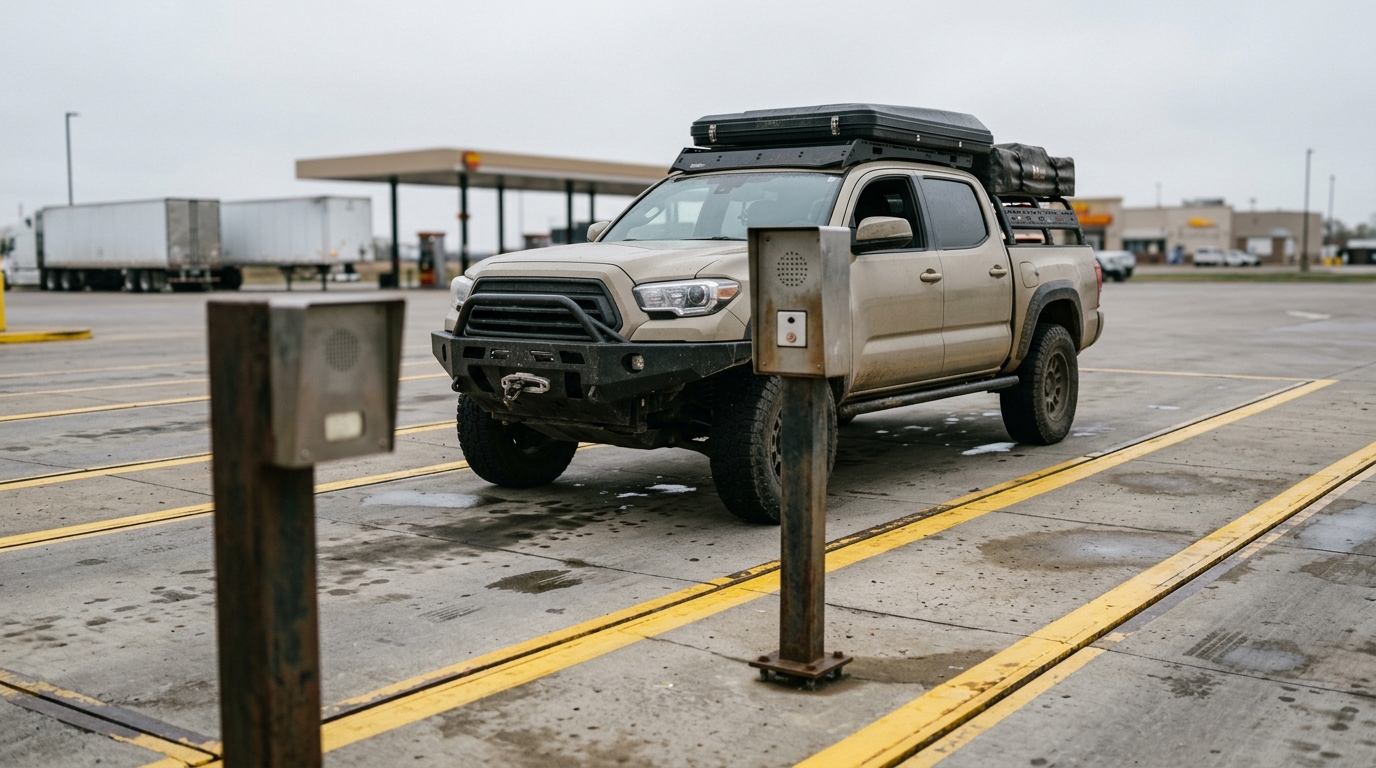
Three platforms sit in a line, and platform one is closest to the intercom sign. Put your front axle on platform one, then your rear axle on platform two. Platform three stays empty for a solo truck, or reads your trailer axles while you tow.
Step 3: Buy the Ticket and Read It Per Axle
Press the intercom, or use the free Weigh My Truck app to pay from the cab. Your ticket lists steer axle, drive axle and gross weight. Compare steer against front GAWR, drive against rear GAWR, and steer plus drive against GVWR. Our reporting on rear axle GAWR ratings explains why one overloaded axle matters even when gross weight looks legal.
Step 4: Weigh Again Empty to Find Your True Payload
Strip the gear, return to the same scale within 24 hours and pay the $5.25 reweigh. Subtract the empty figure from your loaded figure, and you have your real cargo weight. Now subtract the empty figure from GVWR. The result is the payload you truly own today, rather than the one printed at the factory.
Rear-axle findings dominate the results. For example, one Frontier owner running a camper scaled 3,020 lb front and 4,180 lb rear. Gross came to 7,200 lb, against a 6,012 lb GVWR and a 3,434 lb rear GAWR. His rear axle sat 746 lb over rating while his front axle had room to spare. Notably, the split is the exact signature of a rear-loaded overloaded overland build.
Safety note: Never unhitch a trailer on the scale platform. RV weighing guides report scale operators prohibit disconnecting on the deck. Pull off first, park in a trailer space, disconnect there, then return for the reweigh.
What an Overloaded Rig Does to Brakes, Bearings and Tires
Camp Power and Comfort Favorites



Lighthouse 600 Multi Functional Adjustable Light Perfect for Camping
Bearings punish overload on a curve, never a line. Timken rates tapered roller bearing life with an exponent of 10/3. A 20 percent axle overload then leaves about 54 percent of rated life, a loss near half. Push to 50 percent over, and roughly a quarter of the original life remains.
Brakes get tested to a ceiling and no further. FMVSS 135 validates light-vehicle stopping performance at two load conditions only, lightly loaded and GVWR. Above GVWR your brake system sits outside any tested envelope. Also, the heat problem grows with mass, because kinetic energy scales with weight. Long descents, not single stops, are where owners notice.
Tires fail through heat. NTSB names the mechanism as overdeflection, arising from underinflation or overload. In NTSB’s words, overdeflection “causes heat buildup as well as stresses and strains along the shoulder and belt edges of a tire,” and tread separations often follow. The industry body USTMA adds a warning about delay, noting underinflation or overloading leads to tread and belt separation “even at a later date.”
Run the Pressure Math Once You Have Axle Weights
Take a rear axle scaling 4,200 lb, or 2,100 lb per tire. On a Toyo LT225/75R16 load table, 50 psi carries 1,940 lb and 55 psi carries 2,060 lb, both short. At 60 psi the same tire carries 2,190 lb, so 60 psi becomes your minimum cold pressure. A driver following a door placard calling for 45 psi sits 310 lb per tire beyond rating. Meanwhile he believes the factory number protects him.

JACO ElitePro Digital Tire Pressure Gauge - Professional Accuracy - 100 PSI
The load table only protects you if the pressure you set matches the number on it.
- Reads to 100 psi, covering every Load Range E cold pressure on the table
- Calibrated to within 1 psi so the table number matches the tire
- Backlit display reads clearly at a dark trailhead
- Rugged brass and steel build fits in a glovebox
- Needs a battery, unlike a simple dial gauge
- No bleed valve for fast deflation before a trail
How to Fix an Overloaded Overland Build
Order matters more than product choice. Remove weight first, because every pound you delete is a pound no spring, bearing or tire has to manage. Owners report real savings. Pulling a steel drawer system frees 200 lb. Swapping a rooftop tent for a ground tent saves roughly 150 lb. Removing rear seats frees 60 lb, and leaving two camp tables home saves 33 lb.
Springs come second, and only after the scale. A load-rated leaf pack raises spring rate, so the axle stops living on the bump stops, although it changes nothing about GVWR. Owner-quoted pricing runs $548 for a General Spring heavy pack shipped. An Alcan custom pack starts near $690, and a Deaver-built overland pack lands around $1,200. Our piece on why you should upgrade suspension last explains the sequencing trap.
Airbags Level the Stance, Nothing More
Here is the misconception the community corrects most often. Airbags never raise payload capacity. Instead they add weight, so strictly speaking they lower it. Air Lift answers the question on its own FAQ. Asked whether air springs increase a vehicle’s weight rating, the company replies with one word: “No.” One owner put the masking problem well: “Airbags don’t change towing or payload capacity, only stance.” On a half-ton truck the effect is cosmetic. Because your rear sits level again while rear GAWR stays exceeded, you have hidden a symptom rather than solving it.
A Trailer Moves the Load, With a Catch
Towing shifts mass off your axles, and plenty of owners take this route after a bad ticket. Remember the tongue, though. Roughly 10 to 15 percent of a trailer’s weight lands on the hitch, and hitch weight counts against payload exactly like a fridge does. Before assuming a trailer solves everything, weigh the truck alone and the truck coupled, then compare.
You Cannot Re-Rate Your Own GVWR
One route never works. NHTSA’s chief counsel put it on record in a 1991 interpretation letter. Only the vehicle maker, a final-stage builder or an alterer assigns a GVWR. A change by any other party carries no legal effect under Part 567. New springs, bigger brakes and E-rated tires all improve how the truck behaves. Still, the rating on your door jamb stands.
What Each Fix Costs
| Cost Item | DIY | Hiring a Pro |
|---|---|---|
| Weigh-in, loaded plus a reweigh | $20.50 at a CAT scale | $60 to $80 for wheel-position RV weighing |
| Removing gear you stopped using | $0, and often resale income | Not applicable |
| Progressive bump stops, SumoSprings or Timbren | $199 to $415 in parts | Parts plus shop labor, request a quote |
| Airbag helper spring kit | About $250 per set, owner-quoted | Parts plus shop labor, request a quote |
| Load-rated leaf pack | $548 shipped, owner-quoted | About $600 installed at a local spring shop |
| Custom overland spring pack | $690 base to about $1,200 | Add labor to the same parts figure |
Every price above comes from owner-quoted totals posted on ClubFrontier, Expedition Portal, TacomaWorld and WanderTheWest, plus published CAT Scale, RVSEF and Escapees rates. Treat them as a planning range, since parts pricing moves.
Safety note: Leaf spring work puts you under a raised vehicle with a compressed spring pack. Use rated jack stands on level ground, never a jack alone, and support the axle before releasing U-bolts. Also, some airbag kits require removing the factory bump stop, which costs you droop protection off-road, so read the fitment notes before ordering.
Airbags vs. Load-Rated Springs
The biggest difference is what each one changes. Airbags add adjustable support at one point in the travel, letting you dial ride height for a given load. Load-rated springs change the rate through the whole stroke. As a result, the axle resists the load rather than being propped up near the end of it.
Cost and reversibility favor bags. A kit runs about $250 per set, installs in an afternoon and comes off again if you sell the truck. Springs cost twice to five times as much, take longer, and permanently stiffen the empty ride. Notably, owners repeatedly report buying one step softer than they needed, then paying again.
Pick by load pattern. While your rig stays heavy every trip, springs match the job, and the harsher unloaded ride matters little. If you load heavy occasionally and drive empty midweek, bags give you the range. Either way, neither product raises a rating. Both also add a few pounds to the same figure you want to reduce.
Airbags: Pros
- About $250 per set, roughly half the cost of a heavy leaf pack
- Adjustable on the fly, so you match pressure to the day’s load
- Installs in an afternoon with hand tools
- Fully reversible before resale
- Restores level stance, improving headlight aim and steering feel
- Air Lift builds bump stops into many kits, keeping droop protection
Airbags: Cons
- Zero effect on GVWR, GAWR or legal payload
- Adds the kit’s own weight, which comes straight off usable payload
- Masks an overloaded rear axle by restoring ride height
- Many Firestone applications require removing the factory bump stop
- Bags teed together accentuate body roll, so plumb them separately
- Does nothing to move weight forward onto an underloaded front axle
Final Verdict
If you have armor, a winch, a rack and a tent fitted, and you have never seen a scale ticket, odds favor you sitting over at least one rating. Rear GAWR fails first in most cases. The strongest thing weighing gives you is not a verdict. It is a budget you own rather than inherit.
The trade-offs are real and worth naming. Weighing costs you an afternoon, and it might force a decision you would rather postpone, such as selling a tent you love. Owners chasing maximum capability on a mid-size platform will find the numbers unforgiving. Some of them conclude correctly, moving to a three-quarter-ton truck. The bigger truck costs more to buy and more to run, so it deserves the same honest math.
Two tickets and 30 minutes cost $20.50, then tell you exactly which axle needs attention. Set it beside one wheel bearing job, or a $1,200 custom leaf pack chosen on a guess.
Weigh the rig, then decide. If the numbers land under every rating, keep building with the remaining margin written on your dash. Should they land over, cut gear first, then buy springs matched to a measured load rather than a hoped-for one. When both steps leave you heavy, look seriously at an off-road trailer or a heavier platform, because no aftermarket part changes the rating stamped on your door.
Totes That Replace a Steel Drawer System

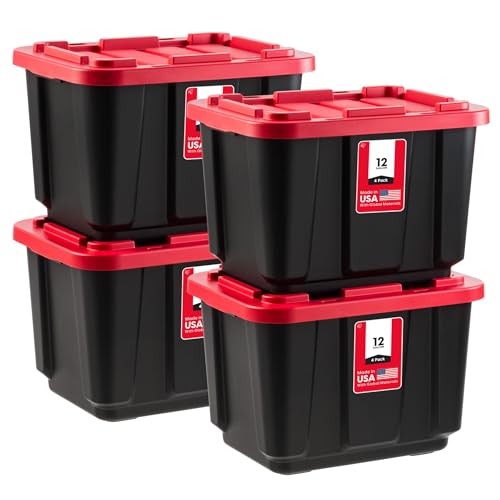
IRIS USA 4-Pack 12 Gal Heavy Duty Storage Tote Bins with Lids

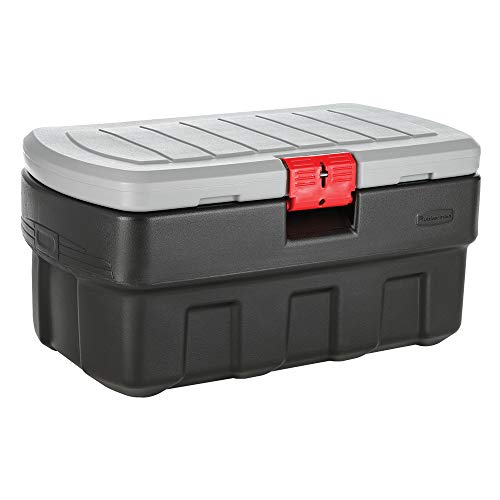
Rubbermaid 48 Gallon Black Action Packer Lockable Latch Indoor and …
Frequently Asked Questions
How do I know if my overland build is overloaded?
Weigh it loaded at a certified scale. Then compare three numbers against your door-jamb sticker: front axle against front GAWR, rear axle against rear GAWR, and the sum against GVWR. Symptoms such as rear sag, bump stop contact and uneven tire wear point the same direction, although only a ticket settles it. Rear GAWR usually fails first on an overloaded overland build.
What happens if you exceed payload capacity?
Wheel bearing life drops faster than the overload itself, roughly 46 percent of life gone at 20 percent over rating, using Timken’s published rating-life equation. Brakes operate outside the load range FMVSS 135 ever tested, tires build heat through overdeflection, and a raised center of gravity reduces rollover resistance. None of these show up on day one, which is why owners miss them.
Is it illegal to drive over GVWR?
It depends heavily on your state. Most states enforce axle weights, bridge limits, tire sidewall ratings and registered weight rather than the maker’s GVWR. Pennsylvania is the clear exception. There, 75 Pa.C.S. section 1304(d) caps a truck’s registered gross weight at the lowest of its axle, tire and horsepower limits, the maker’s GVWR, or its combination rating. Exceeding the registered weight is then a summary offense under section 4945, carrying a $75 fine, plus a further $75 for each 500 lb once you sit more than 3,000 lb over the limit. California, in contrast, works from the tire rather than the rating. CVC section 35550(c) caps each wheel at the lesser of the load molded on the sidewall or 620 lb per lateral inch of tire width, which is a wheel-loading rule rather than a GVWR offense.
How much weight can you put on a roof rack while driving?
Use the dynamic figure in your owner’s manual, not the rack’s rating, then subtract the rack’s own weight. Published dynamic limits run 100 lb on a Gladiator including crossbars, and 110 lb on a four-door hardtop Bronco. A fifth-generation 4Runner allows 120 lb, and a 2025 model 125 to 135 lb. Static ratings apply only while parked, which covers sleeping in a tent, never the drive to camp.
Can you legally increase a vehicle’s GVWR?
No. NHTSA has stated in writing: only a maker, a final-stage builder or an alterer assigns or modifies a GVWR. An owner performing no manufacturing operation has no route to change it. Heavier springs, upgraded brakes and E-rated tires all improve behavior under load. Still, the label governs your truck legally and for warranty purposes.
Related Reading