



Some links in this article are Amazon affiliate links. Purchases made through them support 4wdTalk at no extra cost to you.
Quick Facts:
- Topic: Payload capacity and GVWR for overland trucks and SUVs
- Payload formula: GVWR minus curb weight equals payload capacity
- Typical midsize payload: 1,100 to 1,700 lbs before you add anyone or anything
- Hidden build weight: A full overland build often eats 800 lbs or more
- Main symptoms: Rear sag, longer braking, sway, and tire failure
- Safe target: Stay near 80 percent of rated payload for off-road use
- Best fix: Weigh at a CAT scale, then cut weight or add load support
- Best for: Overlanders and DIY builders who want to keep a rig legal and safe
8 min read
In This Guide
- Payload Capacity Overview: The Number Overlanders Ignore
- Key Weight Numbers at a Glance
- How to Calculate Your Real Payload Capacity
- The Hidden Weight of an Overland Build
- Symptoms of an Overloaded Truck
- Payload Capacity vs Towing Capacity
- How to Fix or Manage an Overloaded Rig
- Final Verdict
- Frequently Asked Questions
Payload Capacity Overview: The Number Overlanders Ignore
Payload capacity is one of the most overlooked specs in the overland world, and blowing past it is why so many rigs sag, brake poorly, and chew through tires. In practice, payload is the total weight your truck carries above its own curb weight. Therefore it includes every passenger, every gallon of fuel, and every piece of gear you bolt on or throw in the bed. In fact, most owners never check the number until something breaks or a scale surprises them.
I learned this firsthand on a 2020 Jeep Gladiator. On paper the Gladiator looked capable, yet its payload ran roughly 1,100 to 1,700 lbs depending on trim. After a bed rack, a rooftop tent, a drawer system, a fridge, water, fuel, and two adults, the build budget vanished quickly. Since then I moved to a Chevy Colorado ZR2, which carries a similar midsize limit near 1,150 lbs. The lesson stuck: capable-looking trucks run out of payload long before they run out of trail.
This guide targets overlanders and DIY builders who want honest math instead of marketing. First, we cover how to calculate your real payload capacity. Next, we break down the hidden weight of a full build. Afterward, we map the warning signs of an overloaded truck and lay out practical fixes. For broader planning, our guide to building a lighter overland rig pairs well with the numbers below.
Key Weight Numbers at a Glance
Before you calculate anything, learn the core ratings governing how much weight your rig handles safely. For example, each number appears on the door-jamb sticker or in the owner manual, and each one limits a different part of the truck. Understanding all four keeps you from confusing payload with towing or axle limits.
| Rating | What It Means |
|---|---|
| GVWR | Gross Vehicle Weight Rating: the maximum a loaded truck is allowed to weigh, set by the manufacturer |
| Curb weight | The empty weight of the truck with fluids but no people or cargo |
| Payload capacity | GVWR minus curb weight: everything you add, including passengers, fuel, and gear |
| GAWR | Gross Axle Weight Rating: the maximum load allowed on the front or rear axle |
| GCWR | Gross Combined Weight Rating: the truck plus a loaded trailer combined |
Level a Sagging Rig
Firestone Ride-Rite Air Helper Spring Kit
Rear air helper springs restore ride height and control on a loaded truck. Adjustable air pressure lets you dial in support for the trail and back off when empty.
How to Calculate Your Real Payload Capacity
To calculate payload capacity, start with the formula printed on your door jamb: GVWR minus curb weight equals payload. For example, my Colorado ZR2 sticker works out to roughly 1,150 lbs of payload, a figure typical of a modern midsize truck. The number looks generous until you remember what has to fit inside it. In practice, the sticker overstates what you truly have for gear.
Here is the step most guides skip. Before you count a single piece of overland kit, subtract the people and the fuel. Two adults average around 340 lbs together. A full tank of fuel adds another 120 to 160 lbs. Therefore the 1,150 lb budget already dropped closer to 650 lbs before I loaded a fridge, water, or recovery gear. This is why so many overlanders learn they are overloaded the first time they weigh in.
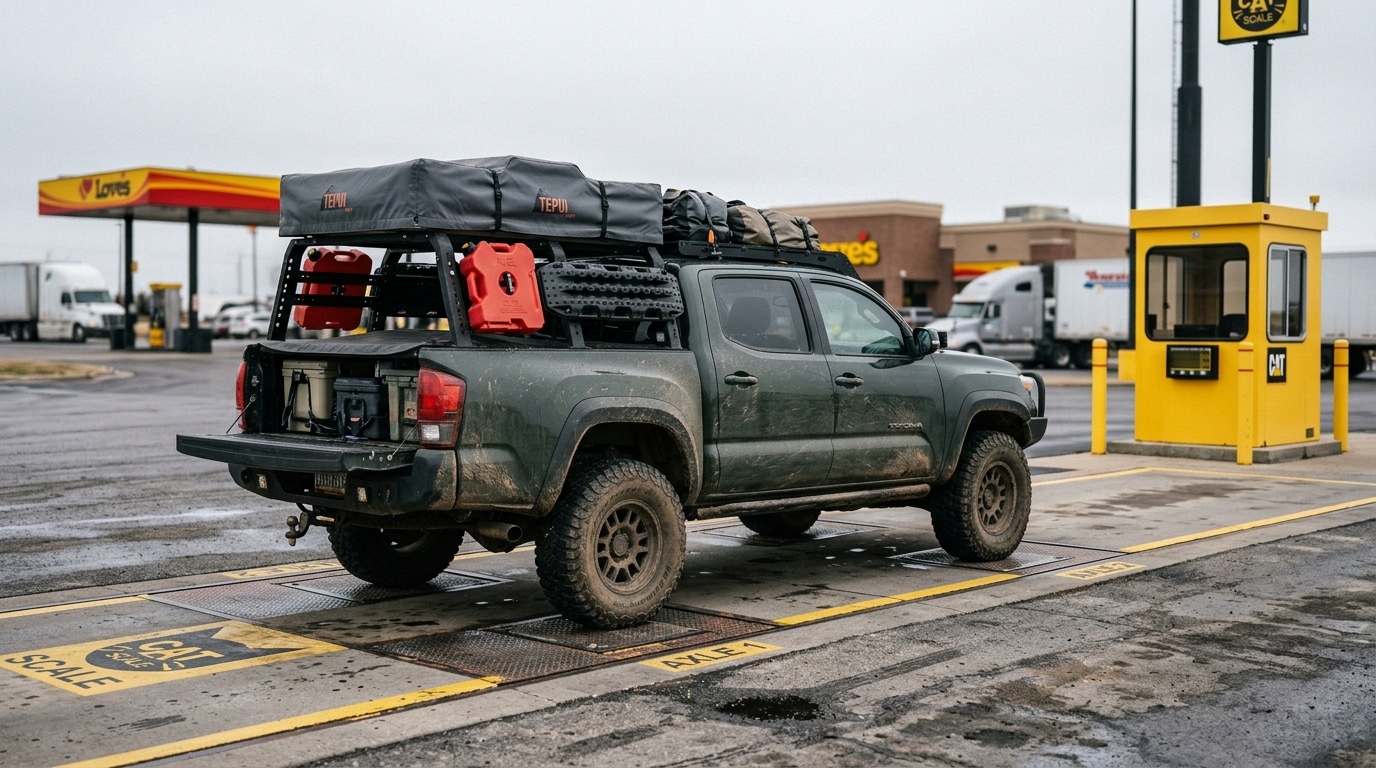
The gold standard is a public CAT scale at a truck stop, which costs around 15 dollars and weighs each axle separately. Specifically, weigh the rig fully loaded, with passengers, full fuel, and every trip item aboard. Compare each axle result against your GAWR and the total against your GVWR. Because the sticker payload assumes a bone-stock truck, real-world weighing is the only way to trust the number.
The Hidden Weight of an Overland Build
The reason overland trucks get overloaded is simple: build weight adds up faster than anyone expects. Individually each item seems reasonable. As a result, they overwhelm a midsize payload budget together. Below is a representative breakdown from a typical midsize overland build, drawn from published product weights and my own scale results.
| Gear Item | Typical Weight |
|---|---|
| Hardshell rooftop tent | 120 to 160 lbs |
| Bed rack or roof rack | 70 to 120 lbs |
| Steel front bumper and winch | 150 to 200 lbs |
| Drawer system | 80 to 130 lbs |
| 12V fridge (loaded) | 55 to 75 lbs |
| Water (6 gallons) | 50 lbs |
| Recovery gear and tools | 60 to 90 lbs |
| Auxiliary fuel and spare fluids | 40 to 70 lbs |
Add those ranges together and a full build lands between 625 and 895 lbs before food, clothing, or a second passenger. On my Gladiator the accessories alone crossed 800 lbs, which explains why the rear sat low on every trip. A rooftop tent weight and load rating deserves special attention, because roof loads also raise the center of gravity and stress the roof rating, not only the payload total.
Symptoms of an Overloaded Truck
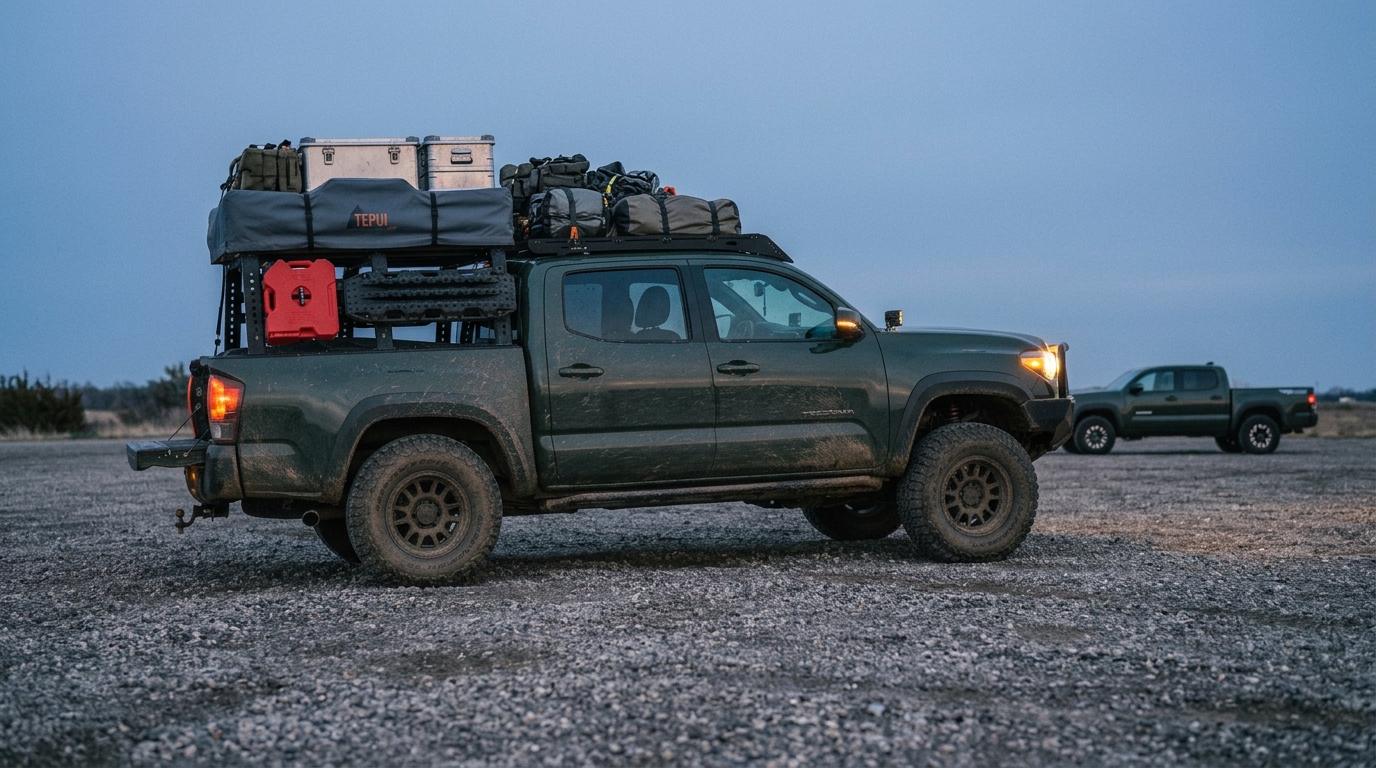
An overloaded rig announces itself through handling long before a spring breaks. The clearest tell is rear sag, where the back of the truck squats and the headlights tilt upward into oncoming traffic. Because the suspension is compressed, the truck also rides harshly over washboard and bottoms out on obstacles it once cleared. These signs point straight to an exceeded payload capacity.
Braking suffers next. In addition, extra weight lengthens stopping distances and overheats the brakes on long descents, a serious risk on mountain grades. Steering feels loose and vague, and the rig sways in crosswinds or when a truck passes. On dirt, a tall, heavy load makes the vehicle top-heavy and twitchy through corners. Consequently, an overloaded truck is harder to control exactly when the terrain demands precision.
Finally, tires take the worst hit. When axle weight exceeds the tire load rating, sidewalls flex, heat builds, and blowouts follow, especially on rough washboard at speed. This is where choosing the right overlanding tires and matching load range to your loaded weight becomes safety equipment, not a style choice. Therefore, check the load index against your heaviest axle reading from the scale.
Payload Capacity vs Towing Capacity
Payload capacity and towing capacity measure two different limits, and confusing them causes real trouble. Specifically, payload is the weight carried on the truck itself. By contrast, towing capacity is the weight a trailer is rated to pull behind it. However, the two are linked, because trailer tongue weight lands on the truck and counts against payload.
Tongue weight usually runs 10 to 15 percent of trailer weight, so a 4,000 lb trailer drops 400 to 600 lbs onto your rear axle. This tongue load eats payload you might have already spent on gear. Therefore a trailer offers a smart way to move weight off the truck, provided you account for tongue weight in the math. Our look at offloading gear weight to a lightweight trailer explains how a light trailer keeps both numbers in check.
How to Fix or Manage an Overloaded Rig
Start with the truth, which means weighing the rig at a CAT scale and comparing each axle against its rating. As a working rule of thumb, aim to keep your loaded weight near 80 percent of rated payload, since off-road impacts and washboard multiply the load your suspension and tires see. Once you know your real numbers, the fixes fall into two camps: cut weight or support the weight you keep. Both matter, yet cutting weight is usually the more effective path for off-road performance.
To cut weight, audit the build item by item and remove what earns its keep least often. For example, swap a steel bumper for aluminum, trade a heavy drawer system for lighter storage, and carry the water and fuel each trip needs and no more. Moving bulky loads to a trailer also frees payload, as covered above. For inflation and recovery air management, a scalable off-road air system keeps essential tools light and organized.
Why Air Springs Do Not Raise Your Legal Limit
Air helper springs and heavier leaf packs restore ride height and control on a loaded truck, which improves safety and handling. Yet they do not raise your legal GVWR or payload rating. Those numbers are fixed by the manufacturer and tied to the brakes, frame, and axles, so no suspension upgrade changes them. Use load support to manage a legal load better, not as permission to carry more than the sticker allows. For a factory-legal jump in payload, the real answer is a heavier-duty platform.
Final Verdict
Payload capacity is the discipline separating a reliable overland rig from a sagging liability. For overlanders and DIY builders, the biggest strength of respecting the number is confidence: predictable braking, stable handling, and tires strong enough to survive the washboard. The 80 percent buffer covered earlier leaves a margin for the gear you always add mid-trip.
The real trade-off is comfort versus capability. In practice, a fully kitted midsize truck rarely stays under its limit once you add people and fuel, so honest owners either cut gear or step up in platform. Anyone unwilling to weigh in and trim the build should look at a half-ton or heavy-duty truck with a larger payload budget instead of forcing a small rig past its rating.
On value, the smartest money is a 15 dollar scale ticket and an honest gear audit, not another accessory. Load support such as air helper springs earns its place by leveling a legal load, while a portable compressor keeps those springs and your tires dialed in. Manage the weight first, then upgrade the suspension to carry it well.
Ready to Buy?
MORRFlate TenSix 12V Air Compressor
A dual-cylinder 150 PSI compressor tops off your air helper springs and reinflates tires fast after a trail run. It moves 10.6 CFM and airs up 35-inch tires in minutes.
Frequently Asked Questions
How to calculate payload capacity?
Subtract your curb weight from the GVWR listed on the door-jamb sticker. The result is payload capacity, the total weight for passengers, fuel, and gear. For a true figure, weigh the loaded rig at a CAT scale and compare it against the GVWR.
What does GVWR mean on a truck?
GVWR stands for Gross Vehicle Weight Rating, the maximum weight a fully loaded truck is rated to reach safely. It includes the vehicle, passengers, fuel, and all cargo. Exceeding it stresses the brakes, frame, and axles, so the manufacturer sets it as a hard limit.
What does payload capacity mean for overlanders?
For overlanders, payload capacity means the real budget left for a build after people and fuel. Because a full setup often eats 800 lbs or more, midsize trucks reach their limit fast. Respecting the number keeps handling, braking, and tires safe on the trail.
What is the difference between GCWR and GVWR?
GVWR limits the loaded truck by itself, while GCWR limits the truck and a loaded trailer combined. Since tongue weight counts against payload, both numbers matter when you tow. Check each rating separately before planning a trip with a trailer.
Do air springs increase payload capacity?
No. Air helper springs level a sagging truck and improve control, yet they do not raise the legal payload or GVWR. Those ratings stay fixed by the manufacturer. Use air springs to carry a legal load better, not to exceed the sticker.
How much does a typical overland build weigh?
A midsize overland build commonly adds 625 to 895 lbs in accessories alone, before food, water, and passengers. Roof tents, racks, bumpers, and drawers drive most of the total. Weighing at a scale is the only reliable way to know your figure.