


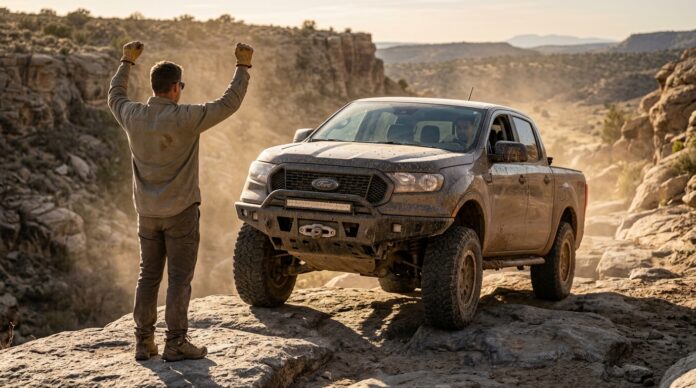

Quick Facts:
- Topic: Off-road hand signals, spotting, and running a group safely
- Core rule: One spotter, chosen by the driver. No signal, no movement
- Signals covered: 12 core spotter signals plus the WARN winch set
- Following gap: Three seconds minimum on dirt (state OHV curriculum)
- Winch standoff: 1.5 to 2 times the cable length for bystanders
- GMRS license: $35, ten years, no exam, covers your family (FCC)
- Gate rule: Leave gates as you found them (Tread Lightly)
- Best for: Trail leaders, tail gunners, and anyone new to convoy travel
16 min read
In This Guide
- Why Off-Road Hand Signals Have No National Standard
- The 12 Core Off-Road Hand Signals
- Off-Road Spotter Position and the One-Spotter Rule
- Trail Leader and Tail Gunner: Who Runs What
- The Off-Road Driver’s Meeting
- Radio Protocol for Off-Road Groups
- Gate Rules and the Access You Are Protecting
- Spacing, Dust, and Keeping the Column Together
- Off-Road Winch Signals and Where Vendors Disagree
- Off-Road Hand Signals vs. Radio: Which Runs the Show
- Final Verdict: Your Group’s Off-Road Hand Signals Standard
- Frequently Asked Questions
Why Off-Road Hand Signals Have No National Standard
Off-road hand signals feel like settled knowledge until you compare two published sets side by side. They disagree on the single most important one. The Happy Trails 4-Wheel Drive Club handbook says stop is both hands in fists, while Bullhide 4×4 publishes stop as one closed fist. A third version sits in The Ranger Station’s additional signals: crossed arms with closed fists, recorded at an Overland Expo demo.
Now compare OSHA’s crane signals, where stop is an open palm swung back and forth. Four sources, four different answers, and one of them is federal law for a different machine. The International 4 Wheel Drive Trainers Association publishes its own skills document, and it opens by admitting many options exist. Its stop is both clenched fists, siding with Happy Trails. A Rising Sun 4WD Club member put the situation plainly on the club forum. There should be common hand signals, he wrote, but for the most part there are not.
Why the Standard Never Formed
The reason is structural rather than cultural. Crane signaling has a federal licensor and a written rule, so it converged. Recreational four wheeling has no licensor, no exam, and no single body with authority over clubs, trainers, and vendors, so it never did. Federal rules even require a posted signal chart at a crane site, plus a full stop the moment signal contact breaks. Trail hand signals therefore work only when your group agrees on them before the first obstacle.
If this is your first group run, none of this should worry you. Your job back in the line is simpler than the leader’s. Know the twelve signals below, hold your spacing, call your turns, and stop when you lose sight of your spotter. This guide gives you the working set, the positioning rules behind it, and the group structure the signals depend on. Treat your own trail hand signals as a local agreement, renewed at every trailhead.
The 12 Core Off-Road Hand Signals
Signals 1 to 6: Motion and Direction
Twelve signals cover almost every obstacle a stock or mildly built rig meets. Each row below names where the signal comes from, so you know which ones rest on a club handbook and which come from a state safety course. Rows 11 and 12 come from those courses as riding signals rather than spotter signals, and groups borrow them for use on the move. First print the table, then hand it out at the trailhead, and finally adjust it as a group.
| Signal | What it looks like | Where it comes from |
|---|---|---|
| 1. Stop | Closed fist held high, or both fists | Happy Trails club handbook; Bullhide 4×4 |
| 2. Come forward | Palms toward you, fingers drawing in | Happy Trails club handbook |
| 3. Distance to the obstacle | Palms facing each other, closing as the gap closes | Happy Trails club handbook |
| 4. A little more | Thumb and index finger pinching together | Bullhide 4×4; Rising Sun club forum |
| 5. Turn toward the driver side | One hand points the way, the other calls the motion | Jim Allen set, via The Ranger Station |
| 6. Turn toward the passenger side | Same pairing, opposite direction | Jim Allen set, via The Ranger Station |
Signals 7 to 12: Terrain, Speed, and Hazards
| Signal | What it looks like | Where it comes from |
|---|---|---|
| 7. Turn the wheels without rolling | Closed fist on the motion hand, pointing hand stays out | Jim Allen set, via The Ranger Station |
| 8. Back up | Index fingers pointing back, or pointing at the driver and drawing toward yourself | Happy Trails handbook; Overland Expo demo |
| 9. This tire will lift | Palm up, hand raised on the lifting side | Happy Trails club handbook |
| 10. This corner will drop | Hand lowered on that side, sometimes a swoop down and up | Overland Expo demo, via The Ranger Station |
| 11. Slow down | Arm out to the side, palm down, pressing down | State OHV curriculum (UT, MI, NH) |
| 12. Hazard on this side | Arm pointing down at the hazard on the side it sits | State OHV curriculum (UT, MI, NH) |
The Two-Hand Method Behind the Set
Jim Allen’s method is the most useful mechanic in the whole set, because it explains why single-signal charts fall apart on real obstacles. One hand carries direction. The other carries motion. Hold up a closed fist and point with the other hand, and you have told the driver to turn the wheels while standing still. Open the fist, and the same pair now means turn and roll.
Make the Signal Big Enough to Read
Size matters as much as shape. A Rising Sun club member describes standing far enough back to spot the whole obstacle, while using whole-arm signals above his head instead of small finger gestures. Small movements read as noise through a dusty windshield at spotting distance. Big ones, in contrast, read as instructions.
Hand signals run the obstacle in front of you, while radio runs the miles between obstacles, and the ladder below prices out the radio half of the same system, from handheld up to the 50-watt mobile the power limits above point toward.
| Budget Handheld | Rugged Handheld | 15W Mobile | Top Pick | |
|---|---|---|---|---|
| Product |  BTECH GMRS-V2 Handheld BTECH GMRS-V2 Handheld | 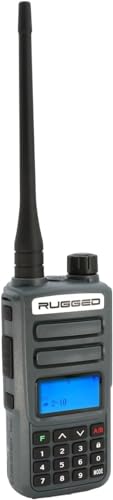 Rugged Radios GMR2 Plus Rugged Radios GMR2 Plus |  Midland MXT275 15W Mobile Midland MXT275 15W Mobile | TOP PICK Midland MXT575 50W Mobile Midland MXT575 50W Mobile |
| Rating | ★★★★☆ 4.3 559 ratings | ★★★★★ 4.7 200 ratings | ★★★★☆ 4.6 1,814 ratings | ★★★★☆ 4.6 262 ratings |
| Format | Handheld | Handheld | Mobile (Fixed Mount) | Mobile (Fixed Mount) |
| Max Power | 5W | 2W | 15W | 50W |
| Price | $44.89 as of Sep 20, 11:12 am | $72.25 as of Sep 20, 11:12 am | $199.99 as of Sep 20, 11:12 am | $439.99 as of Sep 20, 12:37 pm |
| Check Price → | Check Price → | Check Price → | Check Price → |
Say Driver and Passenger, Never Left and Right
This is the convention nearly every source agrees on. The Ranger Station states the reason directly: your left and the driver’s left are not the same. Bullhide gives the same advice. An IH8MUD poll on the question drew 29 voters: 21 chose driver and passenger, 7 preferred hand signals over words entirely, and 1 chose left and right.
Right-hand-drive imports break the shortcut, so name the convention out loud at the briefing when one runs with the group. For example, a club member on the same thread describes a driver who reversed a correction and dropped a front tire off a ledge. Ambiguity costs sheet metal.
Off-Road Spotter Position and the One-Spotter Rule
Where the spotter stands decides whether the signals mean anything. Modern Jeeper puts the spotter far enough from the vehicle to see underneath it and down both sides. The Ranger Station then adds the framing rule: stand in front, face the vehicle, and stay far enough back to read the whole picture rather than one tire.
Two prohibitions carry over from industrial spotting, where the same job kills people. Never stand between the vehicle and a fixed object. Avoid crossing from one side to the other while the vehicle moves. The CORE 4×4 trail leader guide adds a third rule for mountain work: do not walk or stand directly downhill of any vehicle.
Safety note: Watch your own footing before you watch the vehicle. The Ranger Station advises stopping the vehicle and finding a place to stand instead of walking backward over uncertain ground while signaling. Backing over loose rock is how a spotting job becomes an injury.
One Off-Road Spotter, Chosen by the Driver
The Happy Trails handbook states two rules in a row. There should only be one spotter at a time, and the driver should be the one to pick the spotter. Modern Jeeper then explains the failure mode. Because anyone else offering hand signals confuses the driver, confusion leads to a mishap.
A Rising Sun member describes the failure exactly. While pre-running Cliff Hanger in Moab, two people started spotting him from about four feet apart. One pointed left and yelled left. Meanwhile the other pointed right and yelled right. Therefore he stopped, everyone laughed, and one person finished the job.
One controlled exception exists. The Ranger Station allows a second spotter at the rear or another problem area. The second person only yells stop or wait at the primary spotter, who then signals the driver. Either way, the chain of command stays single. Industrial backing guidance sets the same limit: when more than one spotter is needed, only one gives signals to the driver.
No Signal, No Movement
The Happy Trails handbook gives the cleanest version. A spotter stays visible to the driver at all times, the driver trusts the spotter, and no signal means no movement. It adds the rule most groups skip. If your spotter turns to walk ahead, stop the vehicle.
The Ranger Station states the driver’s half. Keep your eyes on the spotter, and if you lose sight of him, stop and get his attention. The spotter watches the trail while the driver watches the spotter. OSHA’s backover guidance says the same for work vehicles, while crane rules make it law: when signal contact breaks, operations stop until it comes back.
Ask First, and the Driver Stays in Command
Ask before you spot. Happy Trails says not everyone needs or wants a spotter, while Modern Jeeper tells potential spotters to always ask first. The Hump’N’Bump event guidelines go further and tell trail helpers to drop the attitude when a driver declines. Notably, Vegas Valley’s reminder list even includes flashing your headlights at a spotter to wave off help.
Authority stays with the driver throughout. The Ranger Station frames spotting as handing over half the control and half the blame. Happy Trails adds a second point: the driver remains in command and decides whether to trust the spotter. A driver’s meeting line quoted from a club forum settles the rest: if you wreck your truck, do not blame the spotter.
Trail Leader and Tail Gunner: Who Runs What
The signal set depends on a group structure. Two roles carry it. The trail leader runs the front, while the tail gunner runs the back, a job also called sweep, drag, whip, or tail-end Charlie. Tom Severin notes the last name is World War II slang for a bomber’s rear gunner. Similarly, a helper in the middle is a mid-gunner.
CORE’s trail leader guide is blunt about authority. On a trail ride the leader runs the group even when board members or more experienced people are present, and personal safety ranks above having a memorable trip. For the wider etiquette, see our guide to 4×4 convoy rules of the trail. Spotting hand signals sit inside the same package of group agreements.
What the Trail Leader Owns
The Vegas Valley event guidelines itemize the job. Leading the official route without bypasses comes first, along with running the driver’s meeting. He also confirms each vehicle belongs on the trail, spots when needed, manages or delegates recovery, handles repairs, and guides participants back to the road. Notably, the final duty carries an explicit warning against simply giving directions instead.
Severin’s published list adds the planning half. First, know the trail and drive it at least once. Next, contact the agency about fire bans, closures, and permits. Then keep an eye on three vehicles behind rather than one. Finally, sequence the group deliberately: newbies right behind the leader, the slowest driver up front to set pace, and winches alternated on hard trails.
He also warns against the accordion idea, where every driver watches only the vehicle behind and the chain holds itself together. Because it does not work well, stop and let the group close up instead.
What the Tail Gunner Owns
Severin publishes ten duties for the tail end, and the most valuable ones are structural. The tail gunner tells the leader when the group has cleared key turns, since the leader sees only a vehicle or two back. Before the group starts up again, he counts every vehicle. As the last one out of camp, he also catches the fire someone left burning and the gear someone left behind.
Three more duties matter on a busy trail. First, the tail gunner warns the group about vehicles overtaking from behind. Second, he thanks oncoming traffic and tells them he is the last one through. Third, Severin has him escort a damaged but drivable rig back to the road, while the Vegas Valley guidelines add staying with a disabled vehicle. Expedition Portal assigns gate closing to the same seat.
Leapfrog Spotting Between the Leader and the Mid-Gunner
Leapfrog spotting is the most useful published technique these roles share. First, the leader pulls well past an obstacle, walks back, and spots until the mid-gunner arrives. Then the leader moves forward while the mid-gunner takes over spotting. Finally, the group repeats the pattern at the next hard section.
The Off-Road Driver’s Meeting
Since no standard exists, the briefing creates one for the day. CORE’s template treats the radio channel as a blank to fill in rather than an assumption. Likewise Severin’s plan names written instructions, a tailgate briefing, radio gear, and spotting hand signals as one package, plus a radio check before leaving.
- Signal set. Run the 12 signals above, and settle stop first.
- Driver and passenger, never left and right. Name any right-hand-drive rig in the group.
- Radio channel, plus a backup channel and who has no radio.
- Order of travel: leader, newbies, slowest driver, mid-gunner, tail gunner.
- Gate assignment and who confirms each gate.
- Spacing rule, and what happens at junctions in dust.
- The one-spotter rule, and the driver’s right to decline a spot.
- Turnaround plan, bail-out points, and who to call.
Radio Protocol for Off-Road Groups
Radios carry the group between obstacles, while spotting hand signals carry it through them. Two things have to be settled before the first mile: what everyone is running, and what everyone says on it.
GMRS Licensing and Power Limits for Off-Road Groups
GMRS is the common choice, since the licensing is simpler than most people expect. The FCC charges $35, the license runs ten years, no exam applies, and you must be 18 or older.
One rule makes GMRS the practical group choice. Under 47 CFR 95.1705, the license covers your immediate family, and the rule names them: spouse, children, grandchildren, stepchildren, parents, grandparents, stepparents, brothers, sisters, aunts, uncles, nieces, nephews, and in-laws. Notably, the same section lets anyone use your station to pass an emergency message.
Power limits explain why cheap handhelds disappoint. Under 47 CFR 95.1767, GMRS mobiles and repeaters run up to 50 watts on the eight 462 MHz main channels. Fixed stations get 15 watts, while handhelds get only 0.5 watt on the 467 MHz interstitial channels. In contrast, FRS tops out at 2.0 watts on channels 1 through 7 and 15 through 22, and 0.5 watt on channels 8 through 14. For comparison, our roundup of the best CB radios for overlanding compares the options, and our primer on radios for off-roading and overlanding explains the bands.
Channel Conventions Are Club Practice, Not Standards
No FCC rule and no national association designates an off-road calling channel. MTU Four Wheelers publishes CB channel 4 as its club channel. In contrast, CORE’s own event announcement used channel 22, while its briefing template leaves the channel blank. GMRS channel 16 circulates in the community with a four-times-four mnemonic, although nothing official backs it. Therefore assign the channel at the meeting.
Radio Discipline That Keeps a Column Together
Vegas Valley publishes the mechanic worth copying. The leader calls out milestones as he passes them, such as intersections and obstacles. Then mid and tail gunners call the same points as they reach them, so the leader knows how far back the group sits. Gunners also report large gaps as soon as they open.
Three placement rules follow from radio range. CORE puts people without radios in the middle, between vehicles with radios. Expedition Portal places trucks with short antennas or weak range in the middle so messages relay. Severin, meanwhile, puts ham operators at the back.
Keep the channel clear otherwise. Expedition Portal describes effective radio work as simple direction and hazard warnings, without overwhelming the line with chatter. Lead and rear vehicles own oncoming traffic calls, especially where visibility is poor or the track has blind corners.
Gate Rules and the Access You Are Protecting
Radio and signals keep the group intact. Gates decide whether the group gets to come back. Tread Lightly’s wording is exact and worth quoting to your group: leave gates as you found them. Notice what it does not say. Nowhere does it say close every gate. An open gate on a grazing allotment is sometimes open on purpose so stock reaches water, and closing it strands animals from a water source.
Wyoming attaches a criminal penalty to the other half. Statute 6-9-202 covers gates and bars in a fence crossing a private road, river, stream, or ditch. Opening one and neglecting to close it is a misdemeanor with a fine up to $750. Since equivalent statutes elsewhere remain unconfirmed, treat Wyoming as the example rather than the rule.
Expedition Portal assigns gate closing to the last driver, and clubs publish the same split. The ACT 4WD Club writes it plainly: unless directed otherwise, Tail End Charlie carries responsibility for any gate closures. Twin Rivers 4×4 Club publishes the other half: the second vehicle pulls aside, opens and shuts the gate, then rejoins ahead of the tail gunner. Whichever pattern you use, name it at the briefing and confirm each gate on the radio.
Access loss is not hypothetical. In late July 2026 the Wyoming Game and Fish Department and BLM closed several roads and two-tracks near Evanston, after landowners complained about unauthorized travel damaging private ground. A BLM spokeswoman summarized it in one line: the landowners are sick of having their land torn up. Nobody has documented a closure caused specifically by an open gate, although the pattern is the same.
Spacing, Dust, and Keeping the Column Together
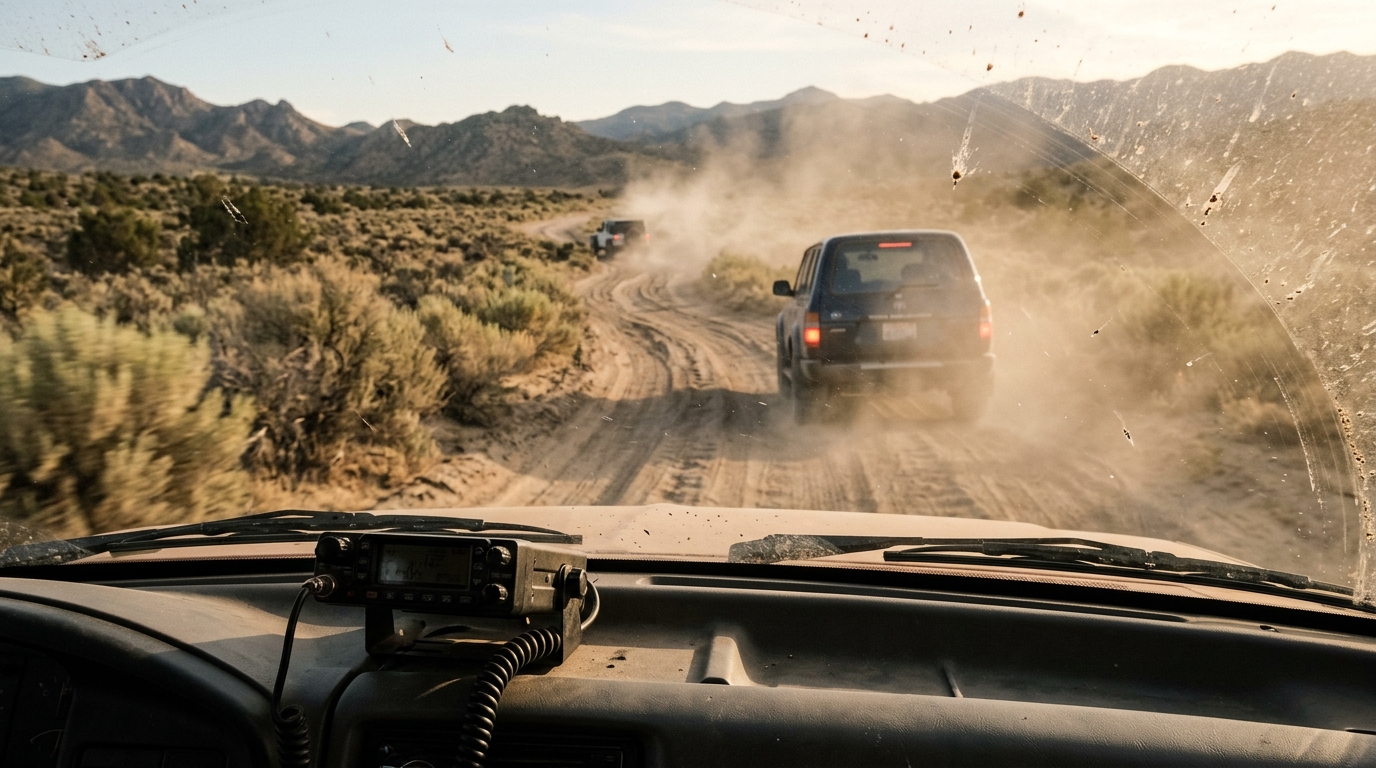
Harry Wagner, an Overland Expo driving instructor, gives the rule in one sentence: keep the vehicle behind you in sight at all times. He then adds the dust condition. When dust is severe enough to break line of sight, stop at every crossroad so the vehicle behind knows where to go.
MTU Four Wheelers publishes the same idea as a hard rule. When you turn onto any trail or road, make sure the vehicle behind you makes the same turn. Deschutes County 4 Wheelers then explains the failure chain. Because the vehicle in front of you loses sight of you, the gap runs up the line to the leader.
Midland MXT575 50W MicroMobile GMRS Two-Way Radio
The 50-watt ceiling set by 47 CFR 95.1767 marks the top of this power class, and this mobile runs at the full legal limit instead of the reduced power most handhelds settle for.
The One Hard Number for Following Distance
Three seconds is the firmest number published in an off-road-specific safety source. The Illinois OHV course teaches it as a counting method. As the vehicle ahead passes an object, count one-thousand-one, one-thousand-two, one-thousand-three. Pass the same object sooner and you are too close.
Treat it as a floor rather than a target. Meanwhile the Happy Trails handbook adds the dust version. Slow to a speed you and the rig handle comfortably, which also lets dust settle, because you cannot avoid what you cannot see. CORE then adds the uphill case, where closing on the vehicle ahead removes your run-up and your escape.
Haul road law makes the same point without a number. Under 30 CFR 56.9315, dust shall be controlled on haulage roads where impaired visibility would create hazards to persons, and MSHA lists excessive dust as a reportable dangerous road condition. No numeric following distance appears anywhere in those rules. A regulator treats dust as a hazard to control rather than an inconvenience to endure, while leaving the spacing to the operator. Your group is the operator.
From experience: The groups I watch fall apart rarely do it on the hard obstacle. They come undone at an unmarked junction in dust, twenty minutes after everyone stopped calling their turns. Almost every trail day I have seen go sideways traced back to something skipped at the trailhead rather than something attempted on the rocks. Brief the boring parts and the hard parts take care of themselves.
Off-Road Winch Signals and Where Vendors Disagree
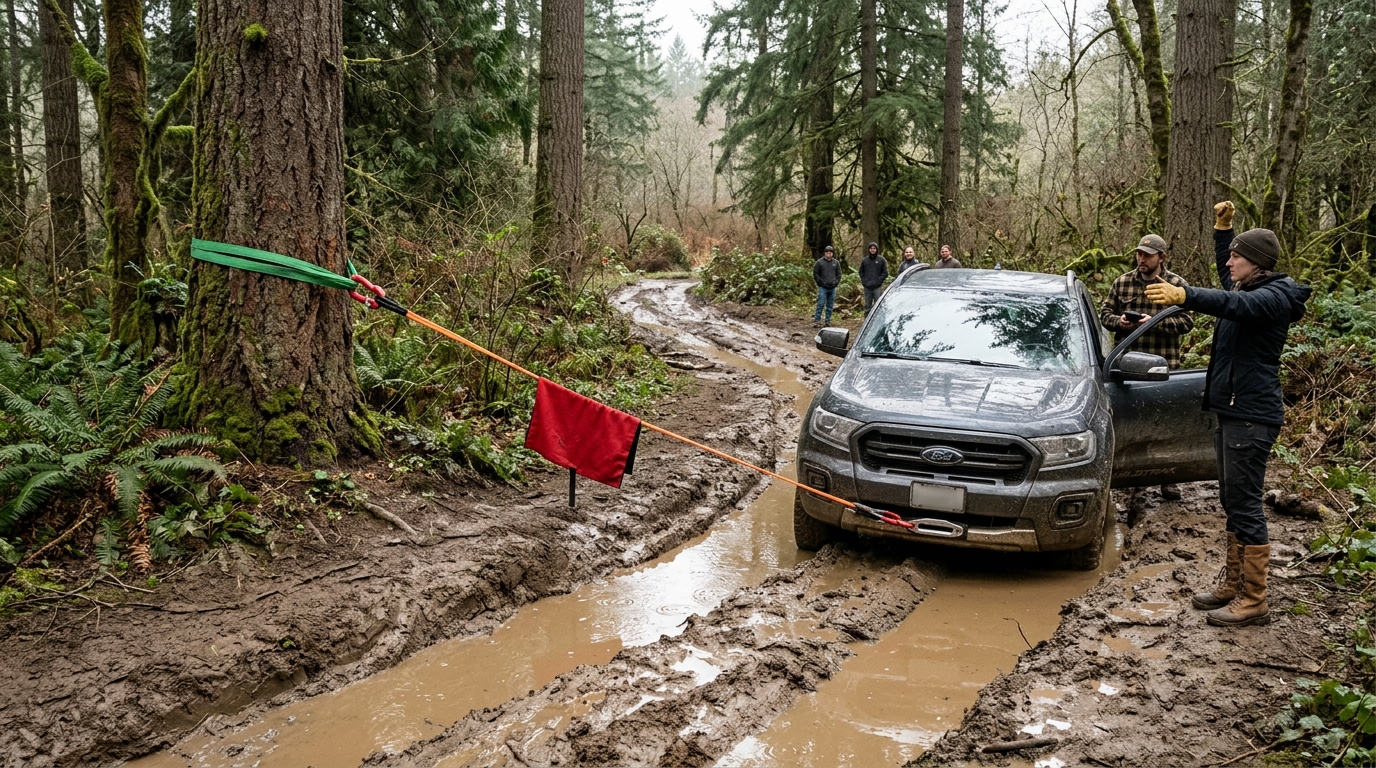
Winching is the one area with a manufacturer-authored signal set. WARN publishes seven signals in its guide to safe winching: direction of steering, power in, power out, pulse wind, stop the winch, braking, and drive assist. Our walkthrough of winching techniques for beginners covers the rigging side.
WARN’s gating rule is the part to memorize. Because the person controlling the winch must see both hands of the assistant, no hands means no power. Both hands, not one. Notably, stop the winch is a clenched fist with the palm toward the driver, held high, while the other arm goes straight out at shoulder height.
Vendor sets disagree here too. Bullhide publishes winch in as a closed fist with thumbs pointed out, while winch out reverses the thumbs. Therefore settle the winch signals before you rig, not while the line sits under load.
Safety note: Move bystanders back 1.5 to 2 times the length of line out. Twenty feet of cable means a 30 to 40 foot standoff. Michigan’s state OHV course publishes the figure, not the winch makers. The same course sets a minimum of 8 wraps on the drum, while WARN specifies 5, so follow the higher number when the two disagree.
Off-Road Hand Signals vs. Radio: Which Runs the Show
Radio and hand signals both work, although they fail in opposite conditions. One covers distance, dust, and the gaps between vehicles, where nobody sees anybody. In contrast, off-road hand signals cover the obstacle itself, where engine noise, wheel spin, and a closed window make voice unreliable. The Happy Trails handbook draws the line: the spotter should use hand signals at all times, since verbal instructions are good but sometimes go unheard.
Failure modes decide the split. A radio dies, loses line of sight in a canyon, or gets stepped on by three people talking at once. Meanwhile a hand signal fails when the spotter moves out of view, walks ahead, or uses a shape the driver reads differently. Both failures share one fix, and it is the crane rule: when contact breaks, stop.
Run them as a layered system. Radio owns the column between obstacles, callouts at junctions, and dust warnings. Hand signals own the obstacle from the moment the driver picks a spotter. Kurt Williams at Expedition Portal argues every vehicle should carry a two-way radio, preferably hard wired with an external antenna. Phones and satellite devices do not do real-time vehicle-to-vehicle work.
Final Verdict: Your Group’s Off-Road Hand Signals Standard
Stop looking for the official chart. It does not exist, and the published sets contradict each other on stop, on back up, and on winching. Even the trainers association publishes its list while opening with an admission: many options exist. Instead, a good template exists, which is what the 12 signals above give you. The value comes from your group agreeing to one version out loud before the tires leave pavement.
Structure beats signals when the two compete. A group with a clear leader, a real tail gunner, an assigned radio channel, and a spacing rule runs safely even with an imperfect signal set. In contrast, a perfect chart and no structure loses somebody at the first junction. Therefore brief the roles first, then the signals.
Five rules deserve no local variation. Each one answers a failure the sources describe firsthand, so treat them as fixed and negotiate everything else.
- One spotter, chosen by the driver.
- Driver and passenger, never left and right.
- No signal, no movement.
- Stop the moment you lose sight of your spotter.
- Both of the assistant’s hands visible before the winch motor turns.
Start with the driver’s meeting checklist above, then shorten it as your group gets fluent. Also print the signal table for newcomers, since a laminated card in the door pocket beats a briefing nobody remembers by lunch. For the rest of the pre-trip work, see our basic off-road safety tips.
Frequently Asked Questions
What are the basic off-road hand signals?
Twelve cover most obstacles. They are stop, come forward, distance to the obstacle, a little more, turn driver side, turn passenger side, turn the wheels without rolling, back up, this tire will lift, this corner will drop, slow down, and hazard on this side. Published sets disagree on the exact shapes, so agree on yours at the trailhead.
Where should a spotter stand?
In front of the vehicle, facing it, far enough back to see underneath and down both sides. Specifically, never stand between the vehicle and a fixed object, never cross sides while it moves, and never stand directly downhill of it. Instead of walking backward over loose ground, stop and pick a place to stand.
Why do spotters say driver and passenger instead of left and right?
Your left and the driver’s left point opposite ways when you face each other. Nearly every published source agrees on the fix, and an IH8MUD reader poll drew 21 of 29 voters to driver and passenger against 1 for left and right. Name the convention at the briefing when a right-hand-drive rig runs with the group.
Who closes gates on a group trail run?
Expedition Portal assigns it to the last driver in the convoy, meaning the tail gunner. Because Tread Lightly’s rule is to leave gates as you found them, an open gate on a grazing allotment stays open. Notably, Wyoming makes opening and neglecting to close a gate a misdemeanor with a fine up to $750.
How far apart should vehicles be in a convoy?
Three seconds is the minimum the Illinois OHV course teaches, counted as the vehicle ahead passes a fixed object. Also add distance in dust, on uphill runs, and near water crossings. The overriding rule from Overland Expo instruction is to keep the vehicle behind you in sight, then stop at every crossroad when dust breaks the line.