



Quick Facts:
- Topic: GMRS vs ham radio for overlanding, plus satellite messengers
- GMRS license: $35, 10 years, no exam, ages 18 and up
- Ham Technician license: $50 total at an ARRL VEC in 2026, 35-question exam
- FCC range expectation: 1 to 25 miles, by station class and terrain
- Who your GMRS license covers: immediate family only, never friends
- Satellite messenger: $299 and up, plus $7.99 to $34.99 a month
- PLB (personal locator beacon): $409.95 and up, no subscription, free NOAA registration
- Best for: Anyone driving beyond cell coverage with or without a group
16 min read
In This Guide
- GMRS vs Ham Radio: Two Jobs, Not One Choice
- FRS, GMRS, CB, and Ham at a Glance
- GMRS vs Ham Radio on Licensing and Cost
- The GMRS Family-Only Rule Breaks Most Convoys
- What GMRS Range Looks Like on a Real Trail
- GMRS Repeaters, Linking, and the Rule Nobody Mentions
- When You Need a Satellite Messenger Instead
- What Happens After You Press SOS
- Antennas, Ground Planes, and Install Reality
- Crossing Into Canada and Mexico
- Build Your Comms Stack by Budget
- Final Verdict
- Frequently Asked Questions
GMRS vs Ham Radio: Two Jobs, Not One Choice
The GMRS vs ham radio argument usually starts in the wrong place. Your rig has two separate jobs to fill. First, talking to the vehicle behind you on a shelf road. Second, reaching help when you are alone, immobile, and 40 miles from the nearest other radio. No single device does both well.
Radios handle the first job. For example, a 50-watt GMRS mobile or a dual-band ham rig lets a convoy space out and call obstacles. Nobody walks back down the trail to coordinate a recovery. Both work only when someone else is listening on your frequency, within your terrain, right now.
Satellite gear handles the second job. Specifically, a messenger or a beacon reaches a staffed center from anywhere with sky view. No other human needs to be nearby. Garmin’s own data makes the case for vehicle travelers. In its 2022 SOS milestone report, driving produced 12 percent of inReach SOS triggers. Only hiking and backpacking ranked higher.
Treat those two layers as separate purchases. First, this guide compares FRS, CB, GMRS, and amateur radio on the terms drivers care about. Then it covers satellite messengers, beacons, and phone satellite texting. Our guide to remote overland route tech covers the rest of the self-sufficiency kit.
FRS, GMRS, CB, and Ham at a Glance
Four services compete for space on your dash. Their rules live in different parts of the federal code. As a result, their power limits and license terms look unrelated. The table below draws on 47 CFR Part 95 for the first three and Part 97 for amateur radio.
| Service | License | Max power | Repeaters |
|---|---|---|---|
| FRS | None | 2 W on channels 1 to 7 and 15 to 22 | No |
| CB | None | 4 W AM, 12 W SSB | No, and amplifiers are banned |
| GMRS | $35, 10 years, no exam | 50 W on channels 15 to 22 | Yes, privately owned |
| Ham, Technician | $50 total, 10 years, 35-question exam | 1.5 kW, far beyond mobile needs | Yes, including linked networks |
The Channel Numbers Confuse Almost Everyone
Familiar channel numbers 1 through 22 come from the FRS rules, not the GMRS rules. Part 95 Subpart E, the General Mobile Radio Service rules, lists frequencies in four groups instead. Sorting them out explains a problem new owners hit immediately, especially with a mobile unit.
Channels 1 through 7 sit on 462 MHz interstitial frequencies and cap at 5 watts. The next seven, 8 through 14, sit on 467 MHz interstitials, cap at half a watt, and allow handhelds only. Your 50-watt mobile refuses to transmit there by design, not because of a defect. Finally, channels 15 through 22 carry the full 50 watts and serve as repeater outputs. The matching 467 MHz main channels act as repeater inputs.
Getting those two interstitial groups backward is the most common error in off-road radio articles. Remember it this way: the 5-watt group is 462 MHz, and the half-watt group is 467 MHz.
What CB Still Does Well, and Where It Loses
Any CB radio vs GMRS decision starts with what CB still does well. It survives because it needs no license, and because truckers still monitor it. Channel 9 stays reserved by rule for emergency and traveler assistance, which no GMRS channel matches. Rules also cap a single conversation at five continuous minutes. A one-minute silence on the same channel follows.
The physics works against it, however. A quarter-wave CB antenna measures about nine feet, so every truck-mounted whip is a loaded compromise. Power also tops out at 4 watts AM, while external amplifiers stay flatly prohibited. For a convoy in tight terrain, CB gives you the worst performance per foot of antenna. Our roundup of the best CB radios for overlanding covers current picks for anyone staying on the band.
| GMRS Handheld | GMRS 50W Mobile | Ham Mobile (Technician) | CB Mobile | |
|---|---|---|---|---|
| Product | TOP PICK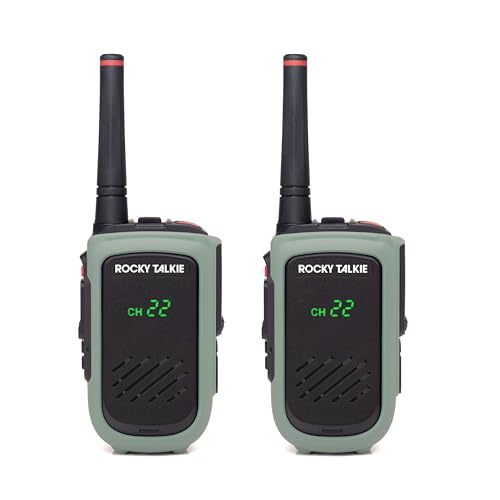 Rocky Talkie Expedition 5W GMRS Rocky Talkie Expedition 5W GMRS |  Midland MXT575 GMRS Mobile Midland MXT575 GMRS Mobile | 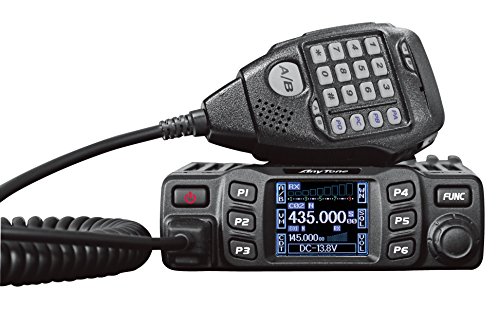 AnyTone AT-778UV Dual-Band AnyTone AT-778UV Dual-Band |  Cobra 29 LTD Classic CB Cobra 29 LTD Classic CB |
| Rating | ★★★★★ 4.8 77 ratings | ★★★★☆ 4.6 262 ratings | ★★★★☆ 4.4 693 ratings | ★★★★☆ 4.4 1,059 ratings |
| License | $35, no exam | $35, no exam | $50, 35-question exam | None |
| Antenna needed | About 6 in stock antenna | About 6 in UHF whip | About 20 in 2m whip | About 9 ft loaded whip |
| Who may transmit | Immediate family only | Immediate family only | Licensee plus a supervised guest | Anyone |
| Price | $390.00 as of Sep 21, 2:14 am | $439.99 as of Sep 21, 2:14 am | $116.00 as of Sep 21, 2:14 am | $149.95 as of Sep 20, 6:19 pm |
| Check Price → | Check Price → | Check Price → | Check Price → |
GMRS vs Ham Radio on Licensing and Cost
Licensing is where the two services diverge hardest. GMRS asks for money and nothing else. Amateur radio asks for study, then charges about the same. Notably, both licenses run 10 years.
A GMRS license costs $35 in FCC application fees, with no exam and no test session. You must be 18 or older. The license arrives with a call sign, and renewal costs $35 again. Spread across a decade, the GMRS license cost works out to $3.50 a year.
A Technician license in 2026 costs $50 total at an ARRL VEC test session. The figure splits two ways. A $15 exam session fee covers the test. Then a separate $35 FCC application fee goes directly to the FCC, within 10 days of its email notice. Youth candidates under 18 pay $5 for the session, and ARRL covers their FCC fee.
The Ham Exam by the Numbers
The exam runs 35 questions drawn from a public pool. Since July 1, 2026, examiners have worked from a 409-question Technician pool, valid through June 30, 2030. Passing takes 26 correct answers, a threshold the FCC sets directly in section 97.503(a) of its rules rather than leaving to the examiners. Articles still quoting 412 questions work from the retired pool.
| Item | GMRS | Ham Technician |
|---|---|---|
| Up-front cost | $35 | $50 ($15 exam plus $35 FCC) |
| Exam | None | 35 questions, 26 to pass |
| Term and renewal | 10 years, $35 renewal | 10 years, $35 renewal |
| Who else may transmit | Immediate family only | The licensee, plus a third party under the control operator’s direct supervision |
| Bands worth using in a truck | 462 and 467 MHz UHF | 2 m VHF and 70 cm UHF |
| Linked repeater networks | Prohibited | Allowed and common |
Two ham privileges matter for vehicle travel. A Technician holds every amateur privilege above 50 MHz. In practice the useful bands are 2 meters and 70 centimeters, plus the repeater networks built on them. Technicians also get four narrow slices of HF, capped at 200 watts, although those bands rarely help from a moving truck.
The GMRS Family-Only Rule Breaks Most Convoys
Here is the detail almost every buying guide gets wrong. One GMRS license does not cover your trail group. Instead, the rule names a closed list. It covers a spouse, children, grandchildren, stepchildren, parents, grandparents, stepparents, brothers, sisters, aunts, uncles, nieces, nephews, and in-laws.
Friends do not appear on the list. Therefore three unrelated drivers on a group run need three separate licenses, at $35 each. No minimum age applies within a family, so your kids operate under your call sign legally.
Two exceptions soften the rule. First, the rules let anyone operate the station to communicate an emergency message. Second, operating a station differs from using one, so other GMRS licensees benefit from a repeater the licensee owns. Neither exception lets a friend key a mic for routine trail chatter.
Amateur radio inverts this. A ham license names one operator. Even so, section 97.115 lets an unlicensed passenger speak as a third party. The control operator must stay at the control point and continuously monitor and supervise. For a mixed group of friends, however, the practical answer is cheap FRS handhelds as loaners. License-free FRS units share channels with GMRS radios at lower power.

Motorola T600 Talkabout Radio, 2 Pack
The article's own answer for friends outside the family-only rule: cheap FRS handhelds nobody needs a license to use.
- No FCC license required for anyone in the group
- Shares channels with GMRS radios at lower power, so loaners still hear the convoy
- Two rechargeable radios ready to hand out at the trailhead
- Waterproof rating survives a wet gear bag
- Lower power than a GMRS handheld means shorter range
- Cannot access repeaters at all
What GMRS Range Looks Like on a Real Trail
Packaging claims and reality disagree wildly. For example, Midland advertises up to 36 miles on the GXT1000 family. A retailer selling the same radio prints a blunt correction on its own product page. In urban conditions, it says, expect 2 miles or less.
The referee is the FCC itself. Its GMRS page puts the expected range at 1 to 25 miles, depending on station class, terrain, and repeater use. Almost nobody in the off-road press cites the figure, although it undercuts every box claim on the shelf.
Terrain Decides Your Range, Not Watts
Terrain decides everything else. Rocky Talkie publishes range guidance for a 2-watt handheld. Peak to peak in mountains, it gives 5 to 25 miles. Aim from a peak down into a valley and the range falls to 3 to 10 miles. With a ridge between two radios, the number is zero. In forest on flat ground the same radio manages 1 to 5 miles. Those figures come from a radio maker rather than an independent lab. No instrumented public GMRS range study appears to exist.
| Scenario | Realistic range |
|---|---|
| Open desert, vehicle to vehicle | Roughly 6 miles at best |
| Mountain peak to peak | 5 to 25 miles |
| Ridge between the two rigs | Zero |
| Dense forest, flat ground | 1 to 5 miles |
| Switchback convoy spacing | Adequate on one face, gone around the corner |
Power buys less than shoppers expect. Rocky Talkie has estimated a 5-watt unit stretches roughly 30 percent farther than a 2-watt unit in lightly obstructed terrain. The estimate comes from the maker’s own promotion rather than published testing. In open line of sight, the gain shrinks further. Antenna height moves the needle far more than watts, which is exactly why repeaters exist. The cb radio vs gmrs comparison lands here too. At 4 watts on a heavily loaded nine-foot whip, CB gives up ground to a 5-watt UHF handheld in most terrain. Notice what none of these numbers cover: reaching anyone outside your own convoy.
GMRS Repeaters, Linking, and the Rule Nobody Mentions
Repeaters sit high, listen on 467 MHz, and rebroadcast on 462 MHz at up to 50 watts. Height is where real range comes from. Access then runs through a CTCSS tone or DCS code on the input, a practice the rules authorize expressly for reaching repeater stations.
Ownership surprises new licensees. Every GMRS repeater is privately licensed and privately owned. Moreover, the rules explicitly let the owner limit access to specific people. No public network exists. In practice you find a repeater on myGMRS, request access from the owner through the site, then receive the frequency pair and the tone.

Wouxun KG-905G Plus Professional GMRS Two Way Radio with USB-C Charging + Bluetooth
A repeater-capable handheld for the reader who just learned most GMRS radios on the shelf cannot reach one.
- Ships with all 8 GMRS repeater channels programmed out of the box
- USB-C charging with Bluetooth control
- Requires the $35 FCC GMRS license, no exam
- Compact enough to carry as a backup alongside a mobile rig
- Most bubble-pack GMRS handhelds on the shelf next to it cannot reach a repeater at all, so check specs before buying a cheaper radio
- Repeater access still requires the owner's permission and tone
The linking rule is the part vendors skip. Here the FCC states plainly: internet linking of repeaters to extend range across a large area violates sections 95.1733(a)(8) and 95.1749 of its rules. Several off-road retailers still market repeater networks as extended coverage. Ham repeater networks carry no such restriction, which is a real argument for taking the exam. Even so, a repeater only helps while someone monitors the other end.
Privacy Codes Provide No Privacy
CTCSS tones and DCS codes open a squelch circuit. They do not scramble or encrypt anything. Therefore, anyone on your channel with tones switched off hears every word you say. Think about it before you name your camp spot on the air. The rules also bar coded messages with hidden meanings, although they explicitly permit ten-codes.
The Off-Road Calling Channel Is Informal
Overlanders talk about a GMRS calling channel as if the FCC named one. CB reserves Channel 9 for emergency and traveler assistance by rule, while GMRS has no equivalent anywhere in Part 95. Instead, Channel 16 at 462.575 MHz has become the informal off-road calling channel, and Channel 19 at 462.650 MHz echoes the CB highway channel. Adoption is real but uneven. Program both, then announce your channel at the trailhead rather than assuming a stranger monitors it.
One requirement does apply everywhere. Every GMRS channel stays open to emergency and traveler assistance traffic, and operators must give priority to emergency traffic at all times.
When You Need a Satellite Messenger Instead
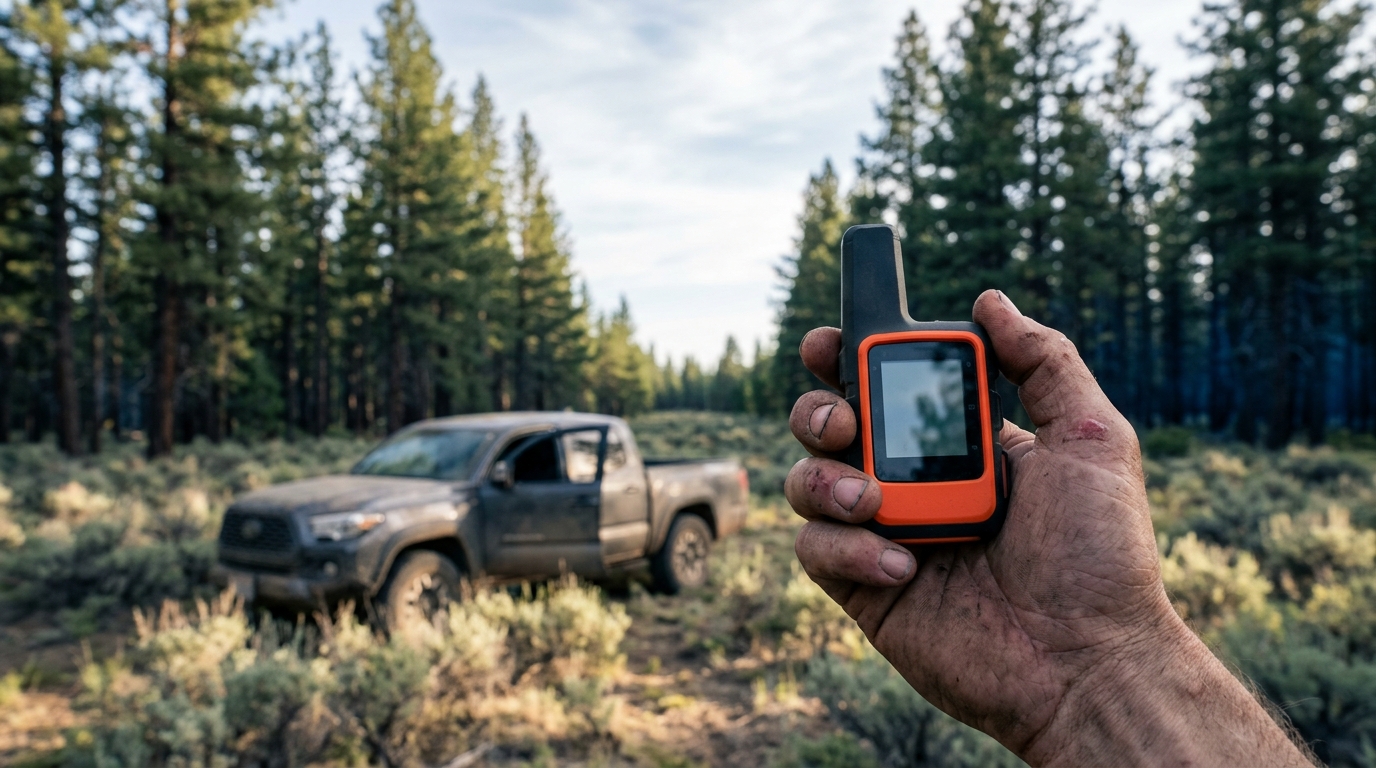
No radio in this guide reaches help by itself. Every one of them needs another human listening within range of your terrain. A satellite messenger for overlanding solves the opposite problem, since it reaches a staffed center from anywhere with a clear view of the sky.
Two product families compete. First, two-way messengers send and receive text, share tracking, and open a conversation with a coordination team. Second, personal locator beacons transmit a distress signal to a government search and rescue system, with no conversation and no subscription. The trade between them is money against dialogue.
| Device | Hardware | Ongoing cost | Notes |
|---|---|---|---|
| Garmin inReach Messenger | $299.99 | Consumer plans from $7.99 a month | Two-way text and SOS |
| Garmin inReach Messenger Plus | $399.99 | Consumer plans from $7.99 a month | Adds photo and 30-second voice messages |
| Garmin inReach Mini 3 Plus | $499.99 | Consumer plans from $7.99 a month | Adds an onboard screen and navigation |
| ZOLEO Prepare plan | Device price plus a $19.99 activation fee | $19.99 a month | 50 satellite messages included |
| ZOLEO Protect plan | Device price plus a $19.99 activation fee | $34.99 a month | Unlimited satellite messages |
| ACR ResQLink 400 PLB | $409.95 to $459.95 | None, registration is free | One-way beacon, no messaging |
Read the Subscription Terms Before You Buy
Subscription terms vary more than the hardware does. For example, ZOLEO plans carry a three-month minimum and a $19.99 activation fee, then pause for $4.50 a month. While paused, the device sends nothing at all, including SOS. Garmin consumer plans run month to month with a 30-day commitment and suspend at zero cost for up to 12 months.
Beacons Trade Conversation for Simplicity
Beacons win on simplicity. An ACR ResQLink 400 carries a five-year battery, runs 24 hours or more once activated, and needs no plan. Federal rules require free NOAA registration, with a renewal every two years. The catch is silence. You cannot describe the problem or ask for a tow truck rather than a helicopter, and standing down means phoning a coordination center yourself.
Three Satellite Devices Worth Comparing Against GMRS

Garmin inReach® Messenger Satellite Communicator, Global Two-Way Messaging
The entry point into the same Garmin network that fielded more than 3,000 inReach SOS messages in 2025.
- Two-way text messaging with an interactive SOS routed to Garmin Response
- 28 days of battery life between charges
- Monthly consumer plans with no long-term contract required
- Plans suspend at no cost for up to 12 months when not in use
- Requires an active satellite subscription before it can send anything
- No onboard navigation screen, pair it with a phone or GPS unit

Garmin inReach® Messenger Plus, SOS Satellite Communicator
The upgrade pick when photo and voice messages matter more than saving on hardware.
- Adds photo sharing and 30-second voice messages to two-way texting
- Interactive SOS routes straight to Garmin Response
- Syncs contacts from a paired phone
- Same monthly consumer plan options as the base Messenger
- Costs more than the base Messenger for features casual users may not need
- Still requires an active subscription to send anything

ACR ResQLink 400 PLB - Satellite SOS GPS Personal Locator Beacon - 2921
The no-subscription alternative for solo drivers who want a beacon rather than a conversation.
- Five-year battery with 24-plus hours of runtime once activated
- No subscription of any kind, ever
- Free NOAA registration required by federal rule
- 406 MHz Cospas-Sarsat signal reaches the same rescue chain as a maritime PLB
- One-way only, no way to describe the emergency or request a specific response
- No tracking or check-in messaging like the Garmin devices offer
Sky View Beats Everything Else
Satellite gear fails the same way a dish does. Specifically, heavy timber, canyon walls, and steep ridges block the path upward. Our first-hand account of sky view and tree cover covers the same physics for Starlink. Park in the open before you send, then wait.
Solo Travel Removes the Radio Option
Solo travel raises the stakes further. With nobody in a second vehicle, radio range stops mattering entirely and a messenger becomes your only link out. Our guide to camping alone safely covers the rest of the solo checklist. Many messengers also handle waypoints and tracking, so compare them against dedicated GPS units for overlanding before buying both.
Your Phone Now Texts by Satellite, With Real Limits
Apple includes satellite features free for two years with an iPhone 14 or later. Emergency SOS works in 20 countries, while Messages via satellite works in the United States, Canada, Mexico, and Japan. Apple has never published what continuing service costs after those two years.
Apple’s own caveats deserve attention. A message takes about 30 seconds to send with a clear view of sky and horizon, and over a minute under light or medium foliage. Under heavy foliage you might not connect at all. Apple warns coverage might not work above 62 degrees latitude, which covers northern Alaska. Apple also states plainly in its documentation not to use Messages via satellite in emergencies.
Carrier satellite texting has gone mainstream too. For instance, T-Mobile’s T-Satellite service costs $10 a month, works with most smartphones, is open to customers of other carriers, and supports texts to 911. T-Mobile still warns the service arrives delayed or limited, or does not arrive at all. For a broadband layer rather than a safety layer, Starlink Roam starts at $55 a month with a $199 Mini kit.
What Happens After You Press SOS
Three devices trigger three different chains, and the three get conflated constantly. Knowing which one you own changes what you should expect in the first hour.
A Garmin inReach alerts Garmin Response, a private center staffed around the clock. Then the team texts you, notifies the emergency contacts on your account, and works with local search and rescue. Garmin says its staff asks what response fits, whether a tow truck or a helicopter. In 2025, Garmin fielded more than 3,000 inReach SOS messages, and users self-rescued more than 12 percent of the time.
A PLB routes through the international Cospas-Sarsat system. First, satellites relay the burst to a ground terminal, then to a mission control center, then to the search and rescue authority for your area and for your beacon’s country code. In the United States, land alerts reach the Air Force Rescue Coordination Center. Canceling an accidental activation takes a phone call to 1-800-851-3051, not a switch on the beacon.
A phone SOS encrypts your text, routes it through the maker’s relay center, and hands it to a local 911 dispatch point along with your Medical ID, questionnaire answers, elevation, and battery level. Crash detection triggers the same path automatically after a severe rollover. Apple advises against quitting an accidental session, since waiting for a responder and explaining the mistake settles it faster.
Antennas, Ground Planes, and Install Reality
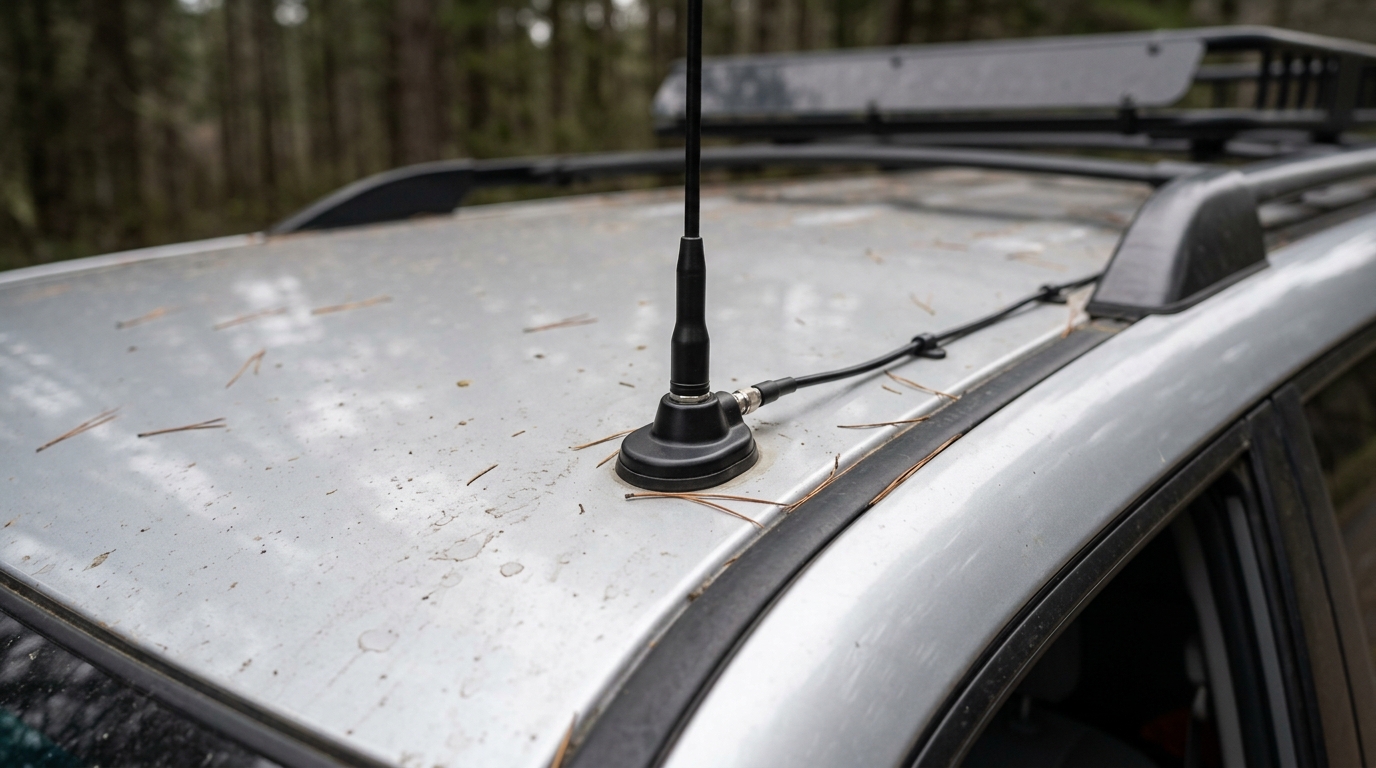
Physics decides your antenna long before your budget does. Specifically, Larsen’s published mobile antenna guidance gives the key numbers. A 5/8-wave antenna at 150 MHz wants a metal ground plane at least 42 inches across. At 450 MHz the same design needs only 15 inches.
Those two numbers explain why GMRS installs easily and 2 meters does not. A quarter-wave GMRS whip measures roughly 6 inches, clears garage doors, and survives branch strikes. The 2-meter equivalent runs about 20 inches, a 5/8-wave version passes 4 feet, and both want far more sheet metal underneath.
Where You Mount It Matters More Than What You Mount
Placement beats hardware. For example, Larsen ranks the center of a metal roof first, then the trunk center, then fenders, then glass. Its own placement data uses a permanent mount at the roof center as the zero-loss reference, with the penalties attaching to position rather than to mount type. Losses come from moving off the roof center, not from choosing a magnet.
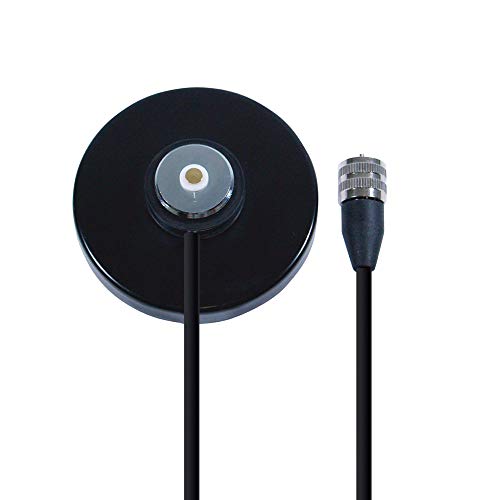
Midland MicroMobile MXTA12 Antenna Mag Mount
The roof-center magnetic mount that removes the top objection to installing an antenna at all: drilling a hole.
- Sets at the roof center, the position Larsen ranks first for mobile antennas
- No drilling required, moves between vehicles in minutes
- Ships with the coax run to the radio
- NMO connection accepts GMRS and ham UHF whips alike
- A dragged magnet can scratch paint instead of being set down flat
- Not rated for wrapped or heavily textured roofs
Fiberglass camper tops need a different part. Larsen’s half-wave designs require no ground plane and mount to wood or fiberglass, so specify a no-ground-plane antenna or add a metal plate. A rooftop tent, a full-length rack, and a raised camper shell all cast RF shadows, so plan the mount position before you buy the radio.
Skip the High-Gain Antenna in Steep Terrain
Gain reshapes a pattern rather than creating signal. Larsen puts numbers on it: a 5 dB collinear antenna aims energy toward the horizon, which suits flat regions with sparse coverage. A quarter-wave radiates more energy vertically, which suits obstructed ground.
Translate the point to a shelf road. When a spotter stands 200 feet above you or the next rig sits below a switchback, a horizon-focused pattern points at empty air. Lower gain often works better on technical trails than the taller antenna next to it in the store.

Midland MXTA25 3DB MicroMobile Compatible Gain Ghost Antenna
The low-gain whip for shelf roads and switchbacks, where a horizon-focused antenna points at empty air.
- 3.5 inch low-profile design clears garage doors and survives branch strikes
- NMO connection swaps onto any existing NMO mount
- Radiates more energy vertically than a tall collinear, which suits obstructed ground
- Compact enough to leave mounted between trips
- Trades flat-ground range for the vertical pattern, a taller collinear reaches farther on open highway
- Not the pick for wide-open desert running
Crossing Into Canada and Mexico
Border rules invert the usual advice, and plenty of off-road articles get it backward. Your ham license travels north cleanly, but your GMRS license does not.
Canada and the United States hold an automatic reciprocal amateur agreement, so neither country asks for a permit or paperwork. You sign your US call sign followed by a slash and the Canadian prefix for the province. Radio Amateurs of Canada confirms the same arrangement.
GMRS works differently across the border. Canada treats FRS and GMRS as license-exempt, so your US license carries no legal weight there. Canadian limits cap these radios at 2 watts on every channel except channels 8 through 14, which cap at half a watt. Driving a 50-watt US mobile north puts you outside those limits, which is the biggest cross-border error in off-road radio articles. The Canadian standards text we reviewed says nothing about GMRS repeaters.
Mexico is harder. According to ARRL’s most recent published guidance, no procedure exists for US amateurs to obtain a Mexican license or operate under a reciprocal agreement. We were unable to verify the status of FRS and GMRS for US travelers against Mexican regulator sources. Do not assume your license means anything south of the border. Satellite messengers stay legal across all three countries, although Garmin notes some jurisdictions regulate or prohibit satellite devices and puts the burden on the user.
Build Your Comms Stack by Budget
Layer the purchase rather than agonizing over one device. The table below assumes you already carry a phone and start with no radio.
| Budget | Buy this | Why |
|---|---|---|
| Under $100 | Pair of FRS handhelds | No license, works with any GMRS radio nearby |
| $100 to $300 | GMRS license plus a 5-watt handheld | Legal power, repeater capable, $3.50 a year |
| $300 to $600 | Add a satellite messenger or a PLB | Covers the job no radio does |
| $600 to $1,000 | 50-watt GMRS mobile, NMO roof mount | Real convoy range in rolling terrain |
| Beyond $1,000 | Technician license, dual-band mobile | Linked repeater networks and cross-border legality |

Midland MXT500 50W IP66 MicroMobile GMRS Two-Way Radio
The next rung up once the license and handheld are already in the truck: real convoy range in rolling terrain.
- 8 repeater channels built in
- External magnetic mount antenna included in the box
- Compact control head fits dashboards with limited space
- Requires the $35 FCC GMRS license, no exam
- 50 watts is illegal to run at that power in Canada, drop to a lower-power radio before crossing the border
- Needs a proper NMO roof or trunk mount for best range, the included mag mount is a starting point
Before You Leave
Check coverage before you leave rather than after. First, pull repeater listings for your route, note where cell service ends, and tell someone your plan. Our guide to plan your overland route covers the mapping side of the same job.
Test the setup at home. Then run a radio check with the group at the trailhead, send an inReach test message rather than triggering a live SOS, and confirm your PLB self-test passes. Handheld runtime and hardwired current draw both deserve a look before a five-day trip.
Final Verdict
For most overlanders, GMRS wins the radio half of the decision. A $35 license needs no exam, a 5-watt handheld covers a convoy in rolling terrain, and a 6-inch UHF whip survives real trails. Repeater access extends range when terrain cooperates and an owner grants permission.
Amateur radio earns the exam under three conditions. First, you travel to Canada regularly, where your license works and a 50-watt GMRS mobile breaks the local power limit. Second, you want linked repeater networks GMRS prohibits. Third, you run regularly with unrelated friends and prefer one license over several, since a ham control operator supervises third parties while GMRS limits transmission to immediate family. For a casual group, FRS loaners still solve it for less.
CB keeps a narrow role. Specifically, truckers still monitor it, Channel 9 stays reserved for emergencies by rule, and it needs no license. Against a GMRS handheld in most terrain, though, a 4-watt AM signal on a loaded whip loses.
None of them substitute for satellite. A satellite messenger for overlanding covers the gap every radio leaves. Therefore, if you drive alone, travel outside cell coverage, or run trails where a rollover means nobody finds you for a day, buy a messenger or a beacon before you upgrade any radio. Garmin’s own numbers put driving second among SOS triggers at 12 percent of incidents, and it says many of those involve people simply needing help on the road.
Gear Mentioned in This Guide
Wouxun KG-905G Plus Professional GMRS Two Way Radio with USB-C Char…
Midland MXTA25 3DB MicroMobile Compatible Gain Ghost Antenna
Frequently Asked Questions
Do I need a license to use a GMRS radio?
Yes. GMRS requires an individual FCC license, and applicants must be 18 or older. No exam applies. FRS radios need no license, share several channels with GMRS at lower power, and make a reasonable loaner for guests in your group.
How much does a GMRS license cost and how long does it last?
The FCC application fee is $35, and the license runs 10 years. Renewal costs another $35 and opens 90 days before expiration. Spread across the term, the gmrs license cost works out to $3.50 a year.
Can my friends talk on my GMRS license?
No. The rule covers immediate family only, naming spouses, children, grandchildren, stepchildren, parents, grandparents, stepparents, brothers, sisters, aunts, uncles, nieces, nephews, and in-laws. Friends need their own $35 license. One exception exists: the rules let anyone operate the station to communicate an emergency message.
Is GMRS better than CB for off-roading?
Usually yes. GMRS reaches 50 watts on its main channels, supports repeaters, and uses a 6-inch antenna instead of a nine-foot whip. CB keeps two advantages, since it needs no license and reserves Channel 9 for emergency traffic by rule.
Do I still need a satellite messenger if my phone texts by satellite?
Probably yes for remote travel. Apple states its Messages via satellite feature should not be used in emergencies, warns coverage might not work above 62 degrees latitude, and notes heavy foliage might block the connection. A dedicated messenger reaches a staffed coordination center, holds a two-way conversation, and shares tracking with people at home.