


Quick Facts:
- Product: Cinch Sky Cruiser hardshell rooftop tent
- Price: $4,999, listed by Cinch and by Yanko Design; reservation-only ordering
- Weight: 219 lbs (99.5 kg)
- Closed size: 68.6 x 56.3 x 12.6 in
- Open size: 84.7 x 57 x 39.3 in
- Shell: Transparent anti-UV polycarbonate over a fiberglass honeycomb base
- Fabric: 280 g ripstop polycotton, PU2000mm coating
- Mattress: 4 cm high-density foam with a peach skin thermal cover
- Sleeps: 2 to 3
- Warranty: 2 years
- Best for: Full-size trucks and body-on-frame SUVs with a rated roof rack
11 min read
In This Guide
- What the Sky Cruiser Hardshell Rooftop Tent Is
- Key Specs at a Glance
- The Skylight and What a Clear Lid Changes
- Remote Deploy and the X-Frame
- Hardshell Rooftop Tent Weight and Roof Load
- Lighting, Storage, Ladder, and Flooring
- What Cinch Leaves Off the Spec Sheet
- Sky Cruiser vs. the Hardshell Rooftop Tent Field
- Fuel Economy, Garage Height, and Ownership Costs
- Final Verdict
- Hardshell Rooftop Tent FAQ
What the Sky Cruiser Hardshell Rooftop Tent Is
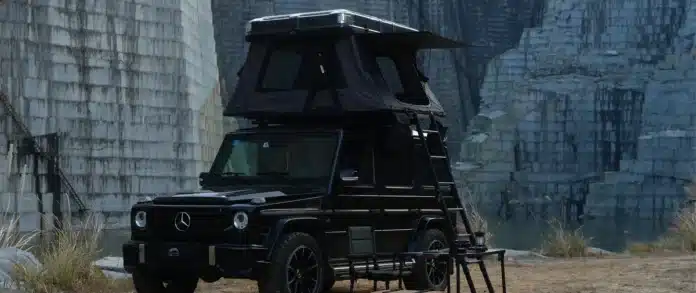
The Cinch Sky Cruiser puts a clear polycarbonate roof over your bed for $4,999. At 219 lbs, this hardshell rooftop tent also outweighs every rival in our comparison set. Cinch lists the price on its own page, though ordering runs through a reservation queue. Nobody outside the brand has slept in one yet, so treat the numbers below as spec-sheet reporting. That said, this tent is IMPRESSIVE!
Its headline feature sits overhead. Instead of an opaque ABS or fiberglass lid, the shell uses clear anti-UV polycarbonate. The roof therefore doubles as a skylight. Otherwise the design follows the current hardshell playbook. An X-frame pops the shell open and locks it. Next, a telescoping ladder extends in one pull, and LED strips run along the interior.
Cinch names each feature: WideTrak for the ladder, GlowRail for the lighting, SkyHold for storage. ThermaSoft covers the insulated floor. Still, none of those names comes with a measurement. Two numbers drive the buying decision instead. First, the tent weighs 219 lbs. The next heaviest hardshell we found, the Thule Basin, is 43 lbs lighter.
Second, the $4,999 price sits at or above every direct rival in our comparison set. Compared to the $4,295 James Baroud Evasion, it costs $704 more. Both figures push this tent toward full-size trucks. Cinch is no startup, though. The brand traces to 2009 and works alongside Wildland, founded in 2002. Its site claims more than 300,000 rooftop tents built across 80-plus countries.
For readers new to the category, our hardtop rooftop tent buyer’s guide covers shell types and mounting basics. Read it before you spend anything.
Key Specs at a Glance
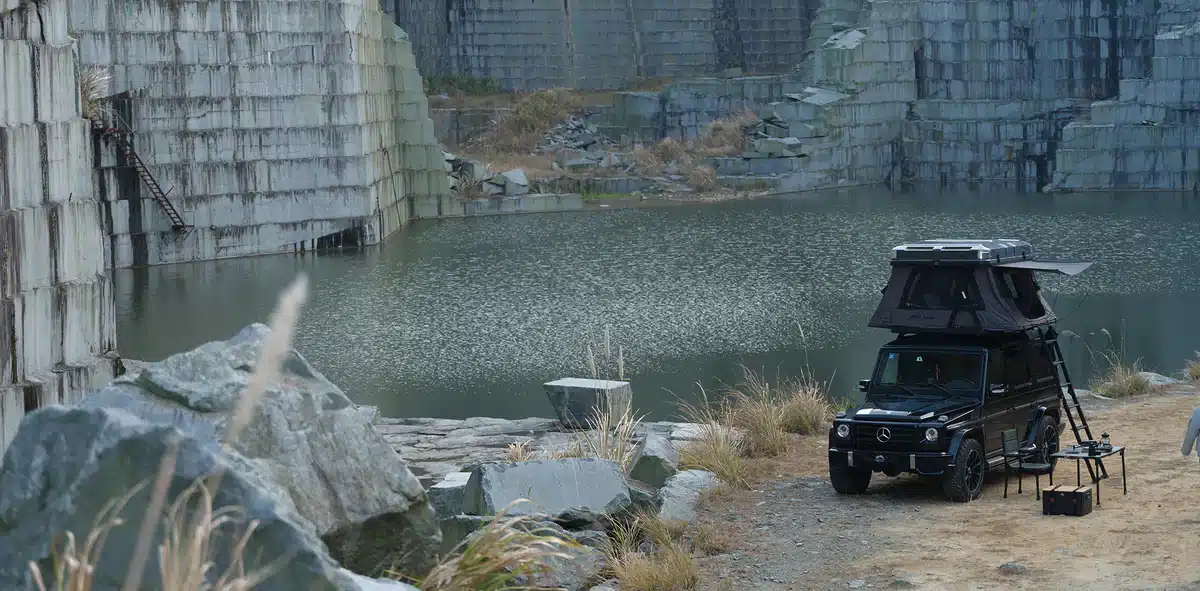
Every figure below comes from the Cinch Sky Cruiser product page, captured in August 2026. Cinch lists the $4,999 price in its reservation block rather than in the spec table. The brand publishes metric first, so the imperial numbers follow its own rounding.
| Specification | Details |
|---|---|
| Sleeping capacity | 2 to 3 people |
| Weight | 99.5 kg / 219 lbs |
| Closed dimensions | 174 x 143 x 32 cm / 68.6 x 56.3 x 12.6 in |
| Open dimensions | 215 x 145 x 100 cm / 84.7 x 57 x 39.3 in |
| Shell | Transparent PC, anti-UV |
| Frame | Wireless remote control mechanism |
| Base | Fiberglass honeycomb plate |
| Fabric | 280 g ripstop polycotton, PU2000mm |
| Mattress | 4 cm high-density foam, peach skin thermal cover |
| Warranty | 2 years, plus advertised lifetime support |
| Price | $4,999 (Cinch and Yanko Design); reservation-only ordering |
| Best Hardshell on Amazon | Lightest Option | Best Brand Support | Best for Full-Size Trucks | |
|---|---|---|---|---|
| Product | TOP PICK Trustmade Hard Shell Trustmade Hard Shell |  Front Runner RTT Front Runner RTT |  Thule Tepui Kukenam Thule Tepui Kukenam |  OVS Nomadic 4-Person OVS Nomadic 4-Person |
| Rating | ★★★★☆ 4.2 6 ratings | ★★★★☆ 4.5 20 ratings | ★★★★☆ 4.3 48 ratings | ★★★★☆ 4.6 56 ratings |
| Shell | Hardshell | Softshell | Softshell | Softshell |
| Weight | not published | 95 lbs | 119 lbs | 185 lbs |
| Sleeps | 3 | 2 | 3 | 4 |
| Price | ||||
| Check Price → | Check Price → | Check Price → | Check Price → |
The Skylight and What a Clear Lid Changes

A rooftop tent with skylight glazing is rare for a reason. Shell makers pick opaque ABS or fiberglass because those materials block solar gain. They also hide scuffs and shrug off hail. Polycarbonate trades some of each away for the view. Cinch specifies anti-UV treatment, which slows the yellowing common to clear roofs in sunlight. Still, no brand here publishes a UV test standard or a service life.
Solar gain is the practical trade-off. A clear panel overhead admits sunlight all afternoon and warms the interior. An August nap in Moab therefore feels hotter than the same nap under a white ABS lid. However, Cinch pairs the skylight with panoramic side windows. Cross-ventilation matters more here than in an opaque tent. Plan on parking in shade when the forecast climbs.
Condensation behaves differently too. Warm breath hits a rigid, cold panel overnight and beads there. Instead of soaking into fabric, the moisture drips. Wiping the panel before you pack up becomes part of the routine. Similarly, dust film shows on clear plastic in a way it never shows on paint. A scratched panel also stays scratched.
None of this cancels the appeal. For stargazing, a rooftop tent with skylight glazing does something no mesh window does. You lie flat and look straight up without unzipping anything. Whether the view is worth a $700 to $1,200 premium is personal. No spec sheet settles it.
Remote Deploy and the X-Frame
Cinch lists the frame as a wireless remote control mechanism. The shell opens at the press of a button rather than by hand. Powered lids are uncommon in this category. Thule, Roofnest, iKamper, and James Baroud all use gas struts and manual latches. A remote therefore puts the Sky Cruiser in a small group.
Cinch’s own walkthrough shows the remote deploy, the ladder, and the skylight in use. However, the video which shows another Cinch two floor tent is brand marketing rather than independent testing. Video: CINCH.
The X-frame underneath follows a familiar pattern. Scissor arms hold the roof parallel to the base. Because the geometry stays rigid without air pressure, the frame keeps its shape in wind. Cinch still sells the Air Cruiser, which uses an inflatable Air Frame and a pump. The Sky Cruiser sits alongside it as the mechanical alternative.
Powered deployment adds a failure mode worth thinking about. Motors need power. Remotes need batteries. Neither appears in the published spec block. Cinch states no voltage, no current draw, and no power source. Nor does the page mention a manual override if the motor quits at 11 p.m. Ask the question before you reserve one.
Setup speed remains the strongest argument for any hardshell over a fold-out. Our breakdown of softshell versus hardshell rooftop tents covers the time difference. It also covers the weight penalty you pay for it.
Hardshell Rooftop Tent Weight and Roof Load
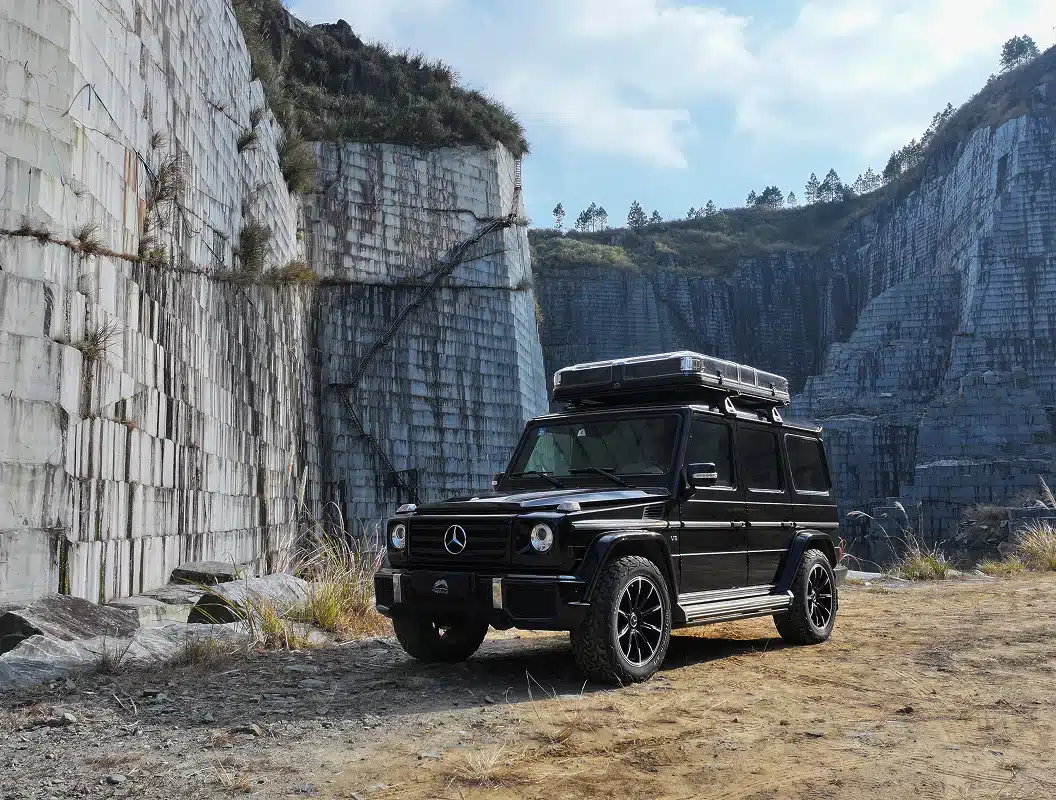
At 219 lbs, the Sky Cruiser is the heaviest current hardshell in our comparison set. Rooftop tent weight matters twice over. First it matters while you drive, then again while you sleep. Roof racks carry separate ratings for those two states. Confusing them is the most common mistake in this category.
Dynamic vs. static load for a hardshell rooftop tent
Dynamic load is the weight your rack carries while the vehicle moves. Static load is the weight it carries parked, with people inside. Thule states the rule plainly in its rooftop tent guidelines. Static capacity runs about three times dynamic capacity. Therefore, a rack rated at 165 lbs dynamic supports roughly 495 lbs parked.
Run the Sky Cruiser through the same math. A 219-lb tent already exceeds the dynamic rating of most crossover factory rails. Industry guidance puts those rails between 100 and 165 lbs. Meanwhile, a body-on-frame truck with a rated platform rack handles it easily. The tent effectively selects your vehicle for you.
Payload and center of gravity come after roof load capacity
Roof load capacity is only the first gate. The second gate is your rig’s payload sticker. Add 219 lbs of tent, a 60-lb rack, two adults, water, and recovery gear. The total climbs faster than most builds expect. Before you order, weigh your rig on a CAT scale. Then compare the corner weights against the door jamb figures.
Mass 6 feet off the ground also changes how the vehicle drives. It raises the center of gravity, slows steering response, and lengthens braking on washboard. Notably, the Sky Cruiser runs 43 lbs heavier than the Thule Basin. Against the iKamper Skycamp Mini 3.0, the gap widens to 94 lbs. The handling penalty scales with the shell you pick.
Lighting, Storage, Ladder, and Flooring
Weight buys comfort features, so look at what the extra pounds deliver. GlowRail is Cinch’s name for the interior LED strip lighting. Built-in strips remove the lantern hook shuffle and free up a corner of the mattress. Brightness and draw decide whether the strips run all night on a small battery. Our guide to campsite lighting lumens and power draw explains which numbers to ask for.
SkyHold covers the internal storage pockets and gear loops. The lid crushes anything left loose in a 12.6-inch closed shell, so pocket placement matters. Roofnest states its position plainly, telling buyers to leave “your sleeping bag, blankets, or pillow right in your tent.” Cinch has published no comparable allowance, so plan on stripping bedding before travel.
WideTrak is the telescoping ladder, which extends in one motion and locks. Telescoping ladders save storage space over sliding aluminum ladders. Still, published ratings stay modest, commonly 300 to 330 lbs. Alu-Cab, for example, rates its telescopic ladder at 330 lbs. Heavier campers should confirm the figure before ordering.
ThermaSoft describes the insulated flooring over the fiberglass honeycomb base. Insulated floors matter in shoulder-season cold, because a rooftop tent loses heat downward into moving air. Meanwhile the 4 cm foam mattress is thinner than the 2.5-inch pads iKamper and Roofnest ship. Bring a topper if you sleep cold.
What Cinch Leaves Off the Spec Sheet
We scraped the full Cinch product page in August 2026. The spec block lists nine fields. Those fields cover capacity, weight, closed size, open size, shell, frame, bottom, fabric, and mattress. Several numbers a buyer needs are absent. Listing them is fair reporting rather than criticism of the design.
Missing: any dynamic load figure and any static or occupant weight limit. Also missing: any wind rating, any ladder length, and any ladder weight rating. Cinch publishes no temperature rating and no motor or battery spec. The $4,999 price does appear, though only in the reservation block. Ordering runs by batch counter rather than by cart. One counter read “August 24th, 84% reserved” while earlier batches showed sold out.
In fairness, wind figures are scarce category-wide. James Baroud is the exception, stating its tents are tested to withstand gusts up to 120 km/h, or 75 mph. Tested-to language is not a certified rating, and no other brand here publishes even a tested-to figure. Nobody should quote a number for the Sky Cruiser. Load ratings are different, because racks publish them and buyers need the pairing math. Cinch also claims a patented expansion system: “20% smaller when closed, 20% more space when open.” The claim names no baseline.
Sky Cruiser vs. the Hardshell Rooftop Tent Field
Prices below reflect US listings captured in August 2026, including active promotions. Re-check before you buy. Two entries carry an asterisk because they are softshells rather than hardshells. Shoppers cross-shop them anyway, so they belong in the table.
| Model | Price | Weight | Closed height | Warranty |
|---|---|---|---|---|
| Cinch Sky Cruiser | $4,999 | 219 lbs | 12.6 in | 2 years |
| James Baroud Evasion | $4,295 | 134 to 163 lbs, no ladder | 13 in (mfr; dealer lists 13.5) | 5 years |
| Thule Widesky | $3,999.95 | 147 lbs | 7.9 in | Thule Guarantee |
| Roofnest Condor 2 Air | $3,795 | 145 lbs | 14 in | 2 years |
| Roofnest Falcon 3 EVO Air | $3,795 | 130 lbs | 8 in | 2 years |
| iKamper Skycamp 3.0 | $3,425 (list $4,895) | 165 lbs | 13.5 in | 2 years |
| iKamper Skycamp Mini 3.0 | $3,000 (list $4,295) | 125 lbs | 13.5 in | 2 years |
| Thule Basin | $2,999.95 | 176 lbs | 12.75 in | Thule Guarantee |
| Thule Basin Wedge | $2,999.95 (sale $2,099.96) | 156 lbs | 12.8 in | Thule Guarantee |
| Thule Approach M *softshell | $2,699.95 | 128 lbs | 11 in | Thule Guarantee |
| Front Runner Roof Top Tent *softshell | $1,199 | 95 lbs | 13 in | Not published |
Where rivals beat the Sky Cruiser
Three gaps stand out. On warranty, James Baroud covers the Evasion for five years against Cinch’s two, at $704 less. Sleeping area favors iKamper, since the Skycamp 3.0 delivers 44.3 square feet for $3,425. Profile favors Thule and Roofnest, since the Widesky closes to 7.9 inches and the Falcon 3 EVO Air to 8 inches. Both sit well under 12.6 inches, which matters for garage doors and wind resistance.
One historical benchmark frames the weight question. The discontinued Go Fast Campers Superlite weighed around 80 lbs. It closed to 4 to 6 inches, though it shipped without a mattress or ladder. Nothing current matches the number. Still, it shows how much of a hardshell’s mass comes from comfort features.
Where the Sky Cruiser answers back
This tent offers two things no other hardshell here sells. First comes the clear shell, then the powered lid. For a buyer who wants a rooftop tent with skylight glazing, no rigid alternative exists. Cinch’s own Air Cruiser has dual skylights, though it inflates rather than folding out on a frame. For everyone else, the field below $4,000 covers the same camping with fewer pounds. Our roundup of the best rooftop tents of 2026 tracks current pricing, and our Uinta Box Shell review covers a vertical-wall hardshell in the same class.
Whichever tent you pick, a few accessories solve the problems this article raises. A rated rack, a condensation mat, published-lumen lighting, and shade round out your build.
Gear a hardshell rooftop tent actually needs
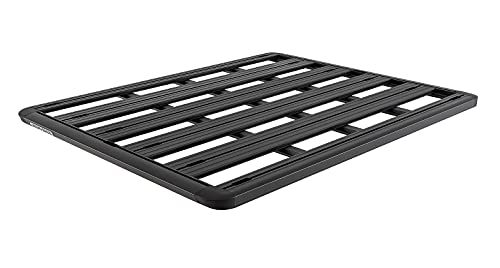
Rhino Rack Pioneer Platform Rooftop Cargo System 107" x 58" (52105F)


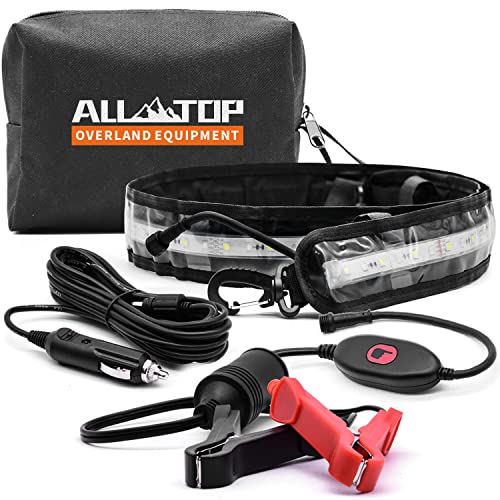
ALL-TOP Dimmable Flexible Camping Light Strip with Mounting Jacket

Overland Vehicle Systems 19519907 HD Nomadic 270 Degree Awning Driv…
Fuel Economy, Garage Height, and Ownership Costs
A 12.6-inch shell on your roof costs fuel every mile, whether or not you camp. Consumer Reports measured the penalty at 65 mph with instrumented testing. A 2019 Nissan Altima dropped from 48 mpg to 43 mpg with a bare rack. Adding a carrier pod took it to 39 mpg, a 19% loss. A 2019 Toyota RAV4 fell from 41 mpg to 35 mpg in the same test.
Those tests used cargo pods rather than tents. Treat the figures as a bracket instead of a measurement. A closed hardshell sits in similar territory for drag. Take 10% to 20% at highway speed as the working range, drawn from those tests. At $3.50 per gallon and 12,000 miles a year, a 15% penalty drops 20 mpg to 17 mpg. Therefore you burn about 106 extra gallons, or roughly $370 a year.
Garage height is the second daily cost. Crossbars run roughly 2 to 4 inches above the roofline, and platform racks 5 to 8 inches. Add 12.6 inches of tent, and a stock full-size truck often loses garage access. Measure your door opening before ordering. A hardshell is no seasonal item you pull off in ten minutes.
Finally, consider theft and parking. A $4,999 shell with a clear lid advertises its contents to anyone in the lot. Hardshell tents also mount with bolts rather than quick-release hardware. Plan on locking hardware and covered parking where possible.
Final Verdict
The Sky Cruiser suits one buyer well. Picture a full-size truck, a rated platform rack, and a wish to sleep under a clear roof. For those buyers, the transparent shell delivers something no competitor sells at any price. The powered lid also removes the last manual step from setup. Behind both, the build spec looks legitimate: 280 g polycotton, PU2000mm coating, fiberglass honeycomb base.
The trade-offs are equally concrete. At 219 lbs, it rules out most crossovers on dynamic roof rating alone. Many mid-size SUVs drop out too, before you add a rack. At $4,999, it asks $704 more than a James Baroud Evasion with a five-year warranty. Against an iKamper Skycamp 3.0 with more sleeping area, the gap reaches $1,574. Buyers on unibody vehicles should look at the Roofnest Falcon 3 EVO Air instead.
On value, the missing numbers weigh as much as the published ones. No load rating, no ladder spec, no motor spec, no temperature rating. Underwriting this purchase is therefore harder than underwriting a Thule or an iKamper. Both of those brands publish more. The reservation model compounds the problem. You join a batch queue rather than buy a tent, and the spec sheet stays thin while you wait.
Wait for the first independent teardown and a published load figure. If you want the skylight experience sooner, the Sky Cruiser is the only current path. Confirm your roof rating first. For the most tent per dollar and per pound, the iKamper Skycamp 3.0 at $3,425 remains the stronger buy.
Hardshell Rooftop Tent FAQ
How much does a hardshell rooftop tent weigh?
The current hardshells in this comparison run from about 125 lbs to 219 lbs. At the light end sits the iKamper Skycamp Mini 3.0. The Sky Cruiser anchors the heavy end. Most models land between 130 and 176 lbs. Budget around 150 lbs of tent plus 40 to 70 lbs of rack.
What is the difference between dynamic and static roof load?
Dynamic load is the weight your rack carries while driving. Static load is the weight it carries parked with people inside. Thule publishes a working rule: static capacity runs roughly three times dynamic. Always size the tent against the dynamic number. Check the vehicle rating, the rack rating, and the crossbar rating.
Will my roof hold a 219-pound rooftop tent?
Probably not if you drive a crossover. Factory roof rails on unibody vehicles are commonly quoted at 100 to 165 lbs dynamic. A 219-lb tent exceeds the figure before rack weight counts. Full-size trucks and body-on-frame SUVs with a rated platform rack handle it. Roof load capacity has three ceilings: vehicle, rack, and crossbar.
How much fuel economy does a hardshell rooftop tent cost you?
Expect a 10% to 20% penalty at highway speed. Consumer Reports measured a 19% loss on an Altima and a 6 mpg drop on a RAV4. Both tests ran at 65 mph with rack-plus-pod setups. Tents behave similarly, because frontal area and roof height change the same way.
Is a hardshell rooftop tent four-season?
Only with the right fabric, insulation, and a heat source. Insulated floors and thick polycotton help. Yet no brand in this comparison publishes a temperature rating. Treat four-season marketing as a construction claim rather than a tested limit. Pair cold-weather trips with a diesel or propane heater.
Does a skylight rooftop tent leak or overheat?
Leaking depends on the seal rather than the panel. A rigid polycarbonate lid seals the same way an opaque shell does. Overheating is the real concern, since clear panels admit solar gain. Park in shade and open the side windows. Expect more condensation on the rigid panel overnight.