


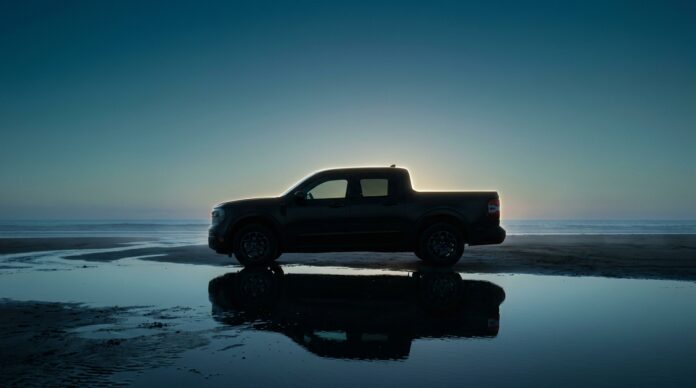

Quick Facts:
- Vehicle: Ford Fathom, four-door crew cab electric pickup
- Starting price: $28,350 MSRP, or $29,945 with the $1,595 destination charge
- Platform: Ford Universal EV Platform, first vehicle to use it
- Base drivetrain: Rear-wheel drive, single permanent-magnet motor
- All-wheel drive: Optional, adds a front induction motor, price unannounced
- Battery: Prismatic LFP cells from BlueOval Battery Park Michigan, capacity unannounced
- Range: Unannounced. Ford confirms a roughly 300-mile option costs extra
- Payload and towing: Unannounced
- Charge port: Native NACS
- Availability: Preorders early 2027, deliveries fall 2027
- Best for: Budget buyers weighing a first electric truck for light trail duty
8 min read
In This Article
- What Ford Announced About the Fathom
- Ford Fathom Specs, Confirmed and Withheld
- The Base Ford Fathom Is Rear-Wheel Drive
- Range Under Load Is the Missing Number
- Charging the Ford Fathom on Remote Routes
- Payload and Towing Decide the Outcome
- LFP Cells, Cold Nights, and a Structural Pack
- Ford Fathom vs. the Alternatives Under $30,000
- Final Verdict
- Frequently Asked Questions
What Ford Announced About the Fathom
Ford named its cheapest electric truck on August 6, 2026. The Ford Fathom starts at $28,350, and it arrives as the first vehicle on the company’s Universal EV Platform. At the advertised price, however, it drives its rear wheels only. All-wheel drive costs extra, and Ford has not said how much.
Two prices circulate, and both are right. Specifically, $28,350 is MSRP, while $29,945 adds the $1,595 destination charge. Back in July we broke down Ford’s $30K electric pickup plan, while the company would still only describe the truck as small. Since then, Ford has confirmed the name, the price, the platform, and the assembly site at Louisville Assembly in Kentucky. Preorders open in early 2027, deliveries in the fall.
What Ford withheld matters more than what it published. Range, battery capacity, payload, towing, ground clearance, bed length, and DC fast-charge speed all stayed off the sheet. Every one of those numbers decides whether a rig works past the pavement. Therefore this article covers the confirmed facts, then flags each gap instead of guessing.
The truck seats five in a crew cab, and Ford projects more passenger volume than a Toyota RAV4. Standard equipment includes bidirectional power, a native NACS port, a frunk, and Apple Maps with EV routing. Kay Hart of Ford Model e called it “not a stripped down vehicle.” Notably, every Fathom ships BlueCruise-capable, although activation costs extra.
Ford’s one-minute launch film. Video: Ford Motor Company.
Ford Fathom Specs, Confirmed and Withheld
The table below separates published facts from open questions. Ford released a name, a price, and a platform story, while the capability numbers stayed behind. Those gaps change a purchase decision.
| Specification | Details |
|---|---|
| Starting MSRP | $28,350 |
| Price with destination | $29,945, including $1,595 destination |
| Base drivetrain | Rear-wheel drive, single permanent-magnet motor |
| All-wheel drive | Optional front induction motor, price unannounced |
| Battery chemistry | Prismatic LFP, BlueOval Battery Park Michigan |
| Battery capacity | Unannounced |
| EPA range | Unannounced. A 300-mile option costs extra |
| Payload | Unannounced |
| Towing | Unannounced |
| Ground clearance | Unannounced |
| Bed length | Unannounced |
| Charge port | Native NACS |
| Body style | Four-door crew cab, five seats |
| Assembly | Louisville Assembly Plant, Kentucky |
| Timeline | Preorders early 2027, deliveries fall 2027 |
The Base Ford Fathom Is Rear-Wheel Drive
Here is the line most coverage buried. The entry Fathom drives its rear wheels through a single permanent-magnet motor. All-wheel drive exists as an option, adding an induction motor to the front axle, and Ford has not priced it. For an off-road audience, therefore, $28,350 buys a two-wheel-drive truck.
Rear-wheel drive is a real constraint on loose surfaces. Sand, wet clay, snow-covered forest roads, and steep climbs all reward front-axle torque. Electric motors help somewhat, because torque vectoring responds faster than a mechanical differential. Even so, one driven axle stays one driven axle on a rutted grade.
Weight distribution complicates the picture further. An empty pickup carries little mass over the rear tires, while the battery sits low and centered instead of over the drive axle. As a result, an unloaded rear-drive Fathom will likely struggle for traction in exactly the conditions where a light truck should shine. Budget for the all-wheel-drive option, therefore, and treat $28,350 as a headline rather than the price of a trail-capable rig. Until Ford publishes the AWD price, the true cost of an off-road Ford Fathom stays unknown.
Range Under Load Is the Missing Number
Ford published no range figure at all. Kay Hart said Ford is “not in a position to announce” the range at this stage, while confirming a roughly 300-mile option costs extra. Reading those two statements together, the standard-range truck lands below 300 miles, although Ford has not said where. For a truck arriving in fall 2027, the silence is understandable, yet the deciding number stays blank.
Overlanding punishes EPA numbers harder than commuting does. A rooftop tent adds frontal area and drag. Rolling resistance climbs on taller all-terrains. A loaded bed adds mass, while sustained elevation gain converts energy into altitude rather than distance. Highway EV range commonly falls 20 to 40 percent once drag, weight, and elevation stack up.
What Comparable Small Electric Trucks Deliver
Two compact electric pickups give useful reference points. Our breakdown of the Toyota Hilux EV range numbers covers 160 miles WLTP from a 59.2 kWh pack. The Slate Truck, meanwhile, delivers 205 miles, alongside a published 1,550-pound payload and a 2,000-pound tow rating. Both range figures describe unloaded trucks on pavement.
Working from this band, a loaded Fathom on a mountain route plausibly operates on 120 to 180 usable miles between charges. Treat any Ford Fathom range in this article as a reasoned bracket rather than a specification, because Ford has released neither a battery size nor an EPA figure. Consequently, trip planning shifts from distance to charger spacing.
Charging the Ford Fathom on Remote Routes
The Fathom ships with a native NACS port, which opens the Tesla Supercharger network without an adapter. This single detail changes road-trip math more than any other confirmed spec. Superchargers cluster along interstates and in gateway towns, so highway legs stay straightforward.
Trailheads are a different problem. Gateway towns such as Moab carry fast chargers, yet the Alpine Loop, the Mojave Road, and the Rubicon all run far beyond them. Consequently a Fathom trip becomes hub-and-spoke: charge in town, run the trail, return before the state of charge gets uncomfortable. Our guide to the Rivian Adventure Network charging coverage shows how thin the purpose-built adventure charging map still is.
Campground Level 2 charging helps less than people expect. A 40-amp connection adds roughly 25 to 30 miles of range per hour on a typical midsize EV, so an overnight stop restores a buffer rather than a full pack. Meanwhile most dispersed sites offer no power at all.
The discipline gas-era overlanders already use transfers directly. For example, our approach to range planning for remote routes splits a tank into thirds: one third out, one third back, one third in reserve. Apply the same rule to state of charge and the Fathom becomes plannable, although smaller in radius than a diesel midsize.
Payload and Towing Decide the Outcome
Ford announced neither payload nor towing. For this audience, those two numbers outrank price and touchscreen size combined. A build with a rooftop tent, drawers, water, recovery gear, and a fridge routinely consumes 625 to 895 pounds before passengers climb in.
Battery weight makes the margin tight on small electric trucks. Our explainer on payload capacity and GVWR limits puts typical midsize payload between 1,100 and 1,700 pounds, and a heavy pack eats into the low end of the range fast. Subtract a full build from a figure near 1,100 pounds and little headroom survives.
One warning about numbers circulating online. Social posts pairing the Fathom with 9,600 pounds or 4,000 pounds of towing are quoting other Ford vehicles entirely. Ford has published no Fathom towing rating, so treat any such figure as unattributed until the company confirms it.
LFP Cells, Cold Nights, and a Structural Pack
Prismatic lithium-iron-phosphate cells come from BlueOval Battery Park Michigan. LFP chemistry is cheap, thermally stable, and long-lived, which is precisely why it makes a sub-$30,000 truck possible. Cold weather, though, is the chemistry’s known weakness.
LFP loses usable capacity as temperatures drop, and it accepts a charge slowly until the pack warms. A high-elevation overnight at 20 degrees Fahrenheit leaves you with less morning range than the dash promised the evening before. Preconditioning helps when the truck is plugged in, yet dispersed camping rarely offers a plug. Winter wheeling therefore demands a wider reserve.
What a Structural Battery Means Underneath
The Fathom mounts interior components directly to the top of a structural battery pack, with no separate floor component. In addition, the platform uses large aluminum unicastings replacing more than 100 individual parts. Both choices cut cost and weight, and both raise unanswered questions.
A structural pack carries vehicle rigidity, so a rock strike becomes a structural event rather than a cosmetic one. Likewise, a cracked unicasting is no bolt-on repair. Ford has published no ground clearance figure, no approach or departure angles, and no word on skid plates. Until it does, plan on conservative line choice and expect underbody protection from the aftermarket, assuming the aftermarket builds for a platform engineered this tightly around aerodynamics.
Ford Fathom vs. the Alternatives Under $30,000
Mainstream coverage benchmarks this Ford electric pickup against the Chevy Bolt at $28,995 and the Tesla Model 3. Off-road buyers shop a different shelf. Instead, the real cross-shop is a Slate Truck, a base Maverick, or a clean used midsize with a known aftermarket.
The Slate Truck undercuts the Fathom at $24,950, or $26,400 delivered, with 205 miles of range and two doors. Our look at the Slate EV truck price and specs covers the full published sheet. In contrast, the Fathom offers four doors, five seats, and a Ford dealer network, while Ford withholds every capability figure Slate has already released.
Gas alternatives still hold the practical edge on capability per dollar. A 2026 Ford Maverick XL starts at $27,145, or about $28,840 delivered, refuels anywhere in five minutes, and carries a deep parts catalog. Meanwhile a used Tacoma or Gladiator at similar money brings lockers, real clearance, and a mature aftermarket. What none of them offer is a $28,350 four-door truck with bidirectional power and a NACS port.
Final Verdict
The Fathom aims squarely at a buyer Ford has been losing: someone who wants a new truck, who needs a payment under a used-truck loan, and who has no interest in a $60,000 rig. For a commuter with weekend trail ambitions, the truck looks compelling. Yet as a dedicated overland platform, it is unproven, and Ford has released nothing to settle the question.
The trade-offs are concrete rather than theoretical. Rear-wheel drive on the base truck, an unpriced AWD option, no published range, no payload, no towing, and a structural pack with unknown protection. Anyone building a rig this season should look elsewhere, because deliveries start in fall 2027 and the spec sheet stays mostly blank.
On value, the platform story is genuinely strong. Specifically, domestic LFP cells, megacasting, and a simplified assembly process are how a legacy automaker reaches this Ford Fathom price without stripping the cabin to a shell. Because Ford took a $19.5 billion write-down on canceled EV projects in 2025 and killed the F-150 Lightning, this truck reads as a deliberate reset rather than a line extension.
Wait for the numbers before forming an opinion on capability. If Ford publishes a payload above 1,300 pounds, an AWD option under $3,000, and a range figure north of 250 miles, then this Ford electric pickup becomes the cheapest credible entry into electric overlanding. Should those figures land low, however, a used midsize or the incoming Slate Truck stays the better trail buy. Either way, the answer arrives with the spec sheet, not with the name.
Frequently Asked Questions
How much does the Ford Fathom cost?
The Ford Fathom price starts at $28,350 MSRP. With Ford’s $1,595 destination charge, the delivered figure reaches $29,945. Both numbers appear across coverage and describe the same truck. In Canada, Ford lists CAD $42,690, or $38,690 after the $4,000 federal EVAP incentive.
What is the Ford Fathom range?
Ford has not announced a range figure. The company confirmed a roughly 300-mile configuration costs extra, which implies a standard-range truck below 300 miles, although Ford has not said so directly. Battery capacity also stayed unannounced.
Does the Ford Fathom have all-wheel drive?
All-wheel drive is optional, not standard. The base truck uses a single rear permanent-magnet motor, while the AWD version adds an induction motor to the front axle. Ford has not priced the AWD option.
How much will the Ford Fathom tow?
No towing rating exists yet. Figures near 9,600 pounds and 4,000 pounds circulating on social media belong to other Ford vehicles, including the Maverick and the Expedition. Payload and bed length also stayed unannounced.
Is the Ford Fathom suitable for off-road use?
Nobody knows yet, including Ford. Ground clearance, approach and departure angles, skid plate availability, and payload all stayed unpublished. The base rear-wheel-drive layout and a structural battery pack both argue for caution until real specifications arrive.
When will the Ford Fathom go on sale?
Preorders open in early 2027, with customer deliveries starting in fall 2027. Production runs at Ford’s Louisville Assembly Plant in Kentucky. The timing points to a 2028 model year.
Related Reading
Source: Ford Fathom official page.