



Quick Facts:
- Subject: UCLA self-powered tent prototype (magnetoelastic fabric generator)
- Published in: Matter, Cell Press, online 31 July 2026
- Team: Eight authors, UCLA Department of Bioengineering
- Peak output: 0.094 mW per 20 by 20 cm panel
- Sustained output: roughly 7.9 microwatts per panel, derived from the study’s capacitor data
- Inputs tested: hand tapping, wind, simulated rain
- Loads demonstrated: one LED and one digital thermometer
- Durability: more than 12,000 compression cycles at 5 Hz
- Materials: porous Ecoflex silicone with NdFeB particles, plus a 500-turn coil
- Status: laboratory prototype; no product, no price, no ship date
- Best for: understanding where fabric energy harvesting stands today
9 min read
In This Guide
- What the Self-Powered Tent Is
- Key Numbers From the Study
- How the Magnetoelastic Effect Works
- What the Team Measured
- Self-Powered Tent Output vs. Real Camp Loads
- What the Live Science Coverage Gets Wrong
- Self-Powered Tent vs. Portable Solar
- What Happened to Earlier Harvesting Gear
- What Would Change Before You Buy One
- Final Verdict
- Self-Powered Tent FAQ
What the Self-Powered Tent Is
A UCLA team has built a self-powered tent fabric turning wind, movement, and rain into electricity. The study appeared in the Cell Press journal Matter on 31 July 2026, with headlines following on 12 August. One number frames the whole story. Specifically, a 20 by 20 cm panel peaks at 0.094 milliwatts. For scale, a single panel makes roughly one two-hundred-thousandth of what a 20-watt phone charger delivers.
The research itself is solid. Eight authors from the UCLA Department of Bioengineering ran it, with Jun Chen as corresponding author. Chen’s lab published the founding work on soft magnetoelastic generators in 2021. Since then the group has applied the same physics to textiles, wearables, and now shelter. Peer review, open methods, and a published DOI all check out.
Framing is where the coverage drifted. The paper targets energy access for unhoused communities in Los Angeles County. Recreational camping appears nowhere in its stated aims. However, overlanding outlets, this one included, are reading it against camp power. Keep the original purpose in view while you read the numbers below.
For overlanders the useful question is narrow. Does a fabric generator move the needle against a folding solar panel? The comparison tables below answer it directly. First, though, look at what the team measured and how.
Key Numbers From the Study
Every figure below comes from the paper itself, “Self-powered magnetoelastic tents for sustainable energy access in unhoused communities” in Matter. Where a number is derived rather than printed, the table says so. Also note the study reports one panel, since nobody has yet built a full magnetoelastic tent.
| Measurement | Value |
|---|---|
| Panel size tested | 20 by 20 cm |
| Peak instantaneous power | 0.094 mW at roughly 100 ohm load |
| Capacitor charge, small | 0.22 microfarads to 5.80 V in 1.5 s by hand tapping |
| Capacitor charge, large | 220 microfarads to 1.7 V in 40 s |
| Sustained power (derived) | about 7.9 microwatts, from the 220 microfarad result |
| Rain input, peak | 0.0807 mW (about 81 microwatts) |
| Rain input, cumulative | 6.47 microjoules |
| Wind speed tested | not published anywhere in the paper |
| Wet performance | about 97.5% of peak-to-peak voltage retained after water spray |
| Cycle life | more than 12,000 cycles at 5 Hz, 4 mm travel |
| Loads demonstrated | one LED, one digital thermometer |
Those numbers show why fabric alone won’t run your camp. Here is the same power ladder in gear you buy today, cheap to premium.
The Power Ladder, In Gear You Can Buy
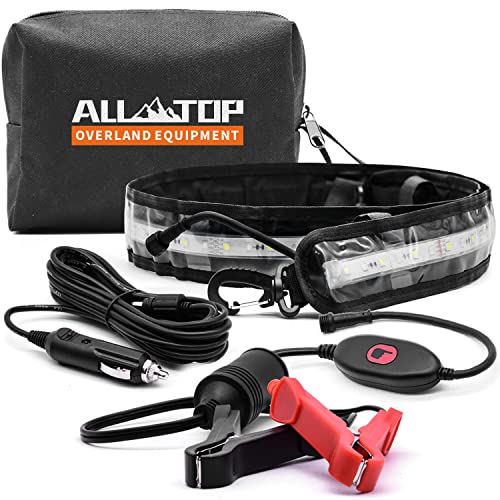
ALL-TOP Dimmable Flexible Camping Light Strip with Mounting Jacket




How the Magnetoelastic Effect Works
The magnetoelastic effect describes a shift in magnetic field strength when a material deforms. Rigid metal alloys show it weakly, although engineers have known about the effect since the 1860s. Instead, UCLA’s approach uses soft, porous silicone loaded with magnetic particles. Squeeze the foam and the particles move relative to one another. As a result, the surrounding field changes, and a nearby coil turns the change into current.
Construction is straightforward. The team mixed Ecoflex 00-30 silicone with 65-micron NdFeB particles at 50 and 83 percent by weight. Porosity lets the composite compress far more than solid rubber. Meanwhile a 500-turn conductive fiber coil sits alongside, and a cotton ribbon scaffold carries the assembly. Silicone and cotton are cheap. Rare-earth NdFeB is the one costly ingredient here.
Two properties matter for outdoor use. First, the generator works while wet, because magnetic coupling passes through water. After a spray test the team recorded about 97.5 percent of peak-to-peak voltage retained. Second, the assembly survived more than 12,000 compression cycles at 5 Hz. In contrast, triboelectric harvesters lose output in humidity, and piezoelectric films crack under repeated flexing. Wet tolerance is therefore the real advance in this energy harvesting field.
What the Team Measured
Tapping and stored charge
Hand tapping drove the highest instantaneous output. Charging a 0.22 microfarad capacitor, one panel reached 5.80 volts in 1.5 seconds. A larger 220 microfarad capacitor climbed to 1.7 volts in 40 seconds. Convert the stored energy back to a rate and you land near 7.9 microwatts sustained. Notably, the abstract states 5.80 volts while the results section states 5.60.
Wind and rain inputs
Rain produced the most complete dataset in the paper. The team logged 0.0807 mW peak and 6.47 microjoules cumulative under simulated rainfall. Wind appears as an input, yet no wind speed is published anywhere in the study. Without a speed, wind output stays unquantified. Meanwhile rain, the best documented input, is missing from every headline written about the work.
What it powered
Demonstrations stayed small on purpose. The prototype lit an LED and ran a digital thermometer. No phone, radio, or light string was powered in the study. Both loads sit in the microwatt to milliwatt band, which matches the measured output honestly. Next, compare those figures against loads overlanders run every night.
Self-Powered Tent Output vs. Real Camp Loads
Instantaneous power
The first table sets one 20 by 20 cm panel against four familiar sources. Multiples use the panel’s peak figure, which flatters it. Compared to the sustained figure, every gap below grows by roughly twelve times.
| Source or load | Power | Multiple of one panel |
|---|---|---|
| One panel, peak | 0.094 mW | 1x |
| One panel, sustained (derived) | 0.0079 mW | 0.08x |
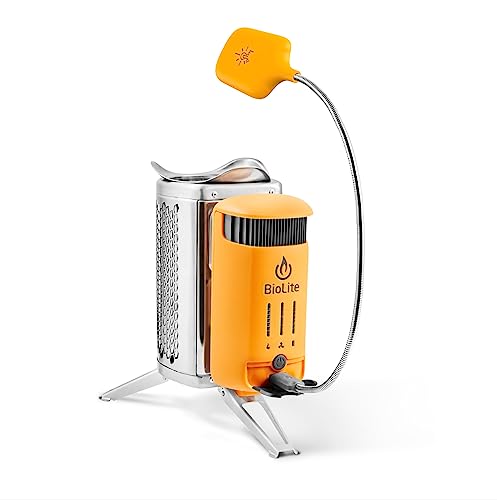
| BioLite CampStove 2+ USB output | 3 W | about 32,000x |
| Starlink Mini, active | about 25 W | about 266,000x |
| 100-watt folding panel at midday | about 75 W | about 800,000x |
Daily energy
Instantaneous watts mislead, so the second table converts everything to watt-hours per day. Tent-level figures scale one panel across roughly 10 sq m of fabric, which is our arithmetic rather than a published measurement. Therefore treat both tent rows as an upper bound.
| Source or load | Watt-hours per day |
|---|---|
| Whole 10 sq m tent, sustained rate (scaled) | about 0.05 Wh |
| Whole 10 sq m tent, peak rate (scaled) | about 0.56 Wh |
| Single 100-watt folding panel, clear day | 350 to 400 Wh |
| 12V fridge, warm weather | about 560 Wh |
| Starlink Mini running 24 hours | about 720 Wh |
Two load rows deserve a note on sourcing. A 12V compressor fridge draws roughly 45 amp-hours daily in hot weather, near 560 watt-hours, so see our 12v fridge guide for model choices. Connectivity costs more still, since Starlink Mini watt draw runs 20 to 40 watts while active. Lighting sits far lower, because 12V strip lighting draws roughly 0.5 to 1.2 amps per meter, per our camp lighting power draw breakdown.
One arithmetic check makes the scale concrete. A 15 watt-hour phone battery holds 54,000 joules. At 0.094 milliwatts, filling it takes roughly 18 years of unbroken output from one panel. Meanwhile the sustained rate pushes the same figure past 200 years. Overlanders carry off-grid power in a battery instead, as our roundup of portable power stations shows.
What the Live Science Coverage Gets Wrong
Nothing inside the paper itself is overstated. Two errors entered with the coverage instead. First, sound. The Live Science headline credits the tent with making electricity from sound. However, search the paper and the words sound, audio, decibel, and speech appear zero times. Acoustic appears twice, although both instances sit inside the reference list, citing separate papers from the same lab.
Second, the device examples. The same Live Science report names microwaves and power tools as small electronics the technology suits. A microwave draws roughly 1,000 watts. Compared to 0.094 milliwatts, the gap runs to about ten million times. The rest of its body copy holds up, so the device examples are the failure.
None of this makes the research weak. A fabric generator working wet, and surviving 12,000 cycles, is a genuine result. Still, overstated coverage sets readers up for disappointment. Specific numbers protect against hype and against dismissal alike.
Self-Powered Tent vs. Portable Solar
Portable solar already solves camp power, and the gap is enormous. A 100-watt folding panel returns 350 to 400 watt-hours on a clear day. Scaled across 10 sq m, meanwhile, the fabric returns about 0.05 watt-hours. Even using the flattering peak figure of 0.56 watt-hours, solar leads by roughly 700 times. In contrast, the sustained comparison runs closer to 8,000 times.
Rated output and field output differ for both technologies, so compare honestly. Our guide to real solar panel output numbers found a 400-watt array delivering about 316 watts outdoors. The tent figures above carry the larger caveat, because they scale a single 400 square centimeter sample to a whole shelter. Nobody has built or measured a complete magnetoelastic tent. Therefore treat every whole-tent number here as arithmetic.
What Happened to Earlier Harvesting Gear
History supports caution here. AMPY Move, a kinetic charger funded on Kickstarter in 2014, shipped in 2015 and failed. Running 20 miles returned under a minute of phone charge. Orange’s solar tent concept never left the render stage. Meanwhile BioLite’s CampStove remains the best known harvesting camp product, producing 3 watts from burning wood. Compared to the fabric panel, a wood stove delivers about 32,000 times the output.
Solar already wins by thousands of times, so pick your panel next. These five folding options run from budget to serious daily charging.
| Top Pick | Most Output | Best for Jackery Owners | Article's Reference Panel | Best Budget | |
|---|---|---|---|---|---|
| Product | TOP PICK Renogy 200W Portable Renogy 200W Portable |  EcoFlow 220W Bifacial EcoFlow 220W Bifacial | 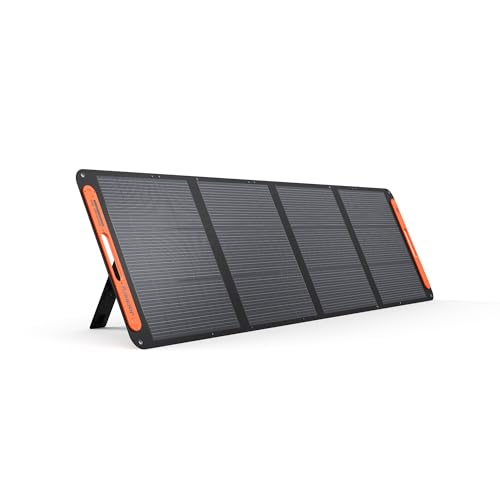 Jackery SolarSaga 200 Jackery SolarSaga 200 |  Renogy 100W Portable Renogy 100W Portable |  FlexSolar 100W FlexSolar 100W |
| Rating | ★★★★☆ 4.4 729 ratings | ★★★★☆ 4.5 672 ratings | ★★★★☆ 4.4 122 ratings | ★★★★☆ 4.6 39 ratings | ★★★★☆ 4.4 287 ratings |
| Rated Output | 200W | 220W | 200W | 100W | 100W |
| Waterproof Rating | IP65 | IP68 | IP68 | IP67 | IP67 |
| Price | $219.99 as of Oct 1, 1:44 pm | $399.00 as of Oct 1, 1:44 pm | $378.99 as of Oct 1, 1:44 pm | $117.07 as of Oct 1, 1:44 pm | $80.99 as of Oct 1, 5:34 pm |
| Check Price → | Check Price → | Check Price → | Check Price → | Check Price → |
What Would Change Before You Buy One
Four gaps sit between this prototype and a tent on a shelf. None is fatal, although each takes years.
First, tent-level output. The paper reports one 400 square centimeter sample and never scales it. Also, real fabric has seams, doors, and large areas nobody touches. Second, cost. NdFeB uses neodymium, a rare-earth metal with volatile pricing, while the composite runs 50 to 83 percent particles by weight. Therefore a full shelter would need kilograms of it.
Third, outdoor durability. The 12,000-cycle test ran indoors at a fixed 4 mm travel. Meanwhile UV exposure, freeze-thaw, packing abrasion, and washing all sit untested. Fourth, power conditioning. Because raw output is low-voltage AC, a rectifier, a storage cell, and a regulator all have to ride along. Those parts add weight and cost, neither of which the paper accounts for.
Watch the field rather than the product. Chen’s group publishes steadily, though the tent’s areal output sits below its own 2021 bioelectronics figures. A shelter making usable watts would need roughly a thousandfold improvement. Progress of such size happens, although rarely inside a decade.
Final Verdict
Read this study as materials science rather than gear news. The result worth remembering is a soft generator working while soaked. It retained 97.5 percent of peak-to-peak voltage after a spray test, and survived more than 12,000 cycles. Because wet tolerance is the hard problem in this field, the UCLA team solved a real piece of it. Sensor-scale uses therefore look plausible within a few years.
For overlanding, the honest answer is no. One panel peaks at 0.094 milliwatts, while a generous whole-tent estimate lands near half a watt-hour a day. In contrast, a single folding solar panel returns hundreds of watt-hours in the same period. No amount of engineering closes a gap of such size soon.
Coverage of the story deserves skepticism, although the research does not. First, sound generation never appears in the paper. Second, microwaves and power tools sit ten million times above the measured output. Meanwhile wind, the input every headline leads with, carries no published speed anywhere.
Spend your attention on off-grid power gear you buy today. A 100-watt panel from our camping solar panel guide, plus a 1,000 watt-hour station, covers lights and a laptop comfortably. Revisit energy harvesting when a paper reports watts per square meter instead of microwatts per panel. Until then, the fabric belongs in a lab notebook.
Self-Powered Tent FAQ
Does a self-powered tent charge a phone?
No. One 20 by 20 cm panel peaks at 0.094 milliwatts. A 15 watt-hour phone battery holds 54,000 joules, so filling it at peak output takes roughly 18 years of unbroken flexing. Instead, the prototype powered an LED and a digital thermometer.
How much power does a self-powered tent produce?
The published figure is 0.094 milliwatts peak per 20 by 20 cm panel, at roughly 100 ohms. Sustained output derived from the study’s 220 microfarad capacitor test lands near 7.9 microwatts. However, nobody has measured a complete tent, so any whole-shelter number is an estimate.
Is a self-powered tent better than a solar panel for camping?
No, and the gap is not close. Scaling the study’s panel across a whole shelter gives well under one watt-hour a day. A single 100-watt folding panel returns hundreds of watt-hours instead. Therefore solar leads by roughly 700 to 8,000 times, depending on the rate used.
What is the magnetoelastic effect?
It describes a change in a material’s magnetic field when the material deforms. Rigid alloys show the effect weakly. Instead, UCLA’s version uses porous silicone filled with NdFeB particles. Because pressing the foam shifts the particles, the surrounding field changes. Finally, a nearby coil converts the change into current.
When will a self-powered tent go on sale?
No date exists, because no product exists. The paper describes a laboratory prototype with no cost, no weight, and no tent-level output figure. Also, rare-earth material cost, outdoor durability, and power conditioning remain unsolved. No brand has announced a commercial magnetoelastic tent.
Does the fabric still work in the rain?
Yes, and rain is one of its documented inputs. Because magnetic coupling passes through water, the generator keeps working while soaked. The team measured 0.0807 mW peak under simulated rainfall. After a spray test it retained about 97.5 percent of peak-to-peak voltage.