



Quick Facts:
- Product: Devos LightRanger 1200 portable area light
- Brightness: Up to 1,200 lumens, 5000K white
- Coverage: Up to 60 ft diameter, 4 / 2 / 1 panel control
- Runtime: About 3.5 hrs on full power, up to 80 hrs on low
- Pole height: 4-section aluminum, 3 to 9 ft
- Charging: USB-C 20W, 100% in about 4 hours
- Weather: IP56 rated, aluminum housing
- Warranty: 2 years
- Price: $149.99
- Best for: Overlanders and tent campers who light a whole site
9 min read
In This Review
- Devos LightRanger 1200 Overview
- Key Specs at a Glance
- Brightness and Coverage
- Battery Life and Charging
- Devos LightRanger 1200 Durability After Two Years
- How I Use It at Camp in Practice
- LightRanger 1200 vs LightRanger 2000
- What to Know Before You Buy the LightRanger 1200
- Pros and Cons
- Final Verdict
- Frequently Asked Questions
Devos LightRanger 1200 Overview: One Pole, a Whole Lit Campsite
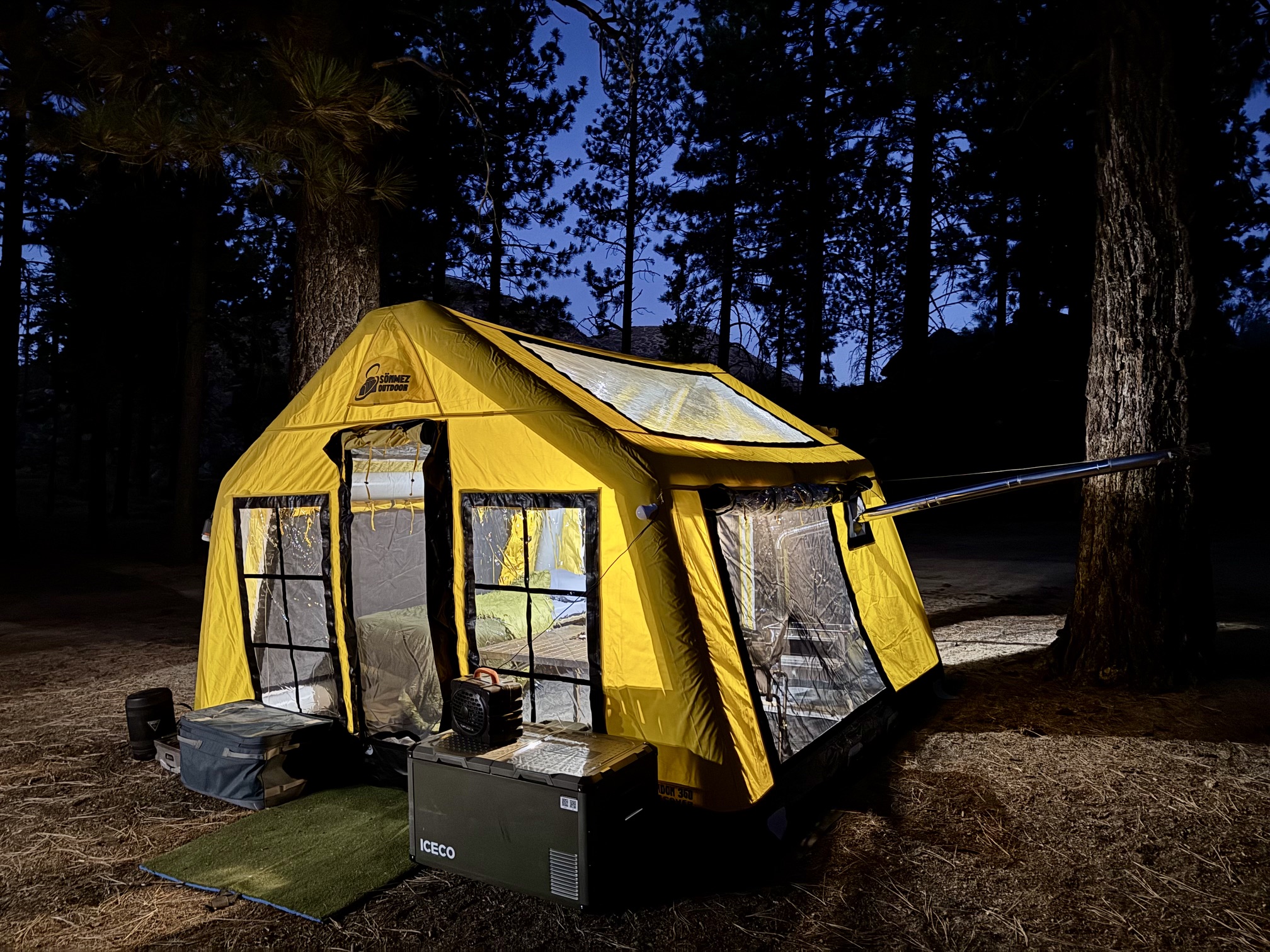
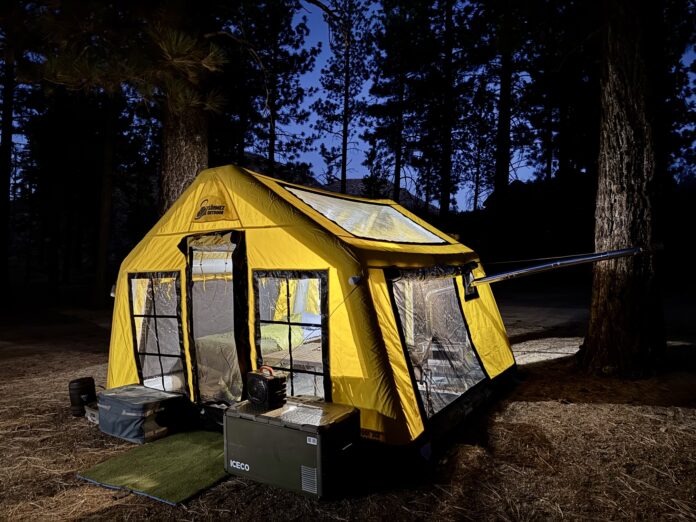
The Devos LightRanger 1200 is a rechargeable portable area light built to flood an entire campsite from a single pole, instead of lighting one picnic table. I have owned mine for two years, and it rides in a plastic bin with the rest of my camp gear. After two seasons of overlanding and tent testing, it remains one of my most reliable lights.
This light suits overlanders, tent campers, and anyone who needs wide overhead lighting at camp. Devos sells it at $149.99, which sits at the premium end of camp lighting. For comparison, a basic rechargeable lantern often runs $30 to $60. However, those small lanterns light a table, while this one lights a whole site. If you are weighing styles first, our camping lights buyer’s guide breaks down the options.
Devos designed the 1200 around four LED panels on a telescoping aluminum pole. You raise the head up to 9 feet, then point the light down and out across the site. Because the source sits overhead, bugs and glare stay out of your eyes. Devos lists the full spec sheet on the official product page, and the model now sits below the newer LightRanger 2000 in the lineup.
Key Specs at a Glance
Here are the verified specs for the Devos LightRanger 1200. Where the manufacturer and Amazon listing differ on weight, both figures appear below.
| Specification | Details |
|---|---|
| Max brightness | Up to 1,200 lumens |
| Color temperature | 5000K white |
| Coverage | Up to 60 ft diameter, 360 degrees |
| Light zones | 4, 2, or 1 panel, dimmable |
| Battery | Rechargeable lithium-ion |
| Charging input | USB-C, 20W supported |
| Recharge time | 60% in 1 hour, 100% in about 4 hours |
| Device output | USB-C output for phones and small devices |
| Pole | 4-section aluminum, 36.5 to 108 in (3 to 9 ft) |
| Weight | 4 lbs (Devos) / 5.25 lbs (Amazon listing) |
| Weather rating | IP56 |
| In the box | Lantern, tripod pole, carry bag, USB cable |
| Warranty | 2 years |
| Price | $149.99 |
| Top Pick | Best Value | Best Add-On | |
|---|---|---|---|
| Product | TOP PICK LightRanger 1200 LightRanger 1200 |  LightRanger 800 LightRanger 800 |  LightRanger 800 Filter Kit LightRanger 800 Filter Kit |
| Rating | ★★★★☆ 4.4 92 ratings | ★★★★☆ 4.5 151 ratings | ★★★★★ 4.8 24 ratings |
| Type | Portable Area Light | Portable Area Light | Colored Lens Filter Kit |
| Brightness | 1,200 lumens | 800 lumens | N/A, accessory |
| Works With | Stands alone | Stands alone | LightRanger 800 only |
| Price | $149.99 as of Oct 2, 2:49 am | $24.99 as of Oct 1, 9:54 pm | |
| Check Price → | Check Price → | Check Price → |
Brightness and Coverage
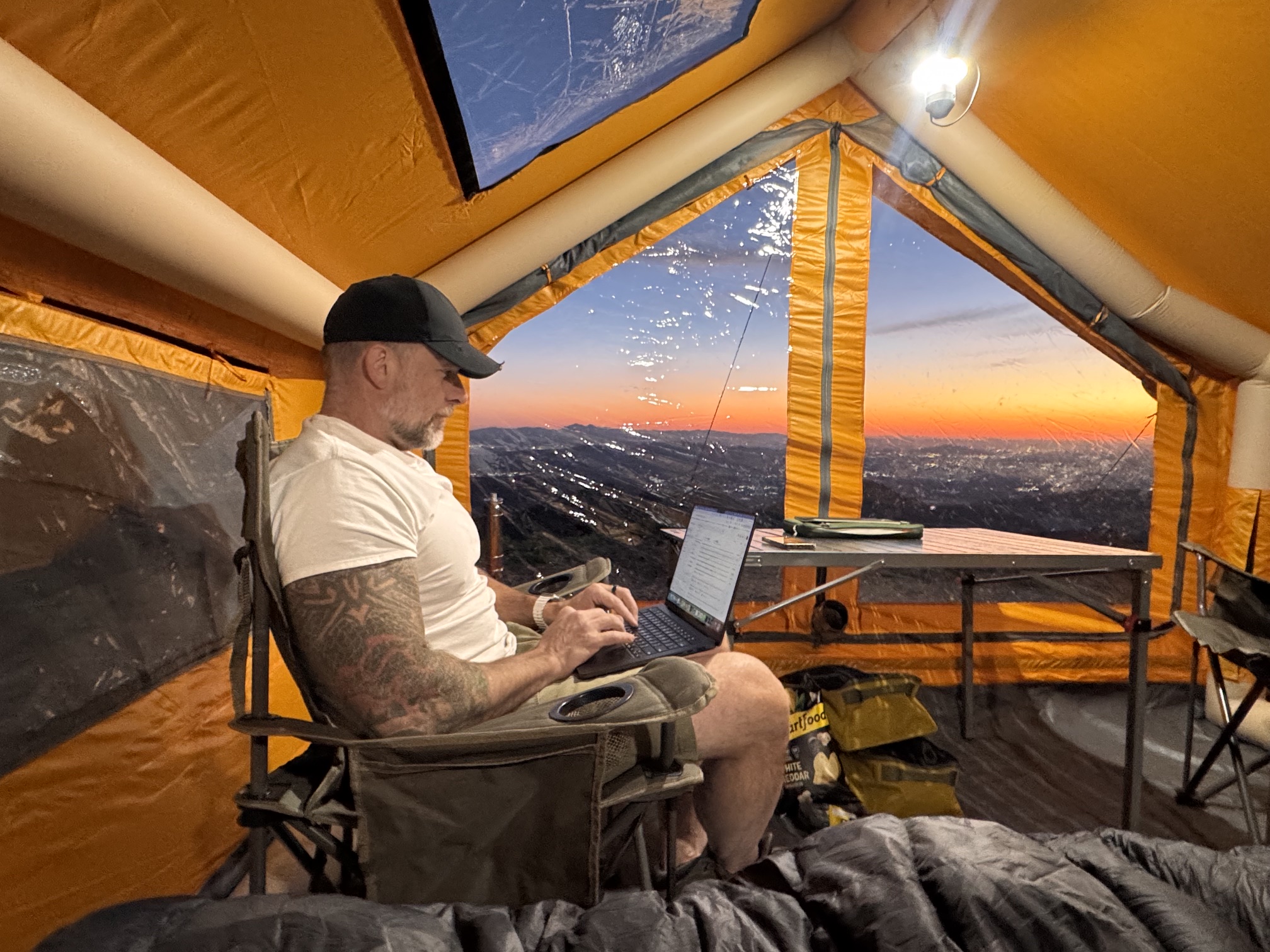
The headline number is 1,200 lumens, and Devos rates the spread at up to a 60-foot diameter. In fact, the overhead mounting matters more than the raw lumen figure. With the head at 8 or 9 feet, the light rains down across a two-vehicle camp and reaches the edges of a 20-by-20 tarp.
You control output two ways. You choose 4, 2, or 1 lit panel, so you light the full circle or only the side you face, and you dim each setting for a softer glow. For example, one panel on low works well for reading inside a tent, while all four on high turn a dark site into a work zone.
The light runs at 5000K, which reads as crisp daylight white. White output is bright and practical, yet it attracts bugs and washes out night vision. Devos sells a colored filter kit for $29.99 if you want amber or red at night. If you camp often, the trade-offs between white and warm light are worth knowing, and I covered them in detail in why you should ditch white camp light after dark.
Battery Life and Charging
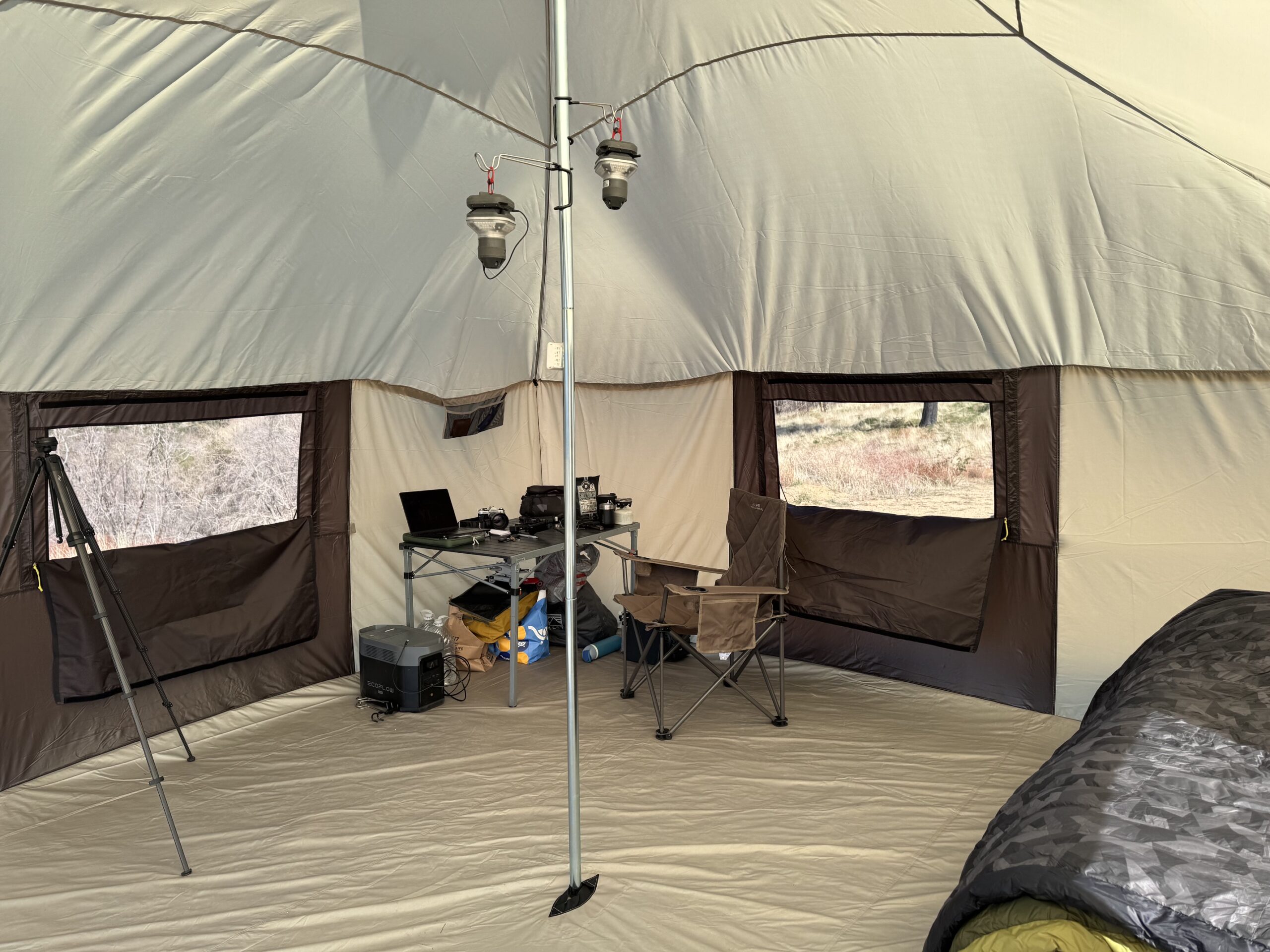
Runtime depends on how many panels you run. Fewer panels and lower brightness stretch a charge dramatically, from a few hours at full output to as much as 80 hours on a single dimmed side. The table below maps each mode.
| Setting | Approximate runtime |
|---|---|
| All 4 sides, high (1,200 lumens) | 3.5 to 3.75 hours |
| 2 sides, high | About 7 hours |
| 1 side, high | About 14 hours |
| 1 side, low (dimmed) | Up to 80 hours |
Charging runs over USB-C at 20 watts. With a 20W charger, the battery reaches 60% in one hour and full in about four hours. The head also doubles as a power bank, since the USB-C port pushes a charge to your phone. Over two years, I have noticed no drop in how long a charge lasts, which is the result owners most want from a lithium pack.
For longer trips, I top the light off from a battery bank. Running it from a compact power station with a larger solar panel attached keeps the light alive for a week without grid power. Devos also sells a 20W solar panel with a receiver for $99.99 if you prefer a dedicated solution.
Devos LightRanger 1200 Durability After Two Years
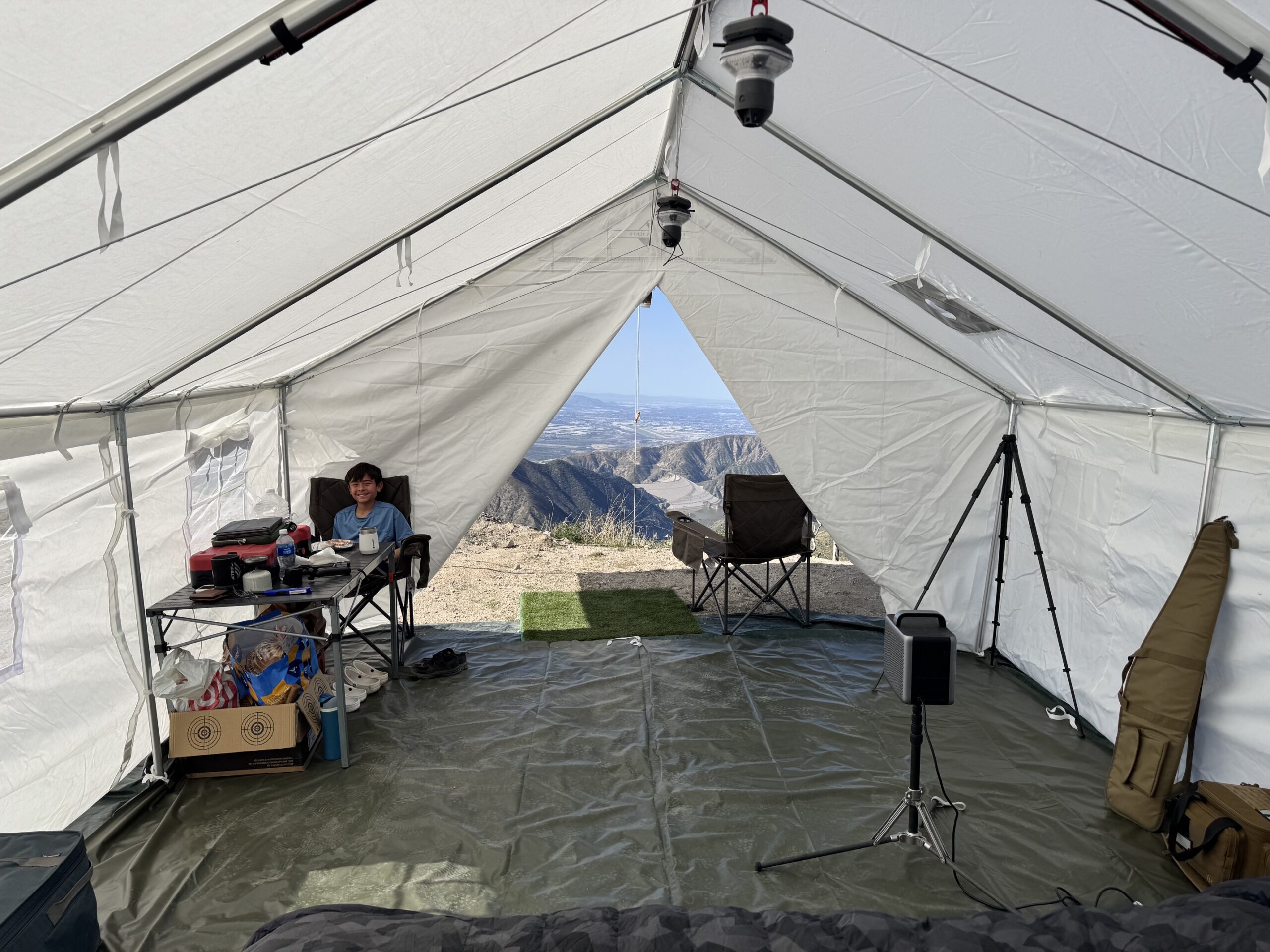
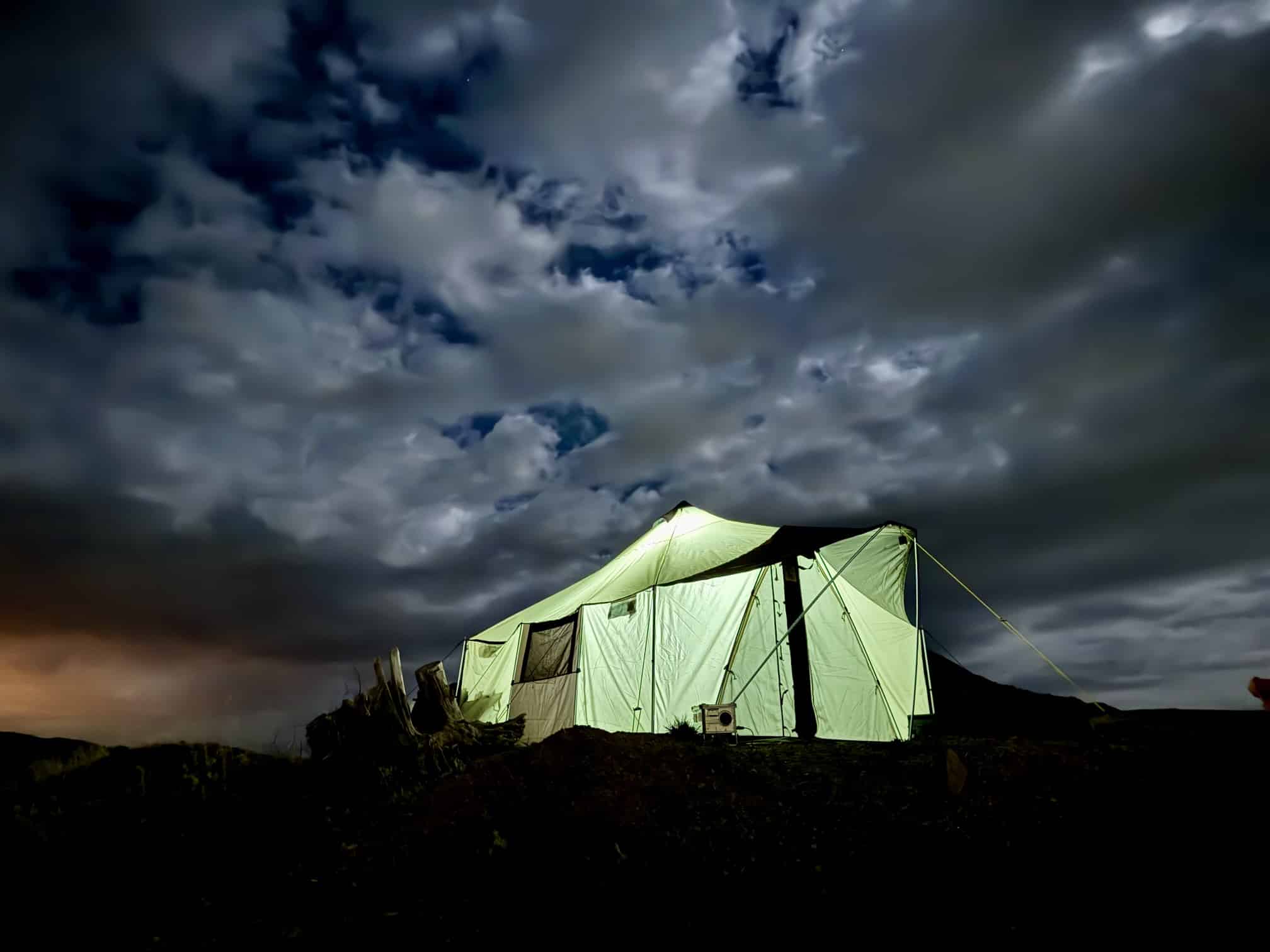
Durability is where this light earns its price. I store mine in plastic bins, and those bins get thrown around, stacked, and dropped on tailgates and rocks. The light has ridden through sand and snow across two seasons. Despite the abuse, it has held up extremely well, with no cracked housing and no failed panels.
The aluminum pole and IP56 rating explain the toughness. IP56 means the housing resists heavy dust and strong water jets, so a dusty trail or a rainy night will not kill it. After two years of rough handling, the lock button still seats the head firmly, and every brightness mode still works.
The battery earns special mention. Many rechargeable lights lose runtime after a season or two, yet mine still holds its rated hours. Because the pack has not degraded, I trust the light for multi-day trips without second-guessing the charge.
How I Use It at Camp in Practice
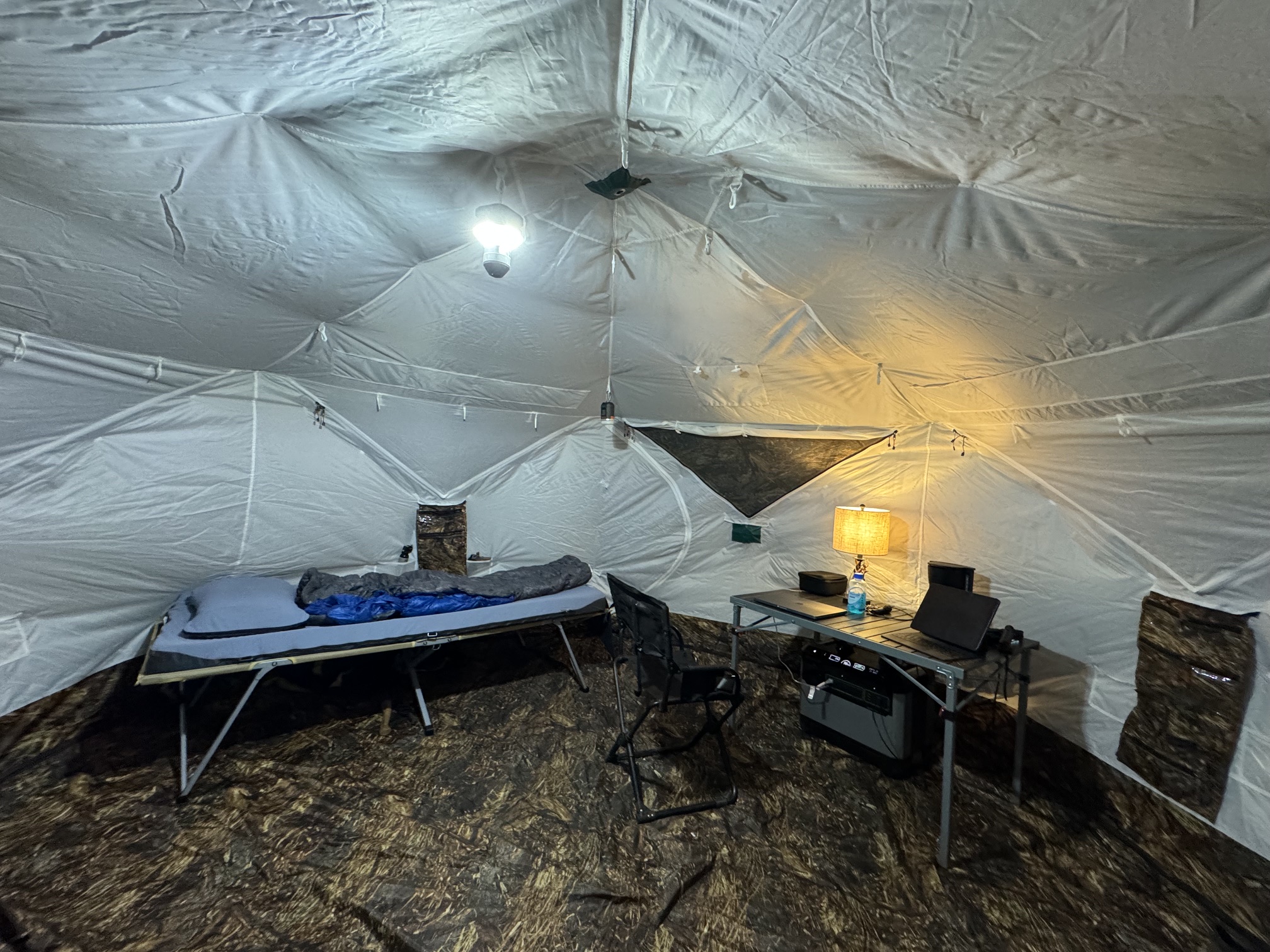
I rarely use the tripod base. In fact, I am not sure where mine ended up. Instead, I run the light almost entirely off the eyelet hooks I hang inside the tents I test. The head pops off the pole, so hanging it overhead takes seconds.
When there is no tent, I improvise. I tie a wrench to a length of paracord, throw the wrench over a tree limb, and hoist the light to hang it over the campsite. Overhead height is the whole point, because it pushes bugs and glare away from your face. Lighting is one of the upgrades I rank highest, a point I make in my guide to tent camping upgrades.
I also owned the matching solar panel. It works fine, yet I found it simpler to plug the light into whatever battery I already carry, since the battery already has a larger solar panel.
LightRanger 1200 vs LightRanger 2000: Which Should You Pick?
Devos now sells the LightRanger 2000 above the 1200, and the differences come down to three things. First, the 2000 pushes 2,000 lumens against the 1,200 here. Second, the 2000 adds Bluetooth app control, while the 1200 cycles modes only through its physical button. Third, the 2000 builds colored light into the head, so you skip the separate filter kit.
The 1200 answers back on price and simplicity. At $149.99, it undercuts the larger model, and the button-only control means nothing to pair or update. For most two-vehicle camps, 1,200 lumens already lights more space than you need.
Pick the 2000 if you want app control, built-in colors, and maximum reach for a large group. Choose the Devos LightRanger 1200 if you want a proven, cheaper light and you are fine cycling modes by hand. After two years, the button has never slowed me down.
What to Know Before You Buy the LightRanger 1200
To round out this review, here are the patterns worth flagging so no angle goes uncovered. The strengths hold up well. Wide coverage and the overhead design stand out most, because raising the head keeps bugs and glare off your face.
The trade-offs are consistent. Price is the main sticking point, since $149.99 runs steep for a camp light. The head’s lock button relies on a spring, which warrants a gentle hand over the years, although the 2-year warranty covers a failure. The colored filter kit adds bulk to your pack, and the tripod legs want weighting down in strong wind. After two years, the price felt steep at checkout, yet the light has outlasted cheaper lanterns I owned.
Pros and Cons
Pros
- Lights up to a 60 ft circle at 1,200 lumens from one pole
- Overhead design keeps bugs and glare off your face
- 4, 2, or 1 panel control plus dimming for any task
- Head pops off the pole to hang from a hook or limb
- USB-C 20W charging fills the pack in about 4 hours
- Doubles as a power bank for your phone
- Up to 80 hours of runtime on a single low panel
- Aluminum and IP56 build shrugged off two years of drops and rough storage
Cons
- At $149.99, it costs more than most camp lights
- No app or remote control on the 1200 model
- Colored light needs the separate $29.99 filter kit
- 5000K white runs harsh without a filter
- Runtime drops to about 3.5 hours with all four sides on high
- Battery is not user-replaceable
Final Verdict
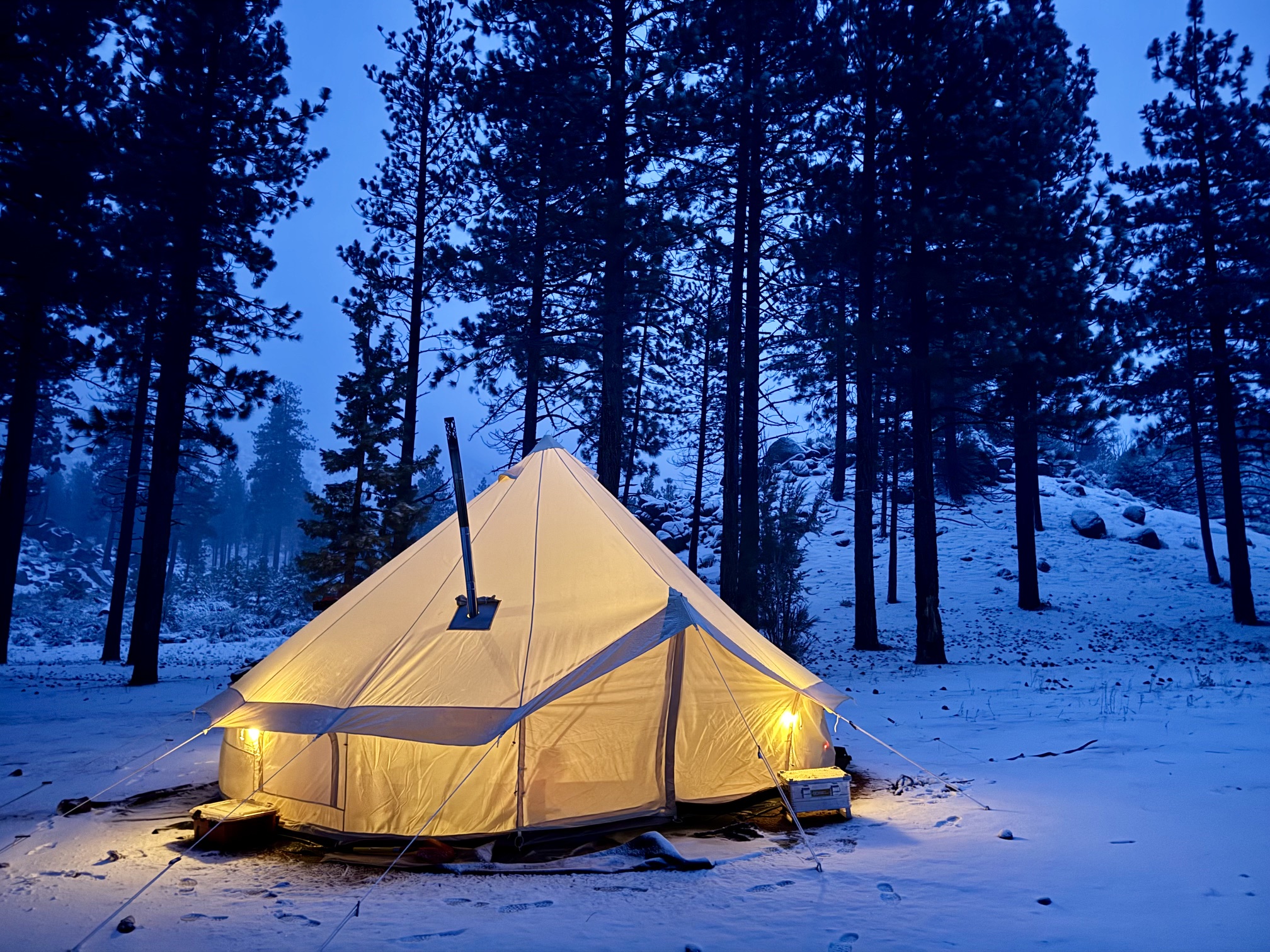
The Devos LightRanger 1200 fits overlanders and tent campers who want to light a whole site, not one table. Its biggest strength is the overhead spread, because 1,200 lumens from 9 feet up beats any eye-level lantern for a working camp. Two years of bins, drops, sand, and snow have not slowed mine down.
The trade-offs are real. You pay $149.99, you live without app control, and you buy a separate kit for colored light. If those points bother you, the LightRanger 2000 adds an app and built-in colors for more money, and a $40 lantern will light a single table for far less.
On value, the price stings at checkout, yet the cost per season drops fast when the light refuses to die. Mine has paid for itself across two years of testing. The half point I hold back reflects the price and the missing app control, not how it performs at camp.
For a durable, bright, no-nonsense portable area light, the Devos LightRanger 1200 earns a strong recommendation. Pair it with a power bank and round out the rest of your kit with our guide to essential overlanding gear.
★★★★★ 4.7 / 5 – 4wdTalk Rating
DEVOS - LightRanger 1200 Telescoping Camp Light, 9 ft tall with 1200 lumens, Rechargeable LED Lantern, Up to 80-hour Runtime, 1-Year Warranty, Includes Carry Case
Two years of tossing it in a gear bin and hauling it through sand and snow, and the housing still has not cracked.
- Lights up to a 60 ft circle from a single pole
- Overhead mounting keeps bugs and glare off your face
- USB-C charging doubles as a phone power bank
- Held up two years of drops, sand, and snow with no cracks or failed panels
- Costs more than most camp lanterns
- No app or remote control
Frequently Asked Questions
How long does the Devos LightRanger 1200 battery last?
Runtime ranges from about 3.5 hours with all four sides on high to as much as 80 hours on a single dimmed panel. Two sides on high last roughly 7 hours, and one side on high lasts about 14 hours. After two years, my pack still holds these rated hours.
Does the Devos LightRanger 1200 have app control?
No. The 1200 cycles brightness and panel modes through a physical button only. App and Bluetooth control is the headline upgrade on the newer LightRanger 2000, so choose the 2000 if remote control matters to you.
Is the Devos LightRanger 1200 waterproof?
The light carries an IP56 rating, which means it resists heavy dust and strong water jets. It handles rain and dusty trails well, though it is not built for full submersion. Mine has held up through dusty trails and wet nights over two seasons.
Will the LightRanger 1200 charge a phone?
Yes. The head has a USB-C output, so it pushes a charge to a phone or small device. This makes it a backup power bank in addition to a camp light, which is handy on longer trips.
How bright is the LightRanger 1200?
It puts out up to 1,200 lumens at 5000K white across a 60-foot diameter. Mounted overhead on the 9-foot pole, the light covers a two-vehicle camp.
Is the Devos LightRanger 1200 worth it at $149.99?
For campers who want wide overhead lighting and proven durability, yes. The price is steep next to a basic lantern, yet the build quality and stable battery life lower the real cost across seasons. Budget shoppers who only light a table will find cheaper options.