


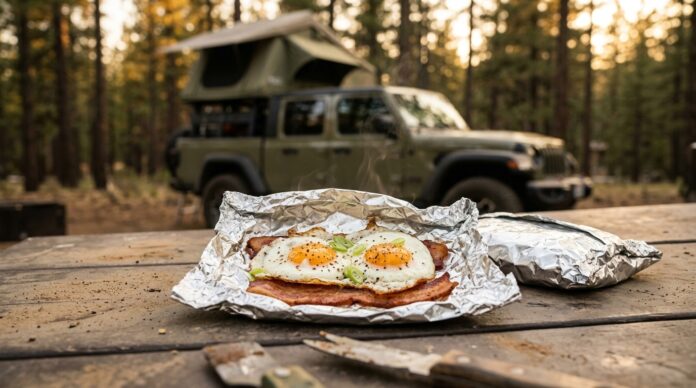

Quick Verdict: Foil packet bacon and eggs gives you a hot protein breakfast with no skillet to scrub. First, lay two strips of bacon on a heavy-duty foil square, crack two eggs over the top, and season. Next, cook on medium coals for 12 to 15 minutes until the eggs set at 160F and the bacon renders. Then each packet feeds one hungry person. Also, the recipe scales from 2 to 6 and leaves zero dishes.
Save this recipe for your next trip.
Last updated: June 2026 | Prep: 5 min at home | Cook: 15 min | Serves: 2
Written by Alex Schult
Editor in Chief of 4wdTalk.com. 15+ years of off-road and overlanding experience with 1,000+ hours on the trail.
We tested this recipe on actual overland trips. Amazon affiliate links support 4wdTalk.com at no extra cost to you.
In This Recipe
Why This Recipe Works for Overlanders
Foil packet bacon and eggs strips a classic breakfast down to its simplest field form. First, you skip the skillet, splatter, and scrubbing. Instead, the foil becomes the cooking surface, the plate, and the trash in one sheet. Specifically, each packet holds two eggs and two strips of bacon, which cook together while the bacon fat bastes the eggs from underneath. Because nothing touches a pan, cleanup drops to zero dishes.
Speed is the second advantage. Since most overland mornings start cold and slow, nobody wants to wait 30 minutes for a hot plate. Then you build each packet in under a minute and set it on coals while coffee brews. Also, because each packet cooks as a single serving, picky eaters control their own seasoning without slowing the group.
Cold mornings show the method’s strength. Because the sealed foil traps steam and radiant heat, foil packet bacon and eggs sets evenly even when the overnight low drops below freezing. When wind or cold stretches the cook, you add a few minutes without changing the technique. This recipe is part of the full foil packet camping recipes collection. While a bigger group breakfast suits the dutch oven camping recipes collection, both hubs roll up to our camp cooking for overlanders guide.
Equipment You Need
- Reynolds Wrap Heavy Duty aluminum foil: approximately 0.94 mil thickness for direct coal contact
- Long-handled tongs: 16-inch to place and flip packets without reaching over coals
- Heat-proof gloves: rated above 500F for handling hot foil packets
- Charcoal chimney starter: lights briquettes in 15 minutes with no lighter fluid
- Kingsford Original briquettes: consistent burn and predictable ash timing
- Fireside Outdoor Pop-Up Fire Pit (optional): contains coals and blocks wind
- ICECO VL75 ProD fridge (optional): keeps eggs and bacon below 40F on multi-day trips
The Essential
Reynolds Wrap Heavy Duty Aluminum Foil
Heavy-duty construction handles direct coal contact without tearing under runny egg and rendering bacon fat. Specifically, one 75 square foot roll wraps roughly 30 single-serve breakfast packets. Also, it is the only foil I trust on overland trips.
Ingredients
Makes 2 packets, one per person
- 4 large eggs (2 per packet)
- 4 strips thick-cut bacon (2 per packet)
- 1/2 teaspoon kosher salt
- 1/2 teaspoon cracked black pepper
- 1 tablespoon butter or cooking spray for the foil
- 1/2 cup shredded cheddar (optional)
- 2 scallions, sliced thin (optional)
- Hot sauce for serving (optional)
- 2 sheets heavy-duty foil, 14-inch square each, plus 2 more for double-wrapping
Step-by-Step Instructions
Prep at home (the night before, 5 minutes):
- Par-cook the bacon halfway: Lay the bacon strips on a sheet pan and bake at 375F for 6 minutes, or until the fat starts to render but the meat stays flexible. This step removes excess grease and shortens the camp cook, which matters in wind. Cool the strips, then stack them between parchment in a zip bag.
- Pre-cut the foil: Tear 4 sheets of heavy-duty foil into 14-inch squares. Two sheets cook the packets and two act as a second layer, since runny egg and bacon fat punch through a single layer on a 15-minute cook.
- Pack the add-ins: Slice the scallions and bag the shredded cheese. Keep the raw eggs in their carton inside the fridge or cooler below 40F.
At camp (morning of breakfast):
- Light the coals: Fill a charcoal chimney with 20 to 25 Kingsford briquettes. Light the bottom and wait 15 to 20 minutes until the coals glow orange under a coat of gray ash. Medium coals run 350F to 400F at the surface, which sets eggs without scorching the bacon.
- Grease the foil: Rub a teaspoon of butter or a quick spray across the center of each foil square. Greased foil releases the cooked egg cleanly.
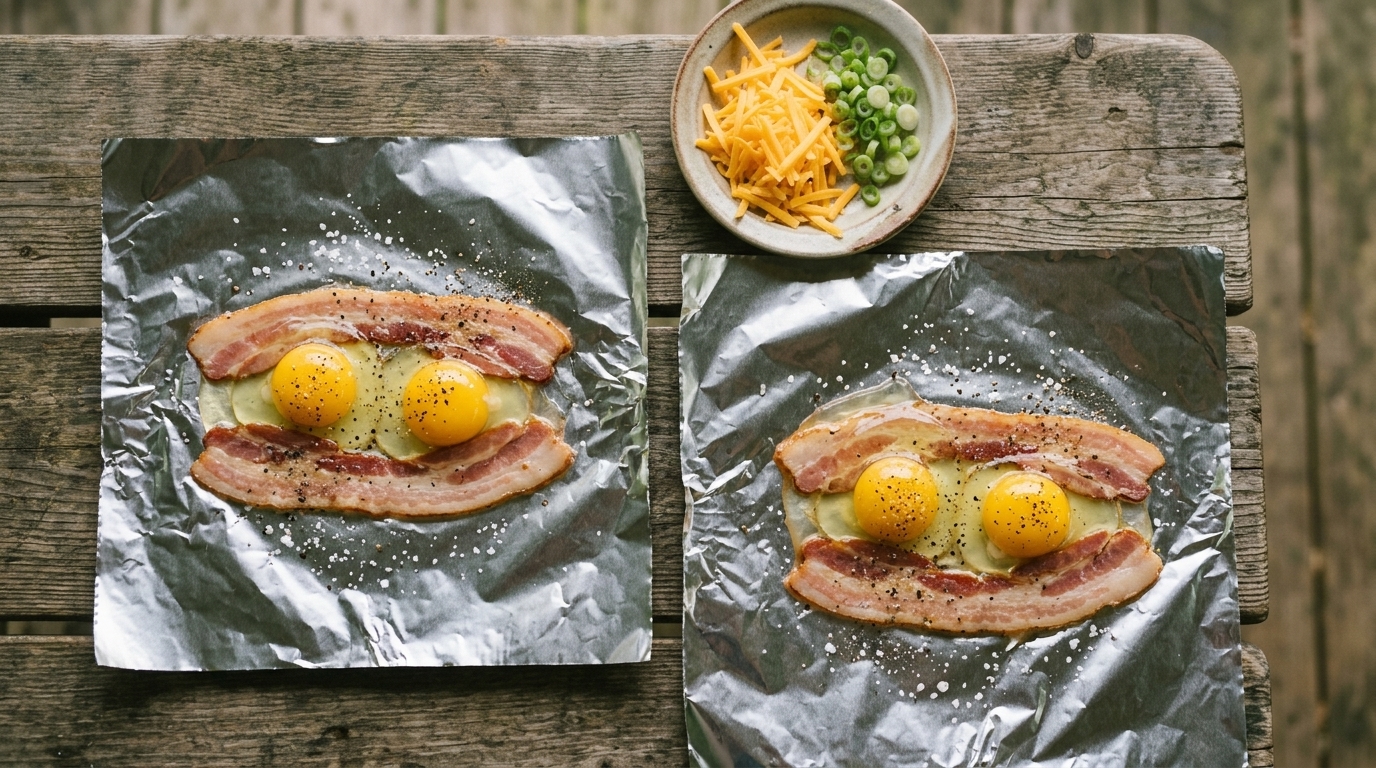
- Lay the bacon base: Place two par-cooked bacon strips side by side in the center of each greased square. The bacon forms a raised platform, so the egg whites pool on top instead of running off the edge.
- Crack the eggs: Crack two eggs directly over the bacon in each packet. Work gently to keep the yolks intact. Season each packet with a pinch of salt and pepper. Add cheese and scallions now if you want them.
- Tent-fold the packet: Bring the two long foil edges up and pinch them together above the food. Fold the seam down twice without pressing onto the egg, then roll the two short ends up twice each. The tent leaves headroom so the eggs steam instead of flattening. Wrap a second foil square around the outside for puncture protection.
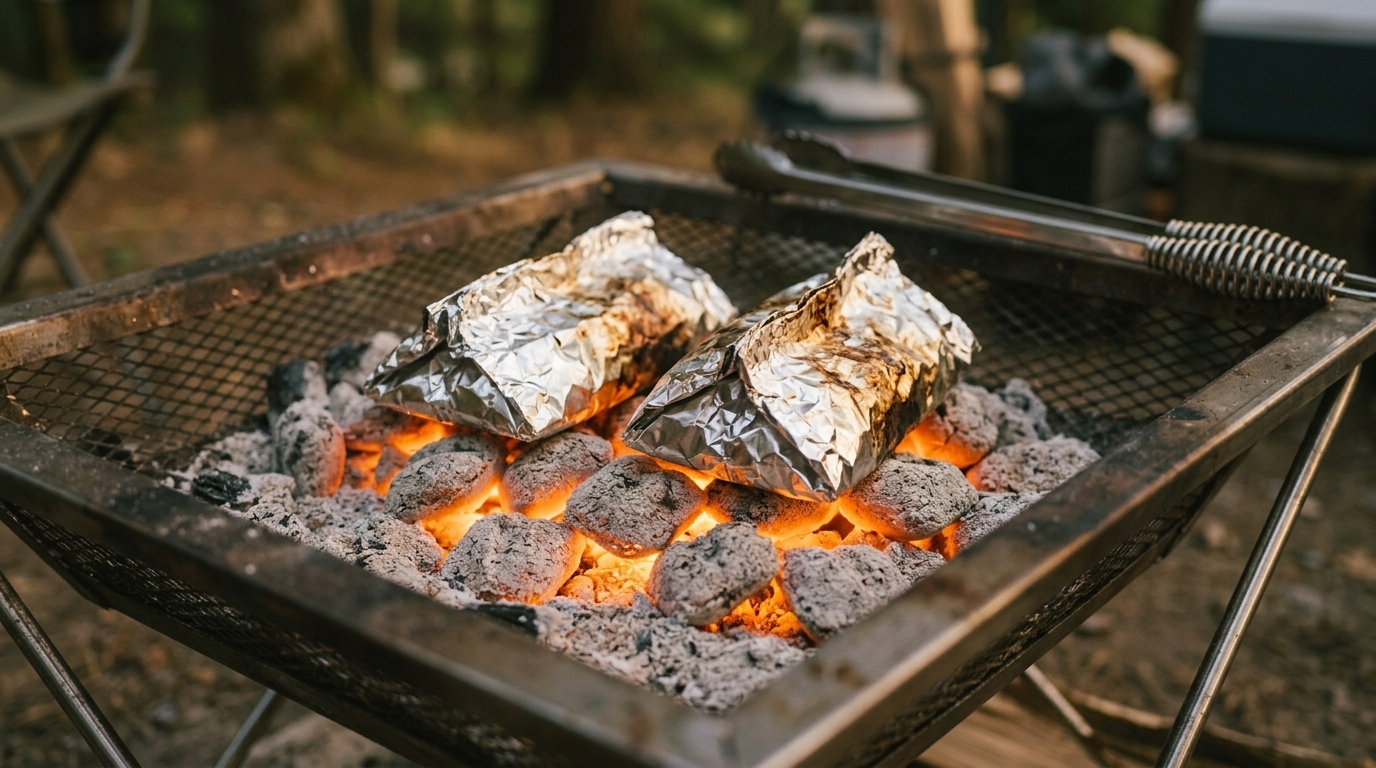
- Set the packets on coals: Rake the coals into a flat single layer. Place each packet seam-side up on the bed using long-handled tongs. Cook 8 minutes without moving them.
- Rotate, do not flip: After 8 minutes, rotate each packet 90 degrees to even out hot spots. Keep the seam up so the egg stays settled. Cook another 4 to 6 minutes. Total cook time runs 12 to 15 minutes on medium coals.
- Check doneness: Open one packet carefully and tilt it away from your face, since trapped steam escapes fast. The whites should look firm and opaque, and the bacon should show no raw pink. Egg should reach 160F, and 165F gives you a firmer set with extra safety margin per USDA guidance.
- Serve from the foil: Eat straight from the open packet, or slide the contents onto a tortilla. Afterward, fold the cooled foil into a ball for pack-out.
Coal Bed Math for Foil Packets
Each packet sits in direct contact with coals, so heat reads off the coal surface instead of a briquette count around a Dutch oven. Therefore, match the look of the coals to the job below.
| Heat Level | Coal Appearance | Surface Temp | Use |
|---|---|---|---|
| Hot | Bright orange, glowing | 500F+ | Quick sears, 5 to 10 min |
| Medium-Hot | Orange with light gray ash | 400F-500F | Most main dishes, 15 to 25 min |
| Medium | Gray ash, orange embers visible | 350F-400F | Eggs, dense vegetables |
| Medium-Low | Mostly gray ash, soft glow | 250F-350F | Reheating, desserts |
Foil packet bacon and eggs runs best on medium coals at 350F to 400F. When you push the heat higher, the bacon edges scorch before the whites set. Then three field adjustments shift the timing. First, when wind tops 10 mph, add 5 to 8 minutes. Second, when ambient temperature drops below 40F, add 3 to 5 minutes. Third, above 5,000 feet, add 5 minutes to any cook over 20 minutes.
Field Tips for Cooking at Camp
Seam position decides whether you eat eggs or scrambled mush. Therefore, keep the tent seam facing up the entire cook so the yolks stay put and the whites pool over the bacon. When you flip a bacon and egg packet, the move breaks the yolks and pushes raw white into the fold, where it leaks. Instead, rotate for even heat, and resist the urge to turn the packet over the way you would a burrito.
Par-cooking the bacon at home pays off twice. First, it renders the heavy grease into your kitchen sheet pan rather than your camp coals, which cuts flare-ups. Second, it shaves 4 to 5 minutes off the camp cook, so a windy morning stays manageable. Specifically, par-cooked strips finish crisp in about 13 minutes, while raw bacon needs closer to 19.
Double-wrapping is not optional for this recipe. Since runny egg and liquid bacon fat find every pinhole in single-layer foil, a leak dumps your breakfast into the ash. Instead, wrap a second 14-inch square around each packet in the opposite direction. Besides costing a few cents, the extra layer saves the meal when a packet shifts on an uneven coal bed.
Variations and Substitutions
- Loaded hash version: Add 1/2 cup of par-boiled diced potato and 2 tablespoons of diced onion under the bacon. Extend the cook to 20 minutes so the potato heats through.
- Spicy southwest: Swap cheddar for pepper jack, add 1 tablespoon of diced jalapeno, and finish with a spoon of salsa after unwrapping.
- Turkey bacon swap: Replace pork bacon with turkey bacon for a leaner packet. Turkey bacon renders less fat, so add an extra teaspoon of butter to the foil.
- Sausage instead of bacon: Crumble 1/4 pound of pre-browned breakfast sausage as the egg base. Pre-cook the sausage fully at home for food safety.
- Veggie scramble: Skip the bacon, add sauteed mushrooms, spinach, and bell pepper, and whisk the eggs before pouring for a true scramble texture.
- Scaled for 4 people: Build 4 packets. Use 8 eggs and 8 bacon strips. Cook 4 packets across a wider coal bed roughly 18 inches by 12 inches.
- Scaled for 6 people: Build 6 packets. Use 12 eggs and 12 bacon strips. Light 30 briquettes and rake them into a long single layer.
- Breakfast taco finish: Slide the cooked egg and bacon onto a warm corn tortilla, top with cheese and hot sauce, and fold for a handheld taco.
Essential Tool
RAPICCA Heat-Proof Gloves
Rated to 932F, these gloves let you rake coals flat and reposition hot packets by hand when tongs feel clumsy. Also, the long cuff guards your forearm over an open coal bed.
Storage and Leftovers
Raw eggs and bacon hold safely below 40F in a cooler or fridge. Specifically, whole eggs in the carton keep 3 to 5 weeks refrigerated, while vacuum-sealed bacon lasts 2 weeks unopened. Instead of pre-cracking eggs, build the packets fresh each morning, since pooled raw egg spoils faster and leaks. Also, keep raw bacon sealed and on the lowest cooler shelf to prevent cross-contamination with ready-to-eat food.
Cooked foil packet bacon and eggs tastes best right off the coals, though leftovers hold below 40F for 24 hours. Then reheat a sealed leftover packet on medium-low coals for 5 to 6 minutes, or slide the contents into a warm tortilla on a camp stove. Otherwise, discard any cooked packet left above 40F for more than 2 hours, per USDA rules. Afterward, set used foil aside to cool, then compact it for pack-out under Leave No Trace.
Frequently Asked Questions
Do I need to pre-cook the bacon before making foil packet bacon and eggs?
Pre-cooking is not strictly required, though it improves the result. Specifically, par-cooking the bacon for 6 minutes at home renders excess grease and shortens the camp cook by 4 to 5 minutes. While raw bacon still works in the packet, plan on 18 to 20 minutes and expect a greasier finish. Therefore, par-cook at home and finish on coals.
What coal temperature sets the eggs without burning the bacon?
Medium coals at 350F to 400F deliver the right balance. Specifically, at this heat the egg whites set in 12 to 15 minutes while the bacon crisps without scorching. However, hot coals above 500F burn the bacon edges before the eggs finish. Finally, look for gray ash over visible orange embers as your cue to start cooking.
Should I flip the packet during cooking?
No, never flip foil packet bacon and eggs. When you flip it, the move breaks the yolks and pushes raw white into the seam, where it leaks onto the coals. Instead, keep the seam up and rotate the packet 90 degrees at the halfway point. Thus, rotation gives even heat without disturbing the egg.
How do I keep the egg from sticking to the foil?
Grease the foil before adding food. Specifically, rub a teaspoon of butter or a quick spray of cooking oil across the center of the square. Also, laying the bacon strips down first lifts the egg off the metal. Therefore, greased foil plus a bacon base releases the cooked egg in one clean piece.
Will foil packet bacon and eggs work on a camp stove instead of coals?
Yes, a two-burner propane stove works well. First, set the burner to medium and place the packet directly on the grate. Since propane heat runs less intense than radiant coal heat, add 3 to 4 minutes to the cook. Besides everyday use, a stove gives you steady control during a fire ban, when open coals are off limits.
What internal temperature is safe for the eggs?
Cook the eggs to 160F for safety, while 165F gives a firmer set with extra margin. Specifically, the USDA recommends 160F for egg dishes to neutralize salmonella risk. Then a pocket thermometer slid into the cooked white confirms the number. Also, the bacon, as pork, should show no raw pink and reach 145F at minimum, which a 15-minute coal cook easily clears.
How many packets fit on one coal bed?
A standard 12-inch by 12-inch coal bed from 25 briquettes holds 4 packets. Meanwhile, for 6 packets, light 30 briquettes and rake them into a longer 18-inch by 12-inch bed. Also, leave an inch of space between packets so heat circulates. Otherwise, crowding the bed creates cold spots and uneven cooking.
How do I pack out the used foil?
Once each packet cools, compress it into a tight ball. Specifically, two breakfast packets fit inside a sandwich-size zip bag inside a sealed container. Because Leave No Trace requires packing out all foil, never bury or burn the scraps. Also, greasy foil belongs in a sealed bag to keep wildlife away from camp.
You Might Also Like
- Foil Packet Breakfast Hash (recipe, coming soon)
- Foil Packet Sausage and Peppers Breakfast (recipe, coming soon)
- For a make-ahead handheld option, see Foil Packet Breakfast Burritos
- Return to the full Foil Packet Camping Recipes collection
- For a group breakfast, see Dutch Oven Mountain Man Breakfast