


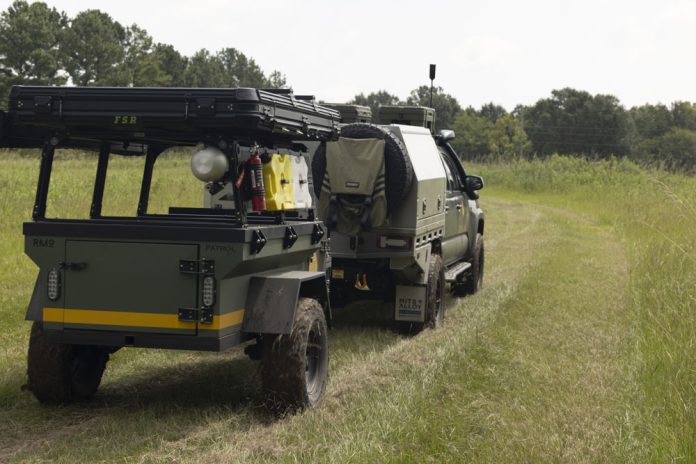

Every off-road trailer suspension question comes back to one factor: ground clearance. Any seasoned overlander knows it: the pain of scraping over roots, dragging through dips, or listening to rockstrikes echo from underneath. In over 30 years of writing about trailers at 4WDTalk, I’ve tested dozens of rigs that promised to conquer terrain and carry camp anywhere. Want to guess the single clearest dividing line between the few that actually delivered and the many stuck in hype?
Ground clearance. On rutted forest roads, rocky washes, and uneven campsites, the distance between the trailer’s belly and the earth spells the difference between adventure and AAA calls. In this guide, I’ll unpack why ground clearance matters so much in off-road trailers, how to tell if yours measures up, and how to use one key spec — departure angle — as an at-a-glance clearance yardstick. Still, any rig can learn to navigate dips and steer for the high line, but no driver can think their way past a hard scrape.
Quick Facts:
- Topic: Off-road trailer ground clearance
- Definition: Distance from trailer undercarriage to ground
- Minimum for rocks: 20 inches
- Patrol XCT clearance: 19 inches
- Departure angle: Maximum descent angle without dragging
- Suspension type: Key factor (link, coil, air bag)
- Best for: Overlanders who tow off maintained roads
9 min read
In This Guide
- What Is Ground Clearance?
- Why Ground Clearance Matters Off-Road
- 4 Factors That Affect Trailer Clearance
- How Much Ground Clearance Do You Need?
- Departure Angle: The 30-Second Clearance Check
- Buy Direct From Rustic Mountain Overland
- The Risks of Too Little Clearance
- The Drawbacks of Too Much Clearance
- The Patrol XCT Sweet Spot
- 3 Ways to Improve Your Trailer’s Clearance
- Check Today’s Price on the Patrol XCT
- Frequently Asked Questions
What Is Ground Clearance?

Let’s nail down the term. Ground clearance is the distance between the lowest point on a vehicle’s underside and the ground. It’s a static measurement, meaning it’s taken with the rig at rest on a level surface, not compressed by cargo or bouncing over bumps. If you crawled under your trailer with a tape measure, you’d size up from the lowest hanging protrusion, usually a differential, axle, or skid plate, straight down to the dirt.
Ground clearance goes hand in hand with two other key off-road specs: approach angle and departure angle. Approach angle measures how steep a slope a vehicle can climb without scraping its front end, while departure angle measures how steep it can descend without dragging its rear. To visualize, picture a speed bump. The approach angle is the sharpness of the bump’s front slope: too steep, and a low-slung front valance will catch. The departure angle is the rear slope: too abrupt, and the back bumper will hang up as you roll off.
In the trailer world, departure angle usually matters more than approach, since the tow vehicle’s rear almost always hangs lower than the front of the trailer. Still, both matter. The breakover angle, or the sharpness of a crest that’ll high-center you, depends on wheelbase and belly clearance together.
Why Ground Clearance Matters Off-Road
Here’s the short version: obstacles. Rocks, roots, ruts, logs, ledges, culverts, and all the other challenges that make overlanding overlanding in the first place. The further your trailer sits off the ground, the less likely it is to snag on any of them.
Think about it this way: every inch of daylight under your frame buys you an inch of worry-free travel over rough ground. That’s an inch you don’t have to sweat a scraped skid plate, an inch you don’t have to get out and move a rock, an inch you don’t have to hold your breath through. Multiply that inch by the length of a rutted fire road, and you start to see why ground clearance sits so high on an overlander’s priority list.
Nowhere is that margin for error thinner than in an off-camber stretch, where one side of the trailer sits high while the other dips low. It’s easy to forget about the low side until it catches a root or a rock you swore you had cleared. With enough clearance, those snags become bumps. With too little, they turn into trail repairs.
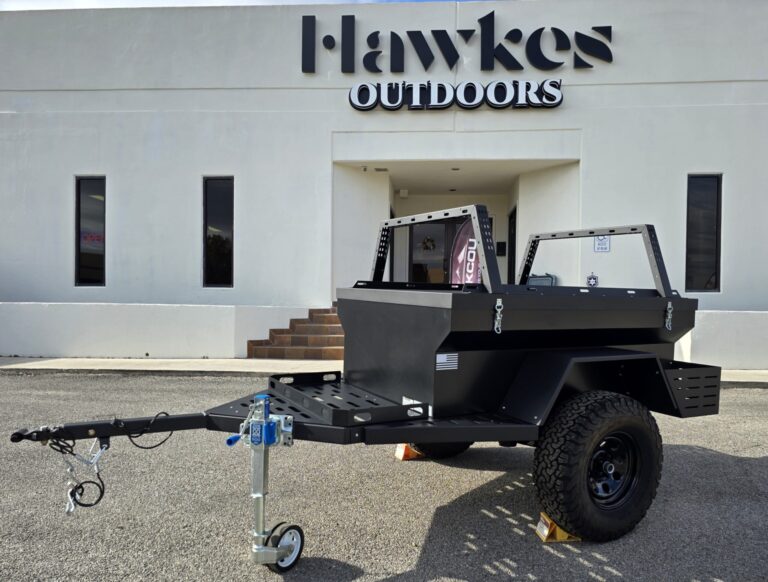
2025 Rustic Mountain Overland Patrol XC
The baseline Patrol, and the cheaper of the two Rustic Mountain trailers Hawkes Outdoors has on the lot. Enclosed cargo bay with a tilting lid and rear tailgate, Timbren HD 2200 lb axleless suspension, and 31-inch AT tires on 15-inch wheels. Listed at $10,737 in black, stock SA1124.
- Enclosed, lockable cargo bay
- Timbren HD 2200 lb axleless suspension
- 31-inch AT tires on 15-inch wheels
- Lock-N-Roll articulating hitch
- ARK tongue jack
- No tongue box, so galley gear rides in the main bay
- One unit on the lot at this price
4 Factors That Affect Trailer Clearance

So what actually sets a given trailer’s ride height? Four main ingredients:
- Suspension: The type (link, coil spring, air bag, torsion axle) and its travel, or how far it can compress and rebound. More travel means more flex over uneven terrain.
- Tire size: A taller tire (say, a 31″ vs. a 25″) puts more meat between the ground and the axle. Plus, the larger the tire’s air volume, the more it can envelop obstacles.
- Axle placement: On a given trailer, pushing the axle(s) toward the rear puts more weight on the hitch, and more of the chassis ahead of the wheels, where clearance is always lowest.
- Body and frame design: On the chassis side, a triangulated tube frame sits higher than a dropped-rail frame. For the body, a smooth, flat underside beats low-hanging protrusions. Plating vulnerable hardware helps too.
How Much Ground Clearance Do You Need?
Most off-road trailers ride somewhere between 15 and 25 inches off the deck. For casual forest roads and the occasional rutted trail, 12 inches is considered the bare minimum. Dip under a foot, and sooner or later, a speed bump in a poorly graded campground will find your rear valance.
For anything steeper or rockier, the floor rises to 15 inches. At that height, careful spotting and a good line will get you through most class II-III trails unscathed. Not quickly, not without some pucker factor, but intact. It’s the start of the “made for dirt” zone.
Step up to 18-20 inches, and your world opens up. That kind of clearance lets you confidently tick off blue-square routes, think Hole-in-the-Rock trail in Utah or Whipsaw in Canada, where rocks and roots come fast and the bail-out options thin out. For reference, our full Patrol XCT review measured 19 inches at the rear diff.
Push past 20, and you’re in rock crawler territory. At that point, armor usually matters more than another inch of ride height; even the most aggressive tires will stuff into fenders before the belly catches. The exception is expedition trailers, where airbag suspensions can push clearance north of two feet to clear obstacles that would high-center a Jeep.
Departure Angle: The 30-Second Clearance Check

Most off-road trailer specs only list ground clearance in one spot: under the axle. That’s helpful as far as it goes, since dragging an axle tube is nobody’s idea of fun. The problem is, it doesn’t tell you much about what’ll happen when the trailer pitches down.
On any descent steep enough to make you think twice, your real worry isn’t the axle. It’s the rear bumper, the rear frame rails, the spare tire — anything low-slung and way back. That’s where departure angle saves the day.
Remember, departure angle measures the maximum slope angle a trailer can crest without scraping its rear. The bigger the angle, the steeper the safe descent. To actually measure it, you’d need to drag the trailer up a ramp until the rear touched, then do some trigonometry I haven’t thought about since 11th grade. For comparison shopping, it’s easier: just look up the spec.
Here’s why departure angle offers a cleaner apples-to-apples clearance check than straight ground clearance: it controls for wheelbase. See, a trailer with a seven-foot rear overhang can ride a mile high at the axle and still drag its bumper on a slope that wouldn’t faze a stubby two-footer. In simple terms, the longer the tail, the shallower the safe angle.
If you do only one spec check on a new off-road trailer, make it the departure angle. At a glance, it tells you how steep a hill you can clear without dropping your tailgate. 28 degrees is a good target; 25 degrees is table stakes for a true backcountry hauler.
The Risks of Too Little Clearance
We’ve all seen those Youtube videos. The ones where a rig slides sideways down a rock ledge, sheds its rear bumper, and rips its plumbing right off the frame. The aftermath shots make you cringe: dented propane tanks, mangled wiring, folded fenders, scars everywhere.
That’s what too little clearance gets you: beat. Every overlander knows the dread of that sound, that low-pitched crrrrrunch that says you just stuffed up and under. On a good day, it costs you paint. On a bad one, it’s an emergency field repair with a welder, a come-along, and some very creative metal origami.
Low-riding trailers also bottom out on washboard roads, embedding gravel in places gravel should never embed. Suspension bushings wear faster, welds fatigue harder, and anything not armor-plated, plumbing, wiring, tanks, is one jump away from replacement. Add up a season of that abuse, and “saving” on ground clearance starts to look expensive.
But even if nothing breaks, low clearance still ruins trips. It turns easy trails into hour-long rock-moving parties. It leaves you staring at Google Maps, wondering how many miles of detour to trade for an easier approach to camp. It traps you in the parking lot while your buddies head for the good spots. And eventually, inevitably, it leaves you high-centered in a taco-shaped frame, waiting on a tug and a prayer.
The Drawbacks of Too Much Clearance
Because no engineering story lands without trade-offs, lifting an off-road trailer above every potential snag does come with compromises. Three, mainly:
- Cost: Big-ticket components like axles and link arms climb in price with every inch of travel. Pushing past 20″ puts you in specialty territory, where parts cost multiples of road-tuned equivalents.
- Weight: Beefier springs, taller shocks, and larger-diameter frame tubes add dozens of pounds. On trailers sized for two-person camping, chasing the last fraction of an inch is a quick path to a 1,500 lb starting weight.
- Center of gravity: The flip side of towering over obstacles is, well, towering. Raising the bulk of a trailer’s mass amplifies every side-to-side sway and demands a wider margin for error on camber changes.
Point is, an expedition-grade monster truck suspension is overkill for an overlander who spends half their nights in the frontcountry. Chasing an extra inch of clearance means nothing if you’re too heavy to tow or too tall to sleep in.
The Patrol XCT Sweet Spot

For most 4wdTalk readers, the sweet spot lands at 19 inches of clearance, a 28° departure angle, and a base weight just under 1,300 lbs. As luck would have it, that’s exactly the Patrol XCT’s recipe.
The Timbren HD 2,200 lb axleless suspension tucks neatly inside the chassis rails, leaving plenty of daylight underneath for stray rocks to slip past. Meanwhile, the 100″ wheelbase hits a Goldilocks length: long enough to flatten washboard, short enough to pop over obstacles. Top it off with a 28° departure angle (well above the 25° benchmark) and you’ve got a backcountry setup that won’t break itself or the bank.
We’ve tested the XCT extensively on Rocky Mountain trails that send low-slung trailers back to the trailhead. Why an off-road trailer improves your base camp covers the full access story, but the highlight reel includes boulder-strewn two-tracks, rut-clogged mud pits, and the kind of breakover humps that would scatter a normal rear bumper across three counties.
Through it all, nothing hangs, nothing scrapes, and nothing leaks. More to the point, nothing forces an early bailout. For overlanders who measure a trip’s success by the spots it unlocks, 19″ and 28° is the right balance of clearance and capacity.
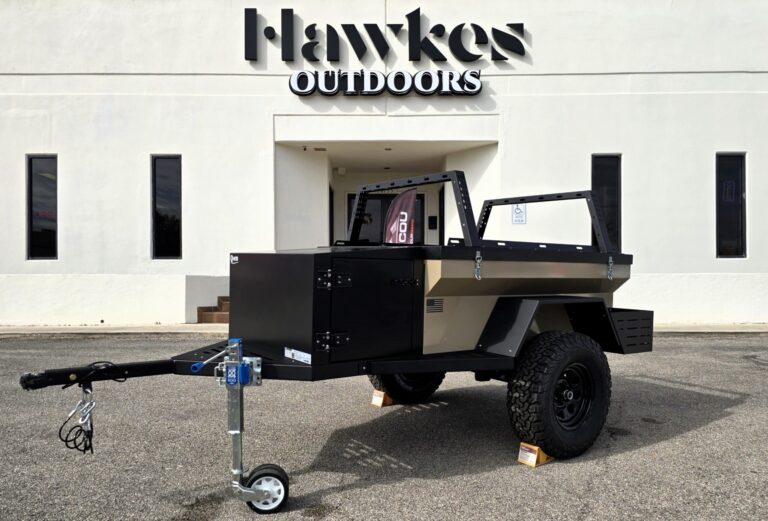
2025 Rustic Mountain Overland Patrol XCT
The XC with a lockable tongue box added forward on the frame, sized for a fridge, electrical, and galley gear, with an access door on the driver and passenger side. That is the piece that keeps cooking gear out of the main bay entirely. 1,250 lbs, tan, listed at $11,489, stock SA1122.
- Tongue box with driver and passenger access doors
- Enclosed main bay with tilting lid and rear tailgate
- Timbren HD 2200 lb axleless suspension
- Custom 16-inch roof rack and front cargo basket
- 1,250 lbs dry
- About $750 more than the Patrol XC
- One unit on the lot at this price
3 Ways to Improve Your Trailer’s Clearance

Already own an off-road trailer but worry it’s riding a little low for where you want to explore? Three upgrades can earn you extra inches without breaking the bank:
- Bigger tires: The simplest way to raise your ride height, assuming your fenders allow it. Jumping from a 25″ to a 31″ tire puts an extra 3″ of rubber between you and the rocks.
- Suspension spacers: If your stock springs still have life in them, a set of spacers (usually hockey puck-like urethane donuts) is cheaper than new shocks. Figure on 1″ to 1.5″ of lift, max.
- Skid plates: If you can’t avoid scrapes, armor up. A beefy skid plate that runs from the drawbar to the suspension mounts protects your plumbing, your propane tank, and your peace of mind.
But as with any clearance chase, there are limits. Bolting on 35s and a 4″ lift will turn your trailer into a unstable, tail-heavy handful long before it turns it into an off-road hero. If the trail you want demands a foot more clearance than the trailer you have, an upgrade (or a rental) is cheaper than a recovery.
Frequently Asked Questions
What is a good ground clearance for an off-road trailer?
For technical trails and rock crawling, 20 inches is considered the safe minimum. At that height, careful line choice can clear basketball-sized boulders. For overlanders who spend more time on forest roads than hard trails, 15-18 inches is enough to navigate ruts, roots, and erosion with confidence.
What happens if your off-road trailer doesn’t have enough clearance?
Scrapes, bumps, and hangups. Low-slung trailers snag on obstacles, drag their rear ends on steep grades, and bottom out their plumbing over rough ground. On a long enough timeline, that means trips cut short by breakdowns or trails never attempted for fear of them.
How do you measure the departure angle of an off-road trailer?
On paper, departure angle is calculated as arctan(ground clearance / distance from rear axle to bumper). But unless you’re designing a trailer from scratch, the easiest way to measure is to back the rig up a ramp until the rear drags, then check the ramp angle with a protractor app.
Is ground clearance or departure angle more important on a trailer?
For most overlanders, departure angle. That’s because the lowest-hanging parts on a typical off-road trailer — the bumper, the spare tire, the rear frame rails — are almost always behind the axle. Those are the bits that drag on steep downhills, and that’s exactly what departure angle measures.
Heads up: Clicking on our affiliate links and exploring our sponsored content helps us at no extra cost to you, and we only recommend gear we’re absolutely crazy about!