



Quick Facts:
- Short answer: Sleep in the back and run heavy, buy the gas i-Force
- Hybrid output: 326 hp, 465 lb-ft, versus 278 hp and 317 lb-ft
- Weight penalty: 375 lb, same trim, same tires
- Cargo penalty: 5.8 cu ft behind the second row
- Payload penalty: roughly 110 lb
- Clearance penalty: none, 9.1 inches either way
- Towing: 6,000 lb on TRD Off-Road, 5,800 lb on hybrid-only trims
- Price delta: $2,800 on every overlapping trim
- Best for: anyone deciding between TRD Off-Road powertrains
9 min read
In This Guide
- 4Runner Hybrid vs Gas: The Short Answer
- What the i-Force MAX Adds
- 4Runner Hybrid vs Gas on the Same Trim
- What the Battery Costs You
- Zero-RPM Torque and Long Descents
- 4Runner Hybrid vs Gas Fuel Economy
- The 2,400-Watt Inverter and Overnight A/C
- Where the Trim Decides the Powertrain
- Which 4Runner to Buy
- Frequently Asked Questions
4Runner Hybrid vs Gas: The Short Answer
The 4Runner hybrid vs gas decision comes down to weight and space, not capability. Buy the gas i-Force TRD Off-Road if you sleep in the back and run heavy. Specifically, you save $2,800, 375 pounds and 5.8 cubic feet, while giving up nothing in ground clearance, approach angle or tow rating. This last point surprises people, so the table below shows it in full.
Buy the i-Force MAX if you tow near the limit, want factory Trailhunter or TRD Pro hardware, or need a 2,400-watt camp inverter more than a flat cargo deck. The hybrid’s real off-road advantage is 184 lb-ft available from zero rpm. Its cost is weight, a raised load floor and lost payload.
Before the numbers, three myths deserve killing. First, the battery does not lower the truck. Second, the A/C does not run all night on the traction battery alone. Third, fuel economy on dirt is not the reason to pick the hybrid.
What the i-Force MAX Adds
First, both powertrains start from the same 2.4-liter turbocharged inline-four and eight-speed automatic. The gas i-Force makes 278 horsepower and 317 lb-ft. By comparison, the i-Force MAX adds an electric motor inside the transmission, rated at 48 horsepower and 184 lb-ft, for a combined 326 horsepower and 465 lb-ft.
Notably, peak torque arrives at 1,700 rpm on both engines, so the peak number understates the difference. What matters on a rock ledge is the motor’s torque at zero rpm, delivered before the turbo has done anything. Meanwhile, Toyota pairs the system with a nickel-metal-hydride pack mounted under the cargo floor.
Even so, capacity is where published figures disagree. Car and Driver’s text cites 1.87 kWh while the spec panel on the same page lists 0.9 kWh for an instrumented 2025 Trailhunter. Since the sources conflict, every argument below holds at the larger figure and holds harder at the smaller one. Placement, however, is settled by its consequences, which the cargo numbers make plain.
4Runner Hybrid vs Gas on the Same Trim
Nearly every comparison online comes out wrong because it sets a base gas SR5 against a loaded hybrid Trailhunter, blending powertrain with trim. By contrast, TRD Off-Road 4WD is offered with both engines on the same tires and the same suspension, so it is the only honest test case.
| 2026 TRD Off-Road 4WD | Gas i-Force | i-Force MAX |
|---|---|---|
| Horsepower | 278 | 326 |
| Torque | 317 lb-ft | 465 lb-ft |
| Curb weight | 4,850 lb | 5,225 lb |
| GVWR | 6,240 lb | 6,505 lb |
| Implied payload | 1,390 lb | 1,280 lb |
| Ground clearance | 9.1 in | 9.1 in |
| Approach / departure | 19.0 / 24.0 deg | 19.0 / 24.0 deg |
| Cargo behind second row | 48.4 cu ft | 42.6 cu ft |
| Tow rating | 6,000 lb | 6,000 lb |
| MSRP | $50,490 | $53,290 |
Therefore read the table twice before reading anyone’s opinion. Our Tacoma hybrid-versus-gas comparison shows the same pattern one platform over.
Next, put gear in it. A fridge, a power station and a rooftop tent are the first three things most owners add, and together they spend most of the payload gap between these two trucks.
| Top Pick | Best Camp Power | Biggest Weight Add | |
|---|---|---|---|
| Product | TOP PICK ICECO VL45 Fridge ICECO VL45 Fridge |  EcoFlow DELTA 2 Max EcoFlow DELTA 2 Max | 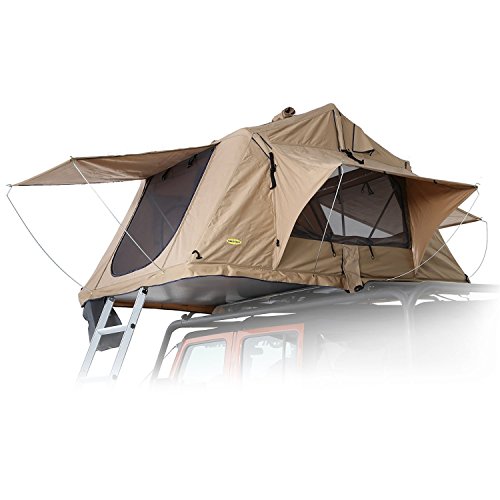 Smittybilt Overlander Tent Smittybilt Overlander Tent |
| Fits either powertrain | Yes | Yes | Needs a roof rack |
| What it spends | Cargo floor space | Cargo floor space | Roof load and payload |
| Price | $559.00 as of Oct 2, 3:56 am | $1,029.00 as of Oct 1, 11:56 pm | |
| Check Price → | Check Price → | Check Price → |
What the Battery Costs You
Ground Clearance Does Not Change
First, the most persistent fear is wrong. Both TRD Off-Road powertrains measure 9.1 inches underneath, with identical 19.0-degree approach and 24.0-degree departure angles. The one-inch difference traded online compares an SR5 on 17-inch wheels against a TRD Off-Road on 33-inch all-terrains, which is a trim and tire difference rather than a powertrain difference.
Cargo Space and the Third Row
Here, however, the hybrid pays. Cargo space behind the second row drops from 48.4 to 42.6 cubic feet, a loss of 5.8. Both figures measure behind the same seat, so the comparison holds. Folding the seats drops maximum volume from 90.2 to 82.6, a loss of 7.6. In addition, the third row disappears on hybrid models, because the pack occupies the space beneath the cargo floor.
Similarly, overall vehicle height stays at 73.6 inches on both, so the volume comes out vertically through a raised load floor. Anyone building drawers or a sleeping platform therefore loses headroom above the deck rather than length. Toyota publishes no figure for how much the floor rises, so measure a demo truck before you commit to a build height.
The 110 Pounds of Payload You Give Up
Curb weight climbs 375 pounds on the hybrid, from 4,850 to 5,225. GVWR rises by only 265 pounds, from 6,240 to 6,505. As a result, the hybrid loses roughly 110 pounds of payload before a single item goes in. Add a rack, a rooftop tent, drawers, water and fuel, and the shortfall bites.
Notably, those payload numbers are derived by subtraction rather than published directly. The authoritative figure for your specific truck sits on the driver’s door jamb sticker and varies by options package, so read it before you build. Our guide on weighing your build before you load it covers how quickly a rear axle passes its rating.
Zero-RPM Torque and Long Descents
Specifically, electric torque at zero rpm is the real argument for the hybrid. On a steep ledge or a loose climb, the motor fills the gap before boost arrives, which smooths throttle response at crawl speed. Owners running tall tires notice it most, since the assist partially masks a gear ratio gone long. Our explainer on crawl ratio and regearing covers the underlying math.
Long descents, in contrast, raise the opposite question. The best available account comes from a 4Runner6G owner thread describing the eight-bar charge meter sitting near three bars in normal use and climbing to seven or eight only under engine braking or regeneration. On a downhill with cruise control engaged, the truck downshifts and the pack fills quickly. Beyond the full point, the system falls back on engine braking and friction brakes exactly like a gas truck.
Again, treat it as owner reporting rather than manufacturer data. No documented traction-battery failure in off-road use appears anywhere we searched. One owner has published a separate complaint about transmission overheating on slow off-road climbs in a hybrid TRD Off-Road, dealer-diagnosed as software. Other owners in the same thread argue the fix is using four-wheel low on those climbs rather than four-wheel high. Although a single report proves little, it is worth knowing before you assume the powertrain is trouble-free.
4Runner Hybrid vs Gas Fuel Economy
Start with the finding nobody publishes: in four-wheel high, the hybrid largely stops behaving like a hybrid. A single owner on the same 4Runner6G thread raised it as a question after driving roughly 100 highway miles in 4Hi without the engine cycling off. It is one person and unconfirmed by Toyota. Mechanically it tracks, and if it holds, the hybrid stops saving fuel exactly where an off-roader spends the day.
Second, the EPA split surprises people. In 4WD form the i-Force MAX rates 23 city, 24 highway and 23 combined. The gas TRD Off-Road rates 19 city, 25 highway and 21 combined. In short, the hybrid wins by four in town and loses by one on the highway.
Even so, real-world numbers land lower. Cars.com ran a 2025 hybrid TRD Off-Road Premium 14,542 miles and averaged 20.2 mpg across 717 gallons, well under the 23 mpg combined rating. Average speed across the test was 41 mph, and the longest tank covered 340 miles on a 19.0-gallon capacity.
Since nobody has published an instrumented dirt-only figure, reason from mechanism instead. Because crawling generates little regeneration, there is no coasting to recapture, and the pack is small. Expect the hybrid advantage to shrink toward zero on a trail day. For trip math, see our fuel range planning for remote routes.
The 2,400-Watt Inverter and Overnight A/C
Notably, this is the strongest pro-hybrid argument for campers, and the most oversold. Every i-Force MAX carries a standard 2,400-watt AC power supply with outlets in both the cabin and the cargo area. In contrast, the gas i-Force gets nothing comparable. Hybrid components carry an 8-year, 100,000-mile warranty, and the hybrid battery itself carries 10 years or 150,000 miles nationwide.
However, overnight air conditioning is where the claim breaks down. Toyota documents no camp mode and no engine-off climate operation. Moreover, owners report the inverter requiring the vehicle to be running, and even the larger of the two published pack capacities holds roughly the energy of a small portable power station against an air conditioning draw above a kilowatt.
Instead, what owners describe is the truck left in READY mode with the engine cycling on and off through the night. Compared with a gas engine idling until morning, it is quieter and less thirsty. But silent electric air conditioning it is not. Readers wanting genuine engine-off climate control should read how off-grid power for overlanding has moved to separate house systems.
Where the Trim Decides the Powertrain
In practice the trap is simple: the two trims most overlanders want are the two removing the decision entirely. SR5, TRD Sport and TRD Sport Premium come only with gas. TRD Off-Road, TRD Off-Road Premium and Limited offer both. Above them, Platinum, TRD Pro and Trailhunter are hybrid only.
Both factory overland trims therefore force the powertrain choice. Trailhunter brings Old Man Emu 2.5-inch forged monotube shocks, an onboard compressor, a low-profile high-mount air intake and an ARB rack. TRD Pro brings FOX QS3 internal bypass dampers. Note also, those three hybrid-only trims rate 5,800 pounds of towing rather than 6,000, so the top of the range tows slightly less than the TRD Off-Road below it.
Meanwhile, the premium stays flat where both engines exist. In each case, TRD Off-Road runs $50,490 against $53,290, TRD Off-Road Premium $56,270 against $59,070, and Limited $58,700 against $61,500. All six figures exclude a $1,450 delivery charge. Buyers cross-shopping should also run our 2026 Land Cruiser vs 4Runner comparison, since it carries the same powertrain in a heavier package.
Alternatively, build a TRD Off-Road toward Trailhunter spec yourself, since three parts do most of the work. Fitment note: the leveling kit below is listed for the 2025 and newer sixth-generation truck, not the 2010 to 2024 chassis most Amazon 4Runner parts still target.
| Top Pick | Best Value | Recovery | |
|---|---|---|---|
| Product | TOP PICK ARB CKMTA12 Twin Compressor ARB CKMTA12 Twin Compressor | Rough Country 1.5in Leveling Kit |  ARB TRED Pro Boards ARB TRED Pro Boards |
| Trailhunter equivalent | Onboard compressor | Ride height | Not factory fitted |
| 6th-gen fitment | Universal | Listed for 2025 and newer | Universal |
| Price | $639.99 as of Oct 1, 10:21 pm | $359.95 as of Oct 1, 11:56 pm | |
| Check Price → | Check Price → | Check Price → |
Which 4Runner to Buy
First, sleep in the back and run heavy, and the gas i-Force TRD Off-Road wins. The $2,800 saved, the 5.8 cubic feet kept, the 110 pounds of payload retained and the flat load floor outweigh 148 lb-ft you meet for seconds at a time.
Second, tow near the ceiling, and the hybrid wins. Both trucks rate 6,000 pounds on TRD Off-Road, so the torque advantage buys no rating. It matters most when the trailer is heavy enough to make the gas engine work, which is why the threshold rather than the activity decides it.
If You Sleep In It And Tow It
Instead of picking a rule, run the arithmetic. A 3,500-pound trailer puts roughly 350 to 525 pounds of tongue weight into the same payload budget as your gear. Against 1,390 pounds on the gas truck, roughly 865 pounds remain. Against 1,280 on the hybrid, about 755.
Next, subtract two adults at roughly 340 pounds, plus a rack and rooftop tent at roughly 200. The gas truck has around 325 pounds left for drawers, water, fuel and everything else. The hybrid has around 215. Below roughly 4,000 pounds of trailer, neither powertrain is working hard and the torque advantage is comfort rather than capability. Count your days: if you sleep in the truck more nights than you tow, the payload column decides, and the payload column favors gas.
Separately, campers who run appliances remain the clearest hybrid case. A standard 2,400-watt supply in the cargo area replaces a fair amount of aftermarket wiring and arrives with a factory warranty. Finally, buyers chasing factory Trailhunter or TRD Pro hardware have no decision to make at all.
Frequently Asked Questions
Does the 4Runner hybrid battery reduce cargo space?
Yes. On the TRD Off-Road 4WD, cargo behind the second row falls from 48.4 to 42.6 cubic feet, and maximum volume drops from 90.2 to 82.6. The third row becomes unavailable, because the pack sits under the cargo floor.
Will the A/C run all night in a 4Runner i-Force MAX?
Not on battery alone. Toyota documents no engine-off climate mode, and the pack holds too little energy for an air conditioning compressor overnight. Owners describe leaving the truck in READY mode with the engine cycling on and off.
Does the 4Runner hybrid have less ground clearance?
No. Both TRD Off-Road powertrains measure 9.1 inches, with identical 19.0-degree approach and 24.0-degree departure angles. The one-inch difference people quote compares different trims and tire sizes rather than different powertrains.
How much heavier is the 4Runner hybrid than the gas model?
375 pounds on the same trim, 4,850 against 5,225 on the TRD Off-Road 4WD. GVWR rises by only 265 pounds, so the hybrid gives up roughly 110 pounds of payload. Check your door jamb sticker for the figure governing your truck.
Which 4Runner trims come with the i-Force MAX?
Platinum, TRD Pro and Trailhunter are hybrid only. TRD Off-Road, TRD Off-Road Premium and Limited offer both powertrains for a flat $2,800 premium. SR5, TRD Sport and TRD Sport Premium are gas only.
Does the 4Runner hybrid tow more than the gas model?
No. On TRD Off-Road, both rate 6,000 pounds properly equipped. The hybrid-only Platinum, Trailhunter and TRD Pro rate 5,800 pounds, so the hybrid never tows more and sometimes tows less.
Related Reading
Specifications come from Toyota’s 2026 4Runner press materials, with trim-level weights, volumes, tow ratings and pricing from Edmunds. Long-term fuel economy comes from the Cars.com 14,542-mile hybrid test. Pricing checked August 2026.