


If you’ve spent serious time off the pavement across the western U.S., you already know this: most trailer problems start at the tires. Not the hitch. Not the frame. The tires. After years of overlanding through the Wind Rivers, the San Juans, the Great Basin, and everything in between, I’ve watched rigs limp back to the trailhead because they were rolling on wheels and rubber built for the highway, not the backcountry. The wrong off-road trailer tire and wheel choice doesn’t slow you down a little; it ends your trip.
When Rustic Mountain Overland built the Patrol XCT, they put the off-road trailer tire and wheel choice front and center. The result is a 1,250-pound overland trailer spec’d with 31″ all-terrain tires on 15″ steel wheels, a Timbren HD 2200-pound axleless suspension system, and a frame built to take punishment on singletrack two-tracks far from the nearest tire shop. In this article, I’ll break down exactly why each of those choices matters for off-road trailer tire and wheel choice, what they mean for real-world trail performance, and how the Patrol XCT stacks up as a purpose-built overlanding platform.
Quick Verdict: The Rustic Mountain Overland Patrol XCT pairs 31″ all-terrain tires with 15″ steel wheels and a Timbren HD 2200LB axleless suspension to deliver one of the most trail-capable compact trailers in its price range. Off-road trailer tire and wheel choice is the single biggest variable in backcountry trailer performance, and Rustic Mountain Overland gets it right here. Starting at $13,495, the Patrol XCT offers genuine off-grid capability with a 16″ roof rack, dual-access tongue box, and financing available for serious build-outs.
Last updated: May 2026 | 9 min read
In This Review
- Patrol XCT Overview: Built for the Backcountry
- Key Specs at a Glance
- Why 31″ AT Tires Are the Right Size for Off-Road Trailers
- Why 15″ Wheels Work Better Off-Road Than Larger Rims
- All-Terrain Tread: The Right Call for Mixed Terrain
- Axleless Suspension and How It Changes Trail Dynamics
- Storage, Roof Rack & the Tongue Box Platform
- Patrol XCT vs. Patrol XC: Which One Fits Your Build?
- Pros and Cons
- Final Verdict
- Frequently Asked Questions
Patrol XCT Overview: Built for the Backcountry

The Patrol XCT is Rustic Mountain Overland’s expanded take on the Patrol XC platform, and a serious off-road trailer tire and wheel choice underpins everything else on the rig. Built in Alabama and proudly made in the USA, the XCT adds a forward-mounted tongue box to the XC’s proven frame, creating a modular storage system suited equally well to a galley kitchen, an electrical hub, or a gear locker. At 1,250 pounds, it stays light enough to tow behind a wide range of 4×4 trucks and SUVs without straining the hitch or degrading fuel economy.
This trailer targets overlanders who need a capable, purpose-built companion for extended backcountry travel. It’s not a glamping weekend unit; it’s a working rig for people who spend real time in the dirt. The XCT pairs well with everything from a mid-size Tacoma to a full-size Gladiator, and its independent suspension handles the kind of rutted two-tracks and boulder fields where a standard trailer axle would bottom out or bind. Financing is available, making the $13,495 base price more accessible for serious overlanders building out a full overland trailer setup over time.
Compared to the base Patrol XC, the XCT brings a meaningful upgrade in forward storage without adding significant weight. The tongue box is accessible from both driver and passenger sides, so camp setup doesn’t require dancing around the hitch side of the trailer. For overlanders who cook, run refrigeration, or carry a full electrical system, the tongue box changes the logistics of a trip entirely. Whether you’re a veteran of the Mojave Road or new to building your first overland trailer setup, the dual-access design alone is worth the step up from the base model.
Key Specs at a Glance
| Specification | Details |
|---|---|
| Base Price | $13,495 |
| Armor Package Price | $14,990 |
| Weight | 1,250 lbs |
| Tires | 31″ All-Terrain |
| Wheels | 15″ steel |
| Suspension | Timbren HD 2200LB axleless |
| Roof Rack Height | Custom 16″ tall |
| Hitch System | Lock-N-Roll |
| Tongue Box Access | Driver and passenger doors |
| Finish | Texture powder coat |
| Color Options | Black, Grey, Tan, OD Green, White |
| Lid Style | Tilting |
| Origin | Made in USA |
| Financing | Available |
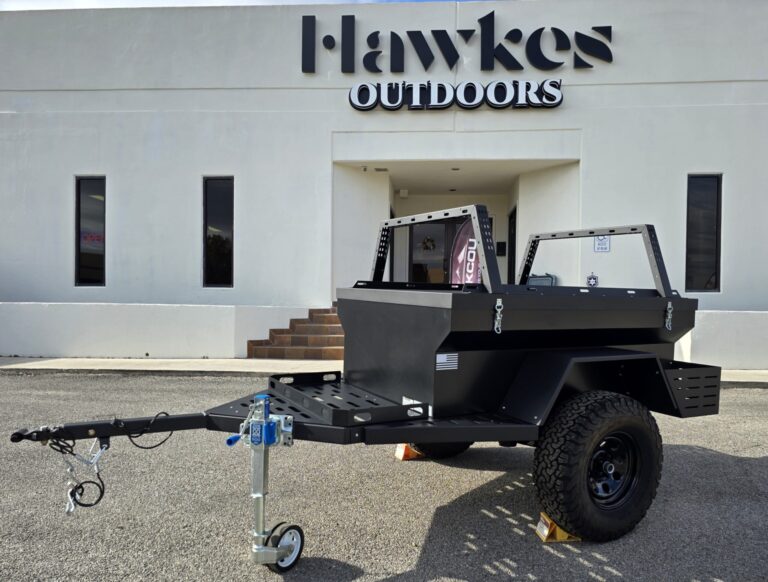
2025 Rustic Mountain Overland Patrol XC
The baseline Patrol, and the cheaper of the two Rustic Mountain trailers Hawkes Outdoors has on the lot. Enclosed cargo bay with a tilting lid and rear tailgate, Timbren HD 2200 lb axleless suspension, and 31-inch AT tires on 15-inch wheels. Listed at $10,737 in black, stock SA1124.
- Enclosed, lockable cargo bay
- Timbren HD 2200 lb axleless suspension
- 31-inch AT tires on 15-inch wheels
- Lock-N-Roll articulating hitch
- ARK tongue jack
- No tongue box, so galley gear rides in the main bay
- One unit on the lot at this price
Why 31″ AT Tires Are the Right Size for Off-Road Trailers
Tire diameter directly determines ground clearance, and on a trailer, ground clearance is everything. At 31 inches, the Patrol XCT’s overlanding trailer tires clear rocks, ruts, and washboarded crossings where a smaller rig’s undercarriage would drag. Most street-spec trailers ship with 205-225mm tires on 15″ or 16″ rims, which keep the trailer body far too close to the ground for rocky desert two-tracks or granite-edged forest service roads. The Patrol XCT’s spec changes the equation entirely.
Beyond diameter, a 31″ tire on the Patrol XCT (1,250 lbs) gives you the sidewall height needed to air down on rough terrain. Airing down to 15-20 PSI on rocky trails increases the tire’s contact patch, improves traction, and lets the overlanding trailer tires absorb impact before it transfers to the frame. Because a trailer mirrors its tow vehicle’s line through obstacles, a tire with real flex and grip is far more forgiving than a stiff highway-spec unit. I’ve crossed Wyoming and Colorado terrain where the difference between a clean crossing and a pinched sidewall was entirely a function of air pressure and sidewall height.
Additionally, a 31″ all-terrain size is practical because it remains widely available across the western U.S. Blowing a tire three counties from the nearest town in Nevada is a real scenario; a 31″ all-terrain is far easier to source on the road than a specialty overland size. On a long-haul overland run through remote country, parts availability isn’t a convenience issue. It’s a safety consideration.
Why 15-Inch Off-Road Wheels Work Better Than Larger Rims

Consumer wheel trends have pushed toward larger diameters: 17″, 18″, 20″. However, for overlanding trailers specifically, those larger sizes work against you. Smaller diameters, specifically 15-inch wheels, allow for a taller tire sidewall relative to the overall tire diameter, and this sidewall acts as supplemental suspension before the trailer’s own suspension units engage.
When pulling a trailer over broken terrain, the tire sidewall absorbs the first wave of impact. A 15-inch off-road wheel paired with a 31″ tire produces a sidewall height of roughly 5.3 inches, which gives the tire real flex capacity under load. On a 20″ wheel running the same overall diameter, the sidewall shrinks to approximately 2.75 inches, transferring far more impact directly into the frame and hitch. Over a full day on rough roads, the cumulative difference compounds into rattled gear, loosened fasteners, and a considerably rougher ride for everything inside the trailer.
Steel construction on 15-inch steel wheels also add a durability advantage on top of the sidewall benefit. Rather than cracking, steel deforms rather than cracks under hard impact, which means a direct hit against a ledge or embedded rock is far less likely to cause catastrophic failure than a similar hit on an alloy wheel. For a trailer spending weeks in the backcountry with no access to a wheel shop, steel on 15″ is the correct durability call.
All-Terrain Tread: The Right Call for Mixed Terrain Overlanding
Rustic Mountain Overland specs the Patrol XCT with all-terrain trailer tires, and for most overlanders covering mixed terrain across the western U.S., this is the correct specification. All-terrain tread splits the difference between highway stability and off-road grip, which matters on an overlanding rig because most routes involve highway miles, graded forest service roads, and unimproved two-track in sequence rather than in isolation.
Mud-terrain tires excel in deep mud and soft soil, however they sacrifice fuel economy, highway stability, and ride comfort on hard surfaces. For a trailer, those trade-offs are amplified; the trailer has no braking or steering input to compensate for unpredictable tread behavior on hardpack. These tires maintain predictable tracking on pavement while still biting into loose soil, gravel, and moderate mud, which is exactly the performance profile needed for western backcountry routes. I’ve run overlanding routes from the Oregon Coast Range to the New Mexico highlands, and all-terrain rubber handles the full spectrum far better than mud-terrain tires handle anything other than mud.
Availability is also a factor specific to this tire category. All-terrain tires exist in far more size variants than mud-terrain tires, specifically in the 31″ diameter range. On a multi-week overland run through remote country, the ability to replace a damaged tire without waiting on a special order isn’t a luxury; it’s trip insurance. This tire spec from Rustic Mountain Overland reflects a clear understanding of how these rigs get used in real-world western terrain.
Axleless Trailer Suspension and How It Changes Trail Dynamics

The Timbren HD 2200LB axleless suspension system on the Patrol XCT is one of the most consequential specs on the entire rig. Traditional trailer axles run a solid beam between both wheels, which means when one wheel hits an obstacle, the opposite wheel reacts. On rough, uneven terrain, the linkage transfers twisting force into the frame and lifts a wheel entirely off the ground, reducing traction and stability on every crossing.
Axleless suspension eliminates the beam. Each wheel operates independently through a rubber load cushion system rated to 2,200 pounds, allowing each side of the trailer to articulate over terrain without affecting the opposite side. Specifically on boulder fields, angled approaches, or uneven crossings, independent wheel travel keeps both tires planted longer, producing more traction and less frame twist throughout the obstacle. The Timbren system also runs maintenance-free; there are no bearings, no grease points, and no pivot joints to wear out in the field.
For overlanders who need even more capability, Rustic Mountain Overland offers an upgrade to the Cruise Master CRS2 suspension. The base Timbren HD handles the vast majority of western overland terrain comfortably. For more extreme demands, the CRS2 upgrade targets technical trails where additional wheel travel becomes necessary, and it’s worth discussing with the Rustic Mountain Overland team before you finalize your overland trailer setup.
Storage, Roof Rack & the Tongue Box Platform
The Patrol XCT’s storage system is what separates it from the base Patrol XC, and it starts with the forward-mounted tongue box. Sized to house a 12V refrigerator, a battery system, or a full camp kitchen setup, the tongue box also features dual-door access from both the driver and passenger sides. At camp, retrieving gear multiple times per day without climbing over the hitch or reaching across the trailer adds up to a meaningful ergonomic advantage on longer trips.
The front cargo basket adds exterior carrying capacity for recovery gear, water containers, or fuel cans. Above the main cargo bed, the custom 16″ tall roof rack provides a platform for a rooftop tent or a full second layer of gear. A tilting lid gives full access to the main cargo bed without obstruction, while the rear tailgate opens for a natural camp table or staging area. Together, the three-tier storage system covers most expedition overlanders’ needs without any aftermarket modification.
Optional upgrades include a tongue box slide, a tongue box rack, a matching spare tire mount, a custom bed liner, and the armor package. The armor package brings the base price to $14,990 and is worth considering for overlanders running technical terrain where frame contact with rock is a real possibility, not a theoretical one. A matching spare tire is also strongly recommended; losing a 31″ AT tire 60 miles into a remote trail isn’t a scenario you want to approach without a backup.
Patrol XCT vs. Patrol XC: Which One Fits Your Build?

The Patrol XC is the foundation; the Patrol XCT is the expanded platform. Both share the same core frame, the same 31″ all-terrain trailer tires on 15″ steel wheels, the same Timbren HD suspension, and the same Lock-N-Roll hitch. The single defining difference is the tongue box. Overlanders whose setup depends on dedicated forward storage for a fridge, an electrical system, or a camp kitchen should choose the XCT without hesitation. Those who run a simpler kit and prefer to minimize weight and complexity get the same tire and suspension performance at a lower overall cost from the Patrol XC.
Both models share the same $13,495 starting price, so the XCT adds meaningful utility without a premium over comparably configured XC builds. Weight difference is negligible for most tow vehicles, and the tongue box doesn’t compromise the main cargo area. For overlanders planning multi-day or multi-week expeditions where self-sufficiency matters, the XCT is the stronger choice. Weekend warriors running a simpler kit get the same trail-ready performance from the XC with less to manage on the road.
Pros and Cons
Pros
- 31″ overlanding trailer tires deliver genuine trail clearance and sidewall height for airing down to 15-20 PSI on rough terrain
- 15-inch off-road wheels provide more sidewall flex than larger rims and resist cracking on hard impacts far better than alloy alternatives
- Timbren HD 2200LB axleless trailer suspension allows independent wheel articulation, keeping both tires planted on uneven crossings
- Tongue box with dual driver/passenger door access speeds up camp setup and retrieval on multi-day trips
- Custom 16″ tall roof rack provides a real platform for a rooftop tent or full second layer of gear
- Texture powder coat resists chipping and UV degradation better than standard paint on a trailer spending extended time outdoors
- Made in the USA with financing available, making the $13,495 base price accessible for phased build-outs
- Armor package option ($14,990) adds meaningful frame protection for technical rocky terrain
Cons
- At 1,250 lbs base weight, the Patrol XCT requires a tow vehicle with a genuine hitch rating; crossovers and light-duty SUVs won’t handle it properly
- Yakima Road Shower and tongue box rack are sold separately, adding to the total cost for overlanders who want those features at the build stage
- No published payload capacity listed; overlanders loading a fridge, battery bank, and full camp kit should confirm their specific weight budget directly with Rustic Mountain Overland
- Purchasing requires direct contact for available models and lead times rather than a fully self-service online checkout process
- Cruise Master CRS2 suspension upgrade pricing requires a direct inquiry, which adds a step for buyers comparing suspension options before committing
Final Verdict

The Rustic Mountain Overland Patrol XCT earns its trail credentials from the ground up, and the off-road trailer tire and wheel choice is where it starts. The 31″ all-terrain tires on 15″ steel wheels aren’t a marketing spec; they’re a practical decision producing real ground clearance, real sidewall flex for airing down, and real durability for terrain where a wrong line costs you a wheel. I’ve covered enough backcountry miles across the American West to know the difference between a trailer engineered for the trail and one engineered to look like it was, and the Patrol XCT falls firmly in the first category.
Overlanders who want a lighter, simpler kit should also consider the base Patrol XC, which shares the same tire, wheel, and suspension platform without the tongue box. The XC is the right choice when forward storage isn’t a priority and you prefer to minimize complexity on the trail. However, for those who need the full expedition platform, the XCT’s tongue box transforms the logistics of a multi-day overland run in a way the XC simply won’t.
At $13,495 base and $14,990 with the armor package, the Patrol XCT sits in a competitive segment of the overland trailer market. The suspension system, the tire and wheel specification, the dual-access tongue box, and the made-in-USA build quality together represent genuine value rather than premium packaging. Financing availability makes the overland trailer setup more accessible for overlanders building toward a full rig over time rather than writing a single check.
Contact Rustic Mountain Overland directly for current models, lead times, and configuration options. If you’re serious about getting deep into the backcountry with a trailer behind you, the Patrol XCT belongs on your shortlist.
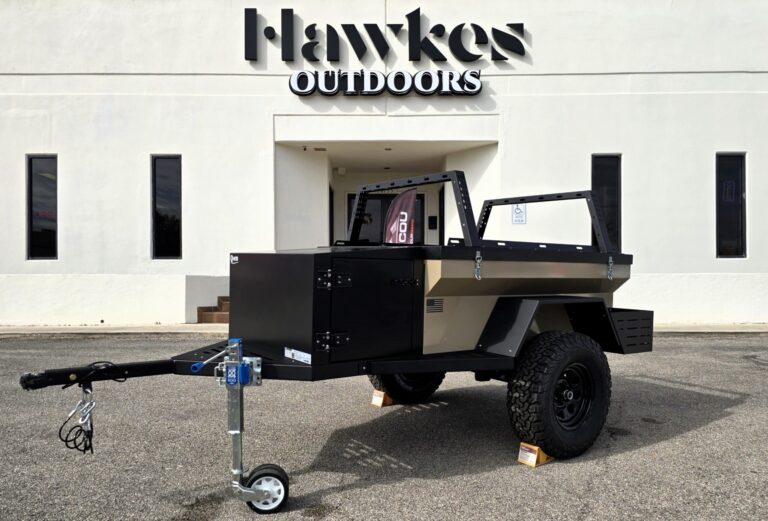
2025 Rustic Mountain Overland Patrol XCT
The XC with a lockable tongue box added forward on the frame, sized for a fridge, electrical, and galley gear, with an access door on the driver and passenger side. That is the piece that keeps cooking gear out of the main bay entirely. 1,250 lbs, tan, listed at $11,489, stock SA1122.
- Tongue box with driver and passenger access doors
- Enclosed main bay with tilting lid and rear tailgate
- Timbren HD 2200 lb axleless suspension
- Custom 16-inch roof rack and front cargo basket
- 1,250 lbs dry
- About $750 more than the Patrol XC
- One unit on the lot at this price
Frequently Asked Questions
What size tires does the Rustic Mountain Overland Patrol XCT come with?
The Patrol XCT ships with 31″ all-terrain trailer tires mounted on 15″ steel wheels. This combination provides trail-ready ground clearance, the sidewall height needed to air down on rough terrain, and the wide availability across the western U.S. necessary for safe extended overlanding far from tire shops.
Why do overlanding trailers use smaller wheels like 15″ instead of 17″ or larger?
Smaller wheel diameters produce taller tire sidewalls for a given overall tire diameter. On a 15″ wheel paired with a 31″ tire, sidewall height reaches roughly 5.3 inches, compared to approximately 2.75 inches on a 20″ rim running the same overall diameter. The extra sidewall allows the tire to flex significantly when aired down to 15-20 PSI, absorbing trail impacts before they transfer into the trailer frame. Smaller wheels, specifically 15-inch off-road wheels, also give overlanders access to a wider selection of quality off-road tire options than larger diameter sizes do.
What is axleless trailer suspension and why does it matter for off-road use?
Axleless trailer suspension eliminates the traditional solid beam connecting both trailer wheels, replacing it with independent suspension units on each side. On the Patrol XCT, Timbren HD rubber load cushions rated to 2,200 pounds handle each wheel independently. When one wheel hits an obstacle, the other side is unaffected, keeping both tires planted on uneven terrain and reducing twisting stress on the frame. For overlanders crossing rocky or angled approaches, independent wheel travel delivers measurably better traction and stability than a conventional axle setup.
How does the Patrol XCT differ from the Patrol XC?
The Patrol XCT adds a forward-mounted tongue box to the base Patrol XC, accessible from both driver and passenger sides. This tongue box is large enough to house a refrigerator, battery system, or full camp kitchen. Both models share the same 31″ AT tires on 15″ steel wheels, Timbren HD suspension system, Lock-N-Roll hitch, front cargo basket, 16″ roof rack, and tilting lid. The XCT is the correct choice for overlanders who need dedicated forward storage for electrical or galley components.
Are all-terrain or mud-terrain tires better for an overland trailer?
All-terrain trailer tires are the better choice for most overland trailer applications because they balance on-road stability with off-road grip across mixed terrain. Mud-terrain tires offer deeper tread for soft soil and mud, however they sacrifice highway tracking, fuel economy, and ride smoothness on hardpack. For western U.S. overlanding, where a typical route combines highway driving, forest service roads, and unimproved two-tracks, all-terrain tires deliver reliable performance across all three surfaces without significant trade-offs.
Does the Patrol XCT come with a spare tire?
A matching spare tire is available as an add-on option. Given the remote terrain this trailer handles, adding a matching spare is strongly recommended. A 31″ AT tire on a 15″ wheel is a widely available size across the western U.S., however remote trail access means you won’t always have the time to source a replacement before you need one on a live trip.
Our articles might have affiliate links and the occasional sponsored content, but don’t sweat it – if you buy something, we get a little kickback at no extra cost to you, and we only hype products we truly believe in!