



Quick Facts:
- Product: MORRFlate Air Hub AutoMagic Digital Air Controller.
- Job: Automatic inflation and deflation to the pressure you set.
- PSI range: 2 to 125 psi, chosen on a backlit digital display.
- Air source: Any compressor or tank with a shutoff or blow-off valve and 1/4-inch I/M fittings.
- Power: Lithium battery, recharged over USB-C.
- Warranty: 3-year “No Hassle” warranty plus a lifetime manufacturer warranty.
- Price: $250 for the controller, case and USB cable.
- Best for: Off-roaders who air down four tires at once and want to stop watching a gauge.
11 min read
In This Review
- Overview: Why the Air Hub Stands Out
- Air Hub Key Specs at a Glance
- How the Hub Sets Your Pressure
- Airing Down on the Trail
- Pairing the Air Hub With Your Compressor
- Accuracy, Battery Life and Build Quality
- What to Know Before You Buy
- Air Hub vs. a Manual Manifold
- Final Thoughts
- Frequently Asked Questions
Overview: Why the Air Hub Stands Out
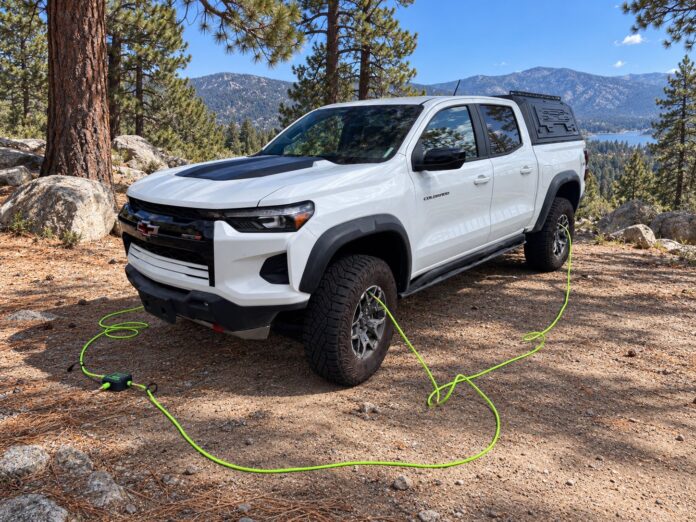
The MORRFlate Air Hub is a $250 digital controller for airing tires down and back up. It sits between your air source and your hose kit, and it stops at the pressure you pick. First, set a number from 2 to 125 psi, then open the valve and walk away. When the tires reach your target, the hub beeps and closes off the flow.
I’ve run a MORRFlate TenSix compressor for the better part of four or five years. Over those years, MORRFlate has kept pushing the ceiling higher on what you get from an off-road air setup. In my view, the Air Hub is the clearest example of this push so far. Specifically, it gives a standard compressor auto-stop at your target pressure, and it automates the air-down too. All of it lives in a box you hang off your rig.
I’ve been testing the Air Hub for the last couple of months. Beyond my own time with it, we searched Reddit and X, then read owner forums and independent tests. As a result, the owner praise and gripes below come from Bronco, Jeep, Tacoma and Tundra communities.
The hub fits you if you already run a 4-tire inflation and deflation system and a capable compressor. Your nearest alternative is a manual manifold with a gauge, which costs less but asks you to watch the needle. For a full breakdown of both approaches, see our guide to automatic vs manual tire inflation. If you air down twice a year, a manual setup still works fine. However, if you air down most weekends, the hub takes the gauge-watching off your list at every trailhead.
Air Hub Key Specs at a Glance
MORRFlate publishes a full spec list on its Air Hub product page. Here are the numbers you need before you buy.
| Specification | Details |
|---|---|
| Price | $250 |
| Pressure range | 2 to 125 psi, digital selection |
| Modes | Automatic inflation and automatic deflation |
| Display and alerts | High-contrast backlit screen, visual and audible job-done cues |
| Memory | Recalls your last air-down and air-up pressures |
| Air source | Shutoff or blow-off valve, 1/4-inch I/M fittings, 1.25 CFM minimum for one tire |
| Hose fittings | 1/4-inch I/M, A, T or Aro |
| Valves | High-flow solenoids |
| Battery | Lithium, USB-C rechargeable |
| Size | 6 x 5 x 2.5 in (body), 9.5 x 8 x 2.5 in with couplers and slide valve |
| In the box | Air Hub, USB-A to USB-C cable, hard-shell EVA foam case |
| Warranty | 3-year “No Hassle” warranty, lifetime manufacturer warranty |
Notably, the hub ships without hoses. If you already own a MORRFlate kit, add the Air Hub Retro Fit Kit to connect it. Otherwise, MORRFlate sells braided Air Hub hose kits, such as the two-tire Duo at $94. The four-tire Quad 125 costs $149, and the Quad+ costs $169. Larger Mega kits start at $188.
Gear for a Complete Air-Down Kit
Next, here is how the air gear around the hub compares. Specifically, the table pairs the TenSix Gen 2 and TenSix PSI Pro compressors with the Stubby manifold, so you see both automatic and manual options.
| Top Pick | Preset PSI Pick | Manual Option | |
|---|---|---|---|
| Product | TOP PICK MORRFlate TenSix Gen 2 MORRFlate TenSix Gen 2 |  MORRFlate TenSix PSI Pro MORRFlate TenSix PSI Pro |  MORRFlate Stubby Manifold MORRFlate Stubby Manifold |
| Rating | ★★★★★ 4.9 71 ratings | ★★★★★ 4.7 68 ratings | ★★★★★ 5.0 4 ratings |
| Type | Portable compressor | Portable compressor with preset PSI | Four-tire manifold |
| Role with the hub | Natural partner | Needs tank mode | Manual alternative |
| Price | $230.00 as of Oct 15, 10:14 pm | $325.00 as of Oct 16, 5:32 am | $75.00 as of Oct 15, 9:11 pm |
| Check Price → | Check Price → | Check Price → |
How the Hub Sets Your Pressure
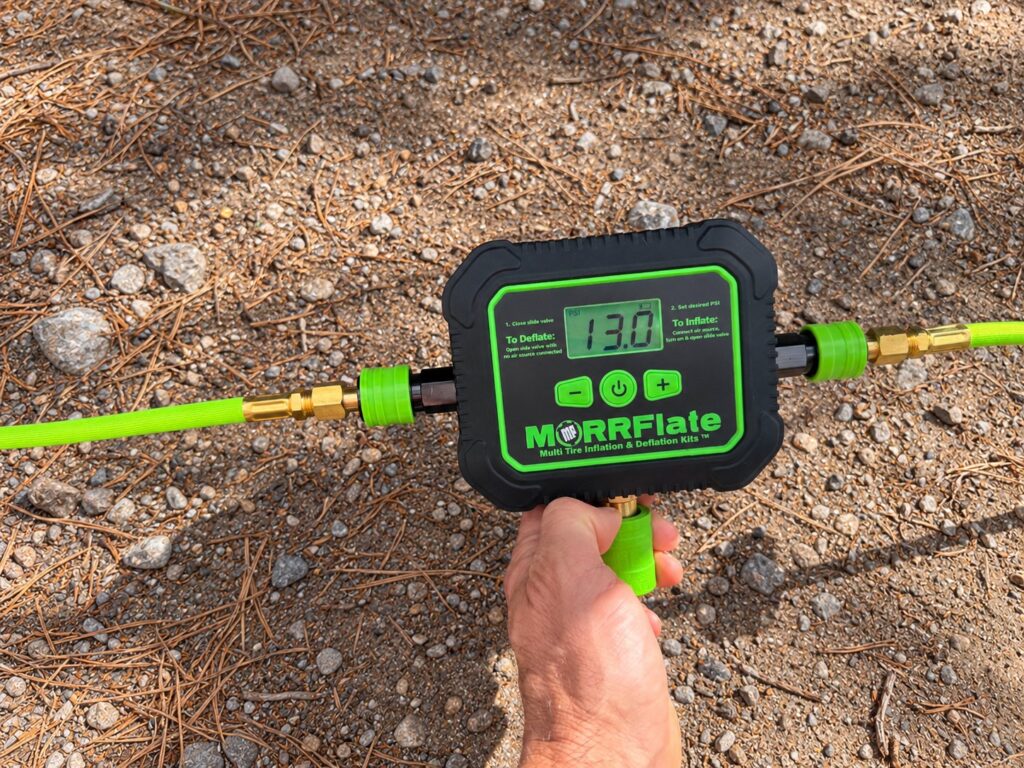
The auto-stop lives in the hub, not in your compressor. Inside, high-flow solenoids open and close the path between the air source and your tires. Meanwhile, a pressure sensor reads the tires and compares them to your target. Once the tires hit the number, the solenoids close and the hub sounds its alert.
Because the hub controls the flow, it works in both directions. For an air-down, it vents the tires through the hub until they drop to your setting. On an air-up, it passes compressor air through to the tires and stops at your target. In both cases, the screen shows live pressure, so you always know where the job stands.
The Pause-and-Check Cycle and Memory
During a run, the hub stops the flow every so often to take a clean reading. You hear it pause, then restart. This is normal behavior, and testers at Trail Tacoma and Trail 4Runner both describe it. The pause also gives the four tires a moment to even out through the hoses.
Next, the memory feature saves the most keystrokes. It remembers your last air-down number and your last air-up number. Consequently, a trailhead stop turns into a power-on, a confirm and a valve turn. This small detail matters most to me on a day with several stops.
Airing Down on the Trail
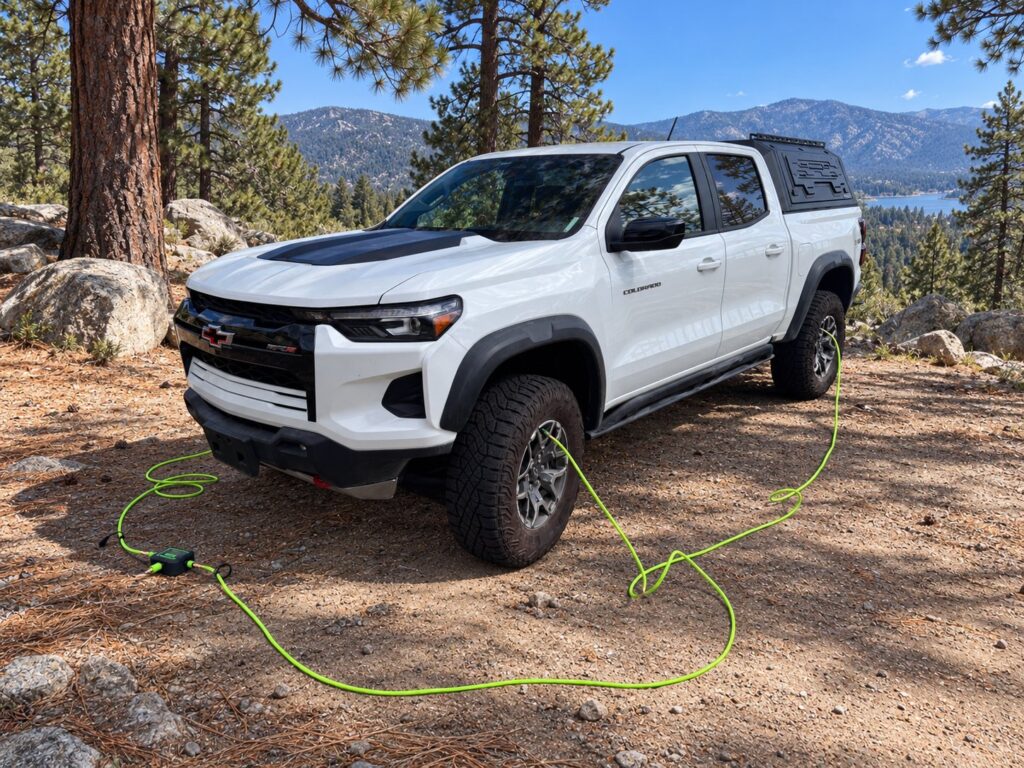
The set-and-walk-away workflow is the standout feature of the hub for me. Hub owners on the Bronco6G and Ford Tremor forums praise the same walk-away feature. You set the pressure, open the valve and listen for the beep. Meanwhile, you lock the hubs, disconnect a sway bar or check the trail map.
Speed numbers from independent testers line up with this. For example, OVR aired down four tires on a prototype hub, from 31 to 25 psi in under two minutes. Off Road Xtreme took a set of 37-inch tires from 35 to 10 psi in 5 minutes and 6 seconds. Bigger tires and bigger drops take longer, since more air has to leave each tire.
The real gain is attention, not raw speed. With a manual manifold, you hover over the gauge and close the bleed valve by hand. Overshoot by 3 psi and you start the job again with the compressor. In contrast, the hub stops itself, so a distracted moment no longer costs you a reset.
Air Hub vs. Screw-On Deflators
A screw-on automatic tire deflator works differently. You preset each one to a pressure, thread it onto a valve stem and wait. Those deflators cost less and need no battery. However, you set each one by hand, and you still need a separate setup to air back up. Our list of the best tire deflators for overlanding covers those options in more depth.
By comparison, the hub acts as an automatic tire deflator and an air-up controller through one hose kit. If you want to air down tires and air them back up with the same gear, the hub covers both jobs. Both jobs still lean on the air source behind the hub, so start there.
Pairing the Air Hub With Your Compressor
The Air Hub does not lock you into MORRFlate compressors. Owners and testers report running it with ARB compressors, including twin-motor units. One owner fills from a Power Tank CO2 system. Trail 4Runner praises this openness, and Trail Tacoma ran it straight off an ARB compressor. I agree with them, and it is the feature I’d point a skeptic to first.
Your air source needs two things. First, it needs a shutoff or blow-off valve, so it stops building pressure when the hub closes. Second, it needs 1/4-inch I/M fittings, or an adapter. MORRFlate rates the minimum flow at 1.25 CFM for a single tire. Trail 4Runner cites MORRFlate’s guidance of 4 CFM for four tires at once.
After years with a TenSix, I see it as the natural partner for the hub. Off Road Xtreme paired a TenSix Gen 2 with the hub. Then the pair took 37-inch tires from 10 to 35 psi in 3 minutes. The TenSix Gen 2 lists at $230 on the MORRFlate site. Our TenSix PSI Pro Gen 2 review goes deeper on the compressor.
Tank Mode, CO2 Tanks and CFM
A few setups need one extra step. For example, Trail 4Runner notes MORRFlate’s instructions call for tank mode on a PSI Pro compressor. Likewise, a Power Tank has no automatic shutoff, so you close the tank by hand when the hub beeps. One Amazon reviewer warns skipping this step risks damage to the hub.
If you shop for a new portable air compressor, check its CFM rating against your tire size first. Higher CFM at working pressure means faster fills on big tires. Owners report a small portable air compressor on a four-tire kit fills slowly and runs hot. Stay at or above MORRFlate’s 4 CFM four-tire rating.
Accuracy, Battery Life and Build Quality
Accuracy
Owners also praise the hub for accurate air-ups. One Bronco owner reports inflation landing within about 1 psi of the target. Another long-time MORRFlate owner calls it far more accurate than the brand’s older battery gauge. In addition, the same owner says it balances pressure across all four tires more evenly.
Deflation gets more mixed reports. One Bronco6G owner says air-downs stop 3 to 4 psi above the setting. Similarly, one customer on MORRFlate’s site reports different readings from the hub, the Jeep’s console and a handheld gauge. My advice is simple. Check one tire with a quality handheld gauge after your first few air-downs, then adjust your target to match. At 12 psi, a 3-psi miss changes the contact patch more than it does at 35 psi.
Battery Life
The USB-C battery ends the AA battery swaps of MORRFlate’s older digital gauge. Trail Tacoma reports three trips before the battery hit its last bar. Testers at Trail 4Runner saw a couple of trips per charge. Still, one Bronco6G owner drained the battery by leaving the hub on. Turn it off when the job ends. Before each trip, top it off from a USB port in your rig.
Build Quality
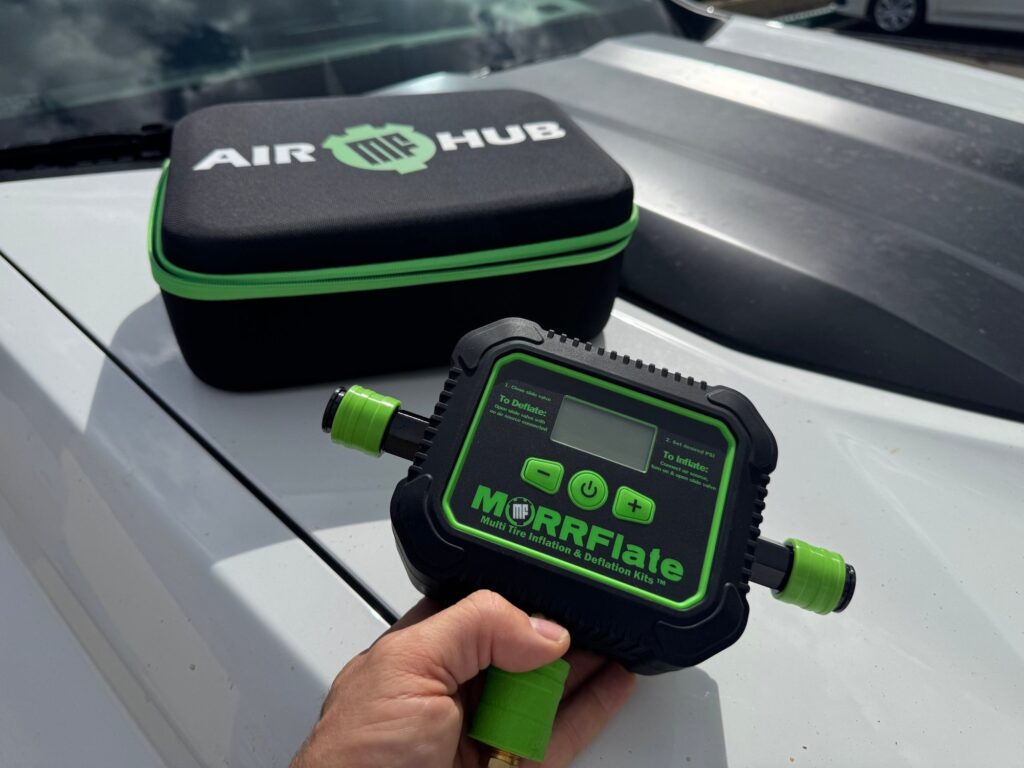
The hub feels built for trail abuse. Rubber bumper guards wrap the body, and a collapsible metal hook lets you hang it off your rig. The hard-shell case has an EVA foam interior to keep the hub secure in transport. I’d say the fit and finish match the $250 price. Trail 4Runner scored build quality 9.0 out of 10, and Trail Tacoma gave it 9.5.
What to Know Before You Buy
The Total Cost and Stock
Price is the top complaint, even from happy owners. Trail 4Runner gave value its lowest score at 8.0 out of 10, and Trail Tacoma scored value at 8.5. The full system adds up fast. For example, a $250 hub plus a $149 Quad 125 hose kit comes to $399 before a compressor. Many owners wait for a sale or a group-buy code before they order.
Stock is the other factor to check before you order. As of mid-October 2026, MORRFlate lists its hose kits as out of stock while it waits on parts. Orders for the hub itself process in 1 to 3 business days.
The Hoses Still Need Handling
The hub removes the gauge-watching, not the hose work. You still pull four hoses, connect four valve stems, then coil and stow everything afterward. Inside its case, the hub also takes more room than a bare manifold. If your storage is tight, measure your bin against the 9.5 x 8-inch footprint with couplers attached.
Safety note: Fittings run hot after a long air-up, so wear gloves when you disconnect. Disconnect each hose with care, because trapped pressure makes a loose hose whip. Air back up to street pressure before you drive at highway speed.
Before you decide, the box below sums up the MORRFlate Air Hub. Specifically, it lists the strengths and trade-offs covered above.

MORRFlate Air Hub Automatic Tire Inflation Deflation System Controller
Set your target pressure, then open the valve and walk away until the beep.
- Stops at your set PSI on air-ups and air-downs
- Remembers your last air-down and air-up pressures
- Works with ARB compressors and Power Tank setups
- Rechargeable lithium battery with USB-C
- Ships without hoses, so budget for a hose kit
- Deflate readings draw mixed owner reports
Air Hub vs. a Manual Manifold
A manual manifold, such as MORRFlate’s Stubby, splits one air line into four tires. You watch an analog or digital gauge and close a bleed valve by hand. It costs less and takes less space. With an analog gauge, it needs no battery either. However, the result depends on you catching the needle at the right moment.
MORRFlate’s controller replaces the gauge and the bleed valve with solenoids and a sensor. As a result, it stops itself, remembers your numbers and alerts you when it finishes. Flow speed stays close to a manual setup, since MORRFlate designed the solenoids so your valve stems set the limit. Therefore, you trade money and bulk for consistency and freed-up attention.
Pick the manual manifold if you air down a few times a year and like a simple tool. Choose the Air Hub if you air down most trips or run with a group. Likewise, go with it if trailhead conversations tend to pull you away. Either way, size your hose kit to your wheelbase. MORRFlate builds its four-tire kits for 100, 125, 155 and 200-inch rigs.
Final Thoughts
The Air Hub is the upgrade I’d point you to if you air down most weekends. Specifically, it fits you if you already own a solid compressor and four-tire hose kit. Its biggest strength is the routine. You set a number, walk away and come back to four tires at the same pressure. After a couple of months of testing, this is the part I’d miss most if the hub left my rig.
I’ll be straight with you about the trade-offs. At $250 before hoses, it is a luxury item. Testers score its value lowest, and one Bronco6G owner balks at the price. You still coil four hoses at the end of the day. Also, verify your first few air-downs with a handheld gauge, since deflate readings draw mixed reports.
If your budget points elsewhere, a manual manifold still gets you aired down. To see how the hub stacks up against MORRFlate’s TenSix, read our Air Hub vs TenSix comparison. For your money, you get a well-built controller and a 3-year “No Hassle” warranty. Throughout my years with the TenSix, MORRFlate has kept pushing the ceiling higher on its air gear. If you air down most weekends, this hub is the next step.
Frequently Asked Questions
Does the MORRFlate Air Hub work with any compressor?
It works with any air source with a shutoff or blow-off valve and 1/4-inch I/M fittings, sometimes through an adapter. Owners and testers run it with ARB compressors, and one owner uses a Power Tank. A TenSix PSI Pro needs tank mode, and a Power Tank needs a manual shutoff at the beep.
How accurate is the Air Hub?
One Bronco owner reports air-ups landing within about 1 psi of the target. Another says all four tires finish more evenly. Deflate readings draw mixed reports, including one owner who saw stops 3 to 4 psi high. Check your first few air-downs with a handheld gauge and adjust your target.
How long does the Air Hub battery last?
Trail Tacoma reports three trips before the last bar, and Trail 4Runner reports a couple of trips per charge. Turn the hub off after each job, because leaving it on drains the battery. Charge it over USB-C before each trip.
Do I need a MORRFlate hose kit to use the Air Hub?
No. The hub works with hoses using 1/4-inch I/M, A, T or Aro fittings, from a single tire to multi-tire kits. Existing MORRFlate kit owners add the brand’s Retro Fit Kit to connect it.
How long does it take to air down four tires?
It depends on tire size and how far you drop. OVR measured 31 to 25 psi on four tires in under two minutes. Off Road Xtreme took 37-inch tires from 35 to 10 psi in about 5 minutes.
Is the Air Hub worth $250?
If you air down often and already own a capable compressor and hose kit, the answer is yes. The time and attention it saves justify the price. Testers still rate value as its weakest score. If you air down a few times a year, a manual manifold costs less and works fine.