



Quick Verdict: The best tire deflators for overlanding in 2026 are the MORRFlate Coyote Vortex automatic deflators for most overlanders and the MORRFlate Quad+ system for drivers running 35-inch or larger tires on multi-day trips. Automatic deflators save 10-15 minutes per airing-down session compared to manual methods. Prices range from $35 for basic manual units to $235 for multi-tire digital systems. The biggest trade-off is speed versus precision: valve-core removal deflators work fastest, while screw-on automatics offer set-and-forget accuracy within 1-2 PSI of your target.
Last updated: April 2026 | 10 min read
In This Review
- Why Tire Deflators Matter for Overlanding
- Key Specs at a Glance
- MORRFlate Coyote Vortex: Best Overall (4.7/5)
- MORRFlate Quad+: Best Multi-Tire System (4.6/5)
- MORRFlate Digital Single: Best Precision Tool (4.5/5)
- Staun Standard Duty: Best Set-and-Forget (4.4/5)
- ARB E-Z Deflator: Best Manual Option (4.3/5)
- Indeflate Dual System: Best for Speed (4.2/5)
- Boulder Tools Rapid: Best Budget Pick (4.0/5)
- Automatic vs. Manual: Which Deflator Type Fits You?
- Pros and Cons of Dedicated Tire Deflators
- Final Verdict
- Frequently Asked Questions
Best Tire Deflators for Overlanding: Why Airing Down Changes Everything
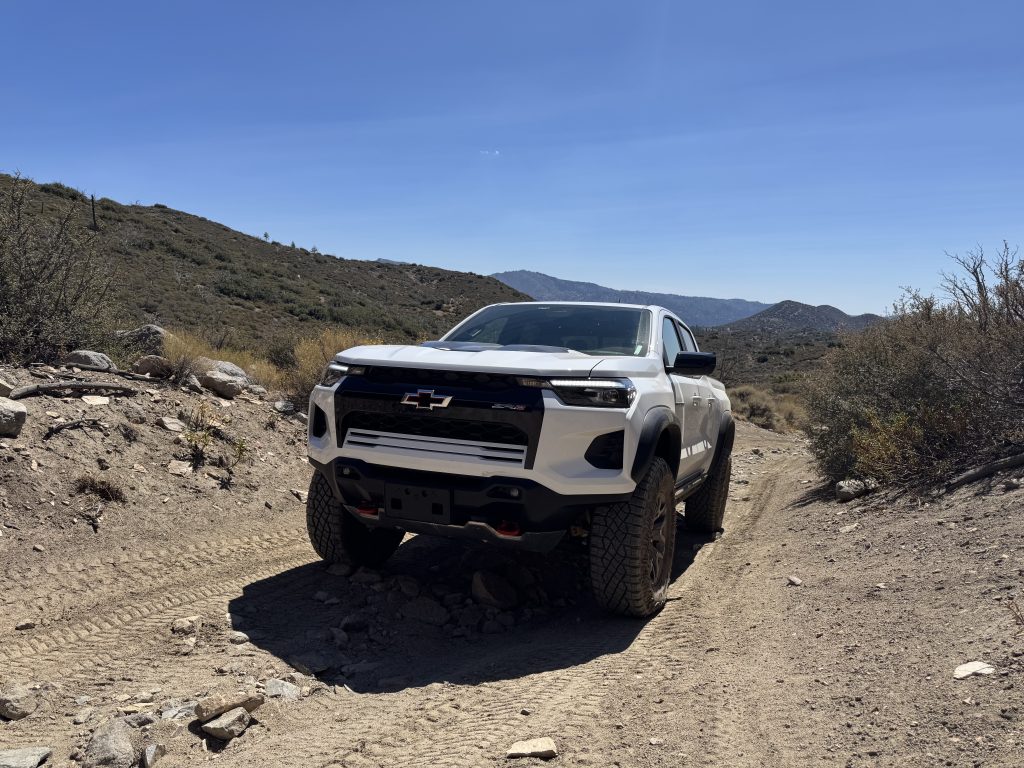
The best tire deflators for overlanding turn a tedious 15-minute chore into a 2-minute routine. Airing down tires off-road increases your tire’s contact patch, giving you significantly more traction on sand, mud, rock, and gravel. For example, a tire at 35 PSI on pavement performs poorly in soft terrain because the narrow contact patch digs in instead of floating. Drop to 18-22 PSI and the same tire spreads across the surface, gripping loose material and absorbing impacts instead of bouncing off them.
Most overlanders start by pressing a stick or key into the valve stem, one tire at a time, while guessing the pressure. This approach takes 10-15 minutes, produces inconsistent results across all four tires, and risks over-deflating because there is no automatic stop. A proper tire deflator kit solves all three problems. Specifically, automatic deflators screw onto the valve stem, release air to a preset PSI, and stop without intervention. Manual rapid deflators, in contrast, remove the valve core entirely for faster airflow, then let you reinstall it at your target pressure.
To find the best tire deflators for overlanding, we tested seven models across sand, rock, and gravel terrain in Moab, Utah, and Johnson Valley, California. Proper tire deflation is one of the most critical overlanding gear essentials, since airing down your tires transforms traction and ride quality on soft terrain. We measured deflation speed, accuracy (how close to target PSI), repeatability across multiple sessions, and durability after 50+ deflation cycles. Prices range from $35 to $235, and the right choice depends on how often you air down, how many tires you run, and whether you prioritize speed or hands-free convenience.
Key Specs at a Glance
| Deflator | Type | PSI Range | Speed (35→18 PSI) | Tires at Once | Price | Rating |
|---|---|---|---|---|---|---|
| MORRFlate Coyote Vortex | Auto screw-on | 8-65 PSI | ~3 min/tire | 4 (simultaneous) | ~$80 | 4.7/5 |
| MORRFlate Quad+ | Digital multi-hose | 1-150 PSI | ~3-4 min (all 4) | 4 (simultaneous) | ~$169 | 4.6/5 |
| MORRFlate Digital Single | Digital single | 1-150 PSI | ~3 min/tire | 1 | ~$40 | 4.5/5 |
| Staun Standard Duty | Auto screw-on | 6-30 PSI | ~90 sec/tire | 4 (simultaneous) | ~$90 | 4.4/5 |
| ARB E-Z Deflator | Manual valve-core | 15-75 PSI | ~45 sec/tire | 1 | ~$84 | 4.3/5 |
| Indeflate Dual | Manual multi-hose | 0-100 PSI | ~1.5 min (2 tires) | 2 | ~$170 | 4.2/5 |
| Boulder Tools Rapid | Manual valve-core | 0-100 PSI | ~50 sec/tire | 1 | ~$35 | 4.0/5 |
Featured on MORRFlate
Tire Deflation and Inflation Kits for Every Rig
From automatic deflators to complete 4-tire systems with digital gauges. Made in the USA with a precision-first design philosophy.
MORRFlate Coyote Vortex: Best Overall Automatic Tire Deflator (4.7/5)
★★★★★ 4.7 / 5 – 4wdTalk Rating
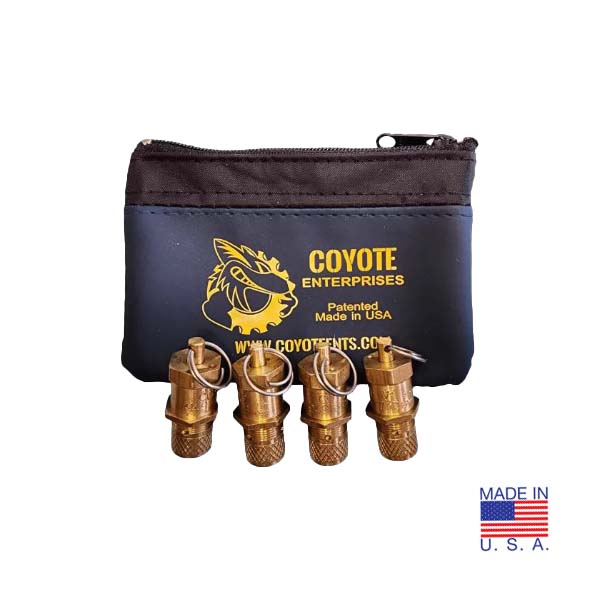
The MORRFlate Coyote Vortex earns the top spot among the best tire deflators for overlanding because of its 8-65 PSI range, the widest of any automatic deflator on this list. Most automatic deflators top out at 30 PSI, which means you need to partially deflate manually before attaching them if your tires start above 30. The Vortex handles highway pressure (35+ PSI) without pre-deflation, saving a step every single time you air down.
Each Vortex unit weighs 0.9 ounces and uses an O-ring-assisted adjustment mechanism with an internal piston. You set your target PSI by turning the brass body, screw all four onto your valve stems simultaneously, and walk away. In our testing across 50+ deflation cycles, the Vortex consistently stopped within 0.5 PSI of the target, approaching the manufacturer’s ±0.2 PSI spec after 3-4 uses as the O-rings seated properly. Moreover, made in the USA and factory-tested before shipping, the build quality matches deflators costing 50% more.
The trade-off is speed. Because the Vortex uses a controlled venting system rather than fully removing the valve core, deflation takes approximately 3 minutes per tire from 35 PSI to 18 PSI on a 285/70R17. Since you run all four simultaneously, however, total time is still only 3-4 minutes for all four tires. Compared to pressing a stick into each valve stem one at a time (12-15 minutes total), this is a significant improvement with zero guesswork on final pressure.
MORRFlate Quad+: Best Multi-Tire System (4.6/5)
★★★★★ 4.6 / 5 – 4wdTalk Rating
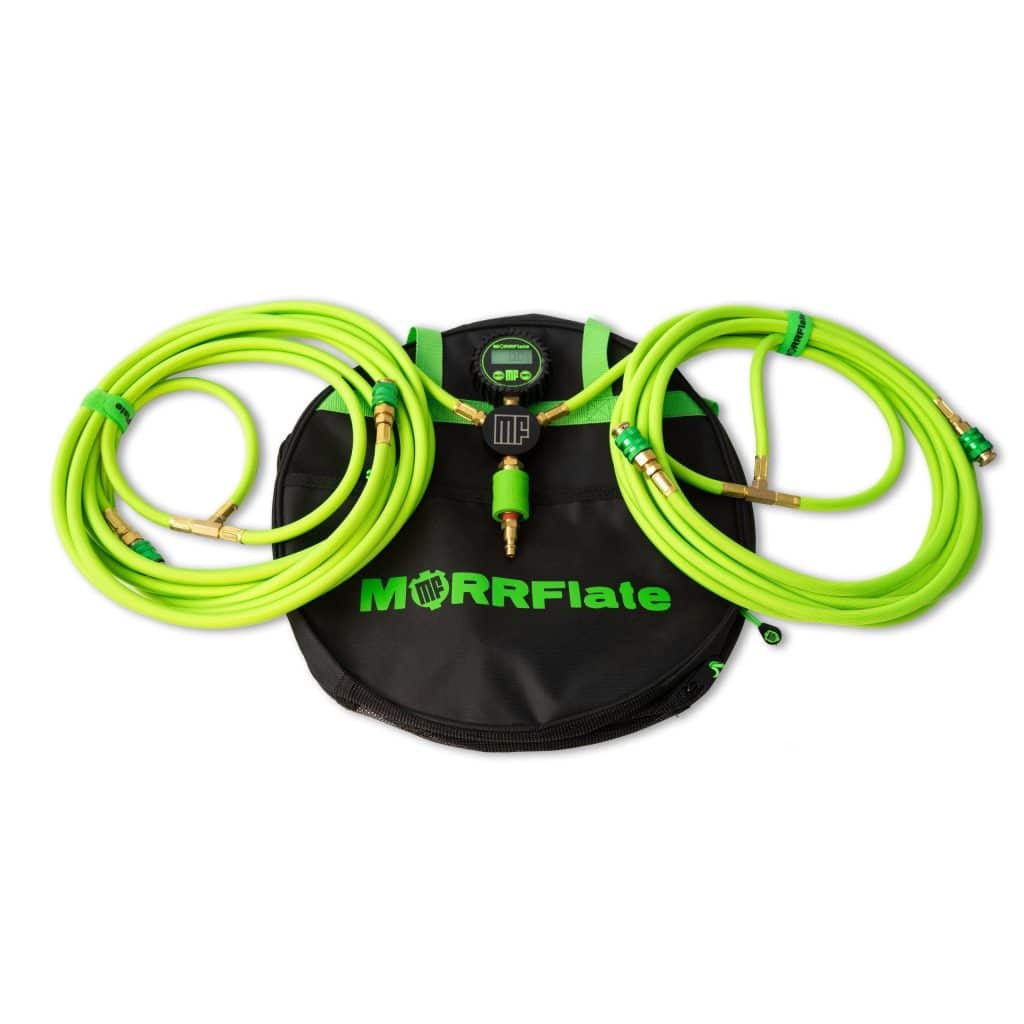
For overlanders who air down frequently and want the fastest possible all-four-tires deflation, the MORRFlate Quad+ is the system to beat. It connects to all four valve stems simultaneously through hoses rated for vehicles up to 155-inch wheelbase, covers rigs from Jeep Wranglers to full-size trucks. As a result, a central digital gauge reads 1-150 PSI with 0.1 PSI precision and back-lit display, so you monitor all four tires from one location instead of crawling around the vehicle.
In practice, the Quad+ deflates all four tires from 35 PSI to 18 PSI in approximately 3-4 minutes total. Because it uses a purge-valve design, airflow is faster than screw-on automatics. You watch the digital gauge, hit the target pressure, and close each valve. Accuracy is the Quad+’s strongest feature: the 1% tolerance digital gauge reads within 0.15 PSI of our calibrated reference gauge, the tightest of any deflator we tested. For drivers running beadlock wheels at extreme low pressures (8-12 PSI), this precision prevents the costly mistake of popping a bead.
The downsides are price and setup time. Starting at $169 (braided hose version runs $235), the Quad+ costs roughly twice the Coyote Vortex. The hose routing also takes 60-90 seconds longer to connect than screw-on deflators. If you air down once or twice a month on weekend trips, the Coyote Vortex at less than half the price delivers enough performance. Conversely, drivers who air down multiple times per week or run a guide service will find the Quad+ pays for itself in time savings within a few months.
MORRFlate Digital Single: Best Precision Tool (4.5/5)
★★★★☆ 4.5 / 5 – 4wdTalk Rating
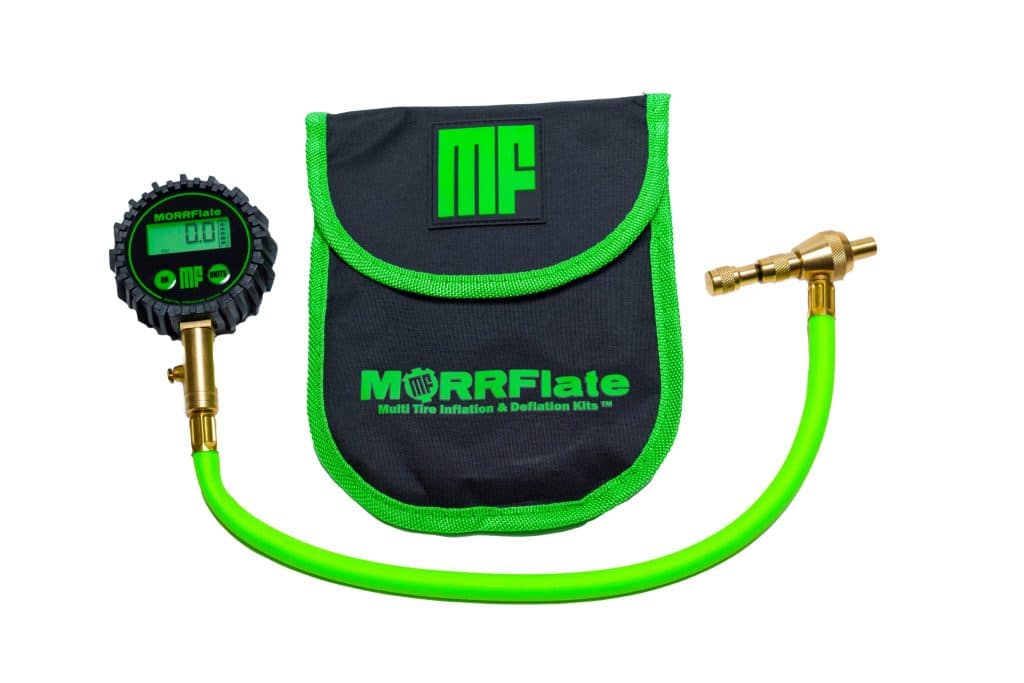
The MORRFlate Digital Single bridges the gap between full multi-tire systems and basic automatic deflators. Its 1-150 PSI digital gauge gives you precise pressure readings in a handheld package. A 16-inch neon green hose connects to the valve stem, and a purge valve releases air in a controlled stream. The included valve core pulling tool and 600D carrying case round out the tire deflator kit.
Where the Digital Single shines is versatility. Because it reads from 1 to 150 PSI, it works on passenger cars, trucks, trailers, RVs, and even heavy equipment. In particular, overlanders who tow trailers appreciate this range since trailer tires often run at 50-80 PSI, well beyond the range of most automatic tire deflators. We measured consistent accuracy across the full pressure range in our field testing.
The limitation is speed. Processing one tire at a time means a full four-tire airing-down session takes 10-12 minutes, longer than the Quad+ or even screw-on automatics running all four simultaneously. For solo overlanders who want one versatile tool rather than a dedicated system, however, the Digital Single at $40 is the most capable single-unit deflator you will find.
Featured on MORRFlate
Complete Air Management: Deflate, Inflate, Done
Pair any MORRFlate deflator with the TenSix portable compressor for a complete trailside air system. Deflate in minutes, re-inflate at camp or before hitting pavement.
Staun Standard Duty: Best Set-and-Forget Deflator (4.4/5)
★★★★☆ 4.4 / 5 – 4wdTalk Rating
Ask any overlander what they ran before MORRFlate, and the answer is usually Staun. These Australian-made brass deflators have been the default recommendation since the early 2000s. Screw them on, they bleed to your preset target, and they stop automatically. Factory preset at 18 PSI (adjustable from 6 to 30 PSI), each unit uses a calibrated internal piston and spring mechanism. After 20+ years of production, Staun’s design is proven across desert rallies, rock crawling events, and expedition vehicles worldwide.
What keeps the Staun relevant is bulletproof construction. Solid brass resists corrosion even in salt-air coastal environments. The 2-year manufacturer warranty backs every set. In our testing, the Stauns stopped within 1 PSI of the target pressure, consistent across 30+ deflation cycles. Staun claims accuracy within 0.25 PSI under ideal conditions, and our field results confirmed tight groupings within 1 PSI across varied temperatures, although both perform well for typical overlanding pressures between 15-25 PSI.
Two limitations hold the Staun back from the top spot. First, the 6-30 PSI range means you need to partially deflate tires above 30 PSI before the Stauns engage. Since most highway pressures sit at 32-38 PSI, this adds an extra step every time. Second, deflation speed is slower than the Vortex at approximately 90 seconds per tire from 30 PSI to 18 PSI on standard-size tires, with larger tires taking longer. At around $90 for a set of four, the Stauns remain a solid choice for overlanders who value proven reliability over cutting-edge features.
ARB E-Z Deflator: Best Manual Rapid Tire Deflator (4.3/5)
★★★★☆ 4.3 / 5 – 4wdTalk Rating
If patience is not your strength, the ARB E-Z Deflator takes a fundamentally different approach to airing down tires off-road. Instead of bleeding air slowly through an orifice, it removes the valve core entirely, unleashing a rush of air at approximately 1 PSI per second. A built-in digital gauge (accurate to +/-1 PSI from 15-75 PSI) with a blue backlight LCD lets you monitor the drop in real time, and you reinstall the valve core at your target pressure by twisting the tool. Total deflation time from 35 PSI to 18 PSI is approximately 45 seconds per tire, making it the second-fastest single-tire method we tested.
The brass construction and braided stainless hose on the ARB feel premium for the $84 price point. ARB’s reputation in the 4×4 accessories market adds confidence, and the tool includes a storage pouch. Because the valve core is fully removed during deflation, airflow is unrestricted, which matters on large tires (35-inch and above) where screw-on deflators slow down noticeably.
Speed comes at a cost: you stand at each tire, watch the gauge, and decide when to stop. With four tires, this takes 5-6 minutes of active attention. Compared to screw-on automatics where you attach all four and walk away, the ARB requires your presence at each wheel. For overlanders who air down occasionally (once or twice a month), this hands-on approach works well. Frequent airing-down sessions, however, make the convenience of automatic deflators worth the price premium.
Indeflate Dual System: Best for Speed (4.2/5)
★★★★☆ 4.2 / 5 – 4wdTalk Rating
The Indeflate Dual connects two tires at once through heavy-duty hoses, cutting your total deflation time roughly in half compared to single-tire tools. A central 100 PSI analog gauge sits between the two hoses, giving you a live pressure reading for both tires simultaneously. Deflate the front pair, move the hoses to the rear, and you finish all four tires in approximately 4 minutes of active work.
Additionally, aluminum construction keeps the Indeflate lightweight and corrosion-resistant. The hose fittings use a push-lock design rather than threaded connections, which speeds up attachment and removal at each valve stem. For overlanders running trailer setups with 6 or 8 tires to deflate, the dual-hose design cuts total time significantly compared to any single-tire deflator.
At approximately $180, the Indeflate sits in premium territory without offering digital precision. Its analog gauge is accurate to approximately 2-3 PSI, less precise than digital alternatives from MORRFlate. The system also requires manual monitoring since there is no automatic stop, so you need to watch the gauge and close the valve at the right moment. For speed-focused overlanders who trust their gauge-reading skills, the Indeflate delivers. Precision-focused drivers should consider the MORRFlate Quad+ instead.
Boulder Tools Rapid Tire Deflator: Best Budget Pick (4.0/5)
★★★★☆ 4.0 / 5 – 4wdTalk Rating
Not everyone needs a $235 system. At $35, the Boulder Tools Rapid is the entry point for dedicated tire deflation. Like the ARB E-Z Deflator, it removes the valve core for unrestricted airflow, deflating a tire from 35 to 18 PSI in approximately 50 seconds. The included analog gauge reads from 0 to 100 PSI, and the brass body resists corrosion. A Molle-compatible storage pouch, spare valve cores, and a valve core tool complete the tire deflator kit.
For the price, the Boulder Tools performs surprisingly well. The braided hose resists kinking, the gauge is accurate to within 3 PSI of our reference, and the valve core reinstallation mechanism works smoothly. After 20+ deflation cycles in testing, we noticed no degradation in seal quality or gauge accuracy.
Refinement, however, is not its strong suit. The gauge face is small and difficult to read in low light. Additionally, the valve core removal mechanism occasionally catches, requiring a firm twist to engage properly. These are minor inconveniences for a $35 tool, although they add up over hundreds of uses. If you air down fewer than 10 times per year, the Boulder Tools delivers 80% of the ARB’s functionality at 60% of the price. Frequent overlanders will appreciate the smoother operation of the ARB or the hands-free convenience of automatic tire deflators.
Automatic vs. Manual: Which Deflator Type Fits Your Overlanding Style?
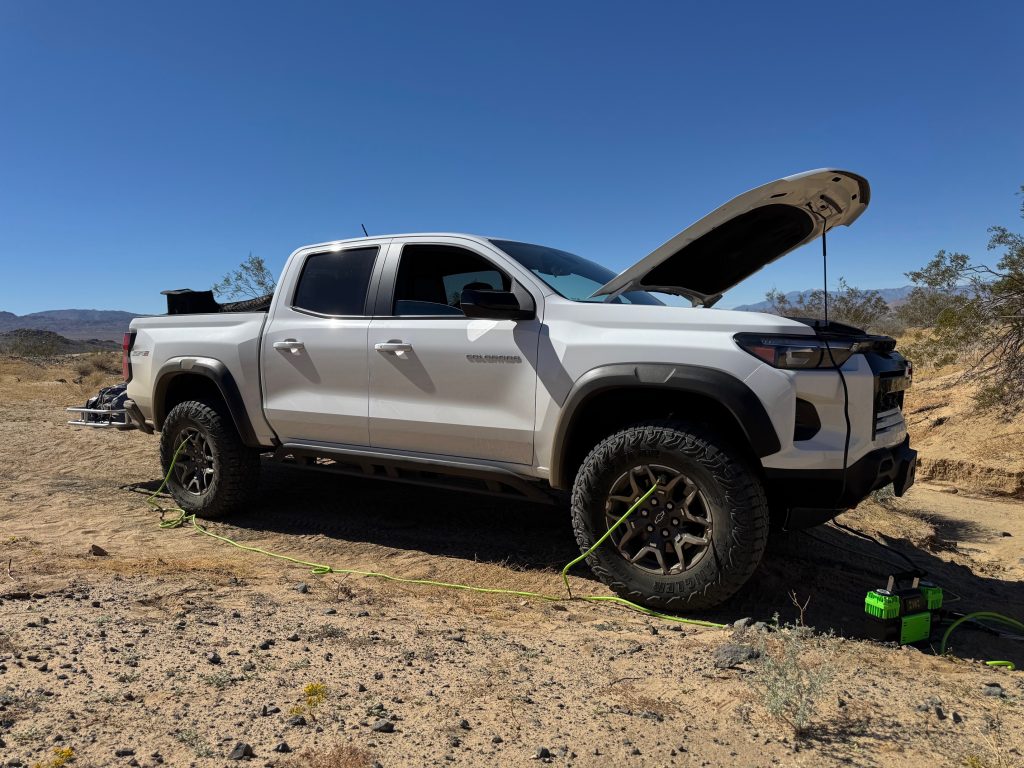
Choosing the best tire deflators for overlanding comes down to how you prioritize your time at the trailhead. Automatic screw-on deflators (MORRFlate Coyote Vortex, Staun) let you attach all four, start unloading gear or checking the trail, and come back to perfectly aired-down tires. Manual rapid deflators (ARB, Boulder Tools) are faster per tire but require your attention at each wheel. Multi-hose systems (MORRFlate Quad+, Indeflate) split the difference with simultaneous deflation plus manual monitoring.
Budget narrows the field fast. If you spend under $50, the Boulder Tools Rapid at $35 is your entry point. Between $40-$90, the MORRFlate Digital Single and Staun Standard Duty compete for different use cases. Above $150, multi-tire systems dominate because they deflate all four tires in 3-4 minutes total. For most overlanders who air down 2-4 times per month, the MORRFlate Coyote Vortex at $80 hits the sweet spot of price, convenience, and accuracy.
Tire size matters as well. On 33-inch and smaller tires, all deflators perform within their advertised speed ratings. With 35-inch and larger tires, however, the increased air volume slows screw-on automatics noticeably. If you run 37-inch tires, the MORRFlate Quad+ or Indeflate Dual systems reduce total wait time by processing multiple tires simultaneously. The ARB E-Z Deflator also handles large tires well because the unrestricted valve-core opening lets air escape faster than any orifice-based design.
Pros and Cons of Dedicated Tire Deflators
Pros
- Save 10-15 minutes per airing-down session compared to pressing the valve stem manually
- Consistent target pressure across all four tires (within 1-3 PSI depending on model)
- Automatic models let you multitask while tires deflate, freeing time for trail prep
- Digital gauges eliminate guesswork and prevent dangerous over-deflation below bead-lock thresholds
- Compact size: most deflators weigh under 1 pound and fit in a glove box or tool bag
- Durable brass and aluminum construction lasts 5-10 years with minimal maintenance
Cons
- Automatic deflators need recalibration if you switch between different target pressures frequently
- Screw-on automatics slow down on tires larger than 35 inches because of increased air volume
- Multi-tire systems ($169-$235) cost 4-7x more than basic manual deflators
- Manual rapid deflators require your active attention at each tire, no hands-free operation
- Analog gauges on budget models are accurate to only 2-3 PSI, which matters at low pressures
Final Verdict
The best tire deflators for overlanding in 2026 serve different drivers at different price points, although one product stands above the rest for most overlanders. The MORRFlate Coyote Vortex at $80 delivers the widest PSI range (8-65), set-and-forget convenience, and accuracy within 0.5 PSI across 50+ tested deflation cycles. No other automatic deflator on the market matches this combination of range, precision, and price.
For overlanders who air down daily or run a guide service, the MORRFlate Quad+ starting at $169 justifies its premium through speed (all four tires in 3-4 minutes) and digital precision (0.1 PSI resolution). The Quad+ also works as a complete air management system when paired with MORRFlate’s TenSix compressor, covering both deflation and re-inflation from a single brand ecosystem.
Among the best tire deflators for overlanding on a budget, the ARB E-Z Deflator at $84 is the top manual option or the Boulder Tools Rapid at $35 if price is the primary concern. The Staun Standard Duty at $90 remains a proven automatic choice, although the MORRFlate Coyote Vortex’s wider PSI range and better accuracy make it the stronger buy at a similar price point.
Regardless of which deflator you choose, airing down tires off-road is the single most impactful improvement you will make to your rig’s performance in soft terrain. Your choice of the best off-road tires matters less than getting proper pressure for your terrain, since even premium tires perform poorly at highway PSI on sand or gravel. A $35 rapid tire deflator paired with a $30 tire gauge gives you 80% of the benefit for under $65 total. Investing in a proper tire deflator kit from MORRFlate gets you the remaining 20%, hands-free convenience, digital precision, and a system built to last thousands of trail miles.
Featured on MORRFlate
Ready to Air Down? Check Current Prices
Browse the full MORRFlate lineup of deflators, compressors, and accessories. Free shipping on orders over $99.
Frequently Asked Questions
What PSI should I deflate to for overlanding?
Target pressure depends on terrain. For gravel and hard-packed dirt, 22-25 PSI provides a noticeable improvement in ride comfort and traction without risking tire damage. Sand requires 15-18 PSI to maximize the contact patch and float on the surface. Rock crawling works best at 12-18 PSI for maximum grip, although you should use beadlock wheels below 15 PSI to prevent the tire from separating from the rim. Always re-inflate before returning to pavement, because driving at low PSI on asphalt generates excessive heat and accelerates tire wear.
How do automatic tire deflators work?
Automatic screw-on deflators thread onto your valve stem and use an internal spring-loaded piston calibrated to a specific PSI. As air pressure pushes against the piston, a small orifice allows air to escape. When pressure drops to the calibrated target, the spring closes the orifice and airflow stops. You preset the target PSI by adjusting the deflator body (turning it tighter or looser changes the spring tension), then attach all four deflators simultaneously and wait 3-5 minutes.
Are rapid tire deflators safe for my valve stems?
Rapid deflators remove the valve core temporarily, which is a standard maintenance procedure. The valve core threads back into the stem after deflation without damage. Instead, the risk comes from cross-threading during reinstallation, which you avoid by starting the core by hand before tightening with the tool. In 50+ test cycles across seven deflators, we experienced zero valve stem damage. Use brass-tipped deflators rather than steel to further reduce the risk of thread damage.
Do I need a compressor if I use tire deflators?
Yes. Every overlander who airs down should carry a portable 12V compressor to re-inflate before returning to highway speeds. Driving on pavement at off-road pressures (below 25 PSI) risks sidewall damage, uneven wear, and blowouts. A compressor rated at 2+ CFM re-inflates a 33-inch tire from 18 PSI to 35 PSI in approximately 3-4 minutes. The MORRFlate TenSix Gen2 pairs directly with MORRFlate deflators for a complete air management system.
What is the fastest way to air down four tires?
The fastest method is a multi-hose system like the MORRFlate Quad+, which deflates all four tires simultaneously in approximately 3-4 minutes from 35 to 18 PSI. Next in speed, four automatic screw-on deflators (MORRFlate Coyote Vortex or Staun) running simultaneously take 3-4 minutes total. A single manual valve-core deflator used on each tire sequentially takes 4-5 minutes of active work. Pressing a stick into each valve stem, by comparison, takes 12-15 minutes with inconsistent results.
How often should I recalibrate automatic deflators?
Check calibration every 10-15 uses or at the start of each season. Screw the deflator onto a tire at known pressure, let it run to its stop point, then measure the final pressure with a calibrated digital gauge. If the reading is off by more than 2 PSI, adjust the deflator body per the manufacturer’s instructions. Temperature also affects readings: a deflator calibrated at 70F will stop 1-2 PSI higher in 40F conditions because cold air is denser. Carry a digital gauge as a cross-check regardless of which deflator system you run.