


Quick Facts:
- Topic: Choosing and mounting a GMRS antenna on a truck or SUV.
- Frequencies: Channels near 462 MHz and 467 MHz.
- Quarter-wave length: About 6.4 in at 462.5625 MHz.
- Best spot: Center of a steel roof.
- No-drill options: Magnet base or hood or trunk lip mount.
- Good SWR: 1.0 to 1.5, with readings up to 2.0 acceptable.
- License: $35 for a new license, valid for 10 years.
- Best for: Overlanders who want more range from the radio they already own.
9 min read
In This Guide
Overview
A GMRS antenna sets how far your radio reaches, and the mount sets how well the antenna works. Many trucks and SUVs leave the factory with no obvious spot for either. Therefore, a bigger radio will not fix short range if the antenna sits in the wrong spot.
This guide covers four mount types: magnet bases, drilled NMO (New Motorola Mount) bases, ditch light brackets and hood or trunk lip mounts. You will see where each one works, where each one fails, and what the numbers say about cable, gain and SWR. If you are still choosing a radio type, the GMRS vs ham radio comparison covers this decision first.
In my view, the mount deserves more of your budget than the radio brand does. The sections below show why, and where the mount goes.
Why Antenna Placement Beats Wattage
Antenna placement matters more than radio power because the FCC caps your output. Then the install decides how much of it you keep. Mobile and base GMRS radios top out at 50 W of output. On channels 1 to 7, the limit drops to 5 W of effective radiated power, which includes antenna gain. Therefore, you cannot buy your way to range with watts alone.
Cable loss shows the same effect. A 15 ft run of RG-58 at GMRS frequencies loses about 1.4 dB, so roughly 27% of your transmit power never reaches the antenna. The same loss hits incoming signals, which means your receiver also hears less. Midland puts the range gain of a 3 dB antenna at about 1.4x under optimal conditions. In effect, one cable run wipes out nearly half of the antenna’s gain.
Obstructions matter too. Roof racks, light bars, GPS antennas and air scoops all interfere with the signal, according to Midland’s mounting guidance. Likewise, forum owners report lopsided range when the whip sits beside pillars, a tailgate or a tire carrier.
In my view, spend on the mount and the cable before you spend on watts.
Each whip below threads onto an NMO base and covers GMRS frequencies, so you match one to your roof setup. The Midland MXTA25 and the Laird Technologies 450-470 Unity Antenna stay short and low-gain, while the Midland MXTA26 is the taller step up for open terrain.
NMO whips to consider

Midland MXTA25 3DB MicroMobile Compatible Gain Ghost Antenna


How a GMRS Antenna Works on a Vehicle
Because GMRS channels sit near 462 MHz and 467 MHz, the wavelength is about 25.5 in. A quarter-wave whip measures about 6.4 in at 462.5625 MHz. For example, the short Laird QWB450 whip is about 6 in long.
Most whips need metal under them to work. Midland calls this metal the ground plane and recommends a steel or aluminum surface about 12 in across. The antenna grounds through the shield of the coax, so a steel roof gives you a simple, full ground plane. As a result, a mount with less than 12 in of metal around it gives up some performance.
Specifically, gain reshapes the signal; it does not add power. A higher-gain whip pushes energy toward the horizon and away from the sky. Midland pairs antennas of 2.1 to 3 dB with obstructed terrain. It pairs 6 to 7.5 dB antennas with open terrain. Owners on myGMRS also say extra gain helps mainly with a clear view to the horizon.
Check the unit on every gain claim. Since dBi equals dBd plus 2.15, a unity-gain quarter-wave whip is 2.15 dBi. The Larsen NMO450CK lists 3.4 dBd, which is 5.6 dBi. Midland, however, lists its 32 in MXTA26 at 6 dB without naming a unit. Tall whips also risk breaking on branches. On a trail rig, I would start with a short, low-gain whip and move up only if you need more.
Where to Mount Your GMRS Antenna on a 4×4
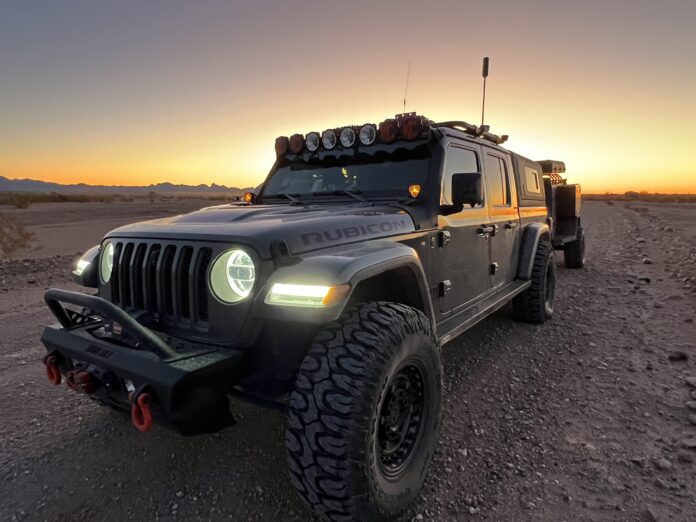
The center of a steel roof is the best spot. It gives the antenna a full ground plane, the most height and a clear view in every direction. Owners on myGMRS and Expedition Portal agree. Midland also advises you to mount the antenna as high as possible.
Some vehicles use aluminum or fiberglass panels, and magnets do not hold on either. In those cases, a drilled base, a lip mount or a bracket on the body gives you a place to attach. Rank the options by how close they get to the roof. Hood and fender mounts keep the tip high and in the clear, though you give up some range. Rear bumpers and tire carriers come last, because owners report detuning and weaker range next to large metal structures.
Keep the whip away from roof racks, light bars, GPS antennas and air scoops, as Midland advises. Also route the coax away from power and ignition wiring, and add ferrite beads if interference shows up. For group runs, see the guide to radio protocol for off-road groups. It quotes Expedition Portal’s Kurt Williams, who prefers a hard-wired radio on an external antenna in every vehicle.
My pick for a truck you plan to keep is a roof center NMO base. It costs you one hole, and then you stop adjusting the antenna.
Ditch Light Mount and Other Compromise Spots
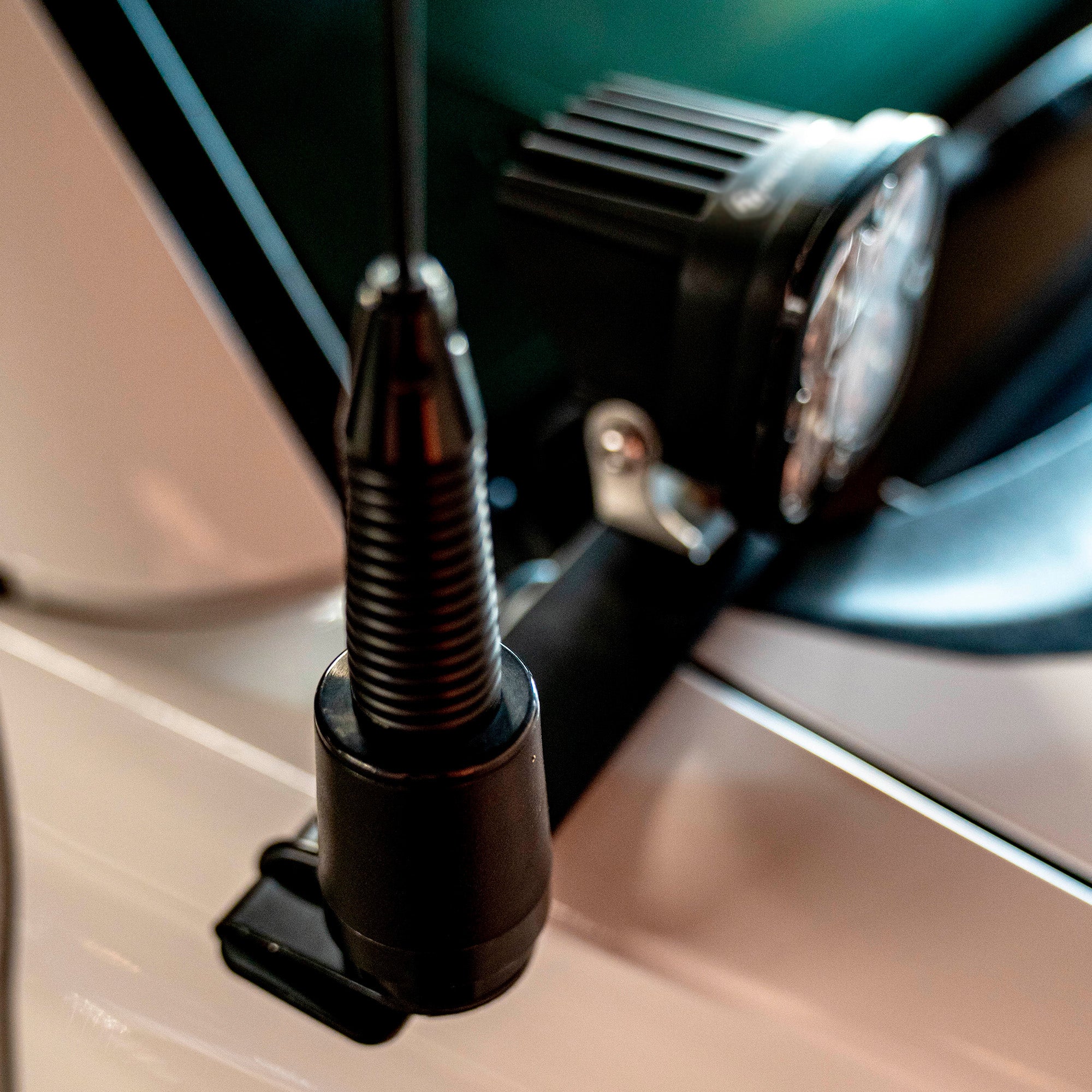
A ditch light mount puts the antenna forward, at the base of the A-pillar. Owners accept it when the roof is off limits, since the bracket ties into hardware already on the truck. However, you trade some range for this convenience. One Expedition Portal owner estimated the ditch spot heard about 60 to 70% of what the roof heard. Treat it as one report, not a measurement.
Hole size decides whether a bracket works. Owners report many ditch light brackets arrive with 3/8 in holes, so you drill them out to 3/4 in for a standard NMO base. Midland lists the MXTA22 ditch light extension bracket with a 5/8 in hole for NMO antennas. Check the hole size on any bracket before you buy. If you add lights at the same time, the off-road lighting setup guide covers the wiring and relays.
Whips on these spots take extra abuse. Owners report ditch-mounted antennas rock and rub the hood and roof edge. For this reason, a short whip suits this spot better than a 32 in whip.
A lip mount needs no drilling. The Midland MXTA27 attaches to the edge of a hood or trunk lid and ships with 20 ft of RG-58U coax. Midland also advises against putting a fiberglass antenna on a lip mount, so check the antenna material before you buy.
Magnet Mount vs. NMO Mount
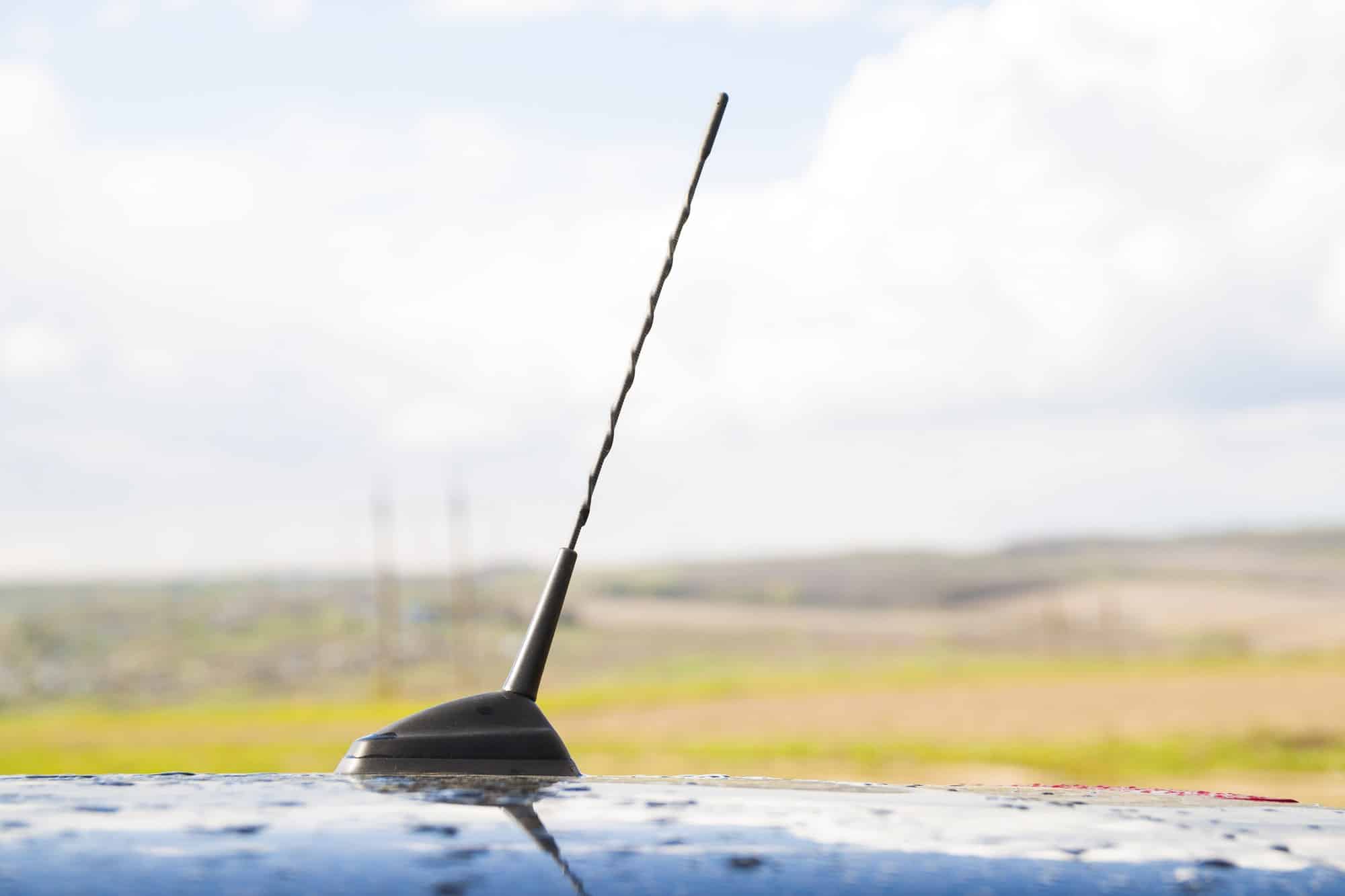
The standard NMO mount bolts through a 3/4 in hole and uses a 1 1/8 in by 18 thread. A magnet base carries the same NMO thread, so the same antenna fits both.
| Mount type | Drilling | Works on | Main trade-off |
|---|---|---|---|
| Magnet base | None | Steel panels | Grit scuffs paint |
| Drilled NMO base | 3/4 in hole | Bare metal at the hole | Permanent hole |
| Ditch light bracket | Often 3/8 in to 3/4 in | Existing bracket | Rubs the hood edge |
| Lip mount | None | Edge of hood or trunk lid | Not for fiberglass whips |
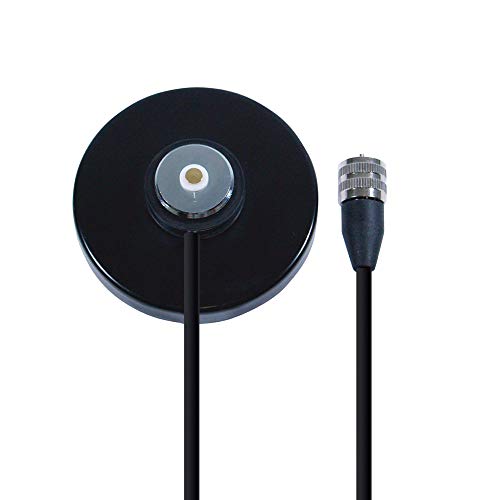
Magnet strength also varies by brand. E/M Wave rates its NMO magnetic bases at 40 lb of pull, and 50 lb for the heavy-duty versions. Meanwhile, the Midland MXTA12 has a 3.5 in base. Owners accept a large magnet on bare steel for a rental, a borrowed truck or a seasonal setup.
Paint care is a common complaint. Grit under the magnet scuffs the finish, so keep both surfaces clean and put clear film under the cable run. A myGMRS contributor notes a magnet couples through the paint, so thin film does not hurt performance. Drilled bases work differently, since Midland advises bare metal without paint or powder coating for proper grounding.
Since owners disagree on how large the performance gap is, choose by how long you keep the truck. If you rent, share or swap trucks, I would buy the magnet base. On a truck you keep, I would drill once and leave it alone.
Mounts Worth Checking Before You Buy
The Midland MXTA12 magnet base and the Midland MXTA27 lip mount need no drilling, while the Rago Ham Antenna Ditch Bracket Extension adds an antenna hole to your ditch light bracket. Check your hood, fender and roof material before you order, since a magnet needs steel.
Mounts to consider


Rago Ham Antenna Ditch Bracket Extension Made in USA 3/4 Inch Hole
Cable and SWR for Your GMRS Antenna
Cable choice costs your GMRS antenna range before the signal reaches it. At 450 MHz, Times Microwave lists LMR-400 at 2.7 dB per 100 ft and LMR-240 at 5.3 dB. Belden lists its RG-58 type at 8.4 dB per 100 ft at 400 MHz. Interpolation puts it near 9 dB at 465 MHz.
On a 15 ft run, RG-58 loses about 1.4 dB, LMR-240 loses 0.8 dB and LMR-400 loses 0.4 dB. Midland’s MXTA27 lip mount ships with 20 ft of RG-58, which costs about 1.8 dB. Therefore, shorten the run or lay the extra cable in loose loops, because Midland advises against tight coils. LMR-400 loses the least but runs stiff and bulky, so in my view LMR-240 is the practical middle ground on a truck.
How to Check SWR on a GMRS Antenna
SWR tells you how well the antenna, mount and cable match the radio. Midland rates 1.0 to 1.5 as ideal and up to 2.0 as acceptable. Specifically, ARRL shows 1.5:1 reflecting about 4% of power, 2:1 about 11% and 3:1 about 25%.
Treat SWR as a pass-or-fail check on your install, not a score for comparing antennas. A good reading on a poorly placed antenna still leaves you with a poorly placed antenna. Also, lossy cable flatters the reading, because the cable absorbs reflected power before your meter sees it. If the number runs high, check the ground contact, the center pin of the connector and nearby metal first. Test one channel near 462 MHz and one near 467 MHz, and keep each transmission brief. For example, one owner saw a whip beside a tire carrier read 1.01 at 462 MHz and 2.18 at 467 MHz.
CB tuning follows different rules at a far lower frequency, so use the best CB radios for overlanding guide if you run both.
Final Thoughts
If you remember one thing, start with the roof. In my view, the best GMRS antenna setup is a steel roof center with a drilled NMO base, short cable and a low-gain whip. Then check SWR once and move on.
If the roof is off limits, you still have good options. A ditch light bracket or a hood lip mount keeps the tip high, while a magnet base suits rentals and borrowed trucks. Still, expect some range loss and keep the whip clear of metal.
Once the antenna is right, the radio is the easy part. One FCC license belongs to one adult, and immediate family members operate under it. The term is normally 10 years. For a convoy, the guide to running a group trail day shows how radios fit into the rest of your trip planning.
GMRS Antenna FAQ
Where is the best place to mount a GMRS antenna on a truck?
Mount it at the center of a steel roof, as high as the roof allows and clear of racks and light bars. This spot gives the antenna a full ground plane and an open view all around. If the roof is off limits, choose a hood, fender or ditch light bracket next.
Is a magnet mount or NMO mount better for GMRS?
A drilled NMO base gives the most reliable result for a truck you keep, because it holds the antenna in the best spot permanently. Magnet bases work well on bare steel when you rent or swap vehicles. Owners disagree on how large the performance gap is.
Will a magnetic mount stick to an aluminum hood?
No. A magnet needs steel, and neither aluminum nor fiberglass holds one. Use a drilled NMO base, a lip mount or a ditch light bracket instead.
Will a ditch light bracket hold a GMRS antenna?
Yes, once you open the hole to fit an NMO base. Owners report many ditch light brackets arrive with 3/8 in holes, and a standard NMO base needs 3/4 in. Midland also lists a ditch light extension bracket made for NMO antennas, so check the hole size before you buy.
Does a higher-wattage GMRS radio give more range than a better antenna?
Usually not. The FCC caps mobile and base radios at 50 W, and the antenna and cable decide how much of this power does useful work. For example, a 15 ft run of RG-58 wastes about 27% of your power before the antenna sees it. Better placement and shorter cable usually raise range more than extra watts.
Related Reading
Sources: FCC GMRS page and Midland antenna mounting tips.