


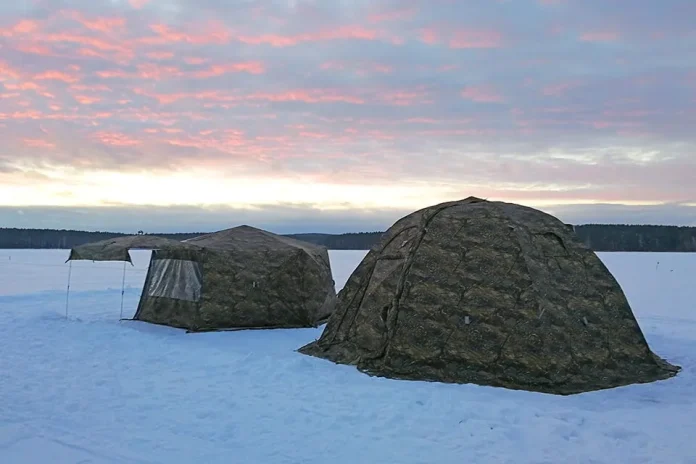

Most camping gear is designed for the weekend. Stakes are thin wire, poles are 8.5mm aluminum at best, and zippers rated for three seasons of moderate use. That’s appropriate for the majority of campers who are out four or five times a year in decent weather. But for overlanders who run multi-week expeditions, hunters who set spike camps for weeks at a stretch, and families or groups who use a tent as a true basecamp across multiple seasons, weekend-grade gear fails on a timeline measured in trips rather than years. The mismatch between how a shelter is marketed and what it’s built to sustain is one of the most expensive surprises in outdoor gear.
Decades of camping and overlanding across the U.S., I’ve accumulated a fairly clear picture of what separates a long-term camping shelter from one that merely looks the part. Those features are specific and verifiable: frame alloy, wall construction method, interior volume relative to group size, heat system integration, and the design decisions that determine whether a shelter stays functional after two hundred nights rather than twenty.
In my kit, the Bereg UP-7 has become the reference point for what a hot tent basecamp done right looks like, and this guide uses it as the working example while covering the principles that apply to any shelter evaluated for serious, extended use.
Quick Facts:
- Topic: What features define a genuinely durable long-term camping shelter
- Featured tent: Bereg UP-7, 5×5m double-wall Oxford dome, B95T1 aluminum frame, stove-ready, rated -50°C to +30°C, includes mini vestibule connector
- Capacity: 5–7 people with stove and folding beds; up to 14 in sleeping bags
- Weight: 35.6 kg (78 lbs), vehicle-based camp only
- Key differentiators: Aviation-grade 10mm aluminum frame, PU 4000 outer fly, sealed seams on both layers, 1-minute deployment, built-in stove jack
- Best for: Overlanders, hunters, group basecamp operators, and families who camp hard across all seasons
- Trade-off: Weight and price make this a vehicle-based investment; not for backpackers or casual three-season campers
10 min read
In This Guide
- What Long-Term Actually Means for a Camping Shelter
- Frame Durability: Why Alloy and Geometry Matter More Than You Think
- Fabric and Construction: The Difference Between PU 1500 and PU 4000
- Interior Volume and Livability for Extended Stays
- Heat System Integration: When a Stove Jack Changes Everything
- Setup Speed at Scale: Why 1 Minute Matters More on Trip 50 Than Trip 1
- The Bereg UP-7: How It Meets the Long-Term Standard
- Pros and Cons
- Final Verdict
- Frequently Asked Questions
What Long-Term Actually Means for a Camping Shelter

A long-term camping shelter is evaluated differently from a weekend tent. The weekend buyer asks: does it fit my sleeping bags, does it keep rain out, and is it under $300? Long-term buyers ask something else entirely: how does this shelter perform after fifty trips? After two hundred nights of pitching, packing, and exposure to freeze-thaw cycles, UV, humidity, and sustained wind? Where do the first failures appear, and how severe are they when they do?
These questions matter because the cost structure reverses at long time horizons. A $300 three-season tent replaced every three seasons costs $100 per year and delivers inconsistent performance as it degrades. One built to last ten or more seasons at a higher initial cost works out to less per year over its life while performing consistently at every camp. Camping shelter durability changes that math further when the shelter is the difference between a functional group basecamp and a miserable one, between a hunting camp where people sleep and recover well, and one where everyone counts the hours until morning. Camping shelter durability and livability are not luxuries in the long-term category. They are the fundamental value proposition.
The features separating genuinely durable shelters from weekend tents are visible in the specifications if you know where to look: frame alloy, waterproofing ratings, construction method, interior dimensions, and whether the shelter’s thermal system is integrated or bolted on as an afterthought. Our UP-7 buyer’s guide covers specifically who this class of shelter serves and who it doesn’t, which is worth reading before committing to the investment.
Frame Durability: Why Alloy and Geometry Matter More Than You Think

The frame is the skeleton of a camping shelter. Every other performance claim, wind resistance, snow load handling, structural integrity across hundreds of pitches, depends on the frame material and geometry holding up under repeated stress. For a long-term camping shelter used across all seasons, frame quality is the first filter to apply.
The Alloy Problem
Not all aluminum poles are equivalent. 6000-series aluminum alloys, common in mid-range tents, perform adequately in three-season conditions but become increasingly brittle below 0°F. In sustained cold, the difference between 6000-series and 7000-series aluminum is measurable in fracture resistance under impact, the kind of impact that happens when a wind gust hits a tent hard enough to flex the poles suddenly. Over repeated exposures across seasons, standard aluminum poles accumulate fatigue at the flex points, and the degradation is invisible until it isn’t.
7000-series aluminum, specifically alloys like AA7075 and its international equivalents, maintains ductility well below -40°F. It resists the cold-induced brittleness problem entirely. The Bereg UP-7 frame uses B95T1 alloy, the Russian designation for AA7075 / ENAW-7075, the same alloy class used in aerospace structural components. At 10mm diameter, lateral wind loads are horizontal compressive forces, and 10mm rods resist bending under those loads significantly better than the 8.5mm or 9mm poles common in three-season designs. For a four-season group tent expected to survive hundreds of pitches and all-season wind exposure, the alloy specification is not a marketing detail. It is the fundamental durability driver.
The Hub-and-Spoke Geometry Advantage
Beyond alloy, frame geometry determines how load is distributed. A standard two-pole dome tent concentrates wind load at the two crossing poles and their junction point, the highest-stress location in the structure. The Bereg UP-7’s dome-and-umbrella hub-and-spoke frame distributes load simultaneously across all eight legs radiating from the central hub. Wind from any direction finds no single weak point to exploit. Snow load is distributed similarly, pressing downward on a dome geometry engineered to shed accumulation rather than hold it. For a long-term camping shelter meant to handle hundreds of nights across serious conditions, the distributed-load geometry compounds its advantage over every trip.
Fabric and Construction: The Difference Between PU 1500 and PU 4000

A camping shelter’s fabric performs two functions: it keeps weather out and it manages heat transfer between inside and outside. Both functions degrade over time at rates determined by the initial material quality and construction method. For a long-term camping shelter, the starting point of the fabric’s waterproofing rating matters, because the relevant question is not “does it work today?” but “does it still work after five seasons of UV exposure, repeated packing, and freeze-thaw cycling?”
Standard three-season tents ship with PU waterproofing ratings between 1500 and 2000 millimeters of hydrostatic head. This means the fabric resists water penetration up to the pressure equivalent of a 1500 to 2000mm column of water. Most rain generates pressure well below this threshold in normal conditions, so the rating seems adequate. However, PU coatings degrade with UV exposure, abrasion, and age. A tent starting at PU 1500 reaches functional uselessness faster than one starting at PU 4000, because it has a smaller margin before degradation becomes performance failure.
The Bereg UP-7’s outer fly uses Oxford 300 fabric with PU 4000 waterproofing, while the inner layer uses Oxford 210 with PU 2000. Oxford weave, a denser basket-weave construction compared to standard nylon or polyester, holds its PU impregnation longer under physical stress. Between the two layers, an air gap reduces condensation by keeping the inner surface warmer than the ambient exterior, so moisture migrates to the outer fly rather than dripping on sleeping gear. Sealed seams on both layers close the remaining penetration pathway that unsealed inner fly seams leave open in extended wet conditions. This is a complete construction approach, not a collection of partially addressed problems.
Authorized Bereg Canada Dealer
Bereg UP-7: The Largest UP-Series Basecamp Tent
5×5m interior, Oxford 300 PU 4000 double-wall construction, B95T1 10mm aluminum frame, stove jack, mini vestibule included. Rated -50°C to +30°C. 5–7 people with stove and beds.
Interior Volume and Livability for Extended Stays

Interior volume is the feature that most distinguishes a long-term camping shelter from a survival shelter. Two-person backpacking tents keep occupants alive through bad weather. A proper basecamp shelter keeps them functional, comfortable, and able to operate effectively the next day. These are different design targets, and the gap between them is measured in square footage, standing height, and the ability to organize gear, cook, sleep, and move without constant physical compromise.
For group use over extended periods, interior volume per person determines how well the shelter serves as a basecamp. The Bereg UP-7’s 5×5×2.3 meter interior, roughly 16 feet square by 7.5 feet at center height, provides approximately 270 square feet of usable floor space. For a group of five with a wood stove, folding beds or cots, and stored gear, this translates to a space where people stand, move between sleeping areas, and use a camp table without stepping over each other. The 7.5-foot center height is specifically significant: it allows standing upright at the center of the tent, which reduces the cumulative physical fatigue of repeated crouching over multi-day camps in a way that shorter shelters don’t.
Storage architecture matters alongside raw volume. The UP-7 includes a mesh shelf under the dome for overhead gear organization, wall pockets for smaller items, and spring hooks for hanging equipment. Two separate entrances with mosquito nets allow independent access, which prevents the constant disruption of a single-door tent when one person needs to get up at 4 a.m. and the others want to sleep. The mini vestibule connector is included in the package, adding an attached external storage space for boots, wet gear, and firewood that keeps the main living area cleaner across multi-day camps. These are not amenities. They are the functional features that determine whether a shelter operates as a genuine long-term basecamp or merely a large weather barrier.
Heat System Integration: When a Stove Jack Changes Everything
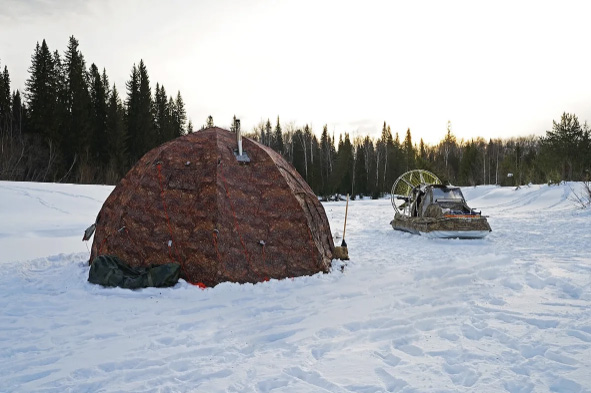
The single feature most separating a purpose-built all-season basecamp shelter from a three-season tent labeled as four-season is a factory-integrated stove jack. Without it, cold-weather use depends entirely on sleeping bag ratings and layering. Interior temperatures track ambient outdoor temperatures with only modest improvement from body heat. On a 10-degree night, that means retreating to sleeping bags at sunset and counting down to morning. With a functioning stove jack and a compatible heat source, the shelter becomes a heated room capable of sustaining comfortable temperatures regardless of what’s happening outside.
The Bereg UP-7 includes a stove jack with two diameter plates accommodating 80mm pipe diameter stoves, plus a removable heat-resistant wall where the stove sits inside the tent. This heat-resistant wall protects the inner Oxford fly from radiant heat, the safety and durability detail aftermarket patches lack. Positioning at the upper section of the dome, where the chimney effect of rising hot combustion gases creates a continuous airflow loop: fresh outside air enters through the bottom ventilation opening, warms as it rises, picks up interior moisture, and exits through the stove pipe. This simultaneously heats the space, manages condensation, and maintains CO dilution, three thermal management problems solved by a single integrated design feature.
In practice, running a wood stove through the UP-7’s stove jack on a Wyoming winter night converts the shelter into a true hot tent basecamp rather than a cold-weather survival calculation. The interior holds in the mid-50s to low 60s Fahrenheit with a moderate-output stove, warm enough to sit without a sleeping bag, cook a meal, and plan the next day’s activities as a group. That experience is categorically unavailable in a tent without stove integration, regardless of sleeping bag rating or insulation layering. For compatible stove options, our UP-7 setup and time-saver guide covers the full stove integration workflow and recommended pairings.
Setup Speed at Scale: Why 1 Minute Matters More on Trip 50 Than Trip 1
Setup speed is easy to undervalue when evaluating a tent from a spec sheet. The first time a camper pitches a new shelter, they’re invested in the process. By trip fifty, setup speed is a direct quality-of-camp metric. Every minute spent wrestling with pole sleeves in fading light or cold wind is a minute not spent on camp organization, fire-building, cooking, or recovery. For overlanders and hunters who move camp frequently, the cumulative effect of slow setup across a season is significant.
The Bereg UP-7’s hub-and-spoke umbrella frame is designed for single-operator one-minute deployment: the frame extends as a unit from the carry bag, locks into the dome position at each leg point, and is ready for the outer fly in under sixty seconds. There are no pole sections to thread, no shock cord loops to align, and no sequential assembly steps that require a second set of hands. The outer fly attaches via wide PVC Velcro fasteners connected directly to the frame, a system designed for operation in cold with gloves, in wind, and with the fine motor impairment that comes at the end of a long day.
For a long-term camping shelter used across many trips, this deployment speed compounds into meaningful time savings over a season. A shelter going from bag to livable in 60 seconds versus 20 minutes is not a minor convenience difference, it’s the difference between arriving at a late campsite and having camp organized before dark versus scrambling with headlamps. It’s also the difference between a shelter system that encourages frequent use and one that, over time, discourages moving camp because the setup cost is too high. The 1-minute deployment is a durability feature in the behavioral sense: it sustains the habit of using the shelter well across hundreds of trips.
Long-Term Basecamp Performance
Bereg UP-7: Built for Seasons, Not Weekends
10mm B95T1 aviation alloy frame, 1-minute deployment, 5×5m standing-room interior, integrated stove jack with heat-resistant wall, mini vestibule included. The long-term camping shelter for groups who camp seriously.
The Bereg UP-7: How It Meets the Long-Term Standard
| Long-Term Shelter Requirement | What to Look For | Bereg UP-7 |
|---|---|---|
| Frame alloy | 7000-series aluminum minimum; 10mm diameter for lateral stiffness | B95T1 / AA7075 aviation alloy, 10mm rods throughout |
| Frame geometry | Distributed load; no single-point failure axis | 8-leg hub-and-spoke dome; load distributed across all legs |
| Outer fly waterproofing | PU 3000+ for long-term durability; PU 4000 preferred | Oxford 300, PU 4000, highest baseline in the category |
| Wall construction | Double-wall with defined air gap; sealed seams both layers | Oxford 300/210 double-wall with air gap; factory-sealed seams throughout |
| Temperature rating | Materially supported to at least -25°C for all-season use | Rated -50°C to +30°C; materials support the claim |
| Interior volume | 7 ft+ center height; sufficient floor area for group + gear + heat source | 5×5×2.3m; 2.3m center height; 5–7 people with stove and beds |
| Stove integration | Factory stove jack with heat-resistant fabric and positioning at dome peak | Built-in stove jack (80mm plates), heat-resistant wall included |
| Setup speed | Under 5 min solo; operable in cold with gloves | 1-minute umbrella-frame deployment; Velcro fly attachments operable in gloves |
| Storage and livability | Vestibule, interior pockets, mesh shelf, multiple entry points | Mini vestibule included, mesh dome shelf, wall pockets, 2 entrances, spring hooks |
Pros and Cons
Pros
- B95T1 aviation alloy frame maintains ductility below -40°F, where standard aluminum becomes fracture-prone; 10mm diameter delivers lateral stiffness that thinner poles lack under sustained wind load
- Oxford 300 PU 4000 outer fly sets the highest waterproofing baseline in the class, extending the interval before DWR refreshes are needed and providing wider degradation margin over the shelter’s lifespan
- Double-wall air gap construction with factory-sealed seams on both layers addresses condensation and seam penetration, the two most common multi-day wet weather failure modes simultaneously
- 5×5×2.3m interior accommodates 5–7 people with stove and beds at a standing height that eliminates the postural fatigue of shorter shelters over multi-day camps
- Factory-integrated stove jack with heat-resistant wall converts the shelter into a heated basecamp in cold conditions, a categorically different experience from a cold tent at the same temperature
- 1-minute hub-and-spoke umbrella frame deployment requires no threading, no alignment, and no second pair of hands; operable in cold with gloves at the end of a long day
- Mini vestibule connector included in the package adds dedicated external storage that keeps the main sleeping space cleaner across multi-day camps
- Two separate entrances with mosquito nets allow independent access without disturbing the full group, a meaningful quality-of-life feature on extended camp stays
Cons
- At 35.6 kg (78 lbs), the UP-7 is exclusively a vehicle-based shelter; any camper evaluating this for backpacking or pack-in use is looking at the wrong product category
- Pricing is listed in Canadian dollars on Bereg Canada’s site; US buyers should verify the current CAD/USD exchange rate before purchasing, as the USD equivalent will differ from the listed price
- Insulated winter floor and PVC floor are sold separately; for sub-zero all-season basecamp use, the additional floor investment is practically necessary and adds to the total system cost
- Larger vestibule options (2×2m, 2×3m, 2×4m) are also sold separately; groups who want maximum covered entry and storage space need to budget for the full system rather than base tent price alone
- Sourcing through Bereg Canada means international shipping timelines from Nova Scotia to US destinations; planning ahead before a specific trip date is necessary
- The 5×5m footprint requires a substantially flat area of at least 20×20 feet; tight or rocky campsites that work for smaller tents will not accommodate the UP-7 without site preparation
Final Verdict

A great long-term camping shelter is not a tent with more marketing copy. It’s a shelter with verifiable material specifications, a construction method that addresses failure modes rather than papering over them, and an interior designed for genuine habitation rather than minimum weather survival. These features define this category: aviation-grade aluminum frames, double-wall construction with air gap insulation, PU 4000 or equivalent fabric ratings, factory stove jack integration, and 270+ square feet of standing-height interior volume. They are also the features that determine performance after two hundred nights rather than two.
The Bereg UP-7 meets every one of those standards with verifiable specifications and field-confirmed performance. Its B95T1 frame is the right alloy at the right diameter. Oxford 300 PU 4000 fabric on the outer fly provides a wide durability margin. Double-wall construction manages condensation and heat retention simultaneously. Stove jack integration converts the shelter from a weather barrier into a heated basecamp on cold nights, and 1-minute deployment makes extended use practical rather than punishing. For overlanders, hunters, and group campers seeking a four-season group tent that functions as a basecamp across all seasons and many years, the UP-7 delivers that in a single package.
The investment is serious: the base tent plus floor and vestibule accessories represents a meaningful gear budget. On the value side, the argument is equally strong: a shelter that delivers this performance level for ten or more seasons costs less per year than a succession of mid-grade tents, and it delivers a qualitatively better camping experience at every one of those camps. For campers whose outdoor use pattern justifies this class of shelter, the UP-7 is a long-term camping shelter in the fullest sense of the term.
Ready to Buy?
Check Pricing on the Bereg UP-7
Order through Bereg Canada, the authorized North American distributor. Includes mini vestibule connector, guy lines, stakes, and setup instructions. Pricing listed in CAD.
Frequently Asked Questions
What makes a shelter suitable for long-term camping?
A genuine long-term camping shelter needs four things: a frame alloy that resists cold-induced brittleness and fatigue over hundreds of pitch-and-pack cycles (7000-series aluminum or equivalent), double-wall construction with sealed seams that manages moisture across all seasons, interior volume sufficient for the group to function rather than only sleep, and a stove jack for heated shelter capability in cold-weather conditions. Without them, basecamp tent performance shows accelerating degradation over extended use in ways their initial pitch-and-pack performance doesn’t predict.
How many people does the Bereg UP-7 sleep?
The UP-7 accommodates 5–7 people with a wood stove and folding beds in a configured camp setup, or up to 14 in sleeping bags in a sleeping-only configuration. The 5×5×2.3 meter interior provides roughly 270 square feet of standing-height floor space. For extended multi-day camps where people need to move, cook, organize gear, and use a heat source inside, the 5–7 person with-stove configuration is the realistic operating capacity for a functional basecamp.
Is the Bereg UP-7 worth the price?
For campers who use a shelter this size regularly across multiple seasons, the long-term cost calculus is straightforward. A shelter built to last ten or more seasons amortizes its price into a per-year cost that compares favorably with replacing mid-grade alternatives every three to four seasons. The performance advantage compounds further: every camp with the UP-7 is a camp with proper heat integration, full standing room, and a frame that doesn’t flex visibly in wind, a qualitative difference that’s felt on every trip. For campers who go out four or five times a year in mild conditions, the investment doesn’t pencil out and the honest recommendation is a less expensive three-season dome.
What is the Bereg UP-7’s setup time?
The hub-and-spoke umbrella frame deploys in approximately one minute for an experienced operator: the frame extends as a unit, locks into dome position at each leg, and accepts the outer fly via wide Velcro fasteners designed for cold-weather gloved operation. There are no pole sections to thread or shock cord loops to align. For a first-time user, allow five to ten minutes on the initial pitch to learn the leg-locking sequence; by the second or third setup, one-minute deployment is realistic.
Does the Bereg UP-7 work in summer?
Yes. The UP-7 is rated from -50°C to +30°C, covering the full year-round range. In warm weather, the inner fly is removable to reduce weight and increase ventilation, and the two entrances with mosquito nets allow airflow while keeping insects out. The stove jack seals when not in use, and dome geometry with Oxford fabric handles sun exposure and heat buildup better than single-wall nylon tents in sustained summer heat, largely because the double-wall construction creates an insulating air gap between the outer fly and the inner sleeping space.
Heads up: Clicking on our affiliate links and exploring our sponsored content helps us at no extra cost to you, and we only recommend gear we’re absolutely crazy about!”