



Quick Facts:
- Product: EcoFlow DELTA Gen4 series, with the DELTA 3800 Gen4 and DELTA 3000 Gen4.
- Capacity: 3,763 Wh (3800) and 3,072 Wh (3000).
- Output: 3,600 W rated and 7,200 W surge on both models.
- Weight: 67.5 lb (3800) and 57.3 lb (3000).
- Truck charging: Needs the separate EcoFlow 800W Alternator Charger. EcoFlow limits this route to 500 W.
- Early-bird price: $1,699 (3800) and $1,299 (3000) at EcoFlow’s US site.
- Ships: Late November (3800) and early December (3000), per EcoFlow. No independent tests yet.
- Best for: Overlanders who want a large battery to move between a truck and camp.
6 min read
In This Article
Overview
The EcoFlow DELTA Gen4 gives you a 3.1 to 3.8 kWh battery to refill from your truck alternator, with one extra purchase. EcoFlow announced two models on November 4, 2026. Both list 3,600 W of output, and the company leads its press release with home backup.
However, truck use depends on a detail the press release leaves out. Alternator charging needs EcoFlow’s separate 800W Alternator Charger. EcoFlow’s product pages also limit charging power to 500 W through the solar/DC input when you use the charger. So plan on 500 W at most, not 800 W.
Neither unit has shipped in the US. EcoFlow lists the DELTA 3800 Gen4 for late November and the DELTA 3000 Gen4 for early December, so every spec below comes from the maker. For a tested look at an earlier model, read our EcoFlow DELTA 2 Max review after a year of use.
Need power before December? These earlier EcoFlow DELTA models are on Amazon today: the DELTA 2 Max, the DELTA Pro and the DELTA 3 Max.
Earlier EcoFlow DELTA power stations on Amazon today



EcoFlow DELTA Gen4 Key Specs at a Glance
| Specification | 3800 Gen4 | 3000 Gen4 |
|---|---|---|
| Capacity | 3,763 Wh | 3,072 Wh |
| Rated output and surge | 3,600 W and 7,200 W | 3,600 W and 7,200 W |
| Weight | 67.5 lb | 57.3 lb |
| Expansion | 4 to 12 kWh | None listed |
| Maximum solar input | 2,000 W | 1,000 W |
| Charging methods | Six | Four |
| Full AC recharge | Under 2.5 hours | Under 2 hours |
| Fridge runtime (EcoFlow test) | Up to 70 hours | Up to 58 hours |
| Early-bird price | $1,699 | $1,299 |
| Ships | Late November | Early December |
Both units draw 14 W with AC on and no load, and 3 W in standby, according to EcoFlow. EcoFlow’s release attributes its comparisons to internal testing from August 2026, so treat every figure as a maker claim.
EcoFlow DELTA Gen4 Alternator Charging in a Truck
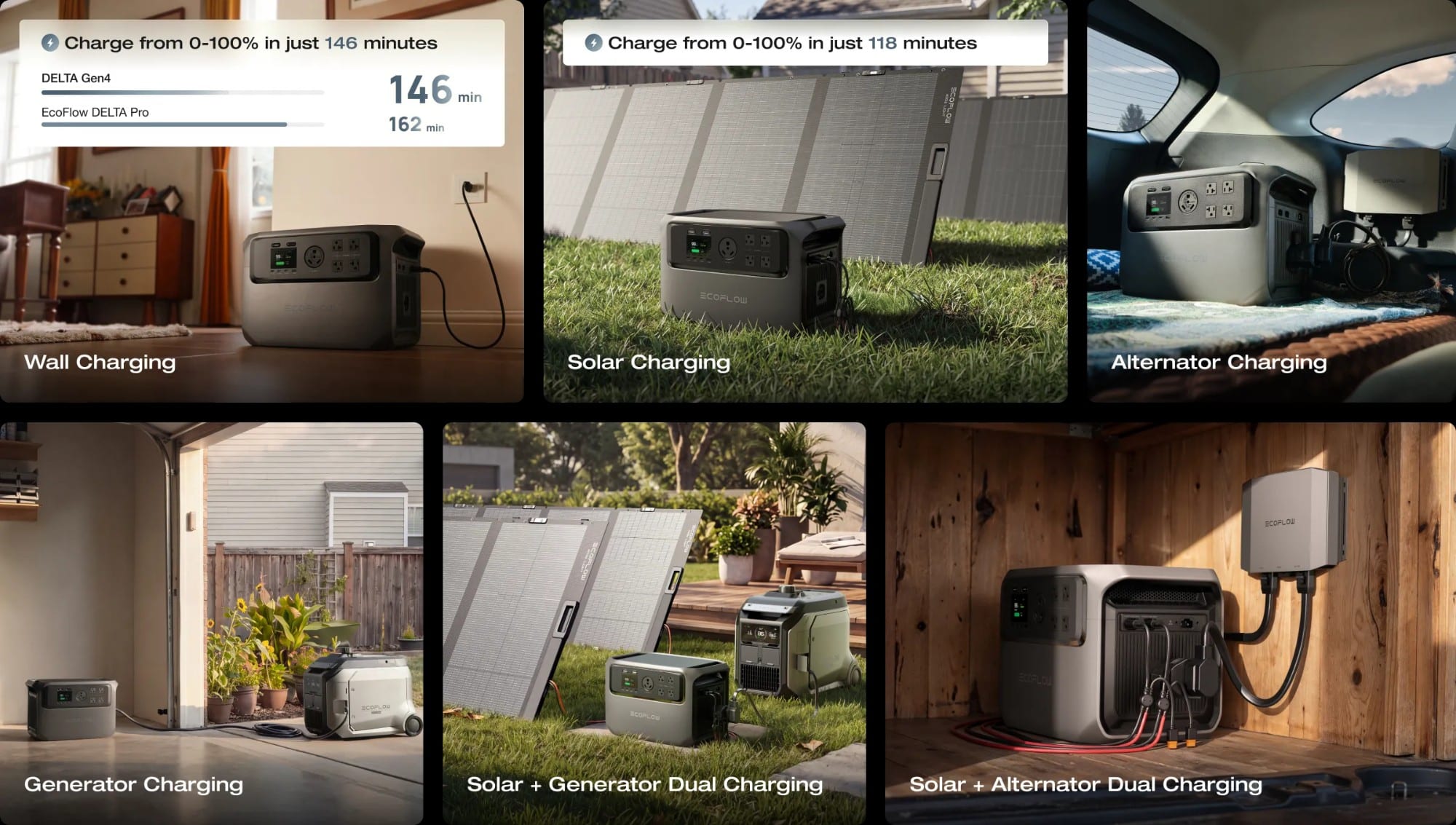
The charger connects to your truck’s electrical system and feeds the power station while the engine runs. Our DC to DC charger guide explains how a smart alternator treats a second battery.
The 3800 supports six charging methods, including alternator and solar together. Meanwhile, the 3000 supports four, so it skips charging from solar and alternator together. Also, the 3800 takes up to 2,000 W of solar through two inputs, while the 3000 takes 1,000 W through one. Our guide to sizing solar for overlanding covers the panel math.
Real-world charging speed is unknown, because no Gen4 owner has posted truck charging numbers yet. A Tacoma owner in an Expedition Portal thread worked out how much power a 130 A alternator has to spare: roughly 270 to 330 W at night or in bad weather, and about 500 W on a good day. This is one truck’s math from measured loads, not a charger reading. Until Gen4 owners post real numbers, I’d plan on roughly 300 to 500 W, not 800 W. At a steady 500 W, a full refill takes about 7.5 hours for the 3800 and about 6 hours for the 3000, before charging losses.
Owners of the earlier charger call the install simple. They describe a power and ground connection, with a thick cable through the firewall grommet as the hardest step. Many owners set a low-voltage cutoff near 12.5 to 13 V and report no drain on the starter battery, although a few report a dead battery.
Fridge Runtime, Heat and Mounting
EcoFlow rates the 3800 for up to 70 hours of refrigerator runtime and the 3000 for up to 58 hours, with Fridge Runtime Boost on. Those figures describe a home refrigerator, so a 12V camp fridge draws a different load. Our guide to 12V fridge sizing lists real daily draws.
EcoFlow lists charging from 32 to 113 °F and discharging from 14 to 113 °F for both models. Winter camps in a cold bed need a plan, because charging starts at 32 °F. In full sun, one owner measured bed temperatures in the 120s °F, above the 113 °F limit, so mount the unit in shade. One commenter on a DELTA Pro thread said the unit shut off above about 99 °F under moderate to high loads while charging. Our Goal Zero Yeti 3000X recall report explains why vehicle heat raises the stakes for any power station.
At 67.5 lb, the 3800 needs a two-hand lift into a bed. One owner of an earlier DELTA straps it to floor L-track. Others suggest dense foam underneath to absorb vibration. In contrast, the 57.3 lb 3000 is easier to carry from truck to camp.
DELTA 3000 Gen4 vs. 3800 Gen4
The 3000 costs $400 less at early-bird pricing and weighs 10.2 lb less. It also recharges from AC in under two hours. In contrast, the DELTA 3800 Gen4 adds 691 Wh, a second solar input and the combined solar plus alternator mode.
The 3800 also expands from 4 to 12 kWh with the DELTA Pro 3 or DELTA 3 Max Plus extra batteries. Pick the 3800 if you want solar and the alternator working together, or plan to add batteries. Choose the 3000 for the lighter unit at the lower price. For a weekend rig with a fridge and lights, either overland power station fits on paper.
A truck build needs more than the power station. Price out the EF ECOFLOW 800W Alternator Charger and the EF ECOFLOW 220W Portable Solar Panel first, and check compatibility with the DELTA Gen4 before you buy.
Truck build add-ons to price out


What the EcoFlow DELTA Gen4 Means for You
Both units sell at early-bird prices before they ship in the US, and no independent truck-charging tests have appeared. Early-bird saves $400 on the 3000 (regular $1,699) and $500 on the 3800 (regular $2,199). EcoFlow also lists 60-day price protection on eligible DELTA Gen4 orders from its own site, so read those terms before you pay.
Check three things before you order. First, decide where the unit rides, because heat and vibration shape the mount. Next, confirm your truck’s alternator output, since owners report speed varies by vehicle. Finally, budget for the charger and the install time, because the power station does not include the charger.
Final Thoughts
The EcoFlow DELTA Gen4 is an overland power station for people who move one big battery between a truck and camp. Personally, the alternator route is the reason I’m watching this launch, because owners of the earlier charger say it beats a 12V socket by a wide margin.
Still, weigh the trade-offs. The charger is an extra purchase, EcoFlow’s own page limits the alternator route to 500 W through the solar/DC input, and no truck measurements of the Gen4 have appeared. Early-bird pricing also means you pay before owners report real results.
Either way, wait for the first charging numbers from real trucks before you decide.
FAQ
Does the EcoFlow DELTA Gen4 charge from a truck alternator?
Yes, both models list alternator charging. You need EcoFlow’s separate 800W Alternator Charger to do it. EcoFlow notes the charging power is limited to 500 W through the solar/DC input with the charger.
How fast does the EcoFlow DELTA Gen4 charge from a truck?
Per EcoFlow, the route tops out at 500 W through the solar/DC input. One Tacoma owner calculated roughly 270 to 330 W of spare alternator power in poor conditions and about 500 W on a good day. No one has posted Gen4 truck charging numbers yet.
How much does the EcoFlow DELTA 3800 Gen4 weigh?
EcoFlow lists the 3800 at 67.5 lb. The 3000 weighs 57.3 lb. Both have dual side handles.
What is the difference between the 3000 and 3800 models?
The 3800 holds 3,763 Wh against 3,072 Wh and adds a second solar input. It also supports six charging methods and expansion to 12 kWh. The 3000 costs less and weighs less.
How long does the DELTA Gen4 run a fridge?
EcoFlow claims up to 70 hours for the 3800 and up to 58 hours for the 3000. Those numbers come from EcoFlow’s testing of a home refrigerator with Fridge Runtime Boost on. A camp fridge will differ.
Is the 3800 expandable?
Yes, EcoFlow lists 4 to 12 kWh of expandable capacity. The DELTA Pro 3 and DELTA 3 Max Plus extra batteries are compatible. EcoFlow lists no expansion for the 3000.
Related Reading