


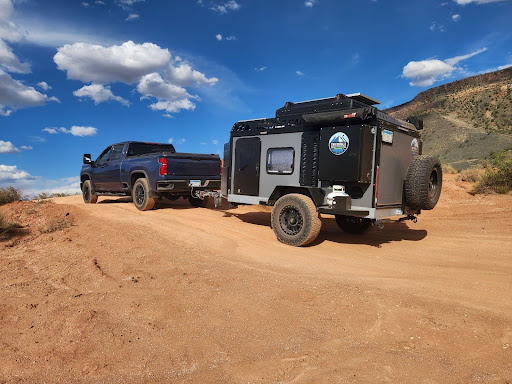

Tires get more of my attention than any other part of my rig. Because tires are the only part of a vehicle touching the trail, every decision about them shows up in ride quality, traction and how often you end up on the side of the road with a jack.
Trailer tires deserve the same research, although most owners never look past the brand on the sidewall. A trailer has no engine and no steering, so it asks different things of its tires. In this guide, you’ll learn how load range works, why matching your trailer tires to your tow vehicle simplifies spares, and where to start with trailer air-down pressures on dirt, rock and sand.
Quick Facts:
- Topic: Choosing and running off-road trailer tires
- Load Range C: 6-ply rating, 50 psi max on most LT tires
- Load Range E: 10-ply rating, 80 psi max on most LT tires
- Example size: LT285/70R17, about 33 inches tall
- Example load: 3,750 lbs max per tire for a Falken Wildpeak A/T4W in E load range
- Tire type: LT (light truck) tires suit most off-road trailers better than ST tires
- Skill level: Beginner
- Best for: Teardrop, squaredrop and expedition trailer owners
8 min read
In This Guide
- Why Off-Road Trailer Tires Matter
- Load Range at a Glance
- How to Pick a Trailer Tire Load Range
- LT vs. ST Off-Road Trailer Tires
- Matching Trailer Tires to Your Tow Vehicle
- Trailer Air-Down Pressure: Where to Start
- Load Range C vs. Load Range E
- Pros and Cons of Running Heavier Tires
- Final Verdict
- Frequently Asked Questions
Why Off-Road Trailer Tires Matter

Off-road trailer tires carry the whole camp over rocks, ruts and washboard, with no driver feeling each hit. On your tow rig, you notice a soft tire through the steering wheel. In contrast, a trailer tire fails quietly behind you until the sidewall gives out.
The right tire balances three numbers: load capacity, pressure and size. Get the load range wrong, and the tire either overheats or rides like a brick. Pick the wrong size, and your spare stops working for half the convoy.
Modern overland trailers ship with truck-grade rubber. For example, the Iron Peak XTR-10 rolls on Falken Wildpeak LT285/70R17 tires with a matching front-mounted spare. Read how the XTR-10 compares to other off-road trailers for a closer look at its running gear.
Load Range at a Glance
Load range is a letter on the sidewall telling you how much air the tire holds and, as a result, how much weight it carries. The chart below covers the common LT load ranges.
| Load Range | Ply Rating | Typical LT Max Pressure |
|---|---|---|
| C | 6-ply | 50 psi |
| D | 8-ply | About 65 psi |
| E | 10-ply | 80 psi |
| F | 12-ply | About 80 to 95 psi |
Ply rating describes strength, not a literal count of layers. Modern radials use fewer, stronger plies, while the rating carries over as a strength comparison.
Truck-Grade Running Gear
Meet the Iron Peak XTR-10
Falken Wildpeak LT285/70R17 tires, 17-inch aluminum wheels and a matching front-mounted spare come standard.
How to Pick a Trailer Tire Load Range
Pick a trailer tire load range by starting with your trailer’s loaded weight, not its dry weight. Dry weight leaves out water, food, gear and propane. Weigh the loaded trailer at a truck scale, then subtract the tongue weight to find what the axle carries.
Run the Math on Your Own Trailer
Here’s an example using published numbers. The XTR-10 weighs 2,110 lbs dry with a 260-lb tongue weight. Its 38-gallon water tank adds about 317 lbs when full, since water weighs about 8.34 lbs per gallon. Add 300 lbs of gear, and the trailer lands near 2,730 lbs.
Subtract roughly 300 lbs of loaded tongue weight, and the two tires share about 2,430 lbs. Consequently, each tire carries around 1,215 lbs. A Falken Wildpeak A/T4W in LT285/70R17 rates 2,755 lbs in load range C and 3,750 lbs in load range E, per TireSize’s spec chart. Either one covers the load with a wide margin.
When Load Range E Earns Its Place
Load range E makes sense on heavier trailers, for sharp rocky roads, or when you want the trailer to share spares with an E-rated truck. Its stiffer sidewall resists punctures from shale and lava rock. However, on a light trailer, an E tire at full pressure rides harshly and bounces cargo. You’ll fix this with lower pressure, which the air-down section covers. For a sense of how weight changes between models, see our XTR-6 vs. XTR-10 comparison.
LT vs. ST Off-Road Trailer Tires
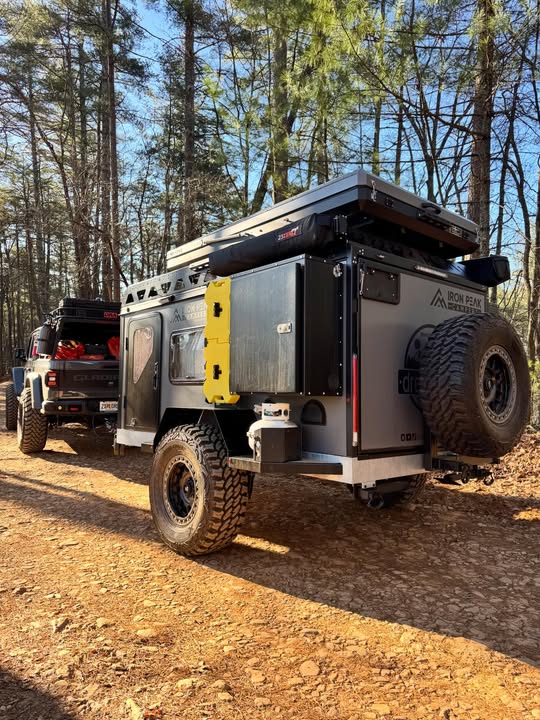
Most off-road trailer tires on premium rigs carry an LT prefix, for light truck. ST tires, short for special trailer, show up on utility and highway campers. Each type suits a different job.
Where ST Tires Fall Short Off-Road
ST tires use stiff sidewalls built for straight-line highway towing. Many carry a 65 mph speed rating, so check the sidewall before a long freeway run. Also, ST tread patterns rarely match an all-terrain truck tire, which rules out sharing spares with your tow rig.
Why LT Tires Fit Overland Trailers
LT all-terrain tires bring aggressive tread, cut-resistant sidewalls and a wide choice of sizes. For instance, the E-rated Falken Wildpeak A/T4W in LT285/70R17 carries a 112 mph speed rating and 18/32-inch tread depth. Therefore, LT tires handle both freeway miles and rocky two-tracks without a compromise on either end.
Matching Trailer Tires to Your Tow Vehicle
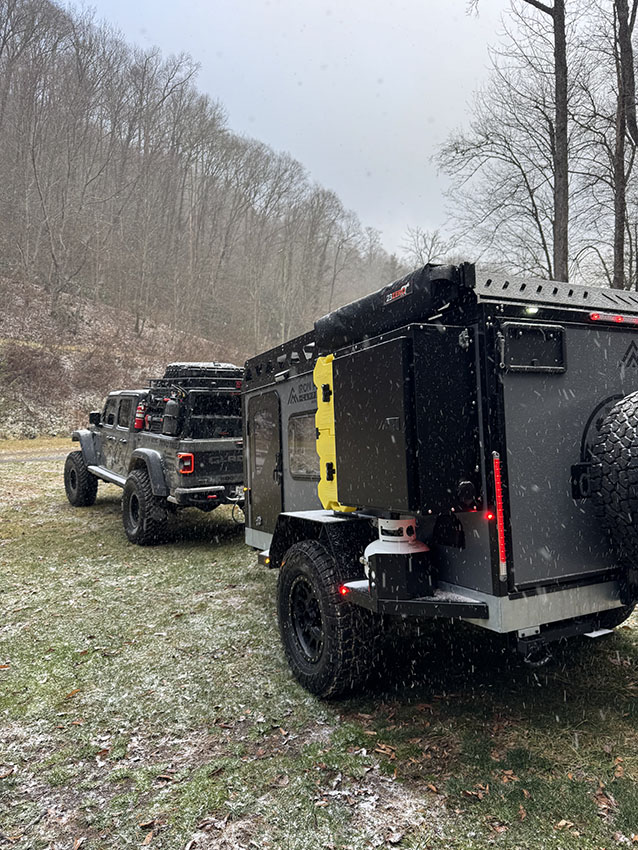
Matching trailer tires to your tow vehicle means running the same tire size, and ideally the same bolt pattern. When both match, one spare covers every wheel in the convoy. On a long backcountry trip, this matters more than any other tire choice.
Size Is Only Half of the Match
Tire size alone isn’t enough. If the trailer’s wheels use a different bolt pattern than your truck, a matching tire still won’t mount. Specifically, check three things: bolt pattern, center bore and wheel offset. Then confirm the spare clears your brakes and suspension on both vehicles.
The Gladiator and Wrangler Example
Jeep fits Rubicon trims of the Gladiator and Wrangler with LT285/70R17 tires from the factory. As a result, an XTR-10 pairs well with a stock Rubicon on tire size. Notably, the XTR-10 page doesn’t list its wheel bolt pattern, so ask Iron Peak before you count on one shared spare.
From experience: When I moved my Gladiator to 35-inch Milestar Patagonia A/T Pro tires, I learned how fast a tire change ripples through a setup. Spares, gearing and trailer matching all shift. Before you upsize your truck, decide whether you still want one spare to fit the trailer too.
Trailer Air-Down Pressure: Where to Start

Trailer air-down pressure follows the same logic as your truck, with one big difference: the trailer carries less weight per tire. Because of this, trailer tires at truck pressures ride stiff and beat up the cargo. Lowering pressure lengthens the contact patch, softens the ride and protects gear inside the cabin.
Start From the Tire Maker’s Load Table
Every tire maker publishes a load and inflation table. Find the pressure matching your per-tire weight, then treat it as your highway number. For example, a tire carrying 1,215 lbs needs far less than the 80 psi max of an E-rated tire.
Use the 4 PSI Rule on the Highway
Next, check your highway setting with the 4 psi rule. Set cold pressure, drive about an hour, then measure again. A rise of about 4 psi means the setting is close. In contrast, a bigger rise means the tire is too soft, and a smaller rise means it’s too firm.
Trail Starting Points
On dirt, drop about 25 to 35 percent below your highway pressure as a starting point. For rock and deep sand, go lower in small steps. Since trailers have no steering or drive torque, you’ll rarely need the low numbers used on a tow rig. Always air back up before pavement.
Safety note: Never tow on pavement or at highway speed with aired-down trailer tires. Low pressure builds heat fast and leads to sidewall failure. Carry a compressor and reinflate before you leave the dirt.
Buy Direct From Iron Peak
A Trailer Built on Truck Tires
The XTR-10 pairs Cruisemaster independent suspension with 33-inch all-terrain tires and 22 inches of ground clearance.
Load Range C vs. Load Range E
Load range C wins on ride and weight for light trailers. The C-rated Falken Wildpeak A/T4W in LT285/70R17 maxes out at 50 psi and 2,755 lbs. Meanwhile, its softer sidewall flexes over rocks with less bounce.
Load range E wins on toughness and flexibility. It handles heavier loads, resists sidewall cuts and shares spares with most E-rated trucks. However, you’ll run it well below its 80 psi max on a light trailer.
Pick C if your trailer stays under about 3,000 lbs loaded and you mainly drive graded roads. On the other hand, pick E if you tow rocky routes, run a heavy build, or want one spare for truck and trailer.
Pros and Cons of Running Heavier Tires
Pros
- E-rated LT285/70R17 carries up to 3,750 lbs per tire
- Stiffer sidewalls resist rock cuts
- Shares spares with most E-rated trucks
- 112 mph speed rating on the A/T4W E version
- 18/32-inch tread depth for long tread life
Cons
- Harsh ride on a light trailer at full pressure
- About 65 lbs per tire for the LT285/70R17 size
- Costs more than C-rated or ST tires
- Needs careful pressure tuning to avoid bouncing cargo
Final Verdict
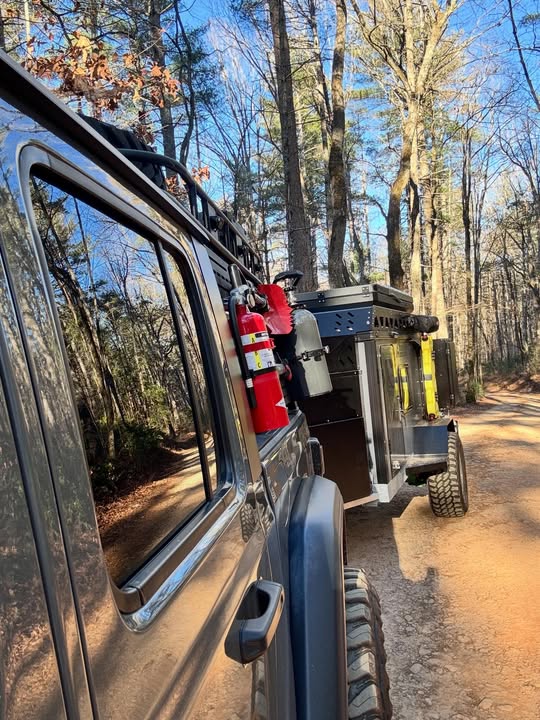
The best off-road trailer tires match your trailer’s real weight, your route and your tow vehicle. For most overland trailers, an LT all-terrain tire beats an ST tire on tread, toughness and spare sharing. Its biggest strength is flexibility on and off the pavement.
The trade-off is ride quality on light builds. An E-rated tire at truck pressure shakes a light trailer, so you’ll need to tune pressure. Owners of small utility trailers on graded roads should look at C-rated LT tires instead.
On value, a matched size pays for itself. One shared spare saves you from carrying two, and it frees up weight and space. Meanwhile, a scale ticket costs little and settles the load range question in minutes.
My recommendation: weigh the trailer loaded, pick the load range from the tire maker’s table, and match your tow vehicle’s size where possible. For more on why owners choose a trailer built around truck-grade parts, read five reasons buyers pick the XTR-10.
Ready to Tow Farther?
Start Your Iron Peak XTR-10 Build
Configure an XTR-10 with a matching spare, independent suspension and an articulating hitch.
Frequently Asked Questions
What load range should off-road trailer tires be?
Most light overland trailers run fine on load range C or E LT tires. Weigh your loaded trailer, divide the axle weight by two, and pick a tire rated well above this number. Choose E for rocky routes or to share spares with an E-rated truck.
Are LT or ST tires better for an off-road trailer?
LT tires suit most off-road trailers better. They offer all-terrain tread, tougher sidewalls and sizes matching common tow vehicles. ST tires work best on highway utility trailers.
Should trailer tires match the tow vehicle?
Matching trailer tires to your tow vehicle lets one spare cover both. Match the tire size, bolt pattern, center bore and offset. Size alone won’t make a spare swap work.
How much should you air down trailer tires?
Start about 25 to 35 percent below your highway pressure on dirt, then adjust in small steps. Trailers carry less weight per tire than trucks, so they rarely need extremely low pressures. Always reinflate before pavement.
What is the 4 psi rule for tires?
Set cold pressure, drive about an hour, then check again. A rise of about 4 psi means the setting is close. A larger rise means the tire is too soft, while a smaller rise means it’s too firm.
A quick heads-up: If you snag something through our affiliate links or check out our sponsored content, we might earn a commission at no extra cost to you. But fear not, we’re all about recommending stuff we’re truly stoked about!