


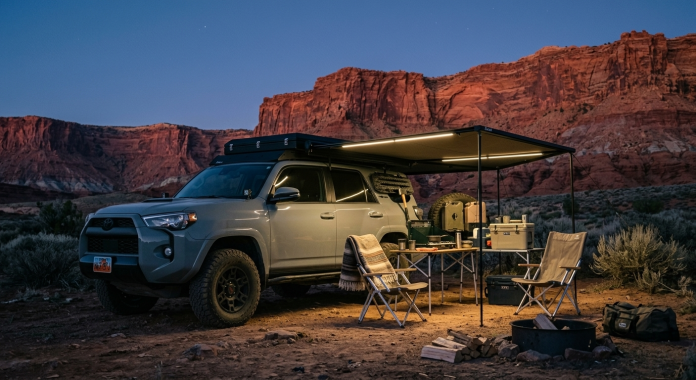

Quick Verdict: Three numbers decide whether your campsite lighting works or fails after dark: lumens for brightness, Kelvin for color temperature, and amp draw for battery runtime. Most overlanders over-buy on lumens and under-plan for power draw. A 24-inch to 36-inch 12V LED strip with tri-color modes and an IP67 rating covers roughly 90% of camp scenarios, typically priced $73 to $96.
Key Takeaways
- Target 300 to 600 lumens for ambient awning light, 500 to 1,000 lumens for cooking and task work, and 100 to 200 lumens for reading inside a tent.
- Choose 2700K to 3000K warm white for camp dinners, 5000K cool white for task visibility, amber around 590 nanometers to reduce bugs, and red at 620 to 700 nanometers for night vision.
- Expect 0.5 to 1.2 amps per meter of draw at 12V. A typical 36-inch tri-color strip pulls roughly 1 amp at full brightness and 0.5 amp at 50% dimming.
- Pick IP65 as the minimum rating for outdoor use and IP67 for overland rigs facing stream crossings, heavy rain, or desert dust.
- A 100Ah lithium battery with a 100W solar panel runs two 36-inch strips at full brightness for roughly 40 hours of real-world use, enough for four to five evenings of camping.
Last updated: April 18, 2026 | By Alex Schult | 9 min read
In This Guide
- Why Campsite Lighting Specs Matter for Overlanders
- Four Campsite Lighting Specs Worth Learning
- Lumens: How Bright Is Bright Enough?
- Color Temperature: Warm, Cool, and Amber
- 12V Power Draw and Battery Runtime
- Why Amber and Red Light Pull Fewer Bugs
- Strip Lights vs Lanterns vs Pod Lights
- Pros and Cons of a 12V Campsite Lighting Setup
- Final Verdict
- Frequently Asked Questions
Why Campsite Lighting Specs Matter for Overlanders
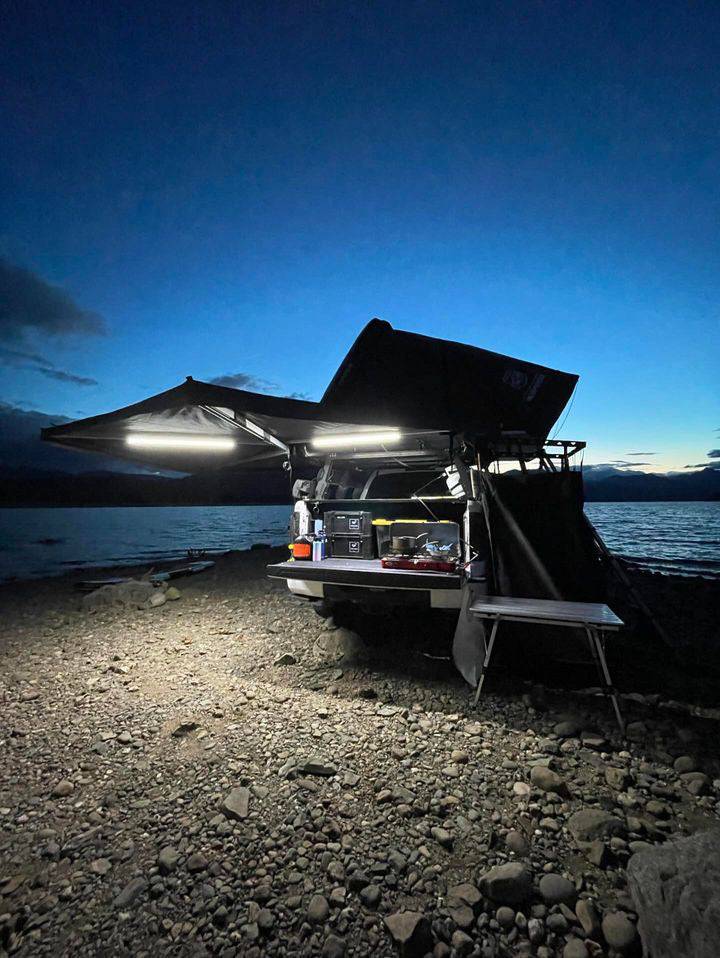
Your campsite lighting setup turns on three specs most overlanders skip during a purchase: lumens, color temperature in Kelvin, and amp draw at 12V. As a result, ignoring those numbers leads to two common failures. First, you drain a leisure battery halfway through a week-long trip. Second, you end up with a 2,000-lumen work light pointed at your dinner when a soft ambient glow would serve you better.
Overlanders and off-road campers build an overland lighting setup around different constraints than car campers. For example, a rooftop tent owner with a 100Ah dual battery and a 100-watt solar panel has a different power budget than a weekend camper relying on AA-powered lanterns. Similarly, a 270-degree awning needs even, diffused light along 10 to 12 feet of fabric, while a single pod light works better over a tailgate kitchen.
Notably, two main approaches dominate the overland lighting market. First, battery-powered lanterns offer portability and no wiring hassle. In contrast, hardwired 12V LED strip lights and pod lights offer longer runtime, even diffusion, and dimming control. Pricing runs from $45 for a single pod light to $231 for a complete 270-awning kit.
Below, four campsite lighting specs matter before your next gear purchase: lumens, Kelvin, amp draw, and IP rating. Each one decides how your camp looks, feels, and runs after sundown.
Four Campsite Lighting Specs Worth Learning
Here are the four specs every campsite lighting buyer should understand before clicking “add to cart.” Every column below matters for a different reason, and skipping any one of them leads to regret at 9 p.m. on a cold Utah canyon night.
| Spec | What It Measures | Target Range | Why It Matters |
|---|---|---|---|
| Lumens | Total light output | 300-600 ambient, 500-1,000 task | Perceived brightness |
| Color Temp (Kelvin) | Warm vs cool tone | 2700K-3000K warm, 5000K cool | Mood and bug attraction |
| Amp Draw | Current pulled per length | 0.5-1.2A per meter at 12V | Battery runtime |
| IP Rating | Water and dust resistance | IP65 minimum, IP67 preferred | Weather survival |
Featured Partner: GoFluxx
Tri-Color LED Strip, IP67, Dimmable at the Switch
White, red, and amber modes in a single anodized aluminum track. Named Best in Class Camp Illumination 2025 by 4wdTalk.
Lumens: How Bright Is Bright Enough?
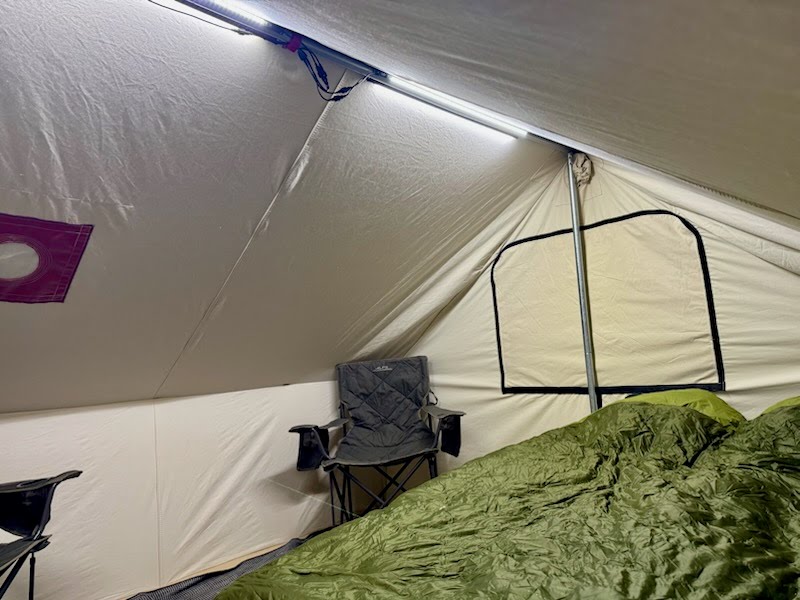
Lumens measure total light output from a source. For example, a candle produces about 12 lumens. By comparison, a standard 60-watt incandescent household bulb outputs roughly 800 lumens. Within campsite lighting specifically, your camp light lumens target shifts based on the task at hand. Specifically, reading inside a tent wants only 100 to 200 lumens. Meanwhile, ambient awning light lands between 300 and 600 lumens. In addition, cooking or detailed task work calls for 500 to 1,000 lumens. Finally, a full work light for trailside repair starts at 1,000 lumens and climbs fast.
Most overlanders make the same mistake when shopping: they pick the highest lumen rating on the page. However, a 2,000-lumen point source creates harsh hotspots and deep shadows across your camp. Instead, 400 to 600 evenly diffused lumens along a 24-inch aluminum-channel LED strip delivers a softer, more useful glow for most camp activities. Additionally, diffused light reduces eye strain when you move between bright spots and darkness.
For comparison, camp light lumens on portable lanterns typically range from 150 on budget models to 1,500 on top-end rechargeables. Similarly, LED camping lights wired to 12V usually come in 300 to 1,000-lumen strip lengths, depending on LED density and total length. For a 270-degree awning, two 36-inch tri-color strips running at 50% dimming deliver enough brightness for cooking without washing out the stars.
Color Temperature: Warm, Cool, and Amber
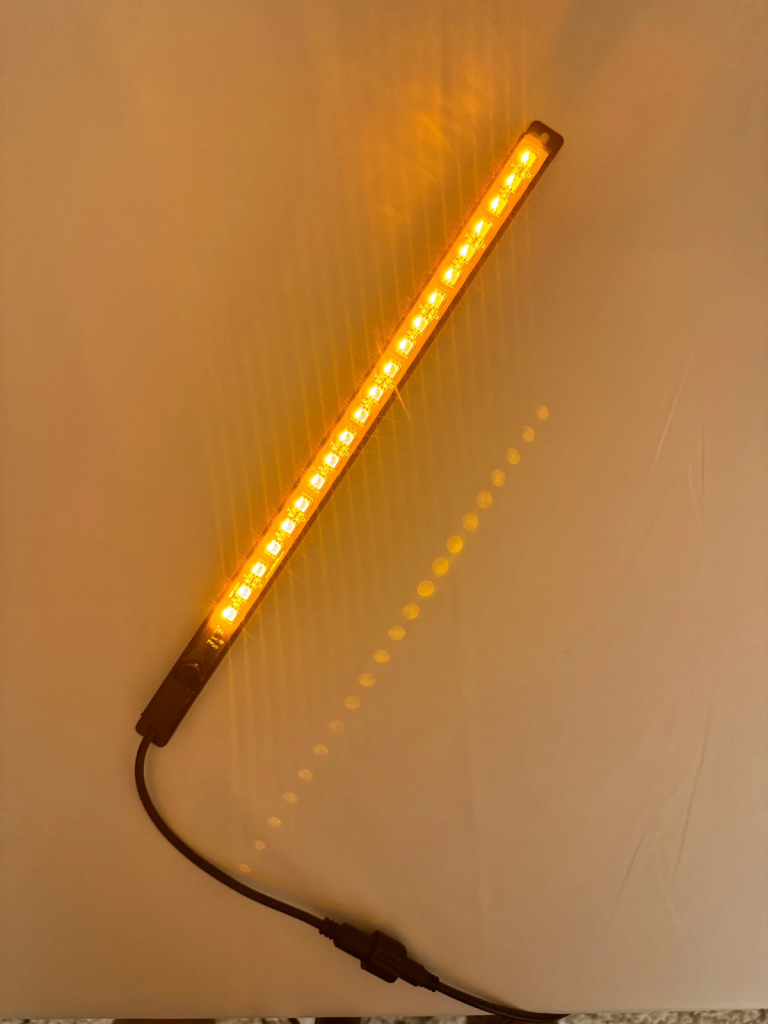
Color temperature, measured in Kelvin, describes the tone of light your fixture throws. Specifically, warm white sits at 2700K to 3000K and looks similar to incandescent bulbs. Meanwhile, neutral white lands around 4000K. In contrast, cool white (also called daylight) runs from 5000K to 6500K and reads as blue-tinted. Notably, amber sits outside the white-light Kelvin scale at roughly 590 nanometers of wavelength, producing a yellow-orange glow.
For campsite lighting, each temperature suits a different scenario. Specifically, warm white at 2700K feels more comfortable around a fire and a camp dinner. However, cool white at 5000K improves visibility for cooking, map reading, and mechanical work at 11 p.m. in the middle of the desert. Additionally, amber earns its spot for two reasons: bug reduction (covered next) and night-vision preservation when you step away from camp to look at the sky.
Tri-color fixtures solve the single-temperature limitation. Models like the GoFluxx tri-color strip cycle between white, red, and amber at the switch. Therefore you pick the mode based on what you are doing, not what you bought three months ago. Additionally, a dimmer on the flagship version adjusts brightness from 10% to 100%, which matters more than raw lumen output for real-world use.
Complete Awning Kit
GoFluxx 270 Awning Kit, Tricolor 36in
Strip, switch, wiring, and mounting hardware for a 270-degree awning. One install, three color modes, IP67 sealed.
12V Power Draw and Battery Runtime
Power draw is the spec most overlanders underestimate. The basic math: amps pulled by your lighting load multiplied by hours equals amp-hours consumed. For example, a typical 12V SMD LED strip pulls between 0.5 and 1.2 amps per meter at full brightness. A typical 36-inch (roughly 0.9-meter) tri-color strip in white mode pulls around 1 amp at 100% output. Conversely, dimmed to 50%, the same strip pulls closer to 0.5 amps.
Now apply those numbers to a real overland setup. Suppose you run a 100Ah lithium leisure battery at a dry camp. You light a 270-degree awning with two 36-inch strips, so total load lands around 2 amps at full brightness. Theoretical runtime comes out to 50 hours, though you should never drain a lithium below 20% state of charge. In practice, runtime lands closer to 40 hours, which covers four to five evenings of camping at five hours per night.
Solar replenishment changes the math. For example, a 100-watt panel outputs roughly 5 amps at midday peak. Over six solid hours of sun, solar returns 30 amp-hours to the battery, more than enough to offset a full night of strip lighting. Consequently, most overlanders running 12V LED strip lights with any solar setup stay well ahead of their lighting load during multi-day trips.
Budget calculation shortcut: add up amps for every light on your rig, multiply by hours of nightly use, then compare to battery capacity. If lighting alone uses more than 30% of your usable battery per night, you need a bigger battery, solar input, or fewer lights running at once. For more detail on sizing your electrical system and light inventory, see our Camping Lights Buyer’s Guide.
Why Amber and Red Light Pull Fewer Bugs
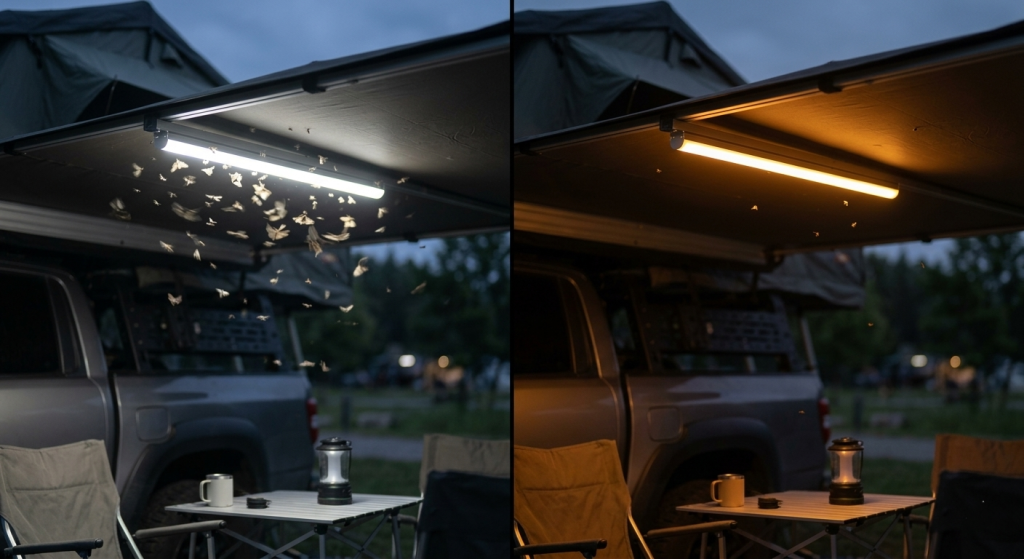
Insect attraction to artificial light depends on wavelength. Specifically, entomology research consistently shows flying insects respond most strongly to ultraviolet light around 350 nanometers and blue light around 450 nanometers. Therefore, white LEDs, especially cool-white 5000K to 6500K fixtures, emit significant blue-spectrum light and pull bugs toward your camp. In contrast, amber LEDs at roughly 590 nanometers fall outside the short-wavelength attraction zone, so they pull noticeably fewer bugs.
Red LEDs at 620 to 700 nanometers attract the fewest insects of any common color. Notably, the same red wavelength preserves night vision better than any other color, because the human eye takes 20 to 30 minutes to fully dark-adapt after exposure to white light. For these reasons, tri-color strips with amber and red modes solve two problems at once. Switch to amber when mosquitoes arrive at dusk. Flip to red when you need to walk away from camp without destroying your dark-adapted eyes. For a deeper breakdown of color selection for off-road applications, see the 4wdTalk lighting library.
Strip Lights vs Lanterns vs Pod Lights
Three lighting types dominate the overland camp market. First, LED strip lights mount inside an awning or along a rooftop tent rail and create even, diffused illumination across 24 to 36 inches or more. Consequently, they work best for ambient coverage and cooking prep. Second, lanterns are portable, battery-powered, and produce point-source light ideal for a picnic table or tent interior. Third, pod lights, also called rock or dome lights, throw directional light from a single fixture and suit accent lighting, wheel wells, or a tailgate kitchen.
Price points differ as well. Premium tri-color strip lights run $54 for a 12-inch to $96 for a 36-inch, while rock pod lights land around $45 each. A full awning kit with mounting hardware, switches, and strips costs $149 to $231 depending on length and features. Lanterns range from $20 for budget models to $150 for top-tier rechargeables. For an overland rig, a layered overland lighting setup using strips for ambient, pods for task, and one lantern for portability covers every scenario. See our best camping lanterns roundup for portable options worth adding to the mix.
Pros and Cons of a 12V Campsite Lighting Setup
Pros
- Even, diffused light over 24 to 36 inches with no hotspots
- Tri-color modes handle task, ambient, and bug-reduction scenarios
- Low amp draw (0.5 to 1.2A per meter at 12V) supports multi-day trips
- IP67 sealing survives rain, dust, and stream splashes
- Dimming control adjusts output from 10% to 100% for exact scene matching
- Flexible mounting options fit awnings, rooftop tents, and trailers
- No battery swaps and no nightly recharging routine
Cons
- Requires 12V wiring and switch installation
- Not portable once mounted to awning or rail
- Higher upfront cost ($54 to $231 depending on setup)
- Draws from your house battery, so power planning matters
- Replacement requires more work than swapping lantern batteries
Final Verdict
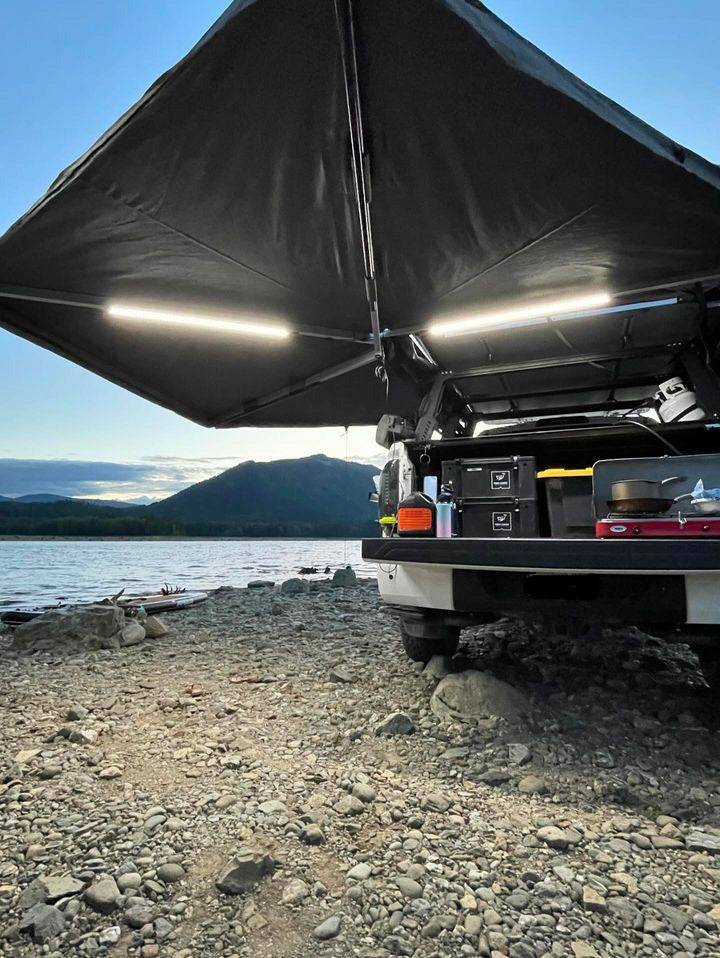
Campsite lighting rewards overlanders who plan around the four specs covered here: lumens, Kelvin, amp draw, and IP rating. If you run a rooftop tent, dual battery, and a 270-degree awning, a tri-color 12V LED strip at 24 to 36 inches gives you even light, scene flexibility, and a power draw you will measure in tens of amp-hours per week rather than per night.
Overlanders still relying on AA lanterns or single-temperature LED pucks will feel the upgrade immediately. However, if you camp mostly solo in a ground tent without a dual battery, a high-quality rechargeable lantern at 600 to 800 lumens handles most needs without any wiring work. Pick the tool for your actual use pattern, not the most feature-rich option on the page.
Value-wise, a $96 tri-color dimming strip earns its cost within a dozen trips. By contrast, a $40 lantern needs replacement every two years on average and pulls bugs toward your face all summer.
For buyers ready for a hardwired system, GoFluxx tri-color dimming strips pair IP67 sealing with anodized aluminum tracks and White/Red/Amber modes, which 4wdTalk named Best in Class Camp Illumination for 2025. Also review our full GoFluxx Lighting Review and the GoFluxx Camp Lighting Setup Guide for wiring diagrams and mounting layouts.
Ready to Light Your Camp?
Shop GoFluxx Camp Lighting
Tri-color strips, rock pod lights, and complete awning kits built for overland rigs. Free shipping on orders over $100.
Frequently Asked Questions
How many lumens do I need for campsite lighting?
For ambient awning light, target 300 to 600 camp light lumens across a diffused strip. When cooking or handling detailed task work, step up to 500 to 1,000 lumens. Meanwhile, reading inside a tent needs only 100 to 200 lumens. Higher lumen numbers are not always better, because a 2,000-lumen point source creates harsh shadows at 10 feet and wastes battery capacity.
What color temperature is best for camping?
No single temperature wins every scenario. Specifically, warm white at 2700K to 3000K feels cozy for camp dinners and relaxed evenings. However, cool white at 5000K improves task visibility for cooking and mechanical work. Meanwhile, amber light around 590 nanometers reduces bug attraction, and red light preserves night vision. Notably, tri-color fixtures solve the trade-off by letting you switch color at the switch.
Does color temperature attract bugs?
Yes. Flying insects respond most to ultraviolet light near 350 nanometers and blue light near 450 nanometers. Therefore, cool-white LEDs emit more blue-spectrum light and pull more bugs. In contrast, amber LEDs at 590 nanometers and red LEDs at 620 to 700 nanometers attract noticeably fewer insects, according to consistent entomology research.
How much power do LED camping lights draw?
Typical 12V LED strip lights pull 0.5 to 1.2 amps per meter at full brightness. For example, a typical 36-inch tri-color strip in white mode draws approximately 1 amp at 100% output. Dimmed to 50%, the same strip pulls closer to 0.5 amps. In contrast, rechargeable lanterns vary widely based on battery size and output mode.
What IP rating do I need for outdoor lighting?
IP65 is the minimum for outdoor use and protects against dust and low-pressure water jets. However, IP67 is preferred for overland use, because it seals against dust entirely and handles temporary immersion up to 1 meter for 30 minutes. Notably, stream crossings, heavy rain, and desert dust storms all warrant IP67 or higher.
Will 12V LED strip lights run from a portable power station?
Yes. Most portable power stations include a 12V cigarette-plug outlet rated for 8 to 10 amps. A 36-inch tri-color strip drawing 1 amp runs for roughly 100 hours from a 1,000Wh power station, assuming no other loads. For an overland rig, a hardwired leisure battery still delivers more consistent long-term runtime than a portable unit.
About the Author
Alex Schult grew up camping and today runs 4wdTalk as its founder and editor. He has logged years of hands-on overland travel across the American West and personally tests camp lighting, recovery gear, and rooftop tent systems for the site. His reviews are grounded in real trail use rather than spec-sheet comparisons. Connect with Alex on the About page or through 4wdTalk Contact.