


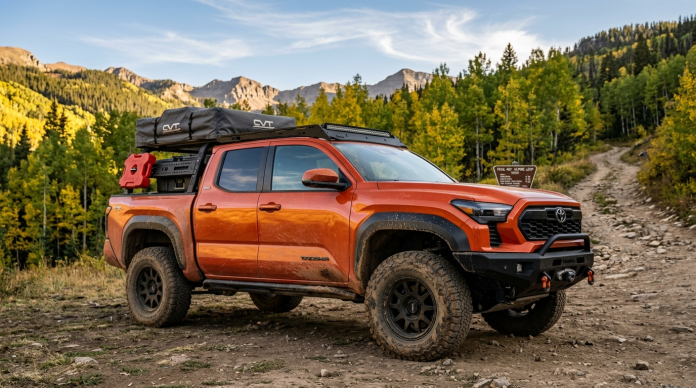

Quick Verdict: Overland truck accessories pay off in a specific order. Start with all-terrain tires, a 2 to 3-inch lift, and rock sliders for roughly $2,000 to $4,500 combined. Next, add recovery gear, off-road lighting, and onboard power before a rooftop tent. Boss Lighting’s Slim Series and Excel Cube 4 pods lead the lighting category with 7,000 to 28,000 lumens and patented flow-through cooling tech.
Last updated: April 2026 | 10 min read
In This Guide
- How to Prioritize Overland Truck Accessories
- Key Specs at a Glance
- Foundation Overland Truck Accessories: Tires, Lift, and Protection
- Recovery Gear Every Overland Rig Needs
- Off-Road Lighting Built for Overland Trucks
- Power, Storage, and Sleep
- Communications and Air Tools
- Vehicle-Specific vs Universal Accessories
- Pros and Cons
- Final Verdict
- Frequently Asked Questions
How to Prioritize Overland Truck Accessories
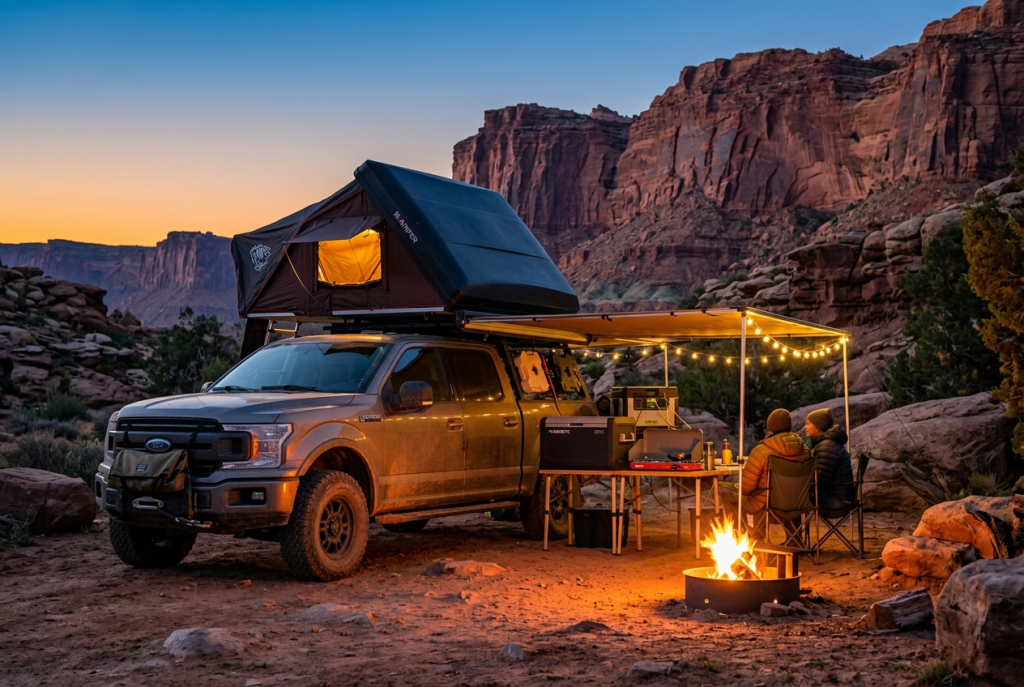
Most first-time overland truck owners spend $5,000 before their rig sees a trail, and a large share of the budget funds gear they rip out within a season. The aftermarket catalog for overland truck accessories runs thousands of SKUs deep, so new builders routinely start with the wrong pieces. This guide ranks the 12 upgrades by priority, so your first dollars fund real trail capability instead of photogenic parts replaced after one trip.
We built this sequence around three outcomes. First, go-anywhere capability: tires, suspension, and underbody protection. Second, self-rescue readiness: winches, recovery boards, and proper lighting. Finally, comfort for multi-day trips: power, storage, and sleep. Follow the order and a stock truck matures into a complete overlanding truck setup without wasted spend.
The 4wdTalk editorial team has tracked overlanding accessories for years. Editor Jason Hall has been researching off-road lighting for more than a decade and walked the booths at Overland Expo, where he saw Boss Lighting’s output firsthand.
His assessment: build order matters as much as brand selection. Overlanding accessories perform best when chosen as a system, and a good overland gear list treats lighting, tires, and recovery as interconnected purchases rather than a pile of one-off parts.
Key Specs at a Glance
| Upgrade | Typical Price Range | Priority Tier |
|---|---|---|
| All-terrain or mud-terrain tires | $1,200 to $2,400 per set | Foundation |
| 2 to 3-inch suspension lift | $1,500 to $3,500 installed | Foundation |
| Rock sliders and skid plates | $800 to $2,000 | Foundation |
| Winch (9,500 to 12,000 lb) | $500 to $1,800 | Recovery |
| Recovery boards and kinetic rope | $300 to $600 | Recovery |
| Off-road lighting (bar + pods) | $500 to $2,500 | Recovery |
| Dual battery or auxiliary power | $400 to $1,200 | Comfort |
| Bed rack or drawer system | $600 to $2,500 | Comfort |
| Rooftop tent or ground sleep setup | $400 to $4,000 | Comfort |
| Fridge (40 to 65 liter) | $700 to $1,400 | Comfort |
| GMRS radio and navigation | $200 to $500 | Comms |
| Onboard air compressor | $250 to $800 | Comms |
Featured Lighting Partner
Boss Lighting: Tested in Hell. Unleashed on Earth.
American-made LED bars and pods engineered with patented flow-through cooling. Fully dimmable, multi-volt, built from CNC-machined 6061 aluminum.
Foundation Overland Truck Accessories: Tires, Lift, and Protection
Foundation gear decides what trails open up to you. Stock tires on a half-ton truck typically run a 265/70R17 highway compound. For overlanding, step up to an all-terrain in 285/70R17 or larger, which adds roughly 1.5 inches of tire diameter and meaningful sidewall strength. Mud-terrains trade highway manners for traction in sand, clay, and loose rock, so match the tire to your trips rather than the Instagram feed.
A 2 to 3-inch suspension lift is the sweet spot for most new builds. More lift forces driveline geometry changes and raises center of gravity, while less lift limits tire clearance. Old Man Emu, Bilstein 6112, Icon Stage 2, and FOX 2.5 are the four kits we see most often on Tacomas, 4Runners, Gladiators, and F-150s. Expect $1,500 to $3,500 installed.
Underbody protection earns its place third. Rock sliders run $800 to $1,400 and protect rocker panels during off-camber contact with rocks. Skid plates for the transfer case, fuel tank, and transmission add another $400 to $1,000. Budget accordingly before moving to recovery gear, because a crumpled rocker panel or punctured fuel tank ends a trip faster than any electrical gremlin.
Recovery Gear Every Overland Rig Needs
Recovery is the category where overland truck accessories save your weekend. Start with a winch rated for at least 1.5 times your truck’s gross vehicle weight. For a 6,000-pound truck, a 9,500-pound winch is the minimum, although 12,000-pound units from Warn, Smittybilt, and ComeUp run $800 to $1,800 and pull with more headroom when the rig is loaded with gear.
Beyond the winch, build a recovery kit around four items. First, a kinetic rope rated for double your truck’s weight. Second, a pair of soft shackles (stronger and safer than steel D-rings). Third, two recovery boards for sand and snow. Finally, a long-handled shovel. This kit runs $300 to $600 and covers 90% of real-world recoveries without another vehicle.
Skip the Hi-Lift jack unless you have trained with one. Hi-Lifts are the most common cause of recovery injuries, and recovery boards paired with airing down tires to 15 to 20 PSI solve most of the same problems with a fraction of the risk. Our complete overland truck build guide walks through the kinetic rope vs tow strap decision in detail.
Off-Road Lighting Built for Overland Trucks
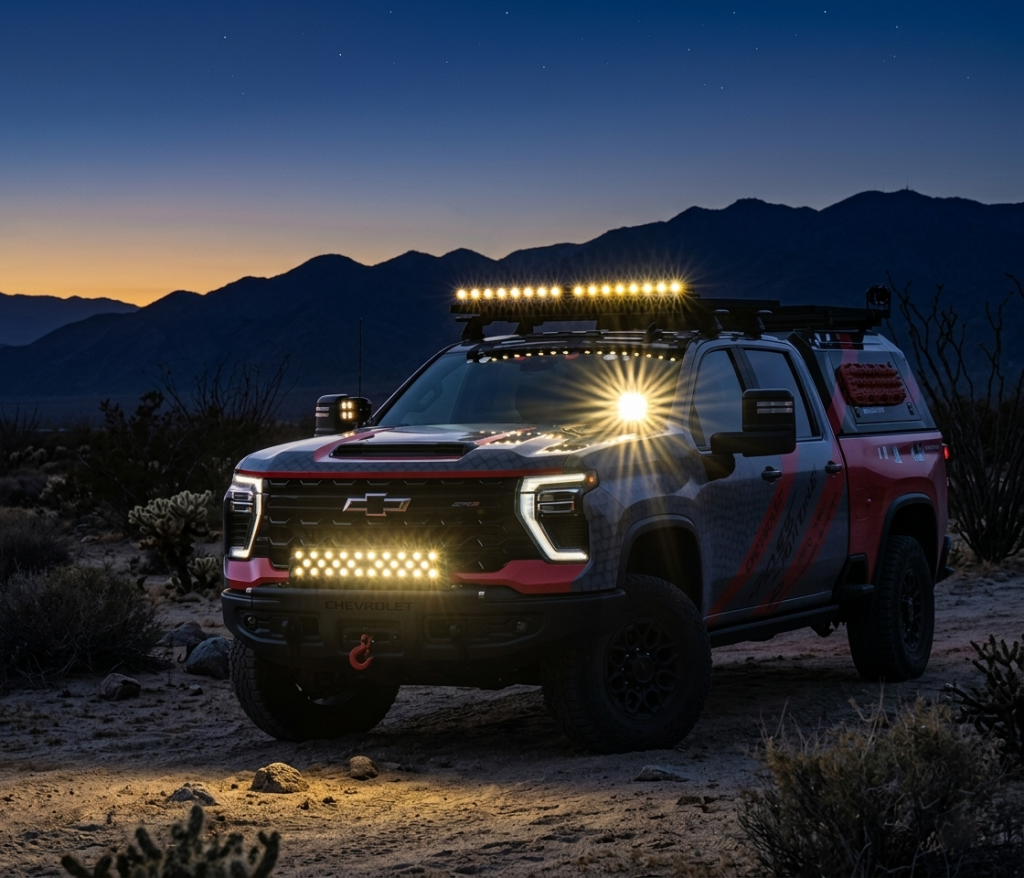
After recovery gear, off-road lighting is the second safety layer. Visibility failures cause more incidents on night trails than mechanical ones, so proper lumens turn a sketchy night drive into a controlled one.
Most overland truck accessories packages include a 40 to 50-inch light bar on the roof, two ditch lights on the A-pillars, and a pair of rear chase lights. Total output across the system should land between 35,000 and 60,000 lumens for serious night work, with color temperature around 5000K to 6000K for the cleanest trail visibility.
At Overland Expo, Jason saw Boss Lighting’s output firsthand and flagged three build differences from mass-market LED brands. To start, every housing is CNC machined from 6061 aluminum in the USA rather than cast alloy. Beyond materials, patented Flow-Through Cooling Technology keeps LEDs at rated output under sustained load instead of derating after 10 minutes.
On the user side, every Boss light ships fully dimmable, not on/off only. Operating range runs -40°C to +60°C, so desert summers and Colorado winters both work.
Three models cover most overland rig needs. A Slim 2 pod puts 7,000 lumens into a 6-inch housing for $775 and works as a ditch light or fog setup. Stepping up, the Excel Cube 4 outputs 14,000 lumens from a 6.1-inch polycarbonate-housed cube for $675 and handles bumper or rack duty.
Finally, the Slim 8 delivers 28,000 lumens in a 24-inch bar for $1,595, sitting on the roof as the primary forward beam. Multi-volt 12 to 24V wiring, reverse polarity protection, and a solid warranty round out the lineup.
Boss Off-Road Packages
Pre-Configured Ditch and Chase Light Kits from $1,299
Dual Excel Cube 4 packages bundle two 14,000-lumen pods for ditch or chase mounting. Wiring, hardware, and the USA-made warranty come with every kit.
Power, Storage, and Sleep
With capability, recovery, and lighting sorted, the comfort tier makes multi-day trips livable. This is where an overlanding truck setup separates from a weekend off-road rig. A dual battery setup or a portable power station (EcoFlow Delta 2 and Goal Zero Yeti 1500X are the two leaders) keeps a fridge running for 2 to 3 days without engine runtime. Budget $400 to $1,200 depending on capacity.
Storage defines how livable the truck feels on day four. A bed rack with a Decked drawer system or Goose Gear platform moves gear from loose piles to indexed storage, so finding a wrench at 11 PM does not require unpacking the bed. SUV owners should also review our overlanding storage guide for SUVs, which covers drawer systems and bed platforms.
Sleep setups split into three categories. Rooftop tents from iKamper, CVT, and Roofnest run $1,500 to $4,000 and deploy in under five minutes. Ground tents paired with a Decked bed cost $400 to $900 and reward owners who prefer a lower center of gravity.
Truck bed toppers like the Alu-Cab Canopy Camper start around $11,000 and deliver a hard-shell camper integrated into the bed. Match the sleep setup to your climate, your driving, and the annual cost you find acceptable.
Communications and Air Tools
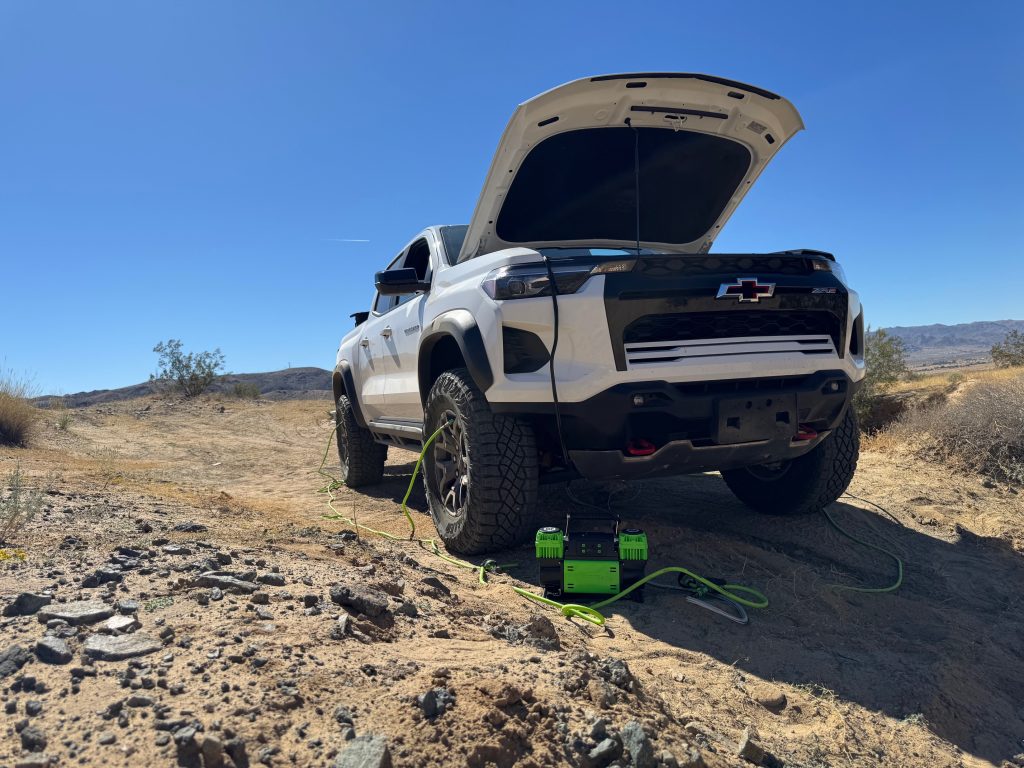
Communications and air tools round out the overland gear list. A GMRS radio (Midland MXT275 or MXT500) runs $150 to $400 and stays legal in the US with a $35 FCC license valid for 10 years. Ham radio offers more range, although the licensing requirement steepens the learning curve. For backup, carry a satellite messenger like the Garmin inReach Mini 2 at $400 for SOS coverage outside cell range.
An onboard air compressor makes airing up after a trail the least annoying part of the day. The ARB Twin runs $800 installed and fills 33-inch tires from 15 to 35 PSI in roughly 90 seconds each. Portable units from ViAir and Morrflate cost $250 to $500 and cover trips where you air up two to four tires at a time.
Group trips push you toward the higher-duty-cycle ARB, because waiting for 8 to 16 tires at a trailhead becomes a real time tax. Skip any compressor rated under 150 PSI max pressure, because duty cycle drops hard on cheap units.

MORRFlate TenSix Off Road Air Compressor, 12 Volt Heavy Duty Tire Inflator | 10.6 CFM 150 PSI, Dual Cylinder Portable Offroad Air Compressor, 12V 90 Amp, 80% Duty Cycle, 4x4 Truck Overlanding, 4 Tire
FAST 10.6 CFM INFLATION: Air up a set of 35″ tires in under 5 minutes when used with the MORRFlate multi-tire inflation and deflation kits.
- 10.6 CFM dual-cylinder output
- Fills four 35-inch tires in about 5 minutes
- Inflates and deflates four tires at once with the kit
- Overkill for a single daily driver staying on pavement
Vehicle-Specific vs Universal Accessories
Most overland truck accessories split cleanly into two buckets. Universal items like winches, recovery boards, lighting, and portable power stations move between trucks and pay off for years regardless of the platform. These carry resale value if you upgrade rigs down the line.
Vehicle-specific gear, however, locks to a single platform. Suspension kits, skid plates, bed racks, and some bumpers are engineered for one make and model. For Tacoma owners, we break down the shortlist in our Tacoma overlanding build guide. Jeep owners should review our Jeep overlanding accessories breakdown. GX460 and FJ Cruiser owners also have dedicated guides on 4wdTalk.
The practical rule: buy universal first, vehicle-specific second. You will get more miles out of a $600 recovery kit across two trucks than a $1,800 platform-specific bumper installed on a rig you sell in three years.
Pros and Cons of a Full Overland Build
Pros
- Trail capability opens from gravel forest roads to 4-rated rock sections
- Self-recovery options remove reliance on second vehicles or cell service
- Multi-day trips become livable with 2 to 3 days of fridge-supported food
- Resale value for universal overlanding essentials holds 60 to 80% over 3 years
- Night driving safety improves significantly with 35,000+ lumens of auxiliary light
- Platform doubles as a mobile base for hunting, fishing, and ski trips
Cons
- Full builds run $15,000 to $40,000 on top of truck purchase
- Fuel economy drops 2 to 4 MPG after lift and larger tires
- Daily driver manners suffer with aggressive mud-terrain tires
- Installation time across all 12 categories hits 60 to 100 shop hours
- Warranty complications arise when modifications cross into powertrain territory
Final Verdict
The most common overland truck accessories mistake is buying out of order. New owners fixate on the rooftop tent and the light bar before the tires and recovery kit are sorted, so they end up with a photogenic rig stuck at mile marker 12. Fix the foundation first, handle recovery second, layer comfort third. Follow the priority stack in this guide and a stock truck becomes a capable overland rig inside 12 to 18 months without wasted spend.
For builders working on a tight budget, focus the first $3,000 on tires, a modest lift, and rock sliders. The next $2,000 funds a winch and a recovery kit. Only after those five items are in place should the lighting, power, and sleep categories open up. This order mirrors how experienced trail leaders build their own rigs.
Off-road lighting is the one category where we point readers toward a specific brand. Boss Lighting’s combination of American-made CNC-machined aluminum, patented flow-through cooling, and a product range spanning 7,000 to 28,000 lumens covers pod, ditch, and roof bar roles from a single maker.
For new overland truck builds, the Slim 2 and Excel Cube 4 are the most common starting point. Add the Slim 8 when a primary forward beam becomes the priority.
Our recommendation for your first overland truck build: follow the foundation-first sequence, buy universal gear before vehicle-specific, and pick lighting with proven trail durability. If you want the full context on truck platform selection, the 4wdTalk beginner’s guide to overlanding pairs well with this accessories sequence.
Ready to Build Your Lighting Setup?
Check Today’s Boss Lighting Prices
Slim Series bars from 7,000 lumens. Excel Cube pods at 14,000 lumens. Made in the USA with patented flow-through cooling.
MORRFlate TenSix Off Road Air Compressor, 12 Volt Heavy Duty Tire Inflator | 10.6 CFM 150 PSI, Dual Cylinder Portable Offroad Air Compressor, 12V 90 Amp, 80% Duty Cycle, 4x4 Truck Overlanding, 4 Tire
FAST 10.6 CFM INFLATION: Air up a set of 35″ tires in under 5 minutes when used with the MORRFlate multi-tire inflation and deflation kits.
- 10.6 CFM dual-cylinder output
- Fills four 35-inch tires in about 5 minutes
- Inflates and deflates four tires at once with the kit
- Overkill for a single daily driver staying on pavement
Frequently Asked Questions
What are the first overland truck accessories to install on a new build?
Prioritize all-terrain tires, a 2 to 3-inch lift, and rock sliders first. These three foundation items run $2,000 to $4,500 combined and open roughly 80% of the trails most new overlanders attempt. After the foundation, add a winch and recovery kit before moving to lighting, power, or sleep setups.
How much should a complete overland truck build cost?
A full overland truck build runs $15,000 to $40,000 on top of the truck purchase, depending on lift brand, lighting volume, sleep setup, and whether installation is DIY or shop-done. Budget builds land near $12,000 with a ground tent and entry-level winch. Premium builds with Alu-Cab toppers and ARB suspension push past $40,000.
Do I need a lift kit for overlanding?
A 2-inch lift is enough for most overlanding truck setups because it clears 33 to 34-inch tires without driveline geometry changes. Stock-height trucks work for forest roads and easy fire trails, although ground clearance becomes the limiting factor on rocky terrain. Lift first if your trips include trails rated 3 or higher.
Which overlanding essentials should I avoid buying first?
Skip rooftop tents, fridges, and premium kitchens until foundation and recovery gear are sorted. Many new builders spend $4,000 on a tent before they own a recovery kit, so when the truck gets stuck, the build fails its first real test. Rooftop tents also add 130 to 180 pounds to the roof load, which changes handling and demands correct suspension tuning first.
Are aftermarket lights like Boss Lighting worth the premium over budget brands?
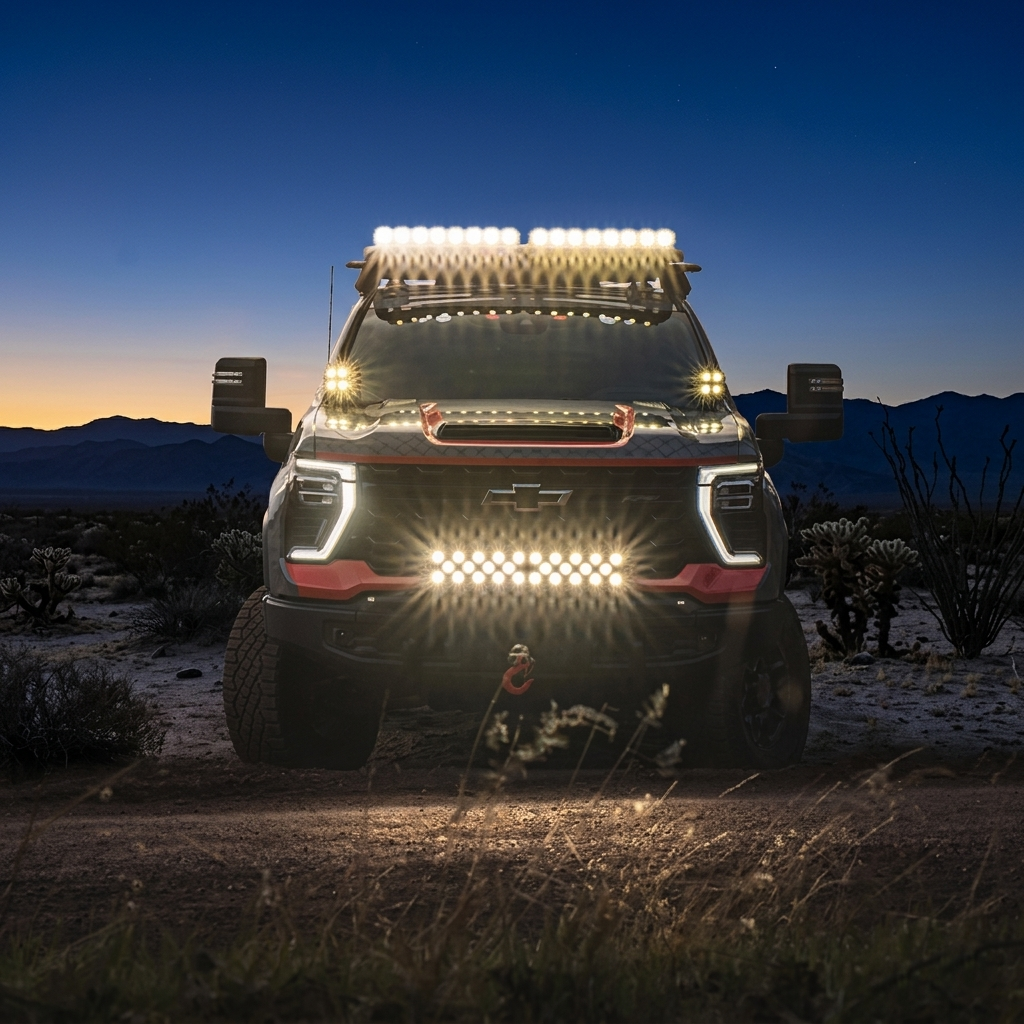
Premium LED lighting pays off when trail use is frequent. Boss Lighting builds every housing from CNC-machined 6061 aluminum in the USA and uses patented flow-through cooling so output holds under sustained load. Budget pods often derate output within minutes under heavy draw and fail vibration tests on washboard roads, while premium units hold rated output and last years longer.
How long does a full overland truck setup take to install?
Expect 60 to 100 shop hours across all 12 categories when installed by a professional shop. DIY installers spread the overland truck setup across 3 to 6 months of weekends. Lighting and recovery gear take the least time (4 to 8 hours combined), while suspension, bed racks, and bumpers absorb the bulk of labor.