



Quick Facts:
- Topic: Overlanding fuel range planning for remote routes
- Core rule: One third out, one third back, one third untouched
- Gasoline weight: About 6 pounds per gallon (EPA)
- Diesel weight: About 7 pounds per gallon (derived from NREL fuel data)
- Biggest measured penalty: Rooftop box, 10% to 25% at 65 to 75 mph (DOE)
- Usable tank: Plan on 80% to 85% of the nominal figure
- Skill level: Beginner math, intermediate gear decisions
- Best for: Anyone planning a leg with 150-plus miles between pumps
16 min read
In This Guide
- What Overlanding Fuel Range Means on a Remote Route
- Fuel Numbers Every Overlanding Build Should Know
- What a Lift, 35s, and a Loaded Roof Cost You
- The Thirds Rule, Borrowed From Cave Divers
- Overlanding Fuel Range Math: Worked Examples
- Jerry Can Rules, Weight, and Mounting for Overlanding
- Auxiliary Tanks and the Payload You Trade
- Water in the Fuel Ends Trips Early
- Diesel Gelling Turns Cold Into a Range Problem
- Jerry Cans vs. an Aux Tank for Overlanding
- Final Verdict: Building Your Overlanding Fuel Range Plan
- Frequently Asked Questions
What Overlanding Fuel Range Means on a Remote Route
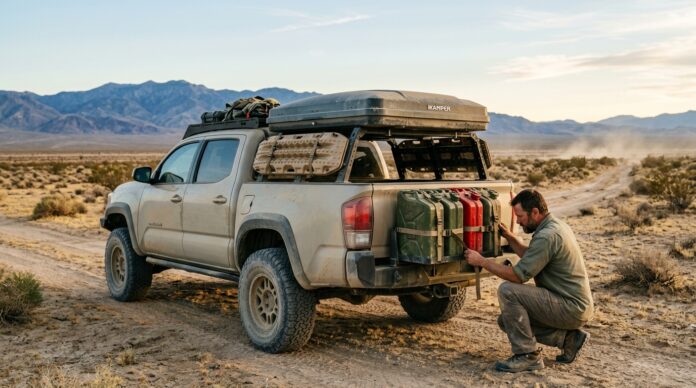
Overlanding fuel range is the distance your loaded rig covers on the fuel you carry. It is never the number printed on a window sticker. A lift, 35-inch tires, a loaded roof rack, and 300 pounds of gear all pull against the EPA estimate. Trail speed and soft surfaces pull harder still.
Most stranded-on-the-trail stories start with arithmetic, not mechanical failure. Someone reads a map distance, multiplies by a highway MPG figure, and skips the reserve. The needle then drops faster than expected, because the return leg climbs into the wind with full water tanks. Better planning fixes this, not a bigger tank.
The overlanding fuel range method below runs five steps and repeats every season. It ends where the real decision sits: portable containers, a plumbed tank, or a shorter route.
Fuel weight matters as much as fuel volume. For instance, gasoline runs about six pounds per gallon according to the EPA, while diesel runs closer to seven. Consequently every gallon you add to stretch your range eats the payload your plan already assumed. Since weight drives both problems, read this alongside our breakdown of payload capacity and why overland rigs get overloaded.
The Overlanding Fuel Range Method in Five Steps
- Find your usable fuel. Start at 80% to 85% of nominal tank capacity until you measure the real fillable volume.
- Measure real economy. Run a loaded tank down on the surfaces you drive, then divide miles by gallons added.
- Correct for tire size. Multiply indicated miles by new tire diameter divided by original diameter.
- Apply the thirds rule. Divide usable range by three: one third out, one third back, one third held.
- Close the gap. Compare the reserve-adjusted range to the longest station-to-station distance on your route.
Fuel Numbers Every Overlanding Build Should Know
Ten figures do most of the work in an overlanding fuel range plan. Each one below comes from a laboratory, a regulator, or a manufacturer. The single exception is the usable-tank figure, which rests on owner reports. Keep the table handy while you build the route.
| Figure | Value and source |
|---|---|
| Gasoline weight | About 6 lb per gallon (EPA) |
| Diesel weight | About 7 lb per gallon (derived from NREL fuel data) |
| Full 20-liter steel NATO can | About 41 lb, on a 9.46 lb empty container holding 5.28 gal |
| Rooftop cargo box at 65 to 75 mph | 10% to 25% fuel economy penalty (DOE) |
| Rear-mounted tray or box | 1% to 5% on the highway (DOE) |
| Added weight | About 1% per 100 lb on a 3,200 lb vehicle (DOE) |
| Speed penalty | Economy at 80 mph runs about 27% below 60 mph (ORNL) |
| Usable tank volume | Plan on 80% to 85% of nominal capacity (owner reports) |
| Untreated #2 diesel cloud point | Roughly 6°F to 14°F (CHS, Cenex) |
| Coldfoot to Deadhorse, Dalton Highway | 240 miles with no fuel (The MILEPOST) |
What a Lift, 35s, and a Loaded Roof Cost You
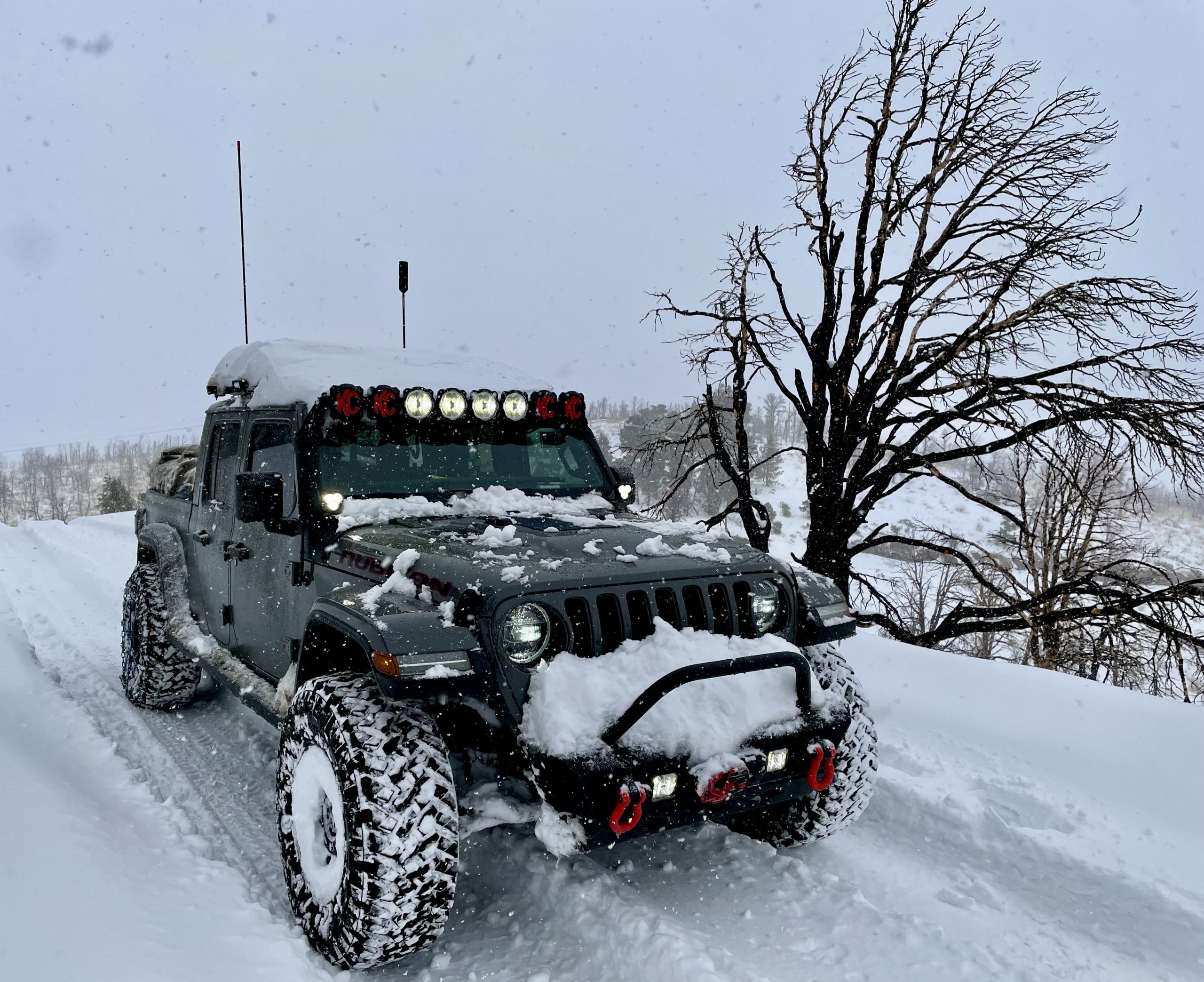
Build penalties get quoted loosely and measured rarely. One number carries real laboratory backing: roof load. Oak Ridge National Laboratory ran a 2009 Ford Explorer on a dynamometer with a rooftop cargo box. At 60 mph, economy fell from 24.9 MPG to 22.9 MPG, an 8% loss. A Corolla in the same test dropped from 42.5 MPG to 33 MPG, or 22%. The spread tracks vehicle shape, so a slippery sedan pays far more than a brick-shaped truck.
Roof Load Is the Penalty You Measure First
Berkeley Lab and NREL took the question national. Published in Energy Policy, their work found roof racks burned 100 million gallons of gasoline in 2015, roughly 0.8% of all US light-duty fuel use. Per vehicle, the penalty runs from zero to 25% on passenger cars. Notably, Americans drive four to eight times more miles with empty racks than loaded ones.
DOE puts numbers on the shape of the load. According to fueleconomy.gov, a large rooftop box costs 2% to 8% in town and 6% to 17% on the highway. At 65 to 75 mph the penalty reaches 10% to 25%. In contrast, a rear-mounted tray costs only 1% to 5% on the highway. Moving weight off the roof therefore buys back most of the loss, while pulling an empty rack between trips costs nothing at all.
| Top Pick | Best for Rack Mounting | Best Budget | |
|---|---|---|---|
| Product | TOP PICK Wavian 20L Steel Jerry Can Wavian 20L Steel Jerry Can |  RotoPax 4-Gal Gasoline Pack RotoPax 4-Gal Gasoline Pack | 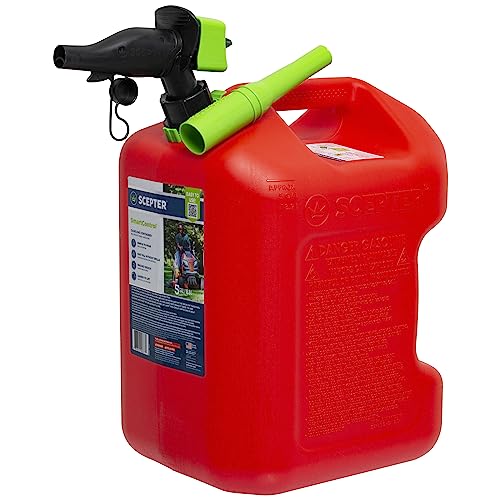 Scepter FSCG552 5-Gal Gas Can Scepter FSCG552 5-Gal Gas Can |
| Rating | ★★★★☆ 4.4 2,974 ratings | ★★★★☆ 4.4 284 ratings | ★★★★☆ 4.3 3,374 ratings |
| Capacity | 5.28 gal | 4 gal | 5 gal |
| Material | Steel | Roto-molded plastic | HDPE plastic |
| Filled Weight at 6 lb/gal | 41 lb | 32 lb | 33 lb |
| Price | $134.99 as of Sep 20, 12:55 pm | $135.62 as of Sep 20, 12:55 pm | $41.11 as of Sep 20, 12:55 pm |
| Check Price → | Check Price → | Check Price → |
Bigger Tires and the Odometer Problem
Tire data is softer. Because no tire maker or SAE paper publishes measured MPG loss by diameter, treat owner reports as reports. For instance, aggregated threads put 33s at 1 to 3 MPG, 35s at 2 to 5, and 37s at 3 to 7. Meanwhile other owners report no change at all. The mechanism stays consistent even when the numbers do not: more rolling resistance, more rotational mass, taller effective gearing, and more frontal area. Our guide to all-terrain tires and fuel efficiency digs into the tradeoff.
The bigger planning risk is measurement error. Larger tires travel farther per revolution, so an uncorrected odometer undercounts miles. One Tacoma owner on 33s measured an undercount of roughly 8%. Your hand-calculated MPG then reads low, and the distance-to-empty display counts down in short miles rather than real ones. Correct the odometer before you trust either number on a remote leg.
What a Lift Costs, and What Nobody Has Measured
No laboratory source publishes a penalty figure for lift height alone, although plenty of retailers quote one. Practically, lift matters because of what rides with it: taller tires, a rack, a tent, and a spare hanging in the wind. Since the whole aerodynamic package moves together, measure the finished rig instead of adding up part-by-part claims. Our notes on off-road fuel economy cover the driving side of the same problem.
Speed Is the Lever You Control for Free
DOE data shows fuel economy dropping rapidly above 50 mph. Across 74 tested light-duty vehicles, economy at 80 mph runs about 27% below 60 mph. Slowing by 5 to 10 mph returns 7% to 14%. On a long dirt transit, therefore, holding 55 mph turns a marginal tank into a comfortable one without a single dollar of hardware. Off-road fuel economy falls further on sand and rock, yet no laboratory has published a multiplier for soft surfaces, so measure the penalty yourself.
The Thirds Rule, Borrowed From Cave Divers
Cave divers formalized the rule of thirds in 1977, in Sheck Exley’s Basic Cave Diving: A Blueprint for Survival. One third of the supply carries you out, one third brings you back, and one third stays untouched. The rule exists because a cave diver has no direct route to the surface. A remote route likewise offers no shoulder, no tow truck, and no fuel delivery.
No major US off-road publication codifies the framework. Instead, writers reach for ad-hoc buffers: a quarter tank here, 25% there, 10% somewhere else. However, a flat percentage fails on out-and-back routes, because it ignores the asymmetry between an easy run out and a loaded crawl home.
Apply the rule like this. First, take your usable fuel, not your nominal tank, and divide by three. One third takes you to the turnaround. Another brings you back. The last third covers the wind you did not plan for, the detour around a washout, the winching, and two hours of idling while somebody changes a tire.
Divers also handle the mixed-group case, and it transfers directly to convoy travel. When one member breathes faster or carries less gas, the group turns around on the smallest supply. On the trail, likewise, the thirstiest rig sets the turnaround for everybody. Announce the number at the trailhead instead of arguing about it at the halfway point.
When to Bend the Thirds Rule
One exception is worth naming. A route with a genuine bail-out, meaning pavement or a fuel stop reachable off the track, does not need a full third held back. The reserve exists to cover a leg with no exit, so scale it to the exit you have.
Safety note: Never plan a leg on your nominal tank size. Owner reports across 4Runner, Land Cruiser, Tacoma, and Ram platforms show fuel lights arriving with three to five gallons still aboard. Pumps also shut off well short of the rated figure. Plan on 80% to 85% of nominal until you measure your own.
Overlanding Fuel Range Math: Worked Examples
Three inputs drive every calculation: usable gallons, measured economy, and the thirds rule. Run them in sequence. For example, the two builds below use verified tank capacities and published route distances.
| Input | 2024 Tacoma on 35s | Wrangler JLU 4-door |
|---|---|---|
| Nominal tank | 18.2 gal | 21.5 gal |
| Usable at 85% | 15.5 gal | 18.3 gal |
| Measured trail economy | 13 MPG | 10 MPG |
| Total usable range | 202 miles | 183 miles |
| One third | 67 miles | 61 miles |
| Thirds-adjusted range | 135 miles | 122 miles |
| Extra fuel for a 170-mile gap | About 4 gal, one can | About 7 gal, two cans |
Take the Mojave Road as the first real case. The trail itself runs 138 miles, but plan on 170 miles between stations in Bullhead City and Yermo. At 10 MPG over sand and rock, the crossing burns about 17 gallons. A JLU holds 18.3 usable gallons, so it arrives on fumes with no reserve at all. Holding a third back means carrying 25 gallons, and two containers cover the difference.
Baker, about two thirds of the way along, is your bail-out.
Alaska’s Dalton Highway sets the harder standard. The MILEPOST logs Coldfoot at mile 174.8 with 24-hour fuel. Deadhorse, the next pump, sits 240 miles north. At 10 MPG the leg burns 24 gallons, and a full reserve third raises the need to 36. Neither example rig gets there without four containers or an auxiliary tank.
Atigun Pass, at 4,800 feet, sits inside the gap, so peak burn and the worst grades arrive together. BLM warns of limited cell coverage and no services, which is where the reserve third earns its keep. Carrying the extra fuel legally is the next question.
Jerry Can Rules, Weight, and Mounting for Overlanding
Portable fuel container rules come from EPA under 40 CFR Part 59, Subpart F. The rule covers containers built on or after January 1, 2009, and holds hydrocarbon emissions to 0.3 grams per gallon per day. Specifically, containers under 0.25 gallons or over 10 gallons fall outside the subpart. The definition also sweeps in any reusable container of any color marketed for fuel. Therefore red, yellow, and blue utility jugs count regardless of the label.
Spout design follows from the same rule. Makers must limit spillage, while a bypass vent stays legal only when it closes automatically. California adds another layer, since CARB certifies portable containers under a separate program and issues each approved product an Executive Order number. Wavian’s US cans now ship with an EPA and CARB compliant spout and a CARB Executive Order. The old story about NATO cans sold as water cans is out of date.
Federal hazmat thresholds sit far above anything an overlander carries. One Washington State column put the private-vehicle limit at roughly 73 gallons, or about 15 jerry cans. Your practical limits are payload and mounting, not the law. Still, state rules vary on plate obstruction, while ferry operators set their own policies. Check your own statute before you arrive with cans on the swing-out.
Where Overlanding Fuel Cans Belong on the Rig
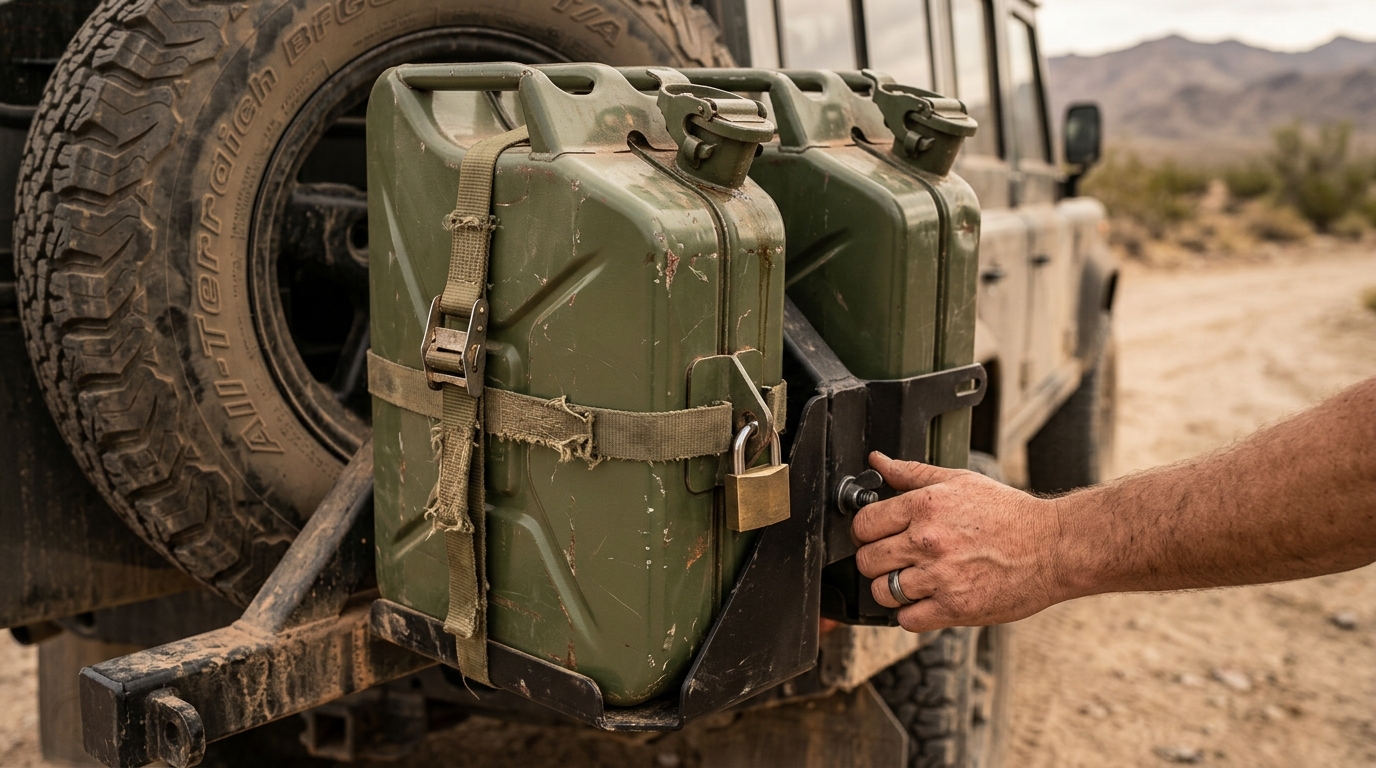
Weight decides the answer. A Wavian 20-liter container holds 5.28 gallons and weighs 9.46 pounds empty. Fill it with gasoline at 6 pounds per gallon and you carry about 41 pounds. Four of them run 165 pounds and 21 gallons, usually hung behind the rear axle. Leverage back there works against you on every off-camber climb.
Roof mounting compounds the problem. Fuel on the roof raises the center of gravity, sloshes, bakes in the sun, and vents under pressure changes. For example, RotoPax owners report cans pushing fuel past the gasket while climbing in elevation, and the maker’s own guidance is to burp cans as altitude changes. A rear bumper or swing-out therefore beats the roof on every axis except convenience. Our guide to RotoPax mounting and capacity covers the hardware side.
Safety note: Keep fuel cans out of the passenger compartment, since gasoline flashes at -45°F and vapor pools in enclosed spaces. Fill cans on the ground, never in a bed or a trunk, because local fire codes commonly require it in writing. Store gasoline longer than three months only with a stabilizer.
Auxiliary Tanks and the Payload You Trade
A plumbed tank solves the weight-placement problem cans create. It sits low, inside the frame, and feeds the engine without anybody handling fuel in the wind. For example, Long Range America lists a 24-gallon auxiliary fuel tank for the 4Runner and GX 460 at $2,895. The same catalog covers a 33-gallon Tacoma replacement from $2,795, plus 17-gallon units for the JLU and Gladiator. On the diesel side, S&B sells a 60-gallon replacement for the 6.7 Power Stroke at $1,349.
What an Overlanding Auxiliary Tank Costs in Payload
Price is the smaller cost. For instance, forty gallons of diesel weighs about 280 pounds before the tank, straps, and plumbing. A 24-gallon aux tank of gasoline adds about 144 pounds. Swapping a Tacoma’s 18.2-gallon tank for a 33-gallon unit moves you from roughly 109 pounds of fuel to about 198. Overlanding fuel range therefore costs nearly 90 pounds on a truck where payload already runs short.
Replacement Tank, Auxiliary Tank, or Transfer Tank
Three things get called the same name, and regulators treat them differently. A replacement tank swaps out the factory tank. An auxiliary tank adds capacity and plumbs into the fuel system. A transfer or refueling tank stores fuel to pour into something else, including your own truck.
Transfer Flow builds replacement and auxiliary tanks to CARB, DOT, and EPA emissions rules. Its tanks meet ANSI and NFPA fastener standards and survive a 30-foot drop test filled with liquid.
Refueling tanks are a different animal, governed by DOT Special Permit SP-11911 and 49 CFR 178.803. Owners mount them at the front of the bed and attend them during loading and unloading. Retesting comes every 2.5 years, and the permit rides with the truck.
Gravity-feed setups sit in the gray area. Transfer Flow states the legality of gravity-fed systems remains unclear, while pointing at 49 CFR 393.67. The company further argues a second point. Capping an OEM rollover valve to stop overfill breaks both the overfill-restriction rules and the 1990 Clean Air Act. Worse, a damaged transfer hose keeps flowing until the tank empties, and leaked diesel near a DPF regenerating at 1,112°F becomes a serious fire risk.
Water in the Fuel Ends Trips Early
Capacity solves only half the problem, since fuel quality strands people too. Water reaches your tank from low-turnover pumps in small towns, from condensation, and from biodiesel blends. All diesel carries dissolved water. Below 32°F, water collected in a filter freezes, restricts flow, and either cuts power or shuts the engine down entirely.
For common-rail diesels the stakes climb sharply. Bosch CP4.2 pumps shed metal particles through the whole fuel system when they fail. Therefore the repair covers injectors, rails, lines, lift pump, filters, and a tank cleaning. GM’s TSB 16-NA-102 rates a full fuel system replacement at 18 to 21 hours of labor. Recall volumes show the scale. FCA covered an estimated 222,410 Ram trucks in December 2021. Ford’s December 2024 campaign then covered 295,449 vehicles with an estimated 4% defect rate.
Prevention Beats Repair on Remote Routes
Prevention is dull and effective. First, drain the separator and change filters on the severe-service schedule instead of the normal one. Next, inspect every filter change for metallic debris, since glitter in the media is the early warning of a failing pump. Finally, let the lift pump prime for 5 to 10 seconds before cranking, and never run a tank dry.
Filtration ratings vary by brand. For example, FASS states its systems remove over 99% of water and filter debris to 2 microns. Racor spin-on separators, meanwhile, come in 2, 10, and 30 micron ratings. Our article on how a secondary fuel filter saves your engine walks through the install side.
Gasoline rigs face a different failure mode. E10 holds only so much water. Past the threshold, the ethanol and water fall out as a separate layer on the tank floor. Phase-separated fuel loses octane, and the engine often will not run on it. Your defense is station selection, a filter you know how to change, and stabilizer in anything stored past three months.

AF8CB 8 GPM Conductive Fuel Filter Portable
A hydrophobic filter screen blocks water while letting gasoline, diesel, and kerosene pass through.
- Filters gasoline, diesel, kerosene, and two-stroke mix for mixed gas and diesel groups
- Rated 5 gallons per minute, so it will not slow a fill at a remote pump
- Corrosion-resistant housing built for repeated field use
- Sized for jerry containers and small tanks, not a full 60-gallon aux tank fill
- No storage pouch included, so pack it where it will not get crushed
Diesel Gelling Turns Cold Into a Range Problem
Cloud point is the temperature where wax crystals appear and the fuel turns hazy. Fuel still flows there. In contrast, cold filter plugging point, or CFPP, is where wax blocks the filter, and it lands 3°F to 5°F below cloud point on untreated #2 diesel. CFPP is the number worth watching, because it predicts the moment the engine quits.
Cloud point varies more than most drivers expect. Power Service puts the range at -30°F to +30°F depending on location, season, refinery, crude slate, and biodiesel content. CHS reports 6°F to 14°F as typical, while Cenex quotes about 14°F for #2. Biodiesel makes it worse, since some samples cloud at 50°F and raise the cloud point of #2 at blends as low as 5%.
Treat diesel gelling as a range problem rather than a starting problem. After all, a plugged filter 90 miles from pavement strands you exactly as thoroughly as an empty tank, and nothing in your fuel plan accounts for it.
Treating Fuel Before the Cold Arrives
Timing controls the outcome. Because anti-gel additives work only when added above the fuel’s cloud point, treat at the last warm fill instead of the cold trailhead. Power Service reports treated fuels reaching a CFPP 15°F to 20°F below cloud point, while recommending double treatment below 0°F or with biodiesel blends.
Blending #1 diesel lowers cloud point about 2°F to 3°F for every 10% added, and CHS suggests roughly 70% #2 to 30% #1 below 30°F. The trade is range, though, since #1 carries less energy per gallon and less lubricity. Therefore factor the economy loss into your math before leaning on it.
What to Do When Fuel Gels Anyway
When fuel gels, the published fix is specific. Power Service directs 16 ounces of Diesel 911 per 20 gallons in the tank. Next, remove the filters and fill them half with Diesel 911. Then reinstall and idle to warm the system. Diesel 911 reverses gelling; still, it does not prevent it. Keep open flame away from the entire job.
Regional blending sets the final trap. Stations switch to winter fuel on a calendar tied to local overnight temperatures. Consequently a tank of southern summer diesel gels in a cold snap where local fuel runs fine. Burn down and refill on local winter fuel before climbing into cold country.
Jerry Cans vs. an Aux Tank for Overlanding
Once the math says you are short, two answers exist: portable containers or a plumbed tank. They differ on weight placement, cost, and effort. Four full steel cans put about 165 pounds high and behind the rear axle. They cost a few hundred dollars, although you lift and pour every gallon in wind and dust. A 24-gallon auxiliary fuel tank puts about 144 pounds low and inside the wheelbase, costs around $2,895 before labor, and moves fuel without anybody touching it.
Frequency decides which one fits. Occasional long routes favor cans. Two of them cover the single 170-mile gap you hit twice a year, then come off the truck. Regular remote travel favors a tank. On diesel platforms especially, a 60-gallon replacement runs $1,349 and adds a full tank of overlanding fuel range with nothing hanging off the back.
Value follows the same logic. Long Range America’s Tacoma replacement tank at $2,795 buys about 15 extra gallons of capacity. Four Wavian containers run roughly $500 to $600, and a quality swing-out carrier adds several hundred more, for 21 gallons you handle yourself. Divide either figure by the number of remote trips you truly run each year, and the answer usually settles itself.
From experience: The rigs I see run dry are rarely the ones with the smallest tanks. Instead, they belong to owners who never re-measured economy after the build changed. Every time I have watched somebody get nervous about fuel on a trail, the trigger was a route change or a headwind, never the original plan. Therefore build the reserve for the change, and the plan holds.
Final Verdict: Building Your Overlanding Fuel Range Plan
Overlanding fuel range planning rewards measurement over hardware. First, fill the tank, run it down on the kind of roads you drive, and divide miles by gallons. Then repeat once a season and once after any build change. Your own number beats every estimate in this article, including the ones with laboratory sources behind them.
The thirds rule costs you range on paper, and some trips will not fit inside it. Someone running a graded forest road with pavement 20 miles away has a bail-out. A full reserve third is overkill there. Save the discipline for routes with no exit. Long desert traverses, winter passes, and remote two-track qualify, along with anywhere a breakdown means a night in place.
On the carrying question, most people overbuy. Two 5-gallon containers and a measured MPG figure solve more problems than a $2,795 tank. Bolting one under a rig used four weekends a year rarely pays. Tanks earn their price on platforms with small factory capacity. They also pay off on diesels where a 60-gallon replacement runs $1,349. Long trips make hand-pouring a real cost of its own.
Start with the free fixes before spending anything. Slow to 55 on transits. Move the load off the roof onto a hitch tray, and pull the empty rack between trips. Those three changes return more range than most fuel-carrying hardware. Add containers next, and add a tank only once they stop being enough.
Frequently Asked Questions
How much MPG do you lose with a lift and 35-inch tires?
No laboratory source publishes a figure for lift height, while tire numbers come from owner reports rather than measurement. Aggregated threads put 35s at 2 to 5 MPG, although some owners report no change. Measure your own rig after the build, since the loaded roof rack usually costs more than the tires do.
What is the rule of thirds for fuel planning?
One third of your usable fuel goes out, one third comes back, and one third stays untouched as reserve. Cave divers formalized it in 1977 for environments without a direct exit. Similarly, it applies to any route where turning around is the only way home.
How much does a full 5-gallon jerry can of fuel weigh?
A Wavian 20-liter steel container weighs 9.46 pounds empty and holds 5.28 gallons. At about six pounds per gallon for gasoline, the filled unit runs roughly 41 pounds. Four of them therefore add about 165 pounds to your payload, usually behind the rear axle.
At what temperature does diesel fuel gel?
Untreated #2 diesel typically clouds between 6°F and 14°F, while the cold filter plugging point follows 3°F to 5°F lower. Cloud point varies from -30°F to +30°F depending on refinery, season, and biodiesel content, so the fuel in your tank matters more than the forecast.
Do I need a fuel water separator for overlanding?
Diesel owners benefit most, especially anyone buying from low-turnover pumps in small towns. Water in a common-rail system contributes to injection pump failures, with repairs running 18 to 21 hours of labor. Gasoline rigs gain less from a separator and more from where they choose to fill up.