


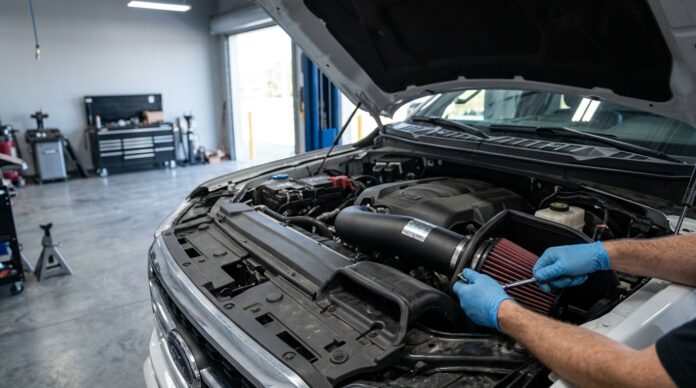
Quick Facts:
- Bill: California SB 1069, adding Health and Safety Code section 43019.4
- Author: Senator Tim Grayson, sponsored by SEMA
- Status: Enrolled and presented to the Governor on September 3, 2026
- What it does: Lets CARB legal aftermarket parts sell during final review
- Manufacturer bar: 10 or more existing CARB EOs, one in the same application category
- CARB response window: 30 business days, or the request is deemed approved
- Conditional term: Two years, extendable by the executive officer
- Effective date if signed: January 1, 2027
- Reach: California plus 16 states and D.C. following its emissions standards
- Best for: Truck and 4×4 owners buying intakes, exhausts, and tuners
8 min read
In This Guide
What SB 1069 Changes for CARB Legal Aftermarket Parts
California SB 1069 rewrites the timeline for selling CARB legal aftermarket parts in the biggest vehicle market in the country. Under the bill, a manufacturer sells, advertises, or installs an emissions-related part while its Executive Order application sits in final review at the California Air Resources Board, instead of waiting on the sidelines. Senator Tim Grayson authored the measure with SEMA as sponsor, and the Legislature passed it, enrolled it, and presented it to the Governor on September 3, 2026.
For a truck owner, the practical effect is supply. Intakes, cat-back exhausts, tuners, and superchargers usually reach 49 states before California, since the state demands a waiver first. SB 1069 keeps the waiver requirement in place, while letting a proven manufacturer sell as the paperwork finishes. As a result, the gap between a national launch and a California one narrows.
The bill sets a real bar for who qualifies. A manufacturer must already hold 10 or more CARB Executive Orders. At least one must also cover a part in the same application category as the new request, as the state’s exemption procedures define these categories. Therefore, a first-time applicant with no track record does not qualify. Established brands with a decade of approvals behind them do.
Signature is the remaining step. If the Governor signs, SB 1069 takes effect on January 1, 2027. CARB then revises its aftermarket exemption procedures under 13 CCR 2222(e) by July 1, 2028. Until then, current rules stand. Consequently, nothing changes on the shelf this fall.
| Top Pick | Best Value | Best Premium | |
|---|---|---|---|
| Product | TOP PICK aFe Momentum GT Intake aFe Momentum GT Intake |  MagnaFlow CARB Converter MagnaFlow CARB Converter |  Edelbrock E-Force Supercharger Edelbrock E-Force Supercharger |
| CARB Status | EO D-550-25 | CARB Compliant | EO D-215-103 |
| Part Type | Cold Air Intake | Catalytic Converter | Supercharger System |
| Price | $414.40 as of Sep 9, 4:57 pm | $175.81 as of Sep 9, 4:57 pm | $7,283.38 as of Sep 9, 4:57 pm |
| Check Price → | Check Price → | Check Price → |
SB 1069 by the Numbers
The mechanics matter more than the politics here. Specifically, the deadlines determine how quickly a part reaches your driveway.
| Provision | Detail |
|---|---|
| Statute added | Health and Safety Code section 43019.4 |
| Manufacturer eligibility | 10 or more CARB EOs already issued, no date cutoff |
| Category rule | At least one prior EO in the same application category |
| CARB completeness ruling | 30 business days, or deemed conditionally approved |
| Extension allowed | 15 business days per block of 50 applications, capped at one |
| Conditional term | Two years unless extended, or until the final EO issues |
| CARB retained powers | Recall, corrective action, and stop-sale |
| Effective date if signed | January 1, 2027 |
Notably, the 30-business-day clock runs against CARB, not the applicant. When the agency misses it, the request is deemed conditionally approved by default. The extension is capped at a single 15-business-day block per 50 applications. Consequently, a flood of filings will not stall the process indefinitely.
What a CARB EO Number Means
An Executive Order is CARB’s formal waiver of Vehicle Code 27156, the state anti-tampering law. Vehicle Code 27156 bars installing or selling an add-on or modified emissions part without a CARB exemption. Consequently, the CARB EO number stamped on a box is the legal permission slip. For example, a smog technician or referee looks for it directly.
CARB is specific about what the waiver certifies. EO numbers beginning with the letter D cover aftermarket add-on and modified parts. The agency describes the exemption as an anti-tampering waiver only. In other words, the part has been shown not to increase emissions. Nothing in the number claims the part reduces them, whatever the marketing copy says.
Verification is free and takes a minute. CARB maintains an Aftermarket Parts Database. You look up a CARB EO number there and confirm it covers your exact year, make, model, and engine. Similarly, a part with a valid EO for a 2019 truck does not automatically cover the 2024 version of the same engine. Instead, check the application list rather than the brand name.
Under SB 1069, a second status appears alongside the familiar one. The bill states a conditional approval is treated as the equivalent of an executive order, so the part is legal to sell and install. However, it carries no final CARB EO number yet, so the database lookup buyers have always relied on will not return the same result. Therefore, ask the seller to state in writing which status applies. Then keep the answer with your receipt.
Why the Approval Backlog Exists
Behind the paperwork sits a real bottleneck. SEMA’s argument for the bill rests on wait times. The association states manufacturers often wait months or years for a final EO. Only then do CARB legal aftermarket parts reach the California market legally. Meanwhile, the part ships to 49 states. California customers either go without or buy something they cannot install on a street vehicle.
SEMA, the bill’s sponsor, points to workload as the cause. SEMA reports its SEMA Garage facility has completed more than 800 EO applications and assisted with roughly half of all aftermarket EOs CARB issued over the past eight years. However, CARB has published no competing account of where the backlog sits. Therefore, treat the testing-capacity explanation as the sponsor’s framing rather than an audited finding.
The economics behind the push are substantial, by the sponsor’s own accounting. SEMA puts California’s specialty automotive aftermarket at $40.44 billion in economic output. The sector supports more than 149,000 jobs, $13.47 billion in wages and benefits, and $6.16 billion in state and local taxes. More than 1,200 of the association’s 7,000-plus member companies are based in California. Consequently, the delay falls hardest on in-state businesses.
Where the Risk Shifts to You
Read the bill text closely and one trade-off stands out. Selling under conditional approval is not deemed a Vehicle Code 27156 violation solely because CARB has not made a final determination. However, on withdrawal, revocation, or expiration of the approval, CARB orders a recall, corrective action, or stop-sale where it sees fit. The manufacturer bears all resulting costs.
The statute assigns those costs to the manufacturer, not the customer. Even so, a stop-sale on a part already bolted to your truck creates practical problems. Specifically, you still need a compliant configuration to pass a smog inspection. Moreover, a recall means shop time, downtime, and a return to whatever you removed.
Two years is the nominal limit on the uncertainty. Conditional approval expires two years from its effective date unless the executive officer extends it, or sooner if the final EO issues. Therefore, a part bought early in a conditional window carries a longer stretch of unresolved status than one bought late.
Warranty questions follow the pattern of any modification. Federal law under the Magnuson-Moss Warranty Act limits a manufacturer’s ability to void coverage over an aftermarket part. Our winch buying guide covers how the law applies to aftermarket parts in more detail. A dealer still pushes back when a modified system sits near a failed component, so documentation helps. The same logic applies to coverage on the rig itself, which is why insuring a modified rig deserves attention early.
CARB Legal Aftermarket Parts Outside California
Sixteen states plus the District of Columbia currently follow California’s vehicle emissions standards under Section 177 of the Clean Air Act. The list runs Colorado, Connecticut, Delaware, Maine, Maryland, Massachusetts, Minnesota, Nevada, New Jersey, New Mexico, New York, Oregon, Pennsylvania, Rhode Island, Vermont, and Washington. Virginia followed California standards until withdrawing, effective January 1, 2025. Together with California, those states account for roughly 40 percent of the United States new-car market.
Adoption is not uniform, though, and reporting on the bill tends to overreach here. Section 177 states adopt California standards to varying degrees. Some follow low-emission vehicle rules without matching every element of the program. Whether a given state enforces aftermarket exemptions the California way is a state-by-state question. Treat “CARB state” as shorthand rather than a guarantee.
The practical effect still reaches beyond state lines. Manufacturers build one part number for the whole country. When California availability improves, catalog availability improves everywhere. Similarly, California rules on off-road equipment shape national product decisions. The same pattern shows up in California’s new tire rules and their effect on all-terrain sizing.
Parts SB 1069 Does Not Touch
The conditional pathway applies to parts working through the EO process. It does nothing for hardware whose entire function is removing or defeating emissions equipment. No version of such hardware gets an Executive Order in the first place.
Diesel owners should be clear on this line. Deleting a diesel particulate filter has been federally illegal for years. Moreover, penalties reach the shop performing the work as well as the owner. Our breakdown of what a DPF delete costs you lays out the exposure. SB 1069 changes the queue for legal parts and leaves the category exactly where it was.
Tools for checking compliance before a smog inspection



ANCEL AD310 Classic Enhanced Universal OBD II Scanner Car Engine Fa…
Tuners occupy the gray zone most owners ask about. A tune with its own CARB EO number covering your specific application is legal in California. Sold for off-road or competition use only, the same tune is not legal, however the seller phrases it. Notably, a conditional approval on some other product in the brand’s catalog does not extend to it.
Final Verdict
SB 1069 is a supply fix. It targets the buyer who has watched a part launch nationally and skip California. If the Governor signs, established brands sell while their applications finish. The practical wait for legal intakes, exhausts, and tuners on newer trucks should shorten from 2027 onward. For anyone building a 4×4 in California or a Section 177 state, the effect on part availability is the clearest benefit in the bill.
The trade-off is a second status buyers now track. Under the statute, a conditional approval carries the same legal weight as an executive order, so the footing is solid. Even so, it expires, and CARB suspends or revokes it when a manufacturer fails to produce sales records or when an application contains materially inaccurate information. Owners wanting zero ambiguity at a smog check should keep buying parts with issued EO numbers.
Value depends on your timeline. Nothing changes before January 1, 2027. CARB has until July 1, 2028 to rewrite its procedures. As a result, a build happening this fall proceeds under the old rules. Waiting buyers get more choice later. Current buyers get nothing new today.
The step worth taking now is unglamorous. Verify the CARB EO number on every emissions-related part already on your truck. Then keep the documentation with your service records. Whichever way the signature goes, the habit protects you at inspection. It becomes more valuable once two kinds of approval exist side by side.
Frequently Asked Questions
What is SB 1069 and how does it affect aftermarket parts in California?
SB 1069 adds section 43019.4 to California’s Health and Safety Code. It lets an established parts manufacturer request conditional approval to sell an emissions-related part while its CARB Executive Order application is in final review. The manufacturer must already hold 10 or more CARB EOs, with at least one in the same application category.
What is a CARB EO number?
A CARB EO number is the agency’s waiver of Vehicle Code section 27156, the state anti-tampering law. Numbers starting with D cover aftermarket add-on and modified parts. CARB describes the exemption as an anti-tampering waiver confirming the part does not increase emissions. You verify one through the agency’s Aftermarket Parts Database.
Does SB 1069 make all aftermarket parts legal in California?
No. The bill only speeds up the queue for parts already working through the Executive Order process at qualifying manufacturers. Hardware designed to remove or defeat emissions equipment, such as a DPF delete, remains illegal. It cannot receive an Executive Order at all.
What happens if a conditional approval is revoked?
On withdrawal, revocation, or expiration of a conditional approval, CARB orders a recall, corrective action, or stop-sale where it sees fit. The bill assigns those costs to the manufacturer. You would still need a compliant configuration to pass a smog inspection, which means shop time and possibly reinstalling the original component.
Which states follow CARB emissions standards besides California?
Sixteen states plus the District of Columbia currently follow California standards under Clean Air Act Section 177. They are Colorado, Connecticut, Delaware, Maine, Maryland, Massachusetts, Minnesota, Nevada, New Jersey, New Mexico, New York, Oregon, Pennsylvania, Rhode Island, Vermont, and Washington. Virginia withdrew effective January 1, 2025. Adoption varies by state, so enforcement of aftermarket rules differs.
When does SB 1069 take effect if the Governor signs it?
The bill takes effect January 1, 2027. CARB then has until July 1, 2028 to revise its aftermarket exemption procedures under 13 CCR 2222(e). The full conditional approval process will phase in across 2027 and 2028.