



I’ve been camping and overlanding most of my life. Over the decades, I’ve run the full spectrum – from sleeping in a bivy sack on frozen ground to rooftop tents to truck bed campers to full trailer rigs. I’ve done the heavy builds. I’ve had the impressive setups that drew admiring looks in the parking lot at the trailhead. And I’ve spent more than a few Friday nights packing gear instead of driving. Somewhere in all of that, I landed on a conclusion I keep coming back to: simple is almost always better. You pack faster, leave earlier, set up in minutes, and spend more time doing the thing you drove out there for. That realization led me straight to what I see happening across the overlanding community right now.
Simplicity in overlanding is making a comeback. After years of heavier builds and gear lists that grew into spreadsheets, a real shift is underway. People are shedding weight, cutting systems, and choosing setups they manage on their own. It’s a correction, not a step backward. This piece covers why that shift is happening, what it looks like in practice, and what gear fits the moment.
Quick Facts:
- Topic: The return of simplicity in overlanding
- Audience: Overlanders, truck campers, and outdoor enthusiasts at any experience level
- Core argument: Gear complexity peaked – now the community is course-correcting toward lightweight, manageable setups
- Featured product: Freedom Camper by Redneck Blinds (truck bed camper, $3,400 to $4,399.99)
- Skill level: All levels – but especially relevant for veterans tired of managing heavy builds
- Key insight: The best overlanding rig is the one you use, not the one you spent the most time building
- Best for: Truck owners looking for a lighter, faster, less complicated way to camp
9 min read
In This Article
How Simplicity in Overlanding Got Left Behind

Overlanding didn’t start complicated. For most of its history, it was vehicle-based travel to remote places with the gear you needed to be self-sufficient. A truck, basic recovery equipment, food, water, and shelter. The community built around that ethos was tight, capable, and practical. Then social media found it. Overland Expo attendance surged. YouTube channels exploded. Suddenly, a weekend camping trip needed a rig that looked like it could cross the Sahara. Simplicity in overlanding gave way to a race for the heaviest builds and the longest gear lists.
The gear bloat era had real consequences. Trucks got so loaded that payload ratings became a serious concern. Setups grew complex enough to require hours of preparation before every trip. The “one-bin rule” started feeling like a radical statement. As one observer put it in early 2026: “The true mark of a seasoned traveler isn’t the complexity of their loadout; it’s the simplicity.” That view is gaining ground fast. According to a 2025 camping trend report, 83% of campers now actively seek tech-free, simpler outdoor escapes that prioritize nature over amenities. That number reflects something shifting at the cultural level, not just in overlanding circles.
Meanwhile, the gear industry kept pushing heavier, more expensive, and more capable products at a market being told it needed all of them. Some of it was genuinely useful. However, a lot of it was overcapacity sitting unused under a bed between trips. The result: expensive builds gathering dust, and overlanders realizing the complexity had become the obstacle, not the terrain. This is what the rise of lightweight camping and overlanding is really a response to – not a trend, but a correction.
The Backlash Against Gear Bloat
The backlash is visible across the community. Solo camping – where you have to manage everything yourself – has been the fastest-growing camping format for three consecutive years, according to The Dyrt’s 2025 data. Solo campers are also the most likely to choose truck camping, overlanding, or van setups over RVs. When you’re the only person managing your rig, complexity becomes a liability fast. People who solo camp regularly converge on the same conclusion experienced overlanders reached years ago. Every pound you add costs you something. Every system you add requires maintenance.
At the same time, glamping took a hit in 2024, with luxury camping resorts reporting booking declines tied to rising costs. The market that built itself on the idea that comfort required expense started losing its audience. People started asking whether the expense was producing better experiences, or whether it was just producing more expensive ones. For a significant portion of the camping market, the answer came back as the latter. Specifically, outdoor recreation research in 2025 pointed to a growing segment prioritizing “rustic retreats” and nature immersion over amenities. Overlanding, at its stripped-down best, fits that demand precisely.
Within the truck camping world, a parallel conversation is happening around payload and weight. Full-size truck campers with full amenities regularly exceed 2,000 pounds fully loaded. Add a loaded truck bed and recovery gear, and you’re asking a lot from a half-ton or even a three-quarter-ton platform. Lightweight overlanding responds to this directly: a shelter system under 300 pounds leaves room on the payload budget for water, recovery gear, and the stuff you need in the field. The math starts to favor simple before you’ve even left the driveway.
Buy Direct From Redneck Blinds
The Freedom Camper: Lightweight Overlanding Starts Here
Four sizes. Two colors. Rated to 20 degrees F. Made in the USA and backed by a 3-year warranty. Starts at $3,400.
What a Simple Overlanding Rig Looks Like

A minimalist camping setup for overlanding doesn’t mean roughing it. It means making intentional choices about what earns a place in the rig. The core philosophy is that every piece of gear should pull its weight – literally. Shelter, sleep system, water, food, and recovery. Those are the categories. Everything else is a bonus. A simple overlanding rig on a midsize or full-size truck looks like this in practice: a truck bed platform or lightweight camper shell, a sleeping bag rated to the conditions, a camp stove, a compact cooler, water, and basic recovery gear. The whole setup lives in the truck bed. Pull up to camp and you’re ready in under 20 minutes.
The shift toward simple camping rigs shows up in the product data from Overland Expo Mountain West 2024. Large off-road trailers still drew crowds, but the breakout interest was in lighter, more modular solutions. Compact truck bed platforms and lightweight insulated shells dominated the conversation. Brands at the intersection of lightweight and capable started earning the attention previously reserved for the most extreme builds. The emphasis shifted from “how much can this rig do?” to “how fast can I break camp?” Those are the questions people who use their rigs consistently start asking.
Experienced overlanders often describe a predictable arc: start with too much gear, learn what gets used, and progressively cut until the kit is lean and fast. The veterans who’ve run that cycle multiple times tend to land in roughly the same place. Their rigs are modest. Their setups are quick. And they’re in camp more often than the people still perfecting builds in the garage. If you want a deeper look at how the gear selection conversation is evolving, the truck camper vs. teardrop trailer breakdown covers the trade-offs that matter most for people choosing between lightweight options.
The Freedom Camper: Simplicity in Overlanding Done Right
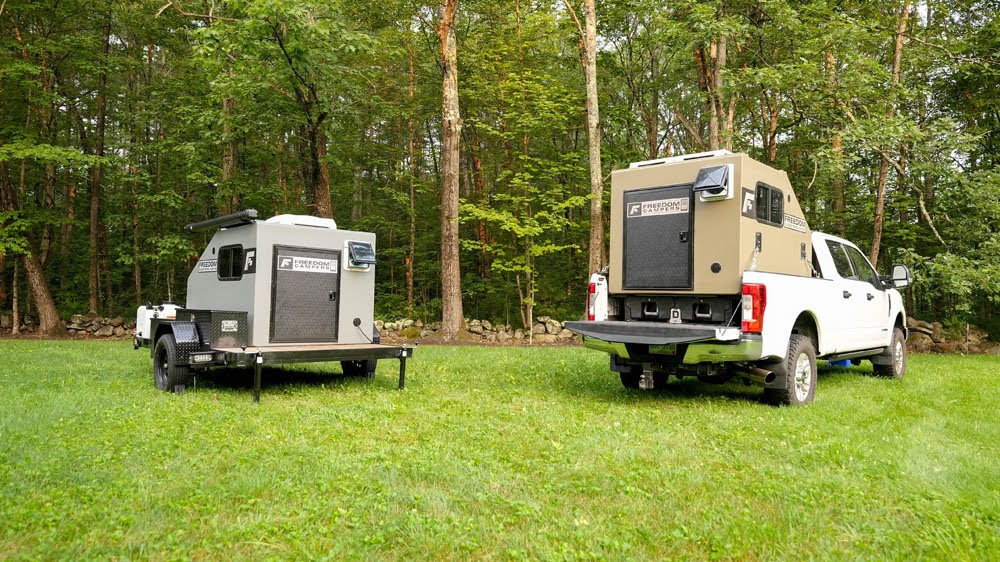
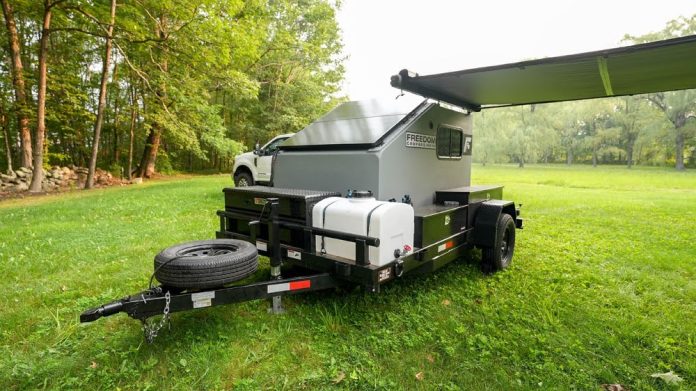
The Freedom Camper from Redneck Blinds is one of the clearest expressions of the simplicity in overlanding trend to come out of the past two years. It’s a lightweight, insulated truck bed camper available in four sizes, from 48×79 inches for midsize trucks up to a 72×89-inch model for trailer use. Weight runs 180 to 270 pounds depending on the size. It fits in a pickup bed or on a utility trailer. A turnbuckle mounting system secures it firmly, and the insulation rates for comfort down to 20 degrees F without supplemental heat. The price starts at $3,400 and tops out at $4,399.99. There’s no plumbing, no slide-out, no complicated leveling system. It’s a shelter. A very good one, built in Lamar, Missouri and backed by a 3-year warranty – but fundamentally, a shelter.
That simplicity is the point. Two people load it into a truck bed without a crane. Drive to your destination, mount it in your bed or drop it on a trailer, and you’re sleeping that night. Leave it at camp when you want to run the trails unburdened. Optional Freedom Camper accessories include a 12-volt air conditioner or ventilation fan for climate control, and the roof has composite wood mounting panels for racks, solar, or awnings. The Freedom Camper is a platform, not a finished product – and that’s by design. It gives you the foundation and lets you build from there on your own terms. For a full hands-on breakdown, the Freedom Camper review covers everything from sizing to real-world performance.
The Freedom Camper doesn’t compete with a Lance 960 or a Northern Lite. It costs a fraction of either and weighs a fraction of either. It requires no special truck prep, no weight distribution system, no complicated mounting procedure. You buy it, build a simple wheel-well platform using Redneck Blinds’ free DIY guide, and go camping. For the overlanding community that spent the last decade adding systems, that sequence is refreshing.
Simple Rigs vs. Full Builds: Which Is Right for You?
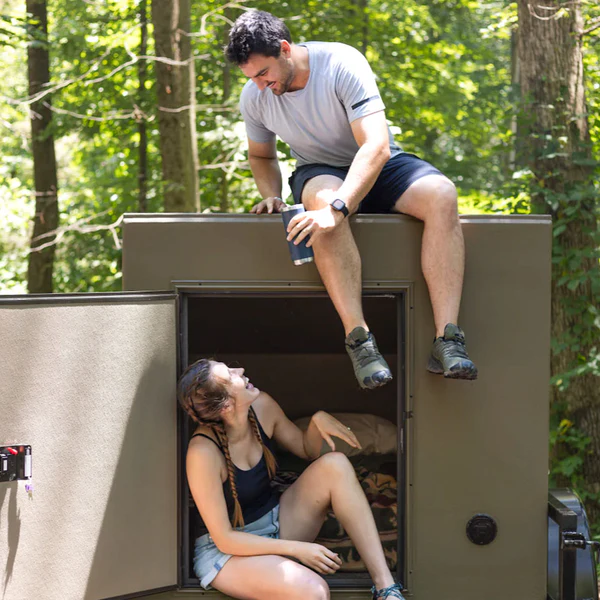
The honest answer to this question depends on one thing more than anything else: how often you go. A full-build rig – heavy slide-in truck camper, fully equipped trailer, van conversion – makes sense if you’re living out of it for weeks at a time or running multi-week expeditions. For those use cases, the amenities pay for themselves in comfort and capability. However, for the majority of overlanders who are running weekend trips and occasional week-long outings, the full build introduces more friction than it removes. You spend more time preparing, more money maintaining, and more energy managing systems instead of using them.
A simple overlanding rig compresses the gap between “I want to go” and “I’m going.” That gap is where most camping trips die. Friction between impulse and action kills more outings than bad weather. A heavy, complicated setup raises the activation energy of every trip. When it takes two hours to prep and load your rig, a spontaneous Friday-night departure starts to feel like a project. When your setup takes 20 minutes, it stays a trip. Simple camping rigs win here by a wide margin, and that margin matters more the busier your life gets.
The financial comparison is also worth making directly. A full-size hard-side truck camper with insulation and amenities starts north of $15,000 and quickly climbs above $30,000 for quality builds. A well-equipped teardrop trailer runs $8,000 to $20,000. The Freedom Camper covers the core use case – weatherproof sleep for two, rated to 20 degrees F – at $3,400 to $4,399.99. For overlanders who prioritize access over amenities, the savings alone free up budget for the fuel, the tires, and the recovery gear that determine where you go.
Save on Your Overlanding Setup
Less Rig. More Miles. Same Adventure.
The Freedom Camper fits midsize and full-size trucks plus trailers. Two people load it without a hoist. Ships in the lower 48.
Pros and Cons of Going Simple
Pros
- Lower activation energy – trips happen more often when prep is fast
- Significant cost savings vs. full-build alternatives ($3,400 vs. $15,000 to $50,000+)
- Better payload headroom for water, recovery gear, and fuel
- Flexibility to detach shelter from your truck and run the trail unburdened
- Faster setup and breakdown – 20 minutes vs. hours for complex rigs
- Lower maintenance burden – fewer systems means fewer failure points
- Scales well for solo travelers and couples who need speed over space
Cons
- No kitchen, bathroom, or running water – external gear required for cooking and sanitation
- Limited interior space; 48-inch interior height means sitting, not standing
- Less suitable for extended expeditions where living space matters daily
- Social perception – simple rigs don’t photograph as impressively as full builds
- Requires discipline to resist adding gear back in over time
Final Verdict

The return of simplicity in overlanding isn’t nostalgia. It’s efficiency. The community got complicated because complication is seductive – there’s always one more piece of gear that promises to solve a problem you haven’t encountered yet. After enough trips, though, you learn what you use and what simply rides along taking up space and weight. Overlanders are arriving at that conclusion faster now because the data is clearer, the community conversation is more honest, and the products supporting simple setups have gotten genuinely good. The Freedom Camper is a useful example of all three things converging at once.
Whether you’re just starting to build a rig or you’re an experienced overlander reconsidering a heavy setup, the argument for going simple is worth taking seriously. Not because capability doesn’t matter – it does – but because the rig you take out every other weekend is more valuable than the rig you take out twice a year because it’s too much work. Simple camping rigs close that gap. They lower the barrier to going. And in overlanding, going is the point.
If you’re ready to simplify your setup, the Freedom Camper is worth a hard look. It starts at $3,400, fits midsize and full-size trucks and trailers, weighs 180 to 190 pounds for the three smaller models, and rates to 20 degrees F. It doesn’t replace your camp kitchen or your recovery gear. Instead, it handles the shelter piece cleanly and leaves room in your budget for everything else. Order the 58×89 for full-size trucks, the 48×79 for midsize rigs, and the 72×89 if you want a trailer-based basecamp. Register after purchase for the 3-year manufacturing warranty.
Ready to Simplify?
Check Today’s Price on the Freedom Camper
Ships direct from Redneck Blinds in the lower 48. Built in the USA. Backed by a 3-year manufacturing warranty.
Frequently Asked Questions
Why are overlanders moving back toward simpler setups?
Several factors are converging at once. Solo camping has grown for three consecutive years. Solo travelers quickly discover that complex rigs are difficult to manage alone. Rising gear costs have pushed people to question whether added expense delivers added experience. Payload concerns have made heavy builds harder to justify on half-ton and three-quarter-ton trucks. A growing cultural shift toward “rustic retreats” is also underway. Confirmed by 2025 camping trend surveys, it’s pulling the outdoor recreation market back toward nature immersion over amenities. Experienced overlanders, meanwhile, have long advocated for light and fast. The rest of the community is catching up.
What is a minimalist overlanding rig?
A minimalist camping setup for overlanding typically centers on the truck itself as the primary platform, with a lightweight shelter solution in the bed or on a trailer. Core components are shelter, a sleep system rated to expected temperatures, a compact food and water setup, and recovery gear suited to the terrain. Everything else is optional. The defining characteristic is manageability. One or two people handle the whole setup without special equipment. It breaks camp in under 30 minutes and leaves payload headroom for the gear used in the field.
Is the Freedom Camper a good choice for overlanding?
Yes, for the right use case. You can also find a dealer near you at the Freedom Camper dealer map if you prefer to see one in person before buying. It weighs 180 to 190 pounds, mounts to a truck bed or trailer with a turnbuckle system, and rates to 20 degrees F for four-season use. Leave it at basecamp while you run the trails. Without a kitchen or bathroom, it works best for people already running a camp stove setup and comfortable with dispersed camping. For those overlanders, it’s a strong fit.
How do you build a simple overlanding setup?
Start with shelter and sleep system, then water and food, then terrain-specific recovery gear. After each trip, pull everything out and note what you didn’t use. Remove those items before the next outing. Most people shed 30 to 50 percent of their starting gear over several trips and find their capability improves because they know their kit completely.
How does lightweight overlanding compare to a full RV build for weekend trips?
For weekend and week-long trips, lightweight overlanding almost always wins on frequency and flexibility. A simple camping rig requires less prep time per trip, costs less to buy and maintain, and keeps more of your truck’s payload budget free for fuel, water, and recovery gear. Full RV builds and heavy truck campers make sense for people spending multiple weeks on the road. For those trips, the living space and amenities justify the complexity and cost. For weekend warriors and occasional-week-long travelers, simplicity delivers more trips per year at lower total cost.
What should I look for when buying a lightweight truck bed camper?
Prioritize insulation rating, weight, and ease of mounting and removal. A four-season-rated insulated shell keeps you comfortable across more of the year without supplemental heat, which matters if you’re camping at elevation or in shoulder seasons in the West. Weight determines whether two people handle loading without equipment – under 200 pounds for the shelter itself is a practical target. Mounting systems should be secure enough to prevent movement on rough roads while still allowing removal when you need the bed for other use. Warranty coverage and domestic manufacturing are also worth factoring into the decision.
Heads up: Clicking on our affiliate links and exploring our sponsored content helps us at no extra cost to you, and we only recommend gear we’re absolutely crazy about!