


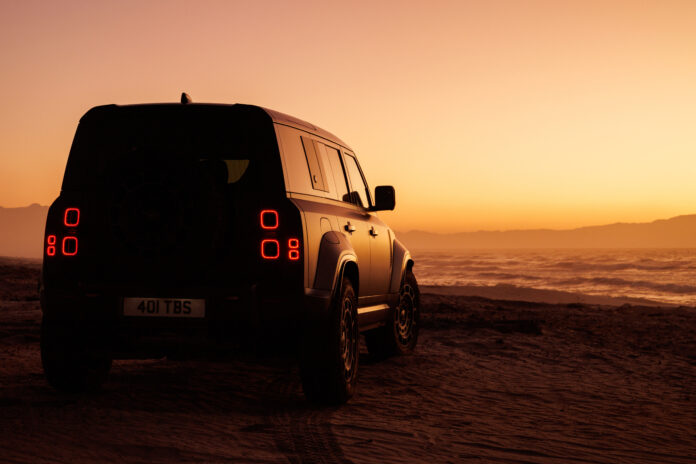

Quick Verdict: The 2026 Land Rover Defender lineup spans four body styles: 90, 110, 130, and OCTA. Pricing runs from $63,500 for a Defender 110 S to $158,300 for the 626-hp OCTA. At the center of the range sits the Defender 110. It offers five doors, seating for up to seven, 11.5 inches of ground clearance, 35 inches of wading depth, and an 8,200-pound tow rating on most trims.
Owners reward it with a 4.5 out of 5 score on Edmunds and an 82 out of 100 Quality and Reliability rating from J.D. Power. However, the same sources flag specific weak points: DC-DC converter failures on the mild-hybrid inline-six, windshield fragility (subject to a class action), and ownership costs of roughly $18,846 over the first 10 years per CarEdge. This guide breaks down each trim, engine, off-road number, and known issue so you walk into a dealership knowing what to ask.
Last updated: May 2026 | 15 min read | Comprehensive buyer’s guide
In This Buyer’s Guide
- What the 2026 Land Rover Defender Represents
- Defender 90 vs 110 vs 130 vs OCTA: Picking a Body Style
- Defender 110 Trim Walk: S, X-Dynamic SE, X, V8, and Trophy Edition
- Engine Options Explained: P300, P400, P500, P525, and OCTA
- Off-Road Hardware and Capability Numbers
- Interior, Cargo, and Technology
- Reliability Score: What the Data Says
- Known Problems Buyers Should Ask About
- Maintenance and Ownership Costs
- How the Defender Compares to the Competition
- Who Each Configuration Is Right For
- Frequently Asked Questions
What the 2026 Land Rover Defender Represents
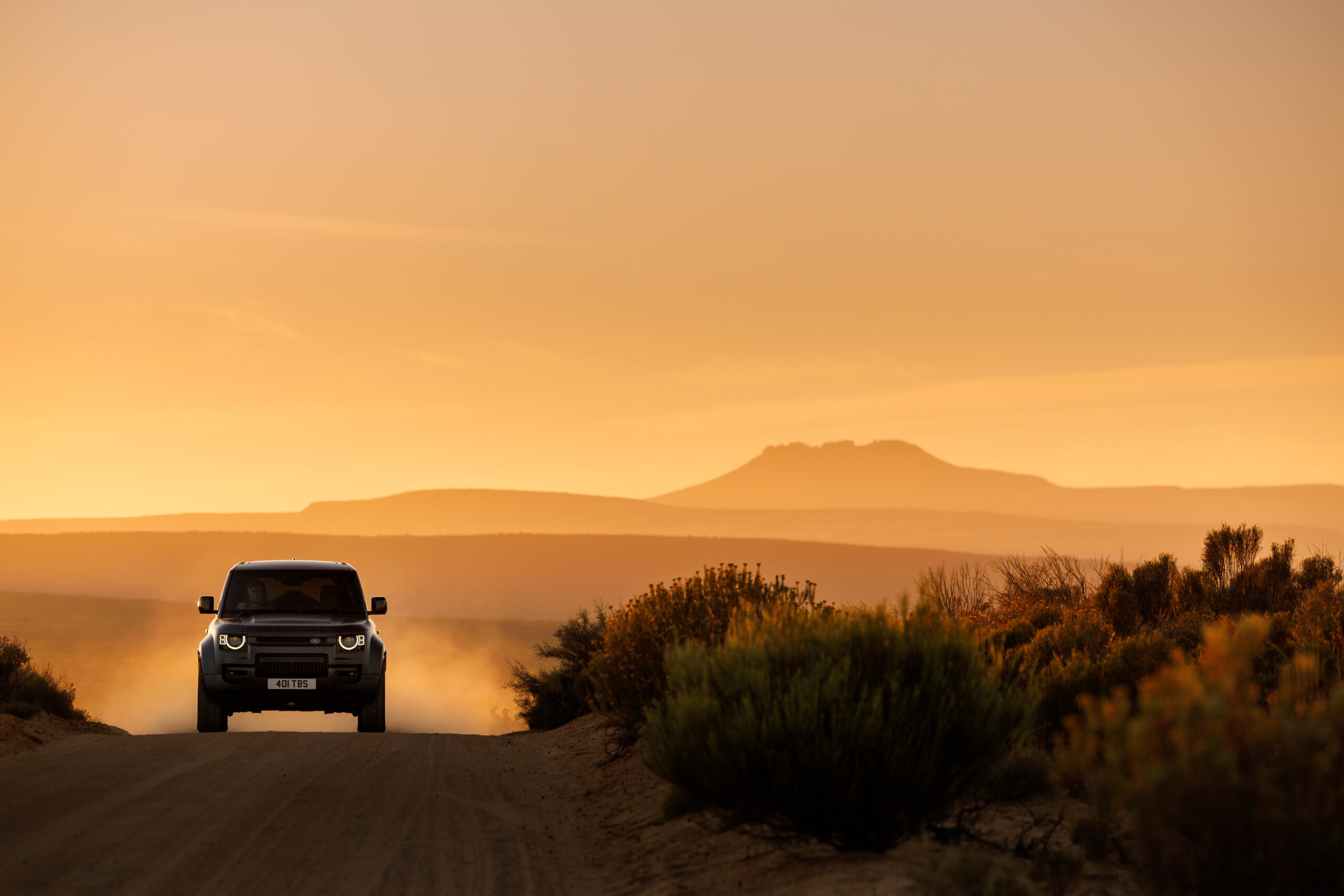
Originally launched in 2020, the current Defender is a clean-sheet redesign of an icon originally produced from 1948 to 2016. Land Rover scrapped the body-on-frame ladder construction of the original. Instead, the new model uses the D7x monocoque platform, a unibody architecture stiffened with an aluminum-intensive structure. The result drives more like a luxury SUV than the agricultural tool the old Defender was. Still, it retains a twin-speed transfer case, a locking center differential, and serious off-road geometry.
Specifically, the 2026 lineup includes four body styles (90, 110, 130, and OCTA). Engines range from a 296-hp turbocharged four-cylinder to a 626-hp twin-turbo V8. Pricing runs from the low $60,000s to north of $200,000 on heavily optioned OCTA Black trucks. The 2026 model year carries forward the architecture introduced in 2020, with refinements including Adaptive Off-Road Cruise Control on higher trims and expanded Trophy Edition availability.
Importantly, the Defender is not a body-on-frame solid-axle off-roader like a Jeep Wrangler or Toyota Land Cruiser. Instead, it uses independent front and rear suspension with available air springs. As a result, it rides better on pavement. On trails, it relies on suspension travel, electronic terrain management, and torque vectoring rather than axle articulation. Buyers cross-shopping a Wrangler Rubicon should understand this distinction before signing.
Defender 90 vs 110 vs 130 vs OCTA: Picking a Body Style
Practically, body style is the first decision and the one which locks in seating, cargo, and personality more than any other choice. Land Rover names each variant by an approximation of its wheelbase in inches, a tradition carried from the original Defender. Here is how the four configurations stack up.
| Body Style | Doors | Seats | Cargo Behind 1st Row | Length | Starting MSRP |
|---|---|---|---|---|---|
| Defender 90 | 3 (2-door style) | 5 to 6 | 44.6 cu ft | 180.5 in | ~$60,150 |
| Defender 110 | 5 | 5 to 7 | 66.2 cu ft | 197.5 in | $63,500 |
| Defender 130 | 5 | 8 | 76.1 cu ft | 211.7 in | $73,000 |
| Defender OCTA (110-based) | 5 | 5 | 78.8 cu ft | 197.5 in | $158,300 |
Defender 90: The Short-Wheelbase Original
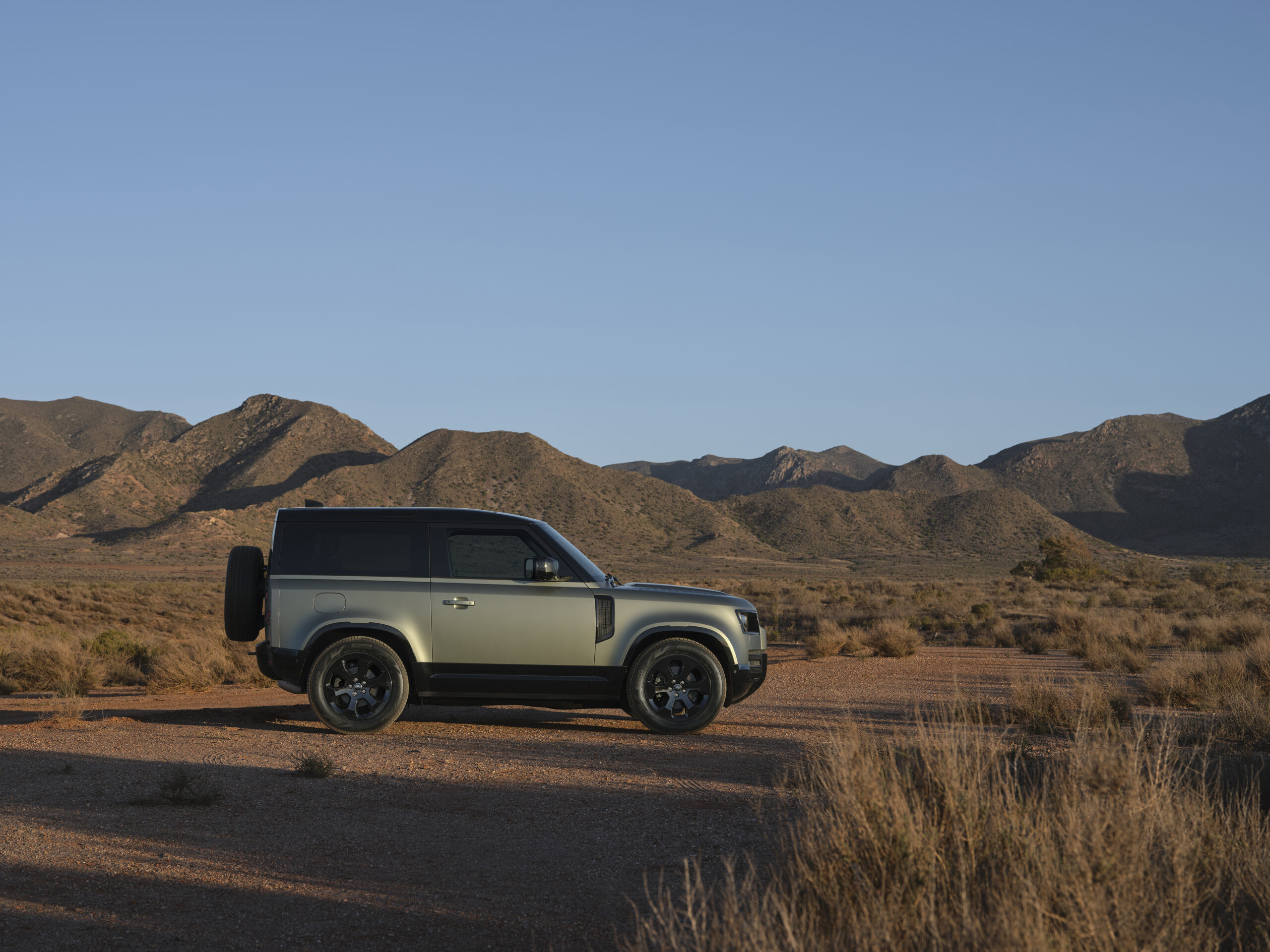
Starting near $60,150, the Defender 90 is the short-wheelbase three-door (rear access doors are integrated into the body, not a separate set). It targets buyers who want maximum trail nimbleness, a tighter footprint for daily use, and the iconic short-Defender silhouette. Inside, the 90 seats five comfortably or six with the optional front jump seat. However, cargo behind the rear seat is tight at 44.6 cubic feet, and rear passengers crawl in through the front doors. Notably, this is the only body style available with the V8 in its most aggressive 518-horsepower tune.
Defender 110: The Volume Pick
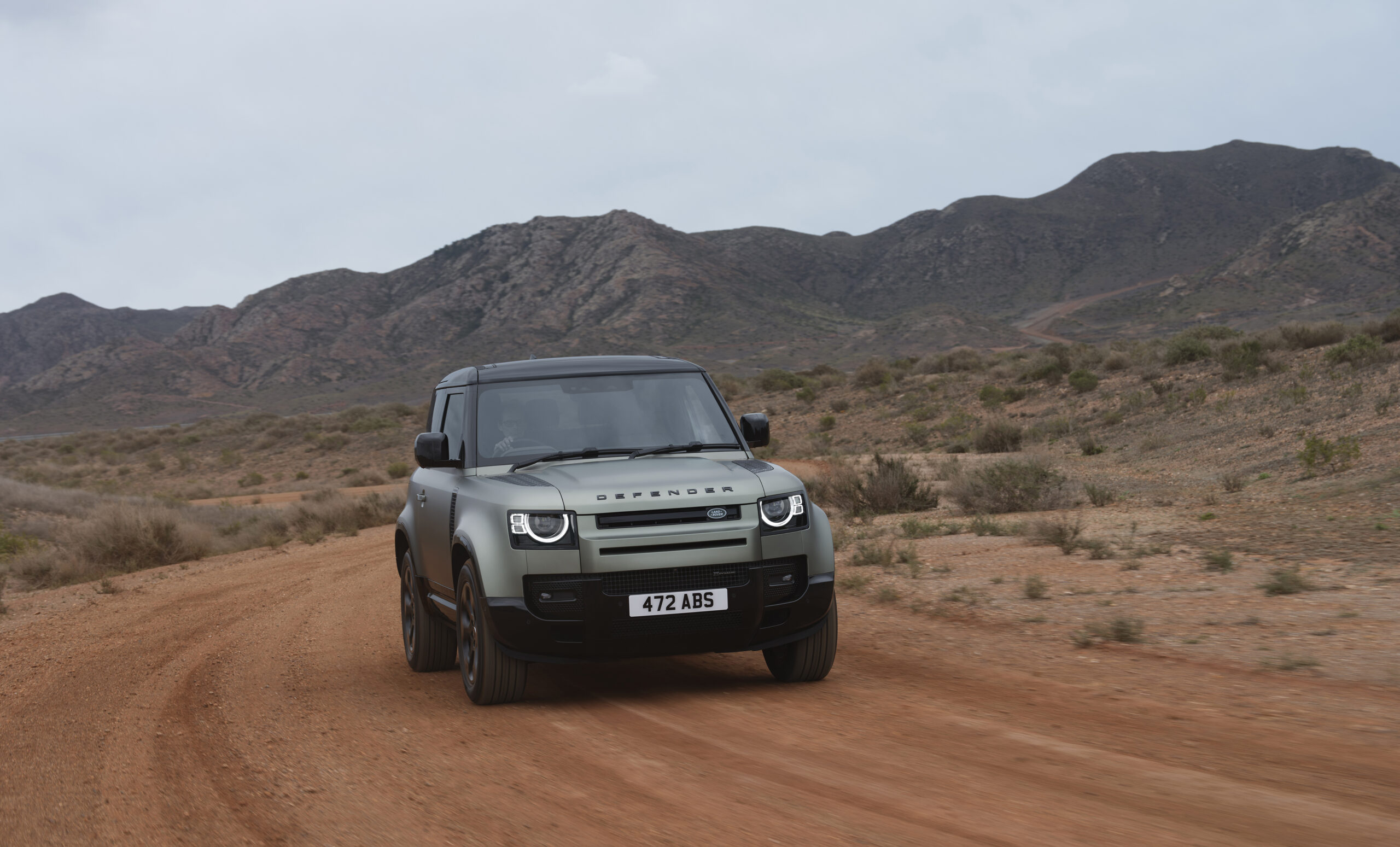
For most US buyers, the Defender 110 is the volume seller and the default recommendation. The five-door body adds 17 inches of wheelbase over the 90, accommodates five passengers as standard, and offers an optional third row which brings capacity to seven. Cargo expands to 66.2 cubic feet behind the second row and ride quality improves noticeably over the 90 thanks to the longer wheelbase. Every powertrain except the highest 518-hp V8 tune is available, and every appearance package fits this body.
Defender 130: The Three-Row Hauler
For families needing eight passengers, the Defender 130 stretches the 110 wheelbase by 14 extra inches of rear overhang. The added length fits a true eight-passenger cabin with usable third-row space. It is the family hauler of the range. The 130 carries the most cargo (76.1 cubic feet behind the second row), but the extended rear overhang reduces departure angle compared to the 90 or 110. For families considering a Land Cruiser, Wagoneer, or Suburban with off-road intent, the 130 alone competes on third-row practicality.
Defender OCTA: The 626-HP Performance Flagship
Sitting atop the lineup, the Defender OCTA arrived for the 2025 model year as Land Rover’s most extreme factory off-roader ever. Built on the 110 body, it gets the 626-hp 4.4-liter twin-turbo V8 from BMW, sourced and tuned for JLR. It also adds unique 6D Dynamics hydraulically interlinked dampers replacing traditional anti-roll bars, widened bodywork, and a wider track. Pricing starts at $158,300. Well-optioned OCTA Black trucks at dealers stretch past $214,000 once dealer accessories and fees are added.
Defender 110 Trim Walk: S, X-Dynamic SE, X, V8, and Trophy Edition
Land Rover sells the 110 in a four-step trim ladder plus appearance editions. Each step bundles a unique combination of engine, wheels, interior, and off-road hardware. Here is what differentiates them.
| Trim | Standard Engine | Starting MSRP | Key Inclusions |
|---|---|---|---|
| Defender S | 2.0L I4 (P300) | $63,500 | 19″ wheels, Meridian audio, 12-way heated seats, 3D surround camera |
| X-Dynamic SE | 3.0L I6 MHEV (P400) | $75,200 | 20″ Satin Dark Grey wheels, cooled front seats, Meridian Surround, Black contrast roof |
| Trophy Edition | 3.0L I6 MHEV (P400) | $87,400 | Deep Sandglow Yellow or Keswick Green, Windsor leather, Configurable Terrain Response |
| Defender X | 3.0L I6 MHEV (P400) | $95,600 | 22″ wheels, panoramic roof, Windsor leather and Kvadrat seats, Electronic Active Differential, Adaptive Off-Road Cruise |
| Defender V8 | 5.0L Supercharged V8 (P525) | $118,300 | 22″ wheels, quad exhaust, three-zone climate, Wade Sensing, Cabin Air Purification Plus |
Defender S: The Value Entry Point
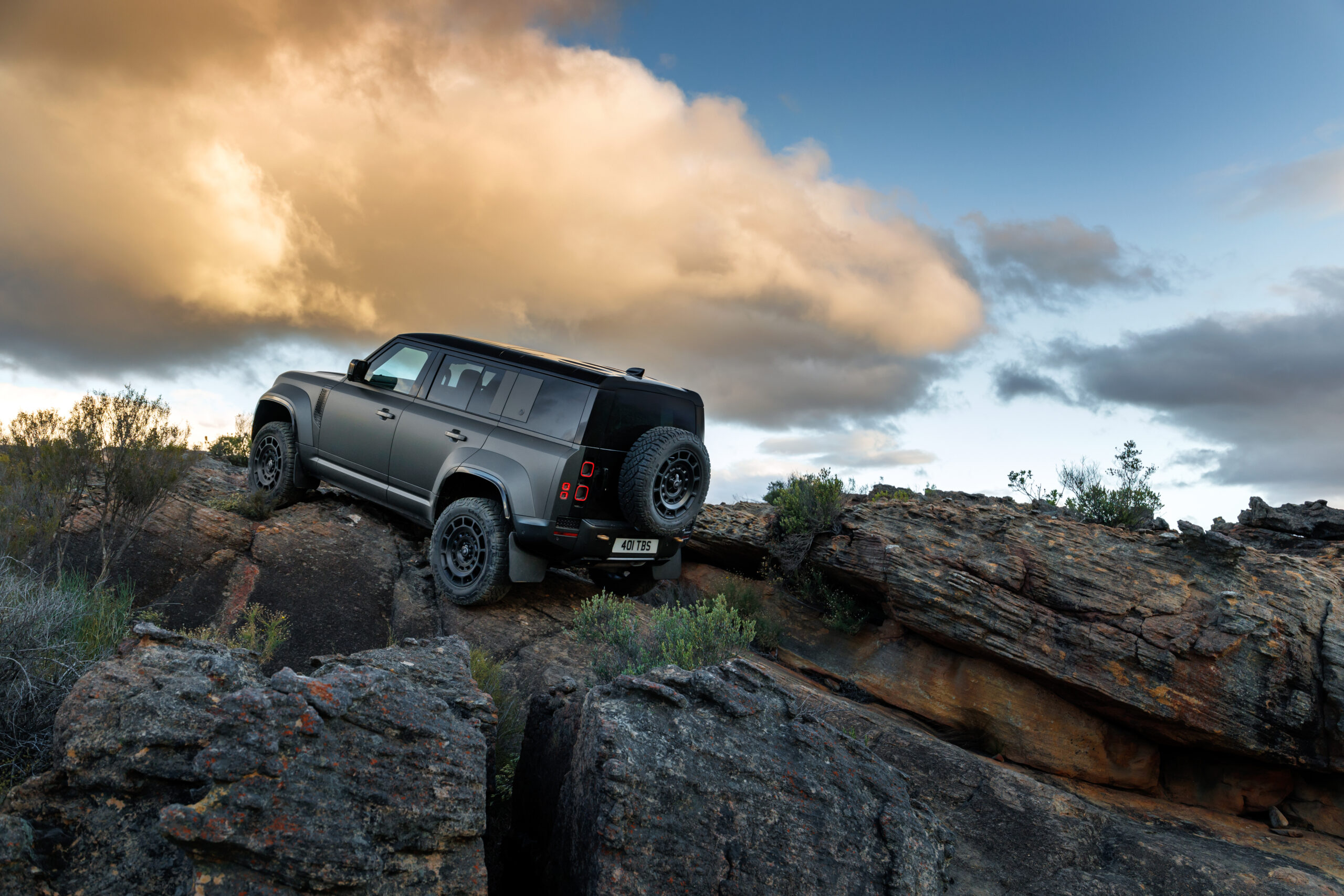
At $63,500, the base Defender S is more equipped than most buyers expect. Standard features include the 13.1-inch Pivi Pro touchscreen, Meridian audio, wireless charging, a 3D surround camera, adaptive cruise control, lane keep assist, and blind spot monitoring. The S is the only trim shipping with the 296-horsepower four-cylinder. As a result, towing tops out at 7,716 pounds and 0-60 takes a leisurely 7.0 seconds. Still, the S is the value pick for buyers who want the look and capability without the running costs of the six- or eight-cylinder options.
X-Dynamic SE: Where Most Buyers Land
At $75,200, the X-Dynamic SE is the volume trim. The $11,700 step from the S buys the 395-horsepower mild-hybrid six, which drops 0-60 to 5.8 seconds. Additionally, the SE adds 20-inch wheels, cooled seats, an upgraded sound system, and a Black contrast roof. This is the trim Edmunds lists as “Most Popular” at $73,725 (close to the $75,200 base before options).
Trophy Edition: The Heritage-Color Pick
At $87,400, the Trophy Edition, new with broader 2026 availability, sits between X-Dynamic SE and X. Buyers choose between Deep Sandglow Yellow or Keswick Green paint. Both pair with a black contrast hood, signature graphic, Windsor leather seats, and the inline-six. It is an appearance and color play more than a hardware upgrade, but it adds Configurable Terrain Response and Wade Sensing not standard on the X-Dynamic SE.
Defender X: The Loaded Mild-Hybrid Flagship
At $95,600, the Defender X sits atop the standard mild-hybrid lineup. Specifically, the $20,400 step over X-Dynamic SE adds 22-inch wheels, a sliding panoramic roof, and Windsor leather with Kvadrat seats. It also brings Adaptive Off-Road Cruise Control and the Electronic Active Differential with Torque Vectoring by Braking. The X is also the trim Edmunds calls its “Editors’ Pick” at $93,425. Wade Sensing (which uses sensors to display water depth on the touchscreen) is also standard.
Defender V8: The Supercharged Statement
At $118,300, the Defender V8 trades hybrid efficiency for naturally raucous performance. Mechanically, the 5.0-liter supercharged V8 makes 518 horsepower in the 90, where it hits 60 mph in about 4.4 seconds per Car and Driver. In the 110, it makes 493 horsepower and runs 0-60 in 5.0 seconds per MotorWeek. The V8 trim adds quad exhaust outlets, Terrain Response 2 with Dynamic Program, and three-zone climate control. Be aware the V8 has zero dynamic roof load capacity, meaning roof racks must remain static-load only.
Configure Your 2026 Defender
See current pricing, paint colors, wheel options, and packages on the official configurator. Specs and availability update in real time.
Engine Options Explained: P300, P400, P500, P525, and OCTA
For reference, Land Rover labels Defender engines by their metric horsepower figures (P300 = roughly 300 PS, P400 = 400 PS, etc.). Here is what each one delivers in the US lineup.
| Engine Code | Configuration | HP / Torque | 0-60 mph | EPA Combined |
|---|---|---|---|---|
| P300 | 2.0L turbo I4 | 296 hp / 295 lb-ft | 7.0 sec (110) | ~19 mpg |
| P400 | 3.0L turbo I6 MHEV | 395 hp / 406 lb-ft | 5.8 sec (110) | ~18 mpg |
| P500 | 5.0L supercharged V8 | 493 hp / 450 lb-ft | 5.0 sec (110) | 16 mpg (MotorWeek) |
| P525 | 5.0L supercharged V8 | 518 hp / 461 lb-ft | 4.4 sec (90, C&D test) | ~16 mpg |
| OCTA | 4.4L twin-turbo V8 | 626 hp / 590 lb-ft | 3.7 sec (C&D test) | 17 mpg |
P300: The 2.0L Turbo Four
Notably, the P300 four-cylinder is the value engine. Notably, it is also the most NHTSA-reliable engine in the Defender range based on owner complaint density. The Weekly Driver rates the P300 at 4.3 on a 5-point scale, versus 2.7 for the inline-six. It feels adequate around town and on highway cruises, but loaded with passengers, cargo, or a trailer it works hard. It does not include the mild-hybrid system blamed for problems for the I6.
P400: The Mild-Hybrid Inline-Six
For most buyers, the P400 inline-six with mild-hybrid technology is the powertrain to consider. It uses a 48-volt belt-integrated starter generator to recapture braking energy, smooth stop-start operation, and provide a small electric torque boost off the line. Smoothness and refinement are noticeably better than the four-cylinder. Additionally, 5.8-second 0-60 acceleration suits the chassis well. However, this engine carries the system most associated with owner complaints, specifically DC-DC converter failures on the mild-hybrid setup. More on those failures below.
P500 and P525: The Supercharged 5.0L V8
Mechanically, the P500 and P525 V8 trims share the same 5.0-liter supercharged V8 used elsewhere in the Jaguar Land Rover lineup. Specifically, the 90 and 110 V8 trims produce 518 horsepower (P525), while the 130 V8 is detuned to 493 horsepower (P500) to accommodate the heavier three-row body. Owners report the plastic coolant hoses on the V8 as a known weak point. Specifically, they crack and cause overheating past 20,000 to 30,000 miles. Quad exhaust outlets are standard on V8 trims.
OCTA: The 4.4L Twin-Turbo V8
At the top, the OCTA uses a 4.4-liter twin-turbocharged V8 (M177-family, originally a BMW/JLR collaboration) producing 626 horsepower and 590 lb-ft. Top speed is governed at 130 mph stock, raised to 155 mph with the Performance Pack. Additionally, the OCTA adds 6D Dynamics. This hydraulically interlinked damper system eliminates traditional anti-roll bars and lets the truck land sustained jumps without bottoming out. Car and Driver measured 0-60 in 3.7 seconds, faster than most sports cars.
Off-Road Hardware and Capability Numbers
The Defender’s marketing leans heavily on off-road imagery, and the numbers back up the brochure claims for buyers who use the capability. Here are the geometry and equipment specs to know on a trail.
Off-Road Geometry at a Glance
- Ground clearance: up to 11.5 inches with the available air suspension at off-road height
- Wading depth: 35 inches (exceeds the Jeep Wrangler at 30 inches)
- Approach angle: 31.5 degrees (90 and 110), up to 37.5 degrees on the 130
- Breakover angle: up to 28 degrees (110 with air suspension)
- Departure angle: 37.7 degrees (90), 40 degrees (110), reduced on 130 due to rear overhang
- Maximum towing: 8,200 pounds (most trims), 7,716 pounds (110 S with 2.0L)
Drivetrain and Terrain Management
Mechanically, standard four-wheel drive runs through a twin-speed transfer case with a locking center differential. In addition, Terrain Response (six selectable modes including Mud and Ruts, Sand, Rock Crawl, and Grass/Gravel/Snow) comes standard across the range. Moving up, Terrain Response 2 with Configurable Terrain Response is available on X-Dynamic SE and standard from Trophy Edition upward. It lets drivers customize throttle map, traction control, and differential lock behavior independently.
Differentials, Dampers, and Adaptive Cruise
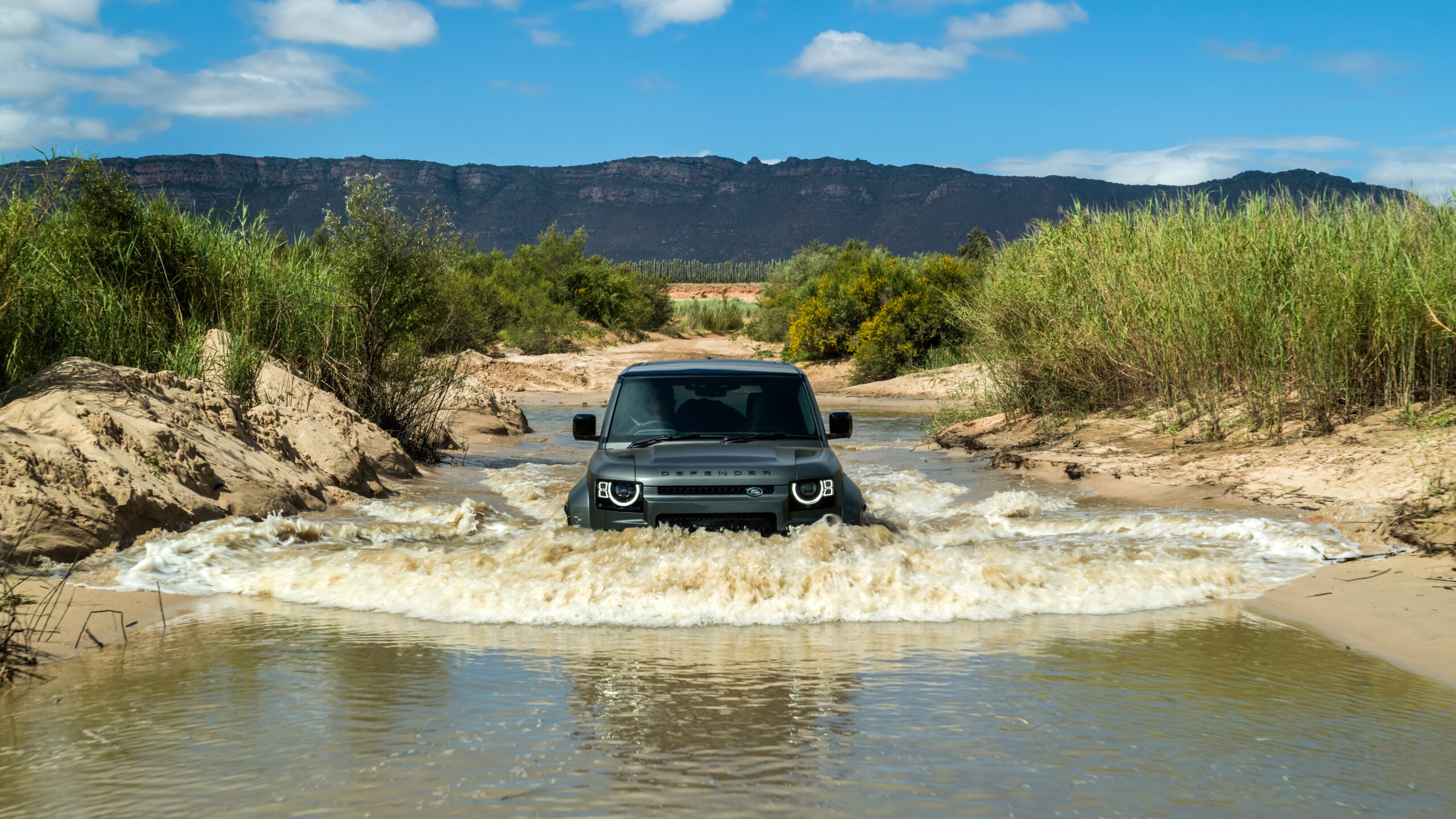
Specifically, the Electronic Active Differential with Torque Vectoring by Braking is standard on X, V8, and OCTA trims. In practice, it splits torque side to side across the rear axle to maintain traction on uneven surfaces. On the OCTA, hydraulically interlinked 6D Dynamics dampers go further. The setup lets the truck sustain repeated jump landings (a first for any Land Rover) without the suspension bottoming or the body rolling unpredictably.
Adaptive Off-Road Cruise Control is available on X and standard on V8 and OCTA. It maintains a set off-road speed across rough terrain while managing throttle and braking individually at each wheel. It is genuinely useful in rocky low-traction situations where holding a constant crawl speed manually requires concentration.
Interior, Cargo, and Technology
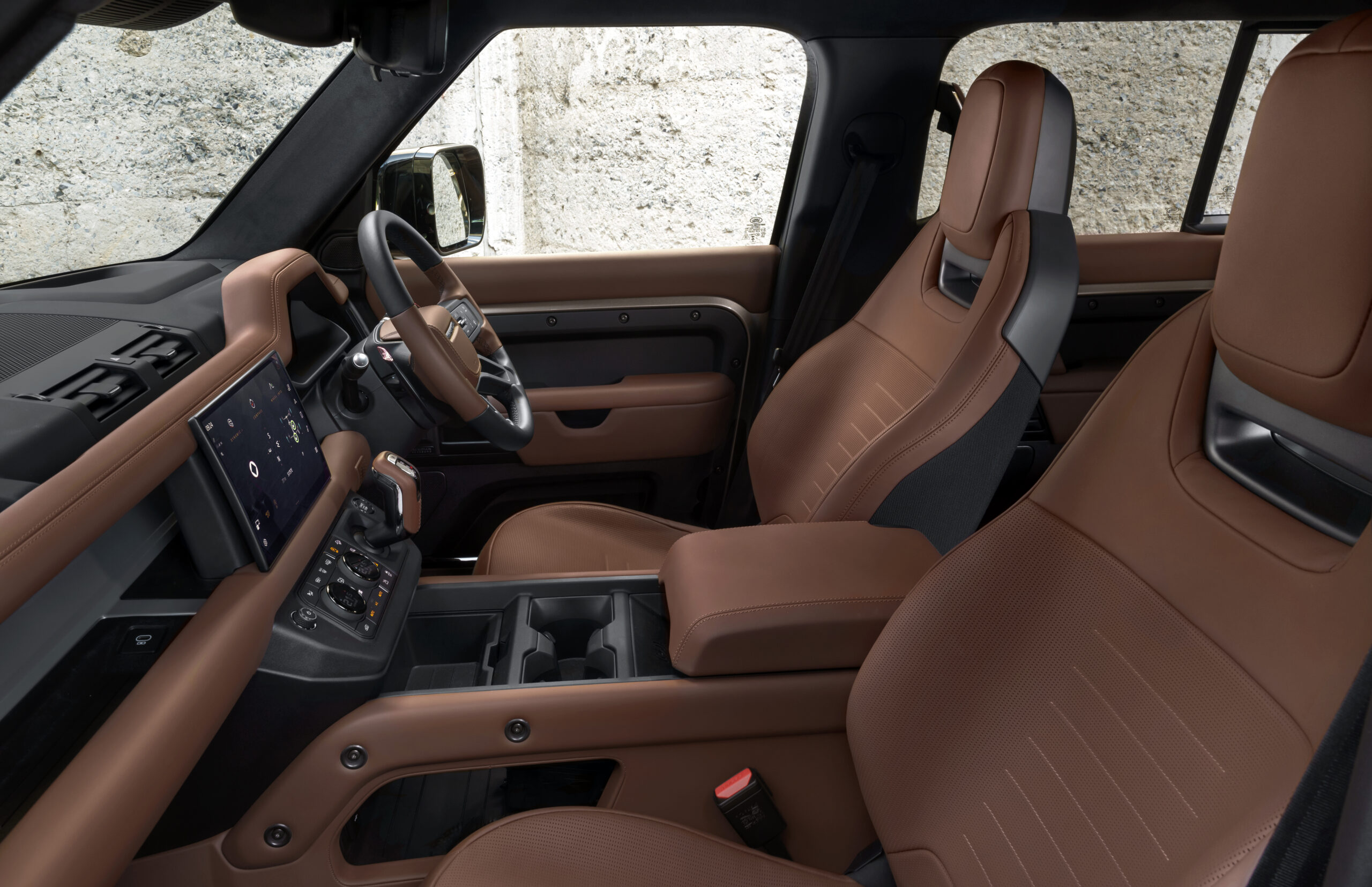
The cabin is where the new Defender most clearly separates itself from the old utilitarian model. Even the base S trim ships with a long standard list. It includes a 13.1-inch curved Pivi Pro touchscreen with wireless Apple CarPlay and Android Auto, a Meridian sound system, and wireless device charging. Additionally, a 3D surround camera with 360-degree view and adaptive cruise control with lane keep assist come standard. Pivi Pro is among the more responsive infotainment systems in the segment. However, early owners (2020 to 2022) reported the original system would freeze in hot weather. Software updates and hardware revisions have since addressed the issue.
Materials and Cabin Treatment
Inside, materials choices climb steeply with trim. At the base S, durable woven Resist fabric and rubber flooring make it easy to wipe down after muddy days. Moving up, the X-Dynamic SE switches to grained leather. By contrast, the X and V8 add Windsor leather with Kvadrat wool inserts. The wool emphasizes the Defender’s utilitarian-luxury positioning. Across all trims, configurable interior lighting, three USB-C ports, and a domestic plug socket come standard.
In terms of cargo, capacity scales with body length. For reference, the 110 offers 66.2 cubic feet behind the second row and 78.8 cubic feet with the second row folded. By comparison, the 90 is space-constrained at 44.6 cubic feet behind row two. Meanwhile, the 130 provides 76.1 cubic feet behind row two and the most space behind row three of any three-row body in the Defender range. Across the lineup, the side-hinged tailgate is standard. It swings open to the curb side, which proves awkward for parallel parking but works well on a trail or at a campsite.
Notably, the optional third row in the 110 adds two child-sized seats with limited adult space. Buyers who plan to regularly carry three rows of adults should consider the 130 instead, where the third row is genuinely usable.
Reliability Score: What the Data Says
Naturally, reliability is the question every Defender shopper asks and the question with the most contradictory answers. The dataset to know:
- J.D. Power 2025 Defender: 79 out of 100 overall, with Quality and Reliability scored at 82 out of 100 (rated “Great” in J.D. Power’s tier system)
- Edmunds owner ratings: 4.5 out of 5 stars from 32 reviews on the 2025 model year, with 81 percent giving 5 stars
- NHTSA complaints (2020-2025): 229 total complaints across six model years, with zero recalls during the period per The Weekly Driver’s NHTSA aggregation
- Engine-specific NHTSA ratings: 2.0L I4 = 4.3 (Recommended), 5.0L V8 = 2.9 (Caution), 3.0L I6 MHEV = 2.7 (Caution)
What the Scores Show
Notably, J.D. Power’s 82-out-of-100 Quality and Reliability score is strong for a luxury SUV. Owners rated the engine’s power and storage flexibility as top likes. Common dislikes included fuel economy, ease of getting into the front seats (the high ride height is a step up), and cabin noise on the highway.
Owner Ratings Tell a Bimodal Story
Meanwhile, Edmunds’ 4.5-star aggregate masks a bimodal distribution. Specifically, 81 percent of reviewers give five stars while 10 percent give one star. Most one-star complaints center on specific failure modes: windshield cracking, electrical issues, and dealer service experience. The split matters. The Defender appears to be either a great ownership experience or a frustrating one, with relatively few owners in the middle.
What the NHTSA Data Reveals
By contrast, the NHTSA dataset (compiled by The Weekly Driver from 2020 through 2025) shows 229 complaints. The complaints cluster in Electrical (75), Exterior (33), Engine (27), and Steering (24). The most common single issue is the DC-DC converter on the mild-hybrid 48-volt to 12-volt system. It accounts for the majority of the 93 battery and propulsion complaints. Multiple owners reported a “Stop Safely, Electrical Fault Detected” warning followed by complete loss of power. At some dealers, replacement DC-DC converters have been on indefinite back order.
Overall, the pattern is consistent: the Defender is broadly reliable by luxury SUV standards, but specific failure modes get expensive and frustrating when they occur. Engine choice has a measurable impact on probability of issues.
Known Problems Buyers Should Ask About
If you are walking into a dealer, these are the issues to mention by name and ask about service history, parts availability, and warranty coverage.
DC-DC Converter Failure on the Mild-Hybrid I6
The 48-volt mild-hybrid system’s DC-DC converter steps voltage down to 12-volt for accessories. It has failed in a notable number of P400 inline-six vehicles, primarily 2022 through 2024 model years. Symptoms include a “Stop Safely, Electrical Fault Detected” warning, dashboard light cascade, and sudden loss of propulsion. Replacement parts have been on back order at multiple US dealers. Ask whether the unit has been replaced under warranty or whether a service bulletin has been performed.
Windshield Cracking
Multiple owners report windshields cracking spontaneously or after minor rock impact. A class action lawsuit has been referenced in Edmunds consumer reviews. Often, insurance comprehensive deductible reductions do not apply because the cracks appear unprompted. Dealer replacement quotes run around $3,400 with parts on back order for months. Buyers should consider supplemental glass coverage.
V8 Plastic Coolant Hoses
The 5.0L supercharged V8 uses plastic coolant hose runs which have cracked and caused overheating, particularly past 18,000 to 25,000 miles. Owners on the NewDefender subreddit consistently report this issue. Some have proactively replaced the affected hoses with aftermarket silicone units.
Early Infotainment Freezes
The 2020 through 2022 Pivi Pro system was known to freeze or reboot in hot weather. Subsequently, Land Rover addressed this through hardware revisions and software updates. Most 2023 and later units are reliable, but it is worth asking whether software is current.
Headlight Failures
A smaller cluster of owner reports cite LED headlight modules failing prematurely, typically replaced under warranty but expensive out of pocket.
Importantly, none of these issues alone disqualifies the Defender. However, they should inform negotiations on extended warranty coverage and dealer service relationships. Importantly, the standard Land Rover new vehicle limited warranty is 4 years or 50,000 miles, with a matching powertrain warranty.
Maintenance and Ownership Costs
Predictably, Defender ownership costs reflect the brand’s luxury positioning and the technical complexity of the platform. The data points to know:
- RepairPal average for the Land Rover brand: $1,174 per year in repair and maintenance costs
- CarEdge 10-year projection for the modern Defender: approximately $18,846 in maintenance and repairs over the first decade
- Industry average for luxury compact SUVs: $859 per year per RepairPal
- Typical EPA combined fuel economy: 18 to 19 mpg on the I4 and I6 trims; 16 to 17 mpg on V8 trims; OCTA at 17 mpg combined
Scheduled Maintenance and Tire Costs
Typically, annual maintenance includes oil changes, brake fluid changes, coolant flushes, and transmission fluid services. Land Rover specifies 16,000-mile oil intervals, but most independent shops recommend 10,000 miles for harsh use. Brake fluid changes every 2 years, coolant every 5 years, and transmission fluid at 100,000 miles round out the schedule. Tire costs are a meaningful line item. Particularly on X and V8 trims with 22-inch wheels, the low-profile rubber wears faster. Replacement runs $400 to $700 per tire.
Out-of-Warranty Repair Estimates
However, out-of-warranty repair costs scale with vehicle complexity. A DC-DC converter replacement on the I6 mild-hybrid system exceeds $2,500 in parts and labor at a dealer, when units are available. A windshield runs about $3,400 with the rain and light sensor recalibration. V8 coolant hose replacement runs $800 to $1,400. Air suspension components (struts and compressor) become a concern past 75,000 miles. Replacement costs run $2,000 to $4,000.
On the upside, Additionally, Land Rover offers a complimentary 5-year/60,000-mile scheduled maintenance program on most new Defenders (“Land Rover Service Plan”). This significantly reduces first-owner costs. Extended warranties are available through Land Rover Premium Warranty (up to 7 years or 100,000 miles) and through third parties. Given the failure mode patterns, extended warranty coverage is worth pricing for owners planning to keep the truck past the standard 4-year or 50,000-mile warranty period.
How the Defender Compares to the Competition
The Defender’s primary cross-shop competitors fall into three groups, each with a different value proposition.
First, against the Jeep Wrangler Rubicon and Gladiator, the Defender offers significantly better on-road manners and far more luxurious interior materials. In addition, it brings more usable technology and slightly better wading depth (35 inches versus 30 inches). However, the Wrangler counters with removable doors and roof, solid axles for trail articulation, a stronger aftermarket parts ecosystem, lower acquisition cost, and significantly lower long-term ownership costs.
Second, against the Toyota Land Cruiser, the Defender offers more engine choices. By contrast, the Land Cruiser is hybrid four-cylinder only in 2026. Additionally, the Defender brings a stronger luxury interior and the OCTA performance halo. However, the Land Cruiser counters with Toyota’s reliability track record, lower projected ownership costs, and a slightly more spacious second row in equivalent body styles.
Third, against the Mercedes-Benz G-Class, the Defender offers a more sensible base price. Specifically, the G-Class starts in the $150,000s. In addition, the Defender brings more usable cargo and rear seat space, and arguably better off-road geometry. However, the G-Class counters with stronger residual values, the prestige of the three-pointed star, and an even more substantial hand-built feel.
Finally, against the Ford Bronco, the Defender offers a substantially more refined cabin. Additionally, it brings higher base capability with the air suspension and a stronger powertrain ladder. However, the Bronco counters with significantly lower pricing, a more focused trail aesthetic, removable doors and top, and Ford’s more accessible dealer network.
Who Each Configuration Is Right For
Given the data above, here is who each Defender configuration best serves.
Best For: Defender 90 Buyers
Solo overlanders, couples, and buyers wanting maximum personality from the platform. The 90 is for buyers who prize the iconic short-Defender silhouette and trail nimbleness over rear-seat space. The 90 is the choice for solo overlanders, couples, and buyers who want maximum personality from the platform.
Best For: Defender 110 S Buyers
Buyers who want the look, off-road geometry, and technology, but plan to use the truck primarily on pavement. The 110 S delivers the lowest acquisition and operating costs in the lineup. The 2.0L four-cylinder is the most reliable engine in the lineup by NHTSA complaint density.
Best For: Defender 110 X-Dynamic SE Buyers
Buyers wanting the inline-six’s refinement and acceleration, willing to absorb the maintenance cost risk of the mild-hybrid system. The X-Dynamic SE is the most popular configuration and carries strong resale support.
Best For: Defender 110 X Buyers
Buyers wanting the Electronic Active Differential, Adaptive Off-Road Cruise Control, and premium interior treatment. The X serves serious off-road users who also want luxury appointments.
Best For: Defender 110 V8 Buyers
Buyers wanting a Defender to sound and accelerate like a performance SUV. The V8 trades higher operating costs and lower fuel economy for a louder visual statement, quad exhaust, and 22-inch wheels.
Best For: Defender 130 Buyers
Families needing three rows of usable seating with the Defender’s off-road geometry. The 130 also fits buyers carrying passengers and gear regularly. The trade-off is reduced departure angle on technical trails.
Best For: Defender OCTA Buyers
Buyers with the budget for a six-figure performance SUV. The OCTA delivers desert-running capability comparable to a Ford Raptor R or Ram TRX, but in a Land Rover-badged package with a luxury interior. Indeed, the OCTA is a niche product but a uniquely capable one.
Schedule a Test Drive
A 30-minute test drive answers questions no spec sheet covers, especially seating position, visibility, and ride quality. Use the official Land Rover retailer locator to find your nearest dealer.
Frequently Asked Questions
Pricing and Configuration FAQs
How much does a 2026 Land Rover Defender cost?
Pricing for 2026 starts at $63,500 for the Defender 110 S, $73,000 for the Defender 130 S, and $158,300 for the high-performance OCTA. Separately, the Defender 90 starts around $60,150. Notably, add $1,950 destination on every configuration. For perspective, well-optioned X and V8 trims push past $100,000, and OCTA Black models at dealers stretch past $214,000 with options.
What is the difference between Defender 90, 110, 130, and OCTA?
Historically, the number refers to approximate wheelbase in inches (a tradition from the original Defender). Specifically, the 90 is a short three-door. By comparison, the 110 is the five-door volume model. Meanwhile, the 130 is an extended five-door with eight-passenger seating. Finally, the OCTA is a 626-horsepower performance variant built on the 110 body with widened track and unique 6D Dynamics suspension.
What is the OCTA?
The Defender OCTA is Land Rover’s most extreme factory off-roader. It uses a 626-hp 4.4L twin-turbo V8, 6D Dynamics hydraulically interlinked dampers (replacing anti-roll bars), widened track, and unique bodywork. The design lets it sustain repeated jump landings and high-speed desert running. For reference, pricing starts at $158,300 and OCTA Black trims at dealers exceed $200,000.
Reliability and Ownership FAQs
Is the Land Rover Defender reliable?
J.D. Power rates the 2025 Defender 82 out of 100 for Quality and Reliability (“Great” tier), and Edmunds owners average 4.5 out of 5 stars. However, NHTSA data shows 229 complaints from 2020 to 2025 with the mild-hybrid 3.0L inline-six rated “Caution” due to DC-DC converter failures. The 2.0L four-cylinder rates better than the I6 or V8 for owner-reported issues.
What is the maintenance cost on a Land Rover Defender?
RepairPal estimates the Land Rover brand at $1,174 per year average maintenance cost, roughly 30 percent above the luxury compact SUV class average of $859. CarEdge projects roughly $18,846 over the first 10 years of ownership for a modern Defender. Land Rover includes a 5-year/60,000-mile scheduled maintenance program on most new Defenders.
What are the most common Defender problems?
The top reported issues include DC-DC converter failure on the mild-hybrid 3.0L inline-six and spontaneous windshield cracking (subject to a class action). Additionally, owners report plastic coolant hose failures on the 5.0L V8 and early infotainment freezing on 2020 through 2022 models. Generally, most issues are addressable under warranty, but parts back orders have been a problem.
What is the Defender warranty?
The standard Land Rover new vehicle limited warranty is 4 years or 50,000 miles, with a matching powertrain warranty. Additionally, a complimentary 5-year/60,000-mile scheduled maintenance program is included on most new Defenders. Beyond standard coverage, extended warranties through Land Rover Premium Warranty are available up to 7 years or 100,000 miles.
Capability and Specs FAQs
How much will a Defender tow?
Most Defender trims tow 8,200 pounds (3,720 kg). The Defender 110 S with the 2.0L four-cylinder is limited to 7,716 pounds. Importantly, maximum tongue weight on trailers with overrun brakes is higher than on trailers without; consult your dealer for specifics.
What is the wading depth of a Defender?
The Defender’s maximum wading depth is 35 inches, which exceeds the Jeep Wrangler’s 30 inches. Additionally, Wade Sensing (available on X and standard on V8 and OCTA) uses ultrasonic sensors in the side mirrors to display real-time water depth on the touchscreen.
Does the Defender come with a V8?
Yes. The Defender V8 trim uses a 5.0-liter supercharged V8 producing 518 horsepower in the 90 and 110 (called P525) and 493 horsepower in the 130 (called P500). The OCTA uses a separate 4.4-liter twin-turbo V8 producing 626 horsepower.
Is the Defender good off-road?
Yes. The Defender offers up to 11.5 inches of ground clearance with air suspension and 35-inch wading depth. Approach angle is 31.5 degrees (37.5 on the 130), with a 40-degree departure angle on the 110. Standard four-wheel drive includes a twin-speed transfer case and locking center differential. Moving up, the X, V8, and OCTA trims add an Electronic Active Differential with Torque Vectoring by Braking.
Sources: LandRoverUSA.com Defender 110 Models and Specifications; Car and Driver 2026 Land Rover Defender Review; MotorWeek 2026 Defender 110 Road Test; J.D. Power 2025 Land Rover Defender; Edmunds 2025 Defender Consumer Reviews; The Weekly Driver 2020-2025 Defender Reliability database; RepairPal Land Rover and Defender 90 pages; CarEdge Defender Maintenance projections; Land Rover Los Angeles Defender 90 vs 110 vs 130 comparison.