


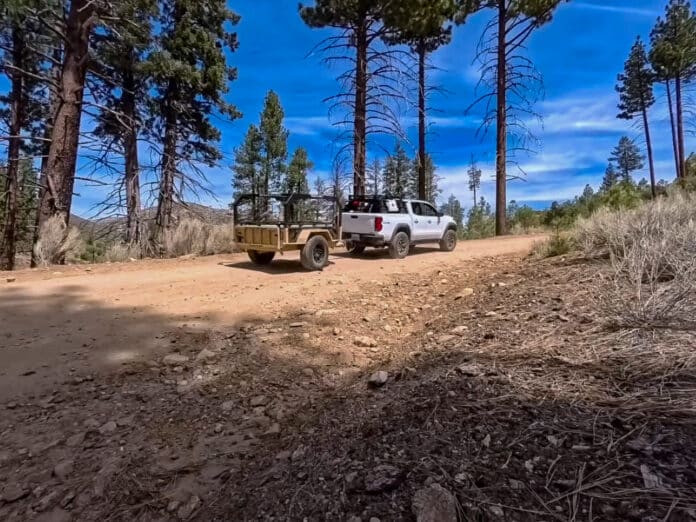

Finding an off-road trailer not costing as much as a used truck has always been the hard part. Most capable overland trailers start well above $15,000, and even mid-tier options push $10,000 before you add a single accessory. Big Slack Off Road set out to solve exactly this problem when they designed the Slack Wagon, a heavy-duty wagon-style utility trailer built to go anywhere your rig goes, starting at $5,999. I had the chance to walk through the Slack Wagon in person up in Big Bear, California, alongside Mark from Big Slack, and what stood out wasn’t one big feature. It was the number of smart, practical decisions packed into a trailer at this price point.
Big Slack Off Road is a family-run operation out of western Kentucky. Brothers Mark and Matthew Cecil built the company around a simple idea: they were avid off-roaders who had pushed every trailer and accessory they owned to the breaking point, and nothing on the market held up the way it should. So they started building their own. The Slacklander, their flagship overland trailer, earned a strong following, but the team heard consistent feedback about it being out of reach for budget-conscious buyers. The Slack Wagon is their answer. It’s a purpose-built foundation trailer giving you a serious off-road platform without locking you into anyone’s ecosystem, including theirs.
Quick Verdict: The Slack Wagon off road trailer is a heavy-duty, wagon-style platform trailer built in Kentucky and designed for buyers who want serious off-road bones without a full overland build price. Starting at $5,999 with a 3,000 lb GVWR, a 3,500 lb Timbren axleless suspension option, and two-inch receiver pockets at all four corners for DIY add-ons, it gives you a capable foundation growing with your setup. As-shown pricing runs around $11,000 with popular options like the Lock and Roll hitch, tailgate, roof rack, and lid. Lead time is currently 8 to 10 weeks, and you’re able to order additional accessories after the fact.
Last updated: May 2025 | 9 min read
In This Review
- Slack Wagon Overview: Who It’s For
- Key Specs at a Glance
- Base Model and Pricing
- Suspension, Tires, and Payload
- Front Platform and Cargo Features
- Lid, Tailgate, and Rack Options
- Recovery Points and Multi-Use Utility
- Slack Wagon vs. Slacklander: Which Should You Choose?
- Pros and Cons
- Final Verdict
- Frequently Asked Questions
Slack Wagon Overview: Who It’s For
The Slack Wagon off road trailer targets a specific buyer: someone who wants a serious, trail-capable platform without paying for a fully kitted overland build they’ll never fully use. According to Mark, the trailer grew out of direct feedback from show attendees who loved the Slacklander but found it too far out of reach. Big Slack’s response was to design a wagon-based utility trailer delivering a heavy-duty foundation at a genuinely accessible price. At $5,999 for the base model, it sits below most comparable purpose-built overland trailers on the market.
The target audience is broad by design. DIY builders appreciate the two-inch receiver pockets built into all four corners of the frame, because those pockets accept standard pickup truck receiver hitch accessories, which means you build whatever rack, mount, or storage system you want without buying proprietary parts. Overlanders looking for a starting point also find the Slack Wagon appealing, because the accessory ecosystem Big Slack has developed (lids, tailgates, roof racks, spare tire mounts, and front baskets) lets you add on over time. Importantly, the trailer also works as a heavy-duty utility trailer for hardware runs, hauling firewood, or any other day-to-day task, so it earns its parking space even when you’re not on the trail.
The Slack Wagon Junior, a smaller version sharing the same frame architecture and accessory system, is available for buyers with smaller tow rigs or tighter budgets. Many accessories cross-pollinate between the two platforms, so starting on the Junior and scaling up later is a realistic path.
Key Specs at a Glance
| Specification | Details |
|---|---|
| Base Price | $5,999 |
| As-Shown Price (with popular options) | ~$11,000 |
| GVWR | 3,000 lb |
| Axle Rating | 3,500 lb (derated to 3,000 lb GVWR for durability) |
| Empty Weight (base) | ~1,000 lb |
| Empty Weight (as-shown with options) | ~1,200 lb |
| Payload Capacity (base) | ~2,000 lb |
| Payload Capacity (as-shown) | ~1,800 lb |
| Bed Interior Length | 6.5 ft |
| Bed Interior Width | 48.5 in |
| Overall Width (fender to fender) | 74 in |
| Front Platform | 48 x 30 in (tapered) |
| Standard Tires | 32 in (265/75R16) |
| Max Tire Size | 35 in |
| Lug Pattern Options | 5×5 (Jeep) or 6×5.5 (Tacoma/4Runner) |
| Standard Hitch | 2-inch ball |
| Receiver Pockets | 2-inch at all four corners |
| Recovery Points | 4 underside points |
| Warranty | 3-year structural |
| Lead Time | 8–10 weeks |
| Built | Western Kentucky, USA |
Big Slack Off Road
Slack Wagon — Starting at $5,999
Heavy-duty wagon-style trailer built in Kentucky. 3,000 lb GVWR, Timbren axleless suspension, and a fully modular accessory system designed to grow with your build.
Base Model and Pricing
At $5,999, the base Slack Wagon off road trailer includes a 2-inch ball hitch, leaf spring suspension, 32-inch tires, two-inch receiver pockets at all four corners, stabilizer jack mounts at each corner, and four underside recovery points. This is a more complete starting point than many trailers at similar prices offer. The powder coat color comes from Columbia Coatings, and you choose your finish during the build process.
The as-shown trailer in the walkthrough was optioned to roughly $11,000, with the Lock and Roll articulating hitch, a tailgate, a lid, and the Timbren axleless suspension upgrade. Those three add-ons are, according to Mark, the most common option combination buyers choose. The Lock and Roll hitch specifically is something Big Slack strongly recommends for off-road use, because it allows the trailer to articulate independently of the tow vehicle. This articulation is also why the four underside recovery points matter so much: if the trailer rolls on the trail, you recover it from those points rather than improvising.
One of the more DIY-friendly decisions Big Slack made is those two-inch receiver pockets. Standard pickup truck receiver accessories like storage boxes, bike mounts, basket systems, and jerry can holders all bolt right in. However, if you want to build your own rack from scratch, you have this option too. The frame accepts standard materials, so you’re not tied to any proprietary system. Big Slack offers their own accessories and is willing to work on custom builds, but the choice is yours from day one.
Suspension, Tires, and Payload

The Slack Wagon ships standard with leaf spring suspension, but the most popular upgrade is the Timbren axleless system. Timbren’s axleless design eliminates the traditional solid axle and replaces it with independent rubber spring units at each wheel, which means the trailer sits flat across the bottom with no axle tube running underneath. This flat profile helps ground clearance on rough terrain and gives the suspension a clean, proven track record in the off-road trailer segment.
The axle on these trailers is rated to 3,500 lb, however Big Slack derated the GVWR to 3,000 lb deliberately. Mark explained the reasoning directly: the heavy-duty use case this trailer gets put through on rocky trails, in recovery situations, and over hard terrain demands a safety margin, and running an axle at its rated limit under those conditions shortens its life. At the base configuration of roughly 1,000 lb empty, you have approximately 2,000 lb of payload. The as-shown trailer at around 1,200 lb still leaves 1,800 lb of payload, which covers most realistic overland load-outs comfortably.
Standard tires are 265/75R16s on 32-inch diameter, and the fender wells accept up to a 35-inch tire. Big Slack adjusts the drop and lift spindles appropriately depending on whether you order the Timbren axleless or leaf-sprung configuration, so the gap between tire and fender stays correct regardless of tire size. Two lug patterns are available: 5-on-5 for Jeep owners and 6-on-5.5 for Tacoma and 4Runner owners. Matching your tow rig’s lug pattern makes swapping a spare significantly faster on the trail.
Front Platform and Cargo Features

The 48-by-30-inch front platform is one of the more useful pieces of real estate on the Slack Wagon. Specifically, it’s designed for a spare tire mount that Big Slack sells separately, but it also holds toolboxes, propane bottles, fuel cans, or whatever else you want within reach at the front of the trailer. The slot-and-hole pattern built into the platform is designed around standard ratchet straps from hardware stores, not proprietary tie-down points. Your Harbor Freight or Lowe’s ratchet straps hook into the slots and come up through the holes, securing cargo without adapters or specialty hardware.
Two hole pass-throughs on the front platform allow wire routing for solar panel setups. If you want to mount a solar panel on the front and run wiring to a battery behind the front valance panels, the path is already there. Those valance panels also provide a mounting surface on their back side, giving you an organized location for electrical components without exposing them to trail debris.
Stabilizer jack mounts, which Big Slack calls “knuckles,” come standard at all four corners of the frame. These accept standard trailer stabilizer jacks for leveling and stability at camp, and they function whether you’re on the Slack Wagon or any other trailer in the Big Slack lineup.
Lid, Tailgate, and Rack Options
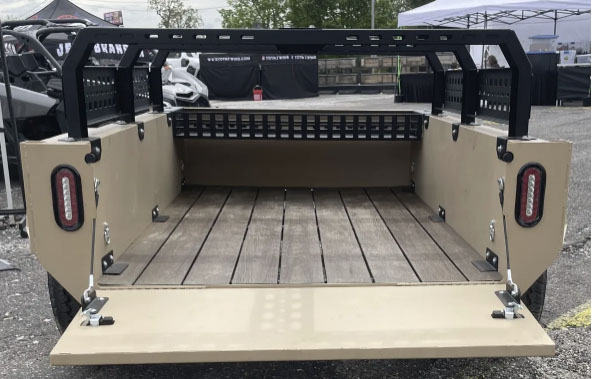
The lid and tailgate are among the most popular add-ons, and for good reason. Without the lid, you get an open bed useful for hauling irregular cargo, though exposed to trail dust and weather. The lid seals out dirt and water and lifts easily enough to let you reach in and grab standard yellow storage totes without removing it entirely. Adding the tailgate alongside the lid means you also get a lower-access point that folds down while the lid stays open, which is especially practical when you’re loading or unloading at camp.
The rack system shown on the walkthrough trailer was built to work with the lid. Specifically, the rack height (approximately 65 inches from the ground) is calibrated so the lid clears the rack when open. Big Slack also offers taller rack configurations that accommodate 270-degree awnings. If you skip the lid entirely, rooftop tent mounts are available in 12-inch and 18-inch riser heights off the bed surface, with a taller option for larger roof tents. The fenders on the Slack Wagon are stand-on rated, same as on the Slacklander, so they function as a step when accessing mounted tents or top-mounted gear.
Side panels feature geometric slot-and-hole designs for mounting accessories on the back side, and Big Slack also offers MOLLE panel upgrades for the exterior faces. Switch mount panels for adding lights and electrical switches are available as well, either installed by Big Slack or prepped for a DIY electrical build.
Build It Your Way
Start with the Base. Add What You Need.
Two-inch receiver pockets at all four corners accept standard accessories. Buy the base at $5,999 and build your setup over time — on your schedule, your budget, your terms.
Recovery Points and Multi-Use Utility
Four recovery points on the underside of the frame give you dedicated attachment locations for getting a rolled or stuck trailer back into service. Mark specifically called this out during the walkthrough: off-road tow vehicles often clear an obstacle cleanly while the trailer behind them doesn’t follow the same line, and rollovers happen. The four underside points let you right the trailer without improvising anchor points or risking damage to frame welds. This kind of thoughtful engineering shows up consistently throughout the Slack Wagon’s design.
The rear two-inch receiver is an optional add-on, and it opens up several practical configurations: bike rack mounts, cargo basket extensions, and tire swing-outs all use standard receiver hardware. Combined with the receiver pockets at all four corners, the Slack Wagon ends up with significantly more mounting flexibility than most trailers in this price range, because every mount point uses a universally available standard rather than proprietary brackets.
The multi-use angle is worth taking seriously. Without the lid, the Slack Wagon is a heavy-duty utility trailer, substantially more capable than a standard Harbor Freight or box-store trailer for hauling lumber, rock, or equipment. With the lid on, it’s weather-protected cargo storage you tow to the trailhead. Big Slack designed this flexibility in specifically to give buyers more than one justification for the purchase, and it works. A trailer earning its spot in the driveway on a Tuesday hardware run is a much easier sell than one that only comes out four times a year.
Slack Wagon vs. Slacklander: Which Should You Choose?

The Slacklander, shown above, is Big Slack’s full-feature overland trailer with an enclosed storage system, integrated kitchen options, a 6-inch channel frame, and a full off-road focused chassis designed for buyers who want a complete trail kitchen and living setup in a single tow. It’s a more expensive trailer, more complex to spec, and targets buyers planning multi-day backcountry expeditions where the trailer functions as a basecamp. The Slacklander’s enclosed design also makes it less useful as an everyday utility hauler.
The Slack Wagon, by contrast, is a wagon-body platform trailer prioritizing flexibility and accessibility. It costs significantly less at entry, works as a daily-use utility trailer, and grows through add-ons rather than arriving fully configured. Buyers who already have camp kitchen gear, a rooftop tent for their vehicle, and coolers they’re happy with often find the Slack Wagon is exactly what they need: a rugged, capable overland utility trailer platform to carry this gear to the trailhead without duplicating systems they already own.
If your primary goal is a ready-to-camp overland basecamp in a single trailer purchase, the Slacklander is the more direct answer. However, if you want a trail-capable platform you build out over time on your own terms, the Slack Wagon off road trailer is the smarter buy, especially at the $5,999 base price.
Pros and Cons
Pros
- Base price of $5,999 is among the lowest in the serious off-road trailer segment
- Two-inch receiver pockets at all four corners accept universal pickup truck accessories, not proprietary parts
- 3,500 lb Timbren axleless suspension option gives a flat underbody and strong off-road articulation
- Up to 2,000 lb payload on the base model handles most realistic overland gear loads
- Four underside recovery points for dedicated rollover and stuck-trailer recovery
- Lug pattern matches common Jeep (5×5) and Toyota (6×5.5) tow rigs for shared spare use
- Multi-use design works as a heavy-duty utility trailer and an overland cargo platform
- 3-year structural warranty backed by a US-based manufacturer
- Accessories are available to add after purchase, so you don’t have to configure everything up front
Cons
- Open bed without the lid leaves cargo exposed on dusty or wet trails
- Going up to 35-inch tires raises the bed height, which makes loading bulkier items harder
- No built-in kitchen, electrical system, or water storage; those require separate planning
Final Verdict

The Slack Wagon off road trailer is a well-thought-out answer to a real problem in the overland market. Most trailers at this price point either lack serious off-road capability or arrive bare-bones with no clear path for customization. The Slack Wagon closes this gap: you get a heavy-duty platform with a 3,000 lb GVWR, four recovery points, a Timbren axleless suspension option, and a modular receiver system opening the trailer up to hundreds of standard accessories. Its dual function as an everyday utility hauler makes the investment easier to justify.
The trade-off is honest: if you option it up the way most buyers do, with the Lock and Roll hitch, lid, tailgate, and rack, you’re approaching $11,000. At $11,000, you’re still below most fully featured overland trailers, but it’s no longer a budget buy. Buyers who want a complete, ready-to-camp setup with integrated kitchen and electrical should look at the Slacklander instead. The Slack Wagon is specifically built for the buyer who wants the platform and prefers to build the system themselves.
For value, the base Slack Wagon is difficult to beat in its category. A 3,500 lb Timbren suspension, universal receiver pockets, heavy-duty steel construction with powder coat from Columbia Coatings, and a 3-year structural warranty at $5,999 represents genuine value. The add-on model also means you don’t have to commit to a full build upfront. You buy what you need when you need it, and Big Slack stocks the accessories to make it work.
If you’re an overlander, a weekend trail runner, or a DIY builder looking for a serious trailer foundation without breaking the budget before you’ve bought a single camp accessory, the Slack Wagon belongs at the top of your shortlist. Call Big Slack directly at 855-244-7525 to build your configuration and get into the order queue. At 8 to 10 weeks lead time, the sooner you call, the sooner you’re on the trail.
Frequently Asked Questions
How much does the Big Slack Off Road Slack Wagon cost?
The Slack Wagon starts at $5,999 for the base model, which includes a 2-inch ball hitch, leaf spring suspension, 32-inch tires, and two-inch receiver pockets at all four corners. The most popular configuration, with the Lock and Roll hitch, Timbren axleless suspension, lid, and tailgate, runs approximately $11,000. Accessories ordered after the initial purchase are available separately through Big Slack’s website or by calling the shop.
What is the payload capacity of the Slack Wagon off road trailer?
The base Slack Wagon weighs approximately 1,000 lb empty, giving you about 2,000 lb of payload within the 3,000 lb GVWR. The as-shown optioned trailer weighs closer to 1,200 lb empty, which leaves 1,800 lb of payload. Big Slack derated the 3,500 lb axle to a 3,000 lb GVWR specifically to build in a durability margin for heavy off-road use.
Can I add accessories to the Slack Wagon after I buy it?
Yes. Big Slack designed the Slack Wagon specifically around a post-purchase add-on model. The two-inch receiver pockets at all four corners accept standard accessories, and Big Slack’s own lid, tailgate, roof rack, spare tire mount, and other accessories are all bolt-on additions. Mark confirmed directly during the walkthrough buyers are welcome to call back after their initial purchase and order whatever they want to add next.
What suspension options are available on the Slack Wagon?
The Slack Wagon comes standard with leaf spring suspension. The most popular upgrade is the Timbren axleless system, which eliminates the solid axle and delivers a flat underbody profile with independent rubber spring units at each wheel. Big Slack adjusts the drop and lift spindles to keep proper tire-to-fender clearance regardless of which suspension you choose, and the system accommodates tires up to 35 inches in diameter.
How long does it take to receive a Slack Wagon after ordering?
Current lead time is 8 to 10 weeks, according to Mark during the walkthrough. This window extends if the order queue grows, so Big Slack recommends calling as early as possible. Orders go through a build sheet process where you spec your trailer, approve the configuration, and choose your powder coat color before production begins. Start the process by calling 855-244-7525 or emailing sales@bigslackoffroad.com.
What lug patterns does the Slack Wagon come in?
Big Slack offers two lug pattern options: 5-on-5, which matches Jeep vehicles, and 6-on-5.5, which matches Toyota Tacoma and 4Runner platforms. Matching your tow rig’s lug pattern means your trailer spare and your vehicle spare are interchangeable on the trail, which is a practical safety advantage worth planning around when you spec your order.
Heads up: Clicking on our affiliate links and exploring our sponsored content helps us at no extra cost to you, and we only recommend gear we’re absolutely crazy about!