



Quick Facts:
- Topic: Best mud terrain tires for deep clay and a long drive home
- Tires compared: 5 current M/T models, plus 2 noted alternatives
- Reference size: 35×12.50R17LT
- Judging criteria: Clay ejection, sidewall build, weight, highway manners
- Our pick: Nitto Trail Grappler, the one we ran eighteen months
- Winter rating: None of the five carries 3PMSF
- Best for: Drivers who reach the trailhead on pavement, not a trailer
9 min read
In This Guide
Why Most Mud-Terrain Roundups Get Clay Wrong
Picking the best mud terrain tires gets harder once you admit two things about your driving. First, you reach the trailhead on pavement rather than behind a trailer. Second, the mud you fight is sticky clay instead of loose slop. Together those facts rule out half the tires people recommend. Notably, almost no roundup accounts for either one.
Clay is the harder problem. It packs into the voids and turns an aggressive tread into a slick. Moreover it refuses to fling out at low speed. Meanwhile the answer most buyers reach for, the biggest void ratio available, is wrong. For example, finite-element work on tractor tires in clay found traction peaking near 130 mm lug spacing, then falling off at 170 mm because wider gaps put fewer lugs in contact at once. The exact number is not a light-truck spec. However, the shape of the curve is the point: more open is not automatically better.
The other half of the problem is the drive home. Specifically, a two-hour highway leg on the wrong M/T is unpleasant. Additionally, no manufacturer publishes measured noise data. Every tire here is worse on pavement than an aggressive all-terrain. The useful question is how much worse, and what you get in return.
We compared five current models in 35×12.50R17LT using manufacturer specifications wherever they exist, and flagged the one tire where they do not. Two more earn a mention. Our pick is the tire with the most first-hand mileage behind it, eighteen months in the conditions this article is about.
The Best Mud Terrain Tires, Specs Side by Side
| Tire | Load range | Tread depth | Weight | Sidewall | Treadwear warranty |
|---|---|---|---|---|---|
| Nitto Trail Grappler | E 121Q | 21.0/32 | 79.9 lb | 3-ply, stated | None |
| Falken Wildpeak M/T | E, 10-ply rated | 20.7/32 | 79.6 lb | DURASPEC 3-ply, 2 turn-ups | None |
| Toyo Open Country M/T | E 125Q | 21.0/32 | 78 lb | High turn-up polyester, no ply count | None |
| BFGoodrich KM3 | D 119Q or E 121Q | 16 to 18/32 (retailers conflict) | 73.7 to 74.4 lb (retailer) | CoreGard Max, no ply count | None (6-yr workmanship) |
| Maxxis Razr MT | E 121Q | 19/32 | 73.9 lb | 3 body plies, select sizes | 40,000 mi (see caveat) |
Three footnotes matter more than the table. First, BFGoodrich publishes neither a ply count nor a tread depth, so those cells come from retailers who disagree. Second, every tire here ships with a standard workmanship warranty; the column above tracks wear coverage only. Third, none of the five holds the three-peak mountain snowflake symbol. Falken and Maxxis state an M+S rating outright, and the rest sell as all-season.
Live pricing for the three currently stocked in the reference size. Confirm the exact size and load range on the listing before ordering, because sellers mix fitments.
| Top Pick | Most Published Spec Detail | D or E Load Choice | |
|---|---|---|---|
| Product | TOP PICK Nitto Trail Grappler Nitto Trail Grappler |  Falken Wildpeak M/T Falken Wildpeak M/T |  BFGoodrich KM3 BFGoodrich KM3 |
| Load range | E 121Q | E 10-ply | D 119Q or E 121Q |
| Weight | 79.9 lb | 79.6 lb | 73.7-74.4 lb |
| Sidewall ply | 3-ply stated | 3-ply + 2 turn-ups | Not published |
| Price | $419.08 as of Sep 23, 3:21 pm | $449.00 as of Sep 23, 3:21 pm | $439.99 as of Sep 23, 3:21 pm |
| Check Price → | Check Price → | Check Price → |
Why Clay Behaves Nothing Like Sand
Sand and clay obey different equations. Because of this, clay defeats tires built for loose, free-draining ground. In sand, available thrust scales with vertical load, so pressing down harder gains grip. In saturated clay, however, thrust scales with cohesion multiplied by contact area. It stays largely independent of load. As a result you gain nothing by weighting the tire. Instead you gain by putting more rubber on the ground.
Clay also gets stickiest at a specific water content. Specifically, adhesion peaks near the liquid limit, roughly 20 to 25 percent water. For instance, a rut drained overnight is often worse than the same rut in a downpour.
Self-cleaning follows from the same physics. Tread pattern gets the credit, although carcass flex and rotational speed do most of the work. Lower pressure lets the casing deform. Then the deformation breaks the soil bond and throws packed material clear. Run a stiff, high-pressure tire through clay and even a huge void ratio holds its load. Similarly, instrumented testing shows clearing improves sharply once wheel speed comes up.
One field report supports the modelling. Expedition Portal’s long-term Falken Wildpeak M/T review found its tight tread cleared packed build-up faster than expected, even at full highway pressure. Note the surfaces were snow, dirt and gravel rather than clay. Read it as evidence about tread geometry instead of proof about mud. Either way the consequence holds: buy the tire whose carcass construction you are able to verify, because carcass flex does the cleaning.
The Five Best Mud Terrain Tires for Deep Clay
1. Nitto Trail Grappler: our pick, and our longest test
Nitto built the Trail Grappler as its compromise M/T, and the company’s own language calls the void ratio balanced rather than high. Notably, balanced is precisely what the lug-spacing research supports for cohesive soil. It runs a stated 3-ply sidewall and 21.0/32 of tread in the reference size.
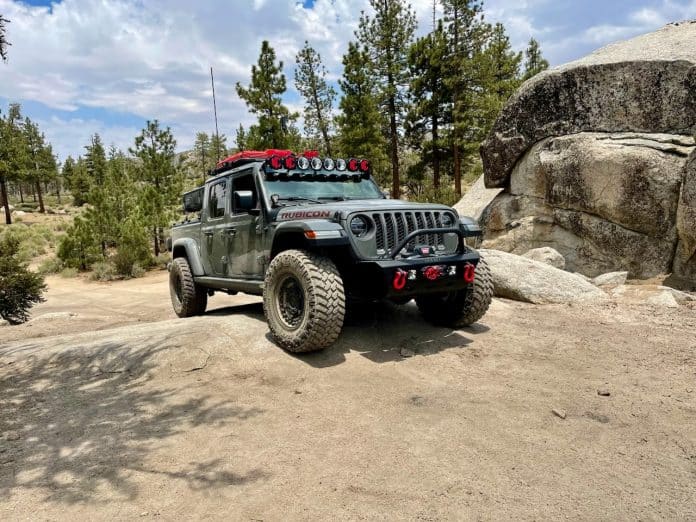
The deciding factor is first-hand mileage. Our eight-month test of the Trail Grappler put a Gladiator through extreme conditions, which is more than we hold for any other tire here. However, the cost is mass. At 79.9 lb it is the heaviest tire in this comparison, nearly 6 lb over the Razr MT, and every pound of it is unsprung.
2. Falken Wildpeak M/T: the most specific spec sheet
Falken publishes the most detailed sidewall construction of any brand here. DURASPEC uses three plies with two turn-ups. Nitto names a 3-ply sidewall too, although nobody else in the group gives a count at all. At 20.7/32 the tread is slightly shallower than the Toyo or the Nitto, and the pattern is noticeably tighter.
The tight pattern is the point, and independent testing found it shedding packed material faster than its void ratio suggests. Falken also states plainly it carries no 3PMSF rating, an unusually honest disclosure. However, at 79.6 lb it sits at the heavy end, and we have not run a set ourselves.
3. Toyo Open Country M/T: deepest tread, thinnest disclosure
Toyo ties the Nitto for the deepest tread at 21.0/32. Additionally it rates this size Load Range E, 125Q, the highest load index in the group. Toyo describes a high turn-up polyester casing. However, it stops short of publishing a ply count, so a direct sidewall comparison against Falken is not possible.
Our own Toyo Open Country M/T review weighed mud and rock traction against longevity and road comfort. At 78 lb it slightly undercuts the Falken and the Trail Grappler. Still, no wear coverage comes with it.
4. BFGoodrich KM3: big reputation, published nothing
The KM3 is the only tire here offered in both D and E load ranges in 35×12.50R17. Therefore buyers get a real choice between compliance and capacity. CoreGard Max also carries a strong field reputation.
Verifying the reputation is the problem. BFGoodrich publishes no ply count, no tread depth and no weight. Consequently every number in the table came from retailers who disagree at 16/32 versus 18/32, and at 73.7 versus 74.4 lb. The KM3 does carry a 6-year limited warranty, the clearest coverage statement of any tire here, although it covers workmanship rather than wear.
5. Maxxis Razr MT: lightest published weight, with a warranty caveat
At 73.9 lb the Razr MT has the lowest manufacturer-published weight here, a full 6 lb under the Trail Grappler. Across four corners, 24 lb of rotating mass turns up in braking distance, steering effort and fuel economy. The KM3 might match it, although BFGoodrich publishes no weight to check.
Maxxis is also the only brand advertising a mileage warranty, at 40,000 miles. However, read the fine print before counting on it. Maxxis’s own US warranty booklet limits treadwear coverage to P-metric sizes and does not list the Razr MT among the covered models. Therefore confirm coverage for your exact fitment. The tread is 19/32, shallower than the Toyo and the Nitto. Sourcing is the other catch, since 35×12.50R17 is currently hard to find in stock anywhere.
Two More Worth Naming
Nitto’s Mud Grappler is the more aggressive sibling and the better pure-mud tire. Still, it fails this brief twice. First, Nitto rates its own road noise at one out of five. Second, it offers no LT-metric 17-inch sizes. For a truck on common wheels with a commute, it is out.
Cooper’s Discoverer STT Pro remains widely sold. However, it no longer appears on Cooper’s own spec sheet in 35×12.50R17, a pattern which usually signals a run-out. Verify availability first.
One tire survives every criterion above, and it carries the longest test behind it.
Nitto Trail Grappler M/T LT35/12.50R17 121Q
The compromise M/T that survived eighteen months on a Gladiator in the conditions this guide is about.
- Balanced void ratio matches what the clay research supports
- Sidewall ply count stated rather than hidden behind a trademark
- Ties for deepest tread in the group at 21.0/32
- The only tire here we have run for eighteen months
- Heaviest tire in the comparison at 79.9 lb
- No treadwear warranty of any kind
Which Are the Quietest Mud Terrain Tires Here?
Quietest to loudest, our estimate runs: Maxxis Razr MT, BFGoodrich KM3, Falken Wildpeak M/T, then the Toyo and the Nitto together. The ordering follows tread depth and pattern density, and it is reasoning rather than measurement. Here is why nobody offers you better.
No manufacturer publishes measured decibel data for any of these tires, and we found no independent measurement either. Moreover the gap is structural. The EU tyre labelling regulation exempts Professional Off-Road tyres from the noise label, so the one regime forcing published numbers skips this category entirely. Every online ranking of the quietest mud terrain tires rests on opinion, including ours.
Only one quantified claim exists in the group. Nitto states the Trail Grappler runs 34 percent quieter than the Mud Grappler on streets and 36 percent quieter on the highway. However, read the baseline first, because Nitto rates the Mud Grappler at one out of five for road noise. A big improvement over an extremely loud tire still leaves a loud tire.
One thing matters more than the starting order. Mud-terrains get markedly louder as they cup, and irregular wear arrives faster on a tire commuting at 70 mph. Therefore rotating every 5,000 miles and keeping pressures honest does more for your drive home than choosing between any two tires on this list.
Mud-Terrain vs. Aggressive All-Terrain
Most people shopping the best mud tires would be happier on a modern aggressive all-terrain. Put a current A/T next to anything on this list and it gives up ground only in deep, sticky clay. What it gains back is several pounds per corner, a real treadwear warranty, and a cabin you hold a conversation in at speed.
The line sits at frequency and depth. If you hit clay ruts deeper than your hubs on most trips, an M/T earns its place. Occasional mud on forest roads does not justify one. Our comparison of how aggressive A/Ts compare lays out the warranty and tread-depth gap in matching sizes. Anyone weighing the best mt tires against a capable A/T should start there.
Weight is the hidden cost either way. These M/Ts run 73.9 to 79.9 lb each in 35×12.50R17, and the unsprung mass works against braking, acceleration and steering. Moving up in size compounds it until gearing stops matching the tire. Our guide on whether you need to regear covers where the factory ratios run out.
Final Verdict
The Nitto Trail Grappler earns the recommendation for sticky clay plus a highway drive home. First, its balanced void ratio is what the lug-spacing research supports for cohesive soil. Second, its 3-ply sidewall is stated rather than hidden behind a trademark. Above all, it is the only tire here we have run for eighteen months in the conditions this article describes.
The trade-offs are real. At 79.9 lb it is the heaviest tire in the comparison, and it ships with no wear coverage. Anyone whose mud runs loose rather than sticky will find a more open pattern digs better. Likewise, anyone counting miles per dollar should look elsewhere.
Pricing across the group sits close enough together to make paying more buy nothing automatic. Instead, construction disclosure, warranty and weight separate the best mud tires from the rest.
Two alternatives deserve a look before you commit to the best mt tires for your rig. Choose the Falken Wildpeak M/T when published construction detail outranks first-hand testing. Alternatively, choose the BFGoodrich KM3 when you want both D and E load ranges available, accepting how little BFGoodrich publishes to verify. Whichever you buy, check California’s new tire rules first, because the phase-in starts January 1, 2029. Manufacturer specifications live on each brand’s own site, starting with Nitto’s product pages.
Frequently Asked Questions
Are mud terrain tires good in snow?
None of the five tires here carries the three-peak mountain snowflake rating. Falken states outright the Wildpeak M/T has no 3PMSF certification. Falken and Maxxis advertise an M+S marking, which reflects tread geometry rather than tested winter grip, and the rest sell as all-season. Deep open tread bites in fresh snow, although it performs poorly on packed snow and ice.
Why are mud tires loud?
Large tread blocks separated by wide voids strike the pavement one at a time instead of rolling smoothly. Because each impact radiates noise, block size and void width set the volume. Deeper tread also makes the blocks taller and more flexible, so they squirm and add to the sound. No manufacturer publishes measured decibel figures, since off-road tires are exempt from EU tyre noise labelling.
How long do mud tires last on pavement?
Four of the five here publish no treadwear figure at all, which tells you what the manufacturers expect. Maxxis advertises 40,000 miles on the Razr MT, although its own booklet restricts wear coverage to P-metric sizes. Highway miles wear soft off-road compounds faster than a comparable all-terrain, and heat from sustained speed accelerates it further.
What is the best psi for mud tires on the highway?
Your door placard covers the factory tire, not a 35×12.50R17LT swap, so it will not give you the right number. Most owners on E-range LT tires this size land between 32 and 38 psi cold. Use the chalk test to confirm: draw a line across the tread, roll forward, then adjust until the chalk wears evenly across the full width.
Do mud tires affect gas mileage?
Yes. The five tires here weigh 73.9 to 79.9 lb each, roughly 15 to 20 lb more per corner than a comparable all-terrain. Because rotating mass costs energy on every acceleration, weight matters, and aggressive tread raises rolling resistance on top of it. Owners commonly report losing 1 to 3 mpg after switching.
All terrain tires vs mud tires: which should I buy?
Buy a mud-terrain only when you regularly meet clay or mud deeper than your hubs. Otherwise a modern aggressive all-terrain matches it nearly everywhere while staying quieter, lighter and longer-wearing. It also usually carries a real treadwear warranty. Frequency of use decides this more than terrain severity does.