




Quick Facts:
- Topic: Choosing a Harbor Freight generator for vehicle-based camping
- Models covered: 6 Predator inverters, 2 open-frame units
- Our overlanding pick: PREDATOR 4200 Watt Dual-Fuel, item 71203, $799.99
- Weight range: 46 lb to 257 lb
- Noise range: 56 dBA to 72.5 dBA
- Longest single-fill runtime: 26 hours on one 20 lb propane tank
- Warranty: 90 days on the product, 2 years on the emissions system
- Return note: generators carry a 20% restocking fee
- Best for: Campers running a fridge, lights, and charging off grid
- Prices observed: August 2026
10 min read
In This Guide
- Harbor Freight Generator: What Our Research Covered
- The Predator Models, Compared
- Which Harbor Freight Generator Fits Your Setup
- How Loud a Predator Runs
- Reliability: How Long a Predator Lasts
- Altitude, Fuel, and Runtime
- Carbon Monoxide at a Campsite
- Harbor Freight Generator vs. the Amazon Field
- Final Verdict
- Frequently Asked Questions
Harbor Freight Generator: What Our Research Covered
A Harbor Freight generator costs a little over half what the closest Honda costs. Naturally, the gap is why people ask whether these hold up. So we answered it with numbers instead of brand loyalty. First, we priced and spec’d the full Predator lineup against the live Harbor Freight catalog in August 2026. Then we worked through owner reports, teardown discussions, and long-term ownership threads dated 2018 through 2026, drawn from overlanding, RV, and generator communities. We did not bench test these units ourselves, so every durability figure below is an owner-reported number we traced to its source.
Two findings drove everything below. First, the reliability reputation is worse than the evidence supports. Our research traced three separate Predator 3500 units documented past 2,000 hours, one of them tracked to 6,120. Another owner reported roughly 7,740 hours before the engine needed rings. Notably, neglect kills these machines far more often than design does. Because the failure pattern is consistent, you plan around it.
Second, almost nothing written about these generators considers vehicle-based camping. For example, spec sheets quote decibels without mentioning the 60 dBA generator limit the National Park Service enforces at 50 feet. They quote runtime while ignoring altitude derate. Yet elevation costs you roughly 3.5% of rated output per 1,000 feet. For a broader primer on the category, our guide to how inverter generators work covers the underlying technology.
The Predator Models, Compared
The Harbor Freight Inverter Lineup
Six inverter models make up the current range, and five of them suit camping. A predator inverter generator matters here for one reason. Because it throttles the engine to match load, it cuts both noise and fuel burn. A conventional generator instead runs at a fixed 3,600 rpm.
| Model | Item | Price | Running W | dBA | Weight |
|---|---|---|---|---|---|
| 2500 Watt inverter | 72010 | $599.99 | 2,000 | 58 | 46 lb |
| 4200 Watt Dual-Fuel | 71203 | $799.99 | 3,200 gas / 2,900 propane | 59.8 | 65 lb |
| 3500 Watt inverter | 71358 | $799.99 | 3,000 | 56 | 102 lb |
| 5000 Watt Dual-Fuel | 71367 | $999.99 | 3,900 | 61.7 | 110 lb |
| 2000 Watt inverter | 72891 | $574.97 | 1,600 | 58 | 49 lb |
| 9500 Watt inverter | 71365 | $1,999.99 | 7,600 | 67 | 257 lb |
The 4200 Watt Dual-Fuel is the newest of these and the one worth most attention. At 65 lb it undercuts the 3500 by 37 lb while making more power. Specifically, it uses a smaller 187cc engine in a tighter package. It also runs 26 hours on a single 20 lb propane tank at 25% load. Therefore it holds the longest single-fill runtime in the line.
Our pick at Harbor Freight, the PREDATOR 4200 Watt Dual-Fuel Inverter, item 71203
| Premium Benchmark | Best Value | Lightweight & Dual-Fuel Pick | |
|---|---|---|---|
| Product |  Honda EU2200i Honda EU2200i | TOP PICK Westinghouse 5000 Peak Watt Westinghouse 5000 Peak Watt |  Champion 2500 Dual Fuel Champion 2500 Dual Fuel |
| Running Watts | 1,800 | 3,900 | 1,850 |
| Noise (dBA) | 48 | 52 | 53 |
| Weight | 47 lb | 104.7 lb | 43.2 lb |
| Price | $1,099.00 as of Aug 20, 9:02 pm | $849.00 as of Aug 20, 9:02 pm | $575.00 as of Aug 20, 9:02 pm |
| Check Price → | Check Price → | Check Price → |
The Harbor Freight Models to Skip for Camping
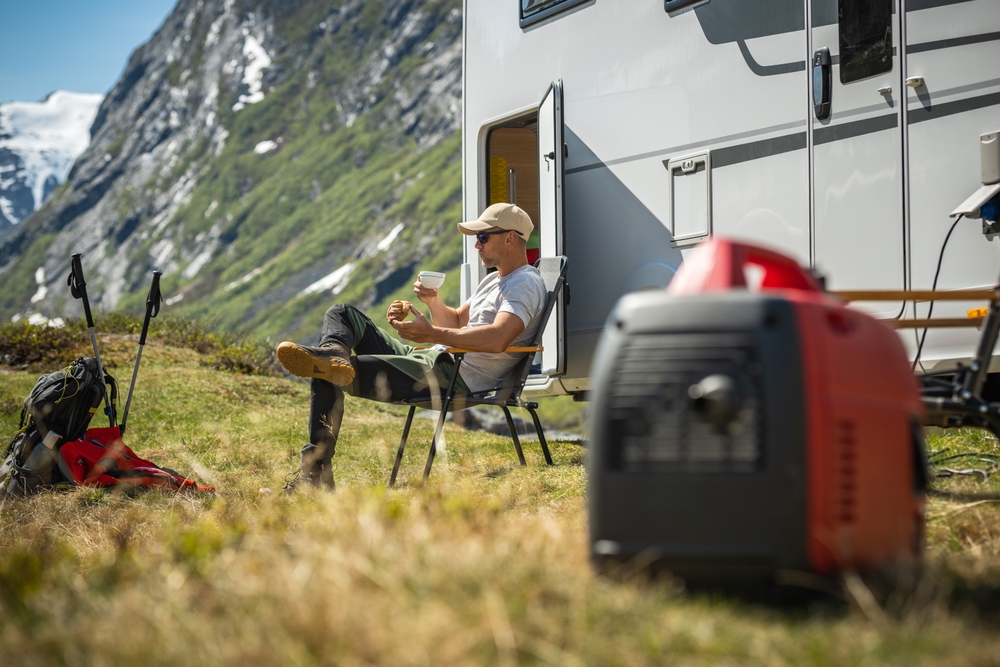
Harbor Freight also sells open-frame conventional generators. None of them belong at a campground. For instance, the 4375 Watt unit (item 59207) runs 72.5 dBA at $479.99. Meanwhile the 5000 Watt (item 72613) runs 71.3 dBA at $499.99. Both save real money over a predator inverter generator. However, both run 12 to 16 dBA louder. Because 10 dB is roughly a doubling, the gap lands between two and three times the perceived loudness. Neither throttles down when your load drops.
Similarly, the 9500 Watt unit is a fine machine and a poor camping choice at 257 lb. Two people struggle to load it. Our guide to generator etiquette at camp covers why noise matters more than watts once neighbors are involved.
Which Harbor Freight Generator Fits Your Setup
Weekend Camping With a Fridge and Lights
A 12V compressor fridge, LED lights, phone charging, and a laptop total well under 300 watts of continuous draw. The 2500 Watt model at 46 lb covers this easily. It is also the lightest generator Harbor Freight sells. Since one person lifts 46 lb into a truck bed alone, weight decides this tier rather than output.
Running Air Conditioning
Air conditioning changes the math. Our research found an 8,000 BTU window unit pulling under 700 watts at full tilt. In eco mode it drops to about 260 watts, which surprises people expecting worse. Still, the startup surge sizes the generator. The 4200 Watt Dual-Fuel handles most RV air conditioners through its TT-30R outlet. Meanwhile the predator 5000 generator adds margin for two loads at once.
Ultralight Builds and Hitch Carriers
Weight drives this decision. At 46 lb, 49 lb, and 65 lb, the 2500, the 2000, and the 4200 are the three Predators most hitch carriers handle comfortably. All three stay manageable once you account for the rest of your load. Meanwhile the 3500 at 102 lb pushes into two-person territory. Fuel adds another 15 lb when the tank is full.
How Loud a Predator Runs
Manufacturer decibel ratings use a set distance under light load, so they flatter every brand equally. The useful number is the comparison. Our research surfaced a 2018 owner test of four generators at 25 feet under the same load. Honda measured 52 dBA, Yamaha 52, Champion 53, and the Predator 56. Separately, an independent sound-meter test of a 3500 read 55 dBA, below the rating on its box. Therefore the published figure is honest.
Three to four decibels sounds small on paper. In practice it is audible. Still, it sits inside the 60 dBA limit the National Park Service sets under 36 CFR 2.12, measured at 50 feet. So a Predator is quiet enough for a developed campground. However, it is not the quietest option if a neighbor sits 20 feet away.
Two habits do more for your noise footprint than the model choice. First, point the exhaust away from neighboring sites. Second, run at the lowest load the job allows, because an inverter generator throttles down and gets noticeably quieter.
Reliability: How Long a Predator Lasts
How Long a Harbor Freight Generator Lasts
The most repeated claim about these generators is a 250-hour service life. Our research traced the figure to a single unsourced 2020 post. Meanwhile the owner evidence contradicts it directly. We traced three distinct 3500 units past 2,000 hours, the highest at 6,120. One of the three was logged at successive milestones from 2,000 to 2,600 hours. Another reached roughly 7,740 hours before needing piston rings. Likewise, a 9500 Watt unit passed 1,000 hours.
The honest caveat is variance. Owner reports call these hit or miss more often than they say the same of a Honda. Quality also differs between production runs. So expect a machine likely to outlast your interest in it. Meanwhile a small share arrive flawed.
What Fails on a Harbor Freight Generator
Four failure modes dominate, and the most common one is preventable. First, carburetor gumming from ethanol fuel is the most cited problem across every source we reviewed. Because ethanol attracts water and varnishes over months of sitting, a generator stored with fuel in the bowl is the classic no-start.
Second, carbon monoxide sensor failure typically arrives at five to seven years. A failed sensor prevents the unit from starting at all. Third, low-oil sensor false trips cause a similar no-spark symptom. Fourth, oil consumption shows up mostly at high hours or in the occasional lemon.
Safety note: Owner forums circulate instructions for bypassing a failed carbon monoxide sensor. Do not do it. The correct fixes are a sensor battery replacement, a warranty claim, or moving the generator far from any enclosed space. A bypassed shutoff removes the protection at exactly the moment it matters.
Preventive maintenance follows from the failure list. Run the carburetor dry or add stabilizer before storage. Then change the break-in oil early and keep the sensor batteries fresh. Harbor Freight covers the product for 90 days and emissions for two years. So the maintenance burden sits with you.
Altitude, Fuel, and Runtime
Altitude Derate and the Included High-Altitude Kit
Naturally aspirated gas engines lose roughly 3.5% of rated output per 1,000 feet of elevation. At a 6,200 foot trailhead about 22% is gone. Therefore a 3,000 watt generator delivers closer to 2,340. Above roughly 9,000 feet, owners report gasoline starting becomes difficult.
Re-jetting restores the fuel mixture, not the lost air density. So the derate stands either way. Notably, the 4200 Watt Dual-Fuel ships with a high-altitude kit in the box. This matters, because our research found owners struggling to source Predator jets separately. One owner noted the unit arrives jetted for 1,000 to 2,000 feet. Reaching the carburetor to change it takes patience.
Propane, Runtime, and Fuel Burn
Propane needs no altitude modification at all, which is why high-country owners lean on it. It also stores indefinitely without varnishing, so the carburetor problem largely disappears. The trade is output: the 4200 makes 3,200 running watts on gasoline and 2,900 on propane.
Runtime favors propane heavily. The 4200 runs 8.25 hours on its 1.48 gallon gasoline tank at 25% load. On a 20 lb propane tank it runs 26 hours. Its automatic changeover switches from propane to gasoline without shutting down. As a result you get over 20 hours of continuous operation. Our comparison of propane versus gas for camping works through the trade in more detail.
On fuel burn, our research found two independent predator 3500 generator owners converging on about 0.3 gallons per hour, one of them at roughly 1,900 watts. Similarly, a Predator 2000 returns 10 or more hours per gallon at light load. Those figures let you plan fuel for a week rather than guess.
Carbon Monoxide at a Campsite
Every harbor freight predator generator in the current inverter lineup carries CO SECURE. It shuts the engine down when it detects dangerous carbon monoxide levels. Harbor Freight’s own guidance is to place a running generator at least 20 feet from any door or window, which in practice means running a 12-gauge outdoor extension cord long enough to cover the distance without pushing the machine closer than it should sit. Point the exhaust away.
One finding deserves emphasis, because it compounds the overlanding case. Carbureted gasoline engines run richer at altitude and produce more carbon monoxide there, and these generators are carbureted. Meanwhile dispersed campers sleep at exactly those elevations, inside vehicles and rooftop tents. So the mountain campsite is the higher-risk setting, not the lower-risk one.
Safety note: Treat the onboard shutoff as a backup, never as your primary protection. Carry a separate battery-powered carbon monoxide alarm inside any tent, camper, or vehicle where people sleep. Never run a generator under an awning, in a vestibule, or inside a closed truck bed.
Our write-up on carbon monoxide safety rules applies here without modification. A standalone battery-powered carbon monoxide alarm inside the tent, camper, or vehicle is the cheapest backstop worth adding, since it keeps watching long after the generator’s own sensor has done its job. For sizing your whole off-grid setup around real draw, see our notes on off-grid power needs. The CPSC carbon monoxide information center carries the official placement guidance.
Harbor Freight Generator vs. the Amazon Field
Predator vs. the Honda Benchmark
The Honda EU2200i is the unit Predator owners measure against. It costs $1,099 against $599.99 for the Predator 2500. On paper the gap is wide: Honda rates the EU2200i at 48 dBA at quarter load against 58 dBA for the Predator 2500. In one owner test of different units under matched load, the measured gap narrowed to 4 dBA. You also get tighter tolerances and a dealer network. Honda also backs its generators for three years against Harbor Freight’s 90 days.
Our research did not find the longevity gap the price implies. For instance, owners reported a Honda EU7000is dead at 200 hours facing a four-month repair wait. Another found a Yamaha 2000 less reliable than the Predator 2000 it replaced. So the decision rule owners settle on is simple. Buy Honda for daily professional use. Buy a harbor freight predator generator for occasional use, then put the savings toward a spare.
The Amazon Field: Westinghouse and Champion
Among the Amazon alternatives, the Westinghouse 5000 Peak delivers 3,900 running watts at 52 dBA for $849. Compared to the predator 3500 generator, it offers more machine and less noise for $49 more, at 104.7 lb. Similarly, the Champion 2500 Dual Fuel answers on weight at 43.2 lb and $575. It undercuts even the Predator 2500 while adding propane capability. Notably, all three Amazon units carry three-year warranties against Harbor Freight’s 90 days.
Apply this guide’s own weight test, though, and the picture narrows. At 104.7 lb the Westinghouse lands in the same two-person territory as the 3500. Meanwhile the Champion carries no TT-30R outlet and ships no high-altitude kit, so it trades away the two features driving our pick. Therefore the warranty gap is real, and it buys less at a dispersed campsite than the spec sheet suggests.
Final Verdict
For vehicle-based camping, the PREDATOR 4200 Watt Dual-Fuel at $799.99 is our pick from the Harbor Freight generator lineup. It weighs 65 lb, the third-lightest in the range. It also adds a TT-30R outlet, 26 hours on a propane tank, an included high-altitude kit, and CO SECURE. No other model stacks those together.
Choose differently in two cases. First, if you only run a fridge, lights, and charging, the 2500 Watt at $599.99 saves money and 19 lb. Second, if you want the lowest noise, the 3500 Watt at 56 dBA is the quietest sold. Still, its 102 lb is a real penalty for a solo traveler. For heavier draw instead, the predator 5000 generator adds capacity at 110 lb.
The honest limitations are warranty and variance. Ninety days is short for an engine. Harbor Freight’s extended service plan covers a single replacement rather than the life of the tool, and every generator we checked carries a 20% restocking fee on return. So buy from a store you visit regularly. Same-day counter exchange is the practical advantage Harbor Freight holds over ordering online.
Finally, skip the open-frame conventional models if a campground is in your plans. Saving $120 to buy 12 more decibels is a poor trade. Quiet hours start at 10 p.m., and your neighbor sits 30 feet away.
Frequently Asked Questions
Are Harbor Freight generators any good?
The evidence supports them for occasional use. Our research traced three separate 3500 units past 2,000 hours and one near 7,740. Notably, neglect caused far more failures than design flaws. Quality varies between units more than with premium brands, so the 90-day warranty window matters.
How long does a Harbor Freight generator last?
Well past the commonly repeated 250-hour figure, which traces to a single unsourced post. Documented owner reports cluster between 2,000 and 3,000 hours, with outliers above 6,000. Specifically, fuel stabilizer, oil changes, and draining the carburetor before storage separate the long-lived units from the rest.
Is a Predator quiet enough for a campground?
Yes for the inverter models. At 56 to 59.8 dBA they sit under the 60 dBA limit the National Park Service applies at 50 feet. Still, they run louder than a Honda. Meanwhile the open-frame models at 71.3 to 72.5 dBA are too loud and draw complaints.
Do Harbor Freight generators work at high altitude?
They run, with reduced output. Expect to lose about 3.5% of rated watts per 1,000 feet, so roughly 22% at 6,200 feet. The 4200 Watt Dual-Fuel includes a high-altitude kit. Meanwhile propane sidesteps the jetting question, since it needs no altitude modification.
Which Predator generator is best for overlanding?
The 4200 Watt Dual-Fuel, item 71203, at $799.99. Its 65 lb weight, 26-hour propane runtime, high-altitude kit, and TT-30R outlet fit dispersed camping better than any other model. Meanwhile the 2500 Watt at 46 lb is the lighter alternative for smaller power needs.
Related Reading
marker, directly under the Harbor Freight button, at roughly the 20% mark of the article.
REVENUE OPPORTUNITIES (from Phase 3 Revenue Agent):
1. Pending Phase 3.
–>