


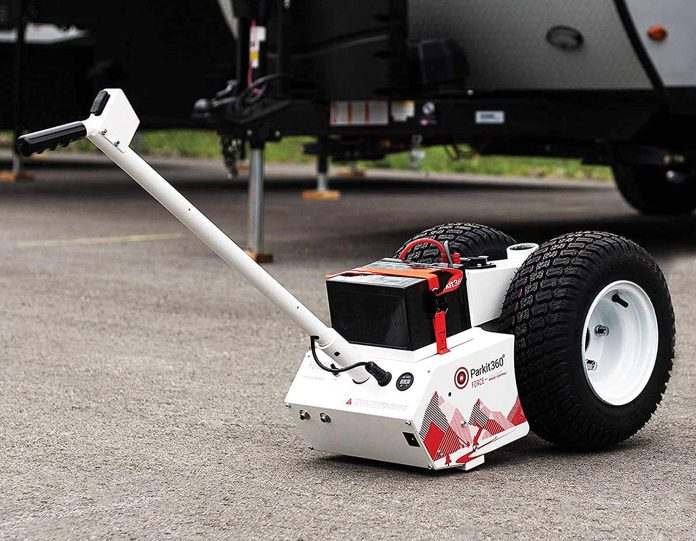

Quick Verdict: The Parkit360 5K Force is the electric trailer dolly to buy if you park a 3,500-5,000 lb trailer in a driveway, storage lot, or backyard site your tow vehicle can’t easily access. Its 1.5 HP motor, 6.5-inch tires, and 5,000-lb GVWR rating handle overland trailers, mid-size boat trailers, and 21-foot campers with predictable precision. At $2,185 it’s not cheap, but it’s meaningfully better built than sub-$1,100 imports and priced $570 below the Force 10K. Skip it if your trailer weighs over 5,000 lbs, or if your terrain exceeds a 6% grade — the 5K will slip.
Last updated: August 2026 | 9 min read
In This Review
- Parkit360 5K Force Overview: Who This Dolly Is For
- Key Specs at a Glance
- Real-World Performance: Grade, Surface, and Load
- Battery, Run Time, and Charging
- Hitch Compatibility and Setup
- Where the 5K Falls Short
- Parkit360 Force 5K vs. Force 10K vs. Transformer 15K
- Pros and Cons
- Final Verdict
- Frequently Asked Questions
| Top Pick | Best for Heavy Trailers | Best Mid-Weight Value | Best Budget | |
|---|---|---|---|---|
| Product | TOP PICK Parkit360 Force 5K Parkit360 Force 5K |  Goodyear Super-Duty 7500 Goodyear Super-Duty 7500 |  Goodyear 3600 Goodyear 3600 |  SuperHandy 2800 SuperHandy 2800 |
| Rating | ★★★★☆ 4.1 73 ratings | ★★★★☆ 3.9 48 ratings | ★★★★☆ 3.9 70 ratings | ★★★★☆ 3.8 583 ratings |
| Max trailer GVWR | 5,000 lbs | 7,500 lbs | 3,600 lbs | 2,800 lbs |
| Max tongue weight | 900 lbs | 1,100 lbs | 600 lbs | 450 lbs |
| Motor | 1.5 HP 12V | 800W 24V | 800W 24V | 800W 24V |
| Price | $1,999.00 as of Oct 5, 7:53 pm | $1,849.99 as of Oct 5, 7:53 pm | $1,099.99 as of Oct 5, 7:53 pm | $979.99 as of Oct 5, 7:53 pm |
| Check Price → | Check Price → | Check Price → | Check Price → |
Parkit360 5K Force Overview: Who This Dolly Is For
The Parkit360 5K Force is a battery-powered electric trailer dolly rated for trailers up to 5,000 lbs GVWR and 900 lbs tongue weight. For overlanders, boat owners, and RV storage users, the appeal is simple: you can maneuver a heavy trailer into a tight backyard slot, storage bay, or gravel parking area without backing up a full-size truck. Parkit360 is a Canadian manufacturer that has been building these dollies since 2011, and the current Force line replaced the older P360 M/L/XL naming scheme around 2020.
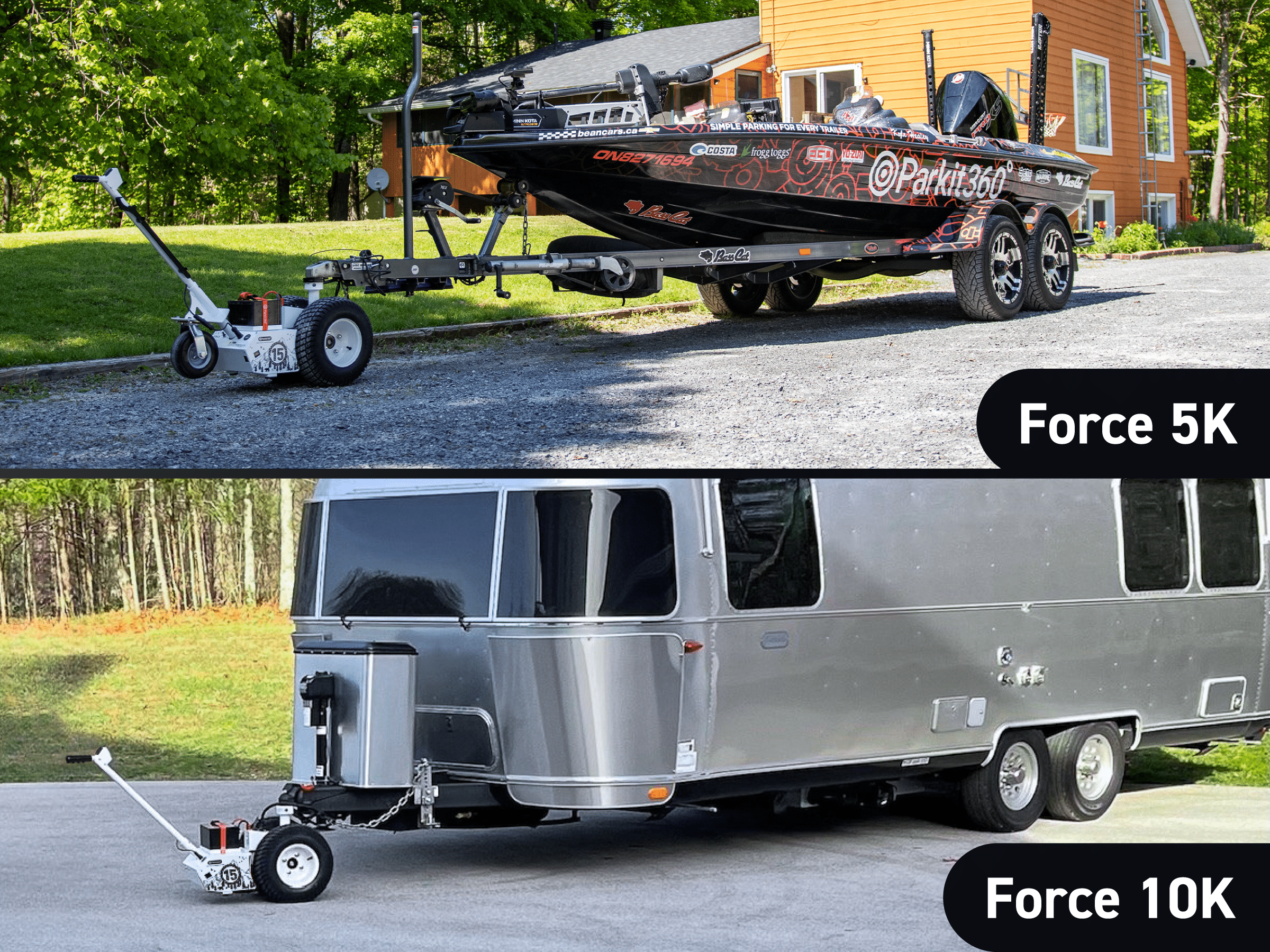
The 5K is the entry point of Parkit360’s powered Force lineup, which now runs to just two models. Below it sits the Scout 3K, a hand-powered dolly rated for 3,000 lbs at $395. Above it are the Force 10K ($2,755), the Carrier 13K ($6,555), and the Transformer 15K ($6,270 for the ball-and-fifth-wheel version), which add wireless control, dual motors, and stabilizer bars for fifth-wheel and gooseneck applications. If your trailer weight and tongue weight fit inside the 5K’s ratings, there’s no meaningful benefit to spending more — the 10K uses the same motor and controls, just with different gearing and heavier construction.
Where the 5K makes sense: 4×8 utility trailers with heavy loads, 12-16 foot boat trailers under 5,000 lbs, teardrop and mid-size overland trailers, small travel trailers up to 21 feet, and horse or cargo trailers within the weight limit. Where it doesn’t: fifth-wheel campers, dual-axle travel trailers over 5,000 lbs, or any trailer that needs to be moved on grades steeper than 6%. Reddit users have documented the 5K slipping on 8% driveways even when properly weighted.
Key Specs at a Glance
| Specification | Details |
|---|---|
| Maximum GVWR | 5,000 lbs |
| Maximum Tongue Weight | 900 lbs |
| Motor | 1.5 HP electric, 12V DC |
| Battery | 12V U1 Interstate (included with charger, voltmeter, cables) |
| Speed (Low / High) | 30 ft/min / 60 ft/min |
| Maximum Grade | 6% slope (all Force models) |
| Run Time Under Load | 45-90 minutes |
| Charge Time | 6-8 hours |
| Assembled Dimensions | 30″ L x 20″ W x 55″ H |
| Assembled Weight (with battery) | ~120 lbs (~90 lbs without battery) |
| Tire Width | 6.5 inches |
| Tire Diameter / Pressure | 16.5 in / 60 PSI |
| Hitch Ball Compatibility | 2″ and 2 5/16″ (both included) |
| Ball Mount Height | 20 inches |
| Compatible Surfaces | Asphalt, concrete, packed gravel, firm grass |
| Country of Manufacture | Canada |
| Warranty | 2 years (Parkit360) |
| Street Price | $2,185 direct from Parkit360 (about $2,300 on Amazon) |
Real-World Performance: Grade, Surface, and Load
Where the 5K Force shines is flat and gently sloped terrain on firm surfaces. On concrete driveways, packed gravel, or asphalt storage lots, the dolly moves a properly weighted 3,500-4,500 lb trailer with essentially no drama. The rocker switch on the handle controls forward and reverse, and the two-speed selector lets you crawl at 30 feet per minute for tight maneuvering or move at 60 feet per minute across longer stretches. Small Boats Magazine documented the 5K moving a 2,280-lb boat and trailer combo effortlessly.
The 6% grade limit is real and worth respecting. Parkit360 publishes this rating conservatively — the 5K will start climbing slightly steeper grades but will lose traction and stall out somewhere between 7% and 9% under load. This is the number-one complaint in Reddit and forum threads: users trying to push heavy trailers up their driveway inclines and finding the tires slip when things get steep. If your storage site has a steep approach, measure the grade before ordering.
Surface matters as much as grade. The 6.5-inch tires perform well on asphalt, concrete, packed gravel, and firm grass. They struggle in loose gravel, soft grass, mud, sand, and any surface that won’t compact under load. Overland trailer owners who park at rural sites with variable ground conditions should plan on laying down plywood or track pads where the dolly needs to pull the trailer. For a broader look at what makes a real off-road trailer, our off-road trailer breakdown covers the ground clearance and suspension standards that affect where a Parkit360 can and can’t help you.
Tongue weight compliance is critical. Parkit360 rates the 5K for 900 lbs of tongue weight, and trailers approaching that limit will feel labored on inclines even if the total GVWR is well under 5,000 lbs. A 4,000-lb trailer with 900 lbs of tongue weight taxes the dolly harder than a 4,500-lb trailer with 600 lbs of tongue weight. Weigh your tongue with a bathroom scale and hitch mount before assuming the 5K is right for your setup.
Battery, Run Time, and Charging
The Force 5K ships with a 12V U1 Interstate battery, a compatible charger, cables, and a built-in voltmeter. Interstate U1 is a standard deep-cycle format used in lawn mowers and small marine applications, and replacements run $60-$120 at any auto parts store when the original eventually fails. This is a real advantage over dollies that use proprietary battery packs — you’re not locked into buying a $400 replacement from the manufacturer when the battery reaches end of life.
Run time under load is 45-90 minutes depending on grade, surface, and trailer weight. For typical driveway parking use — pull the trailer 50-100 feet, position it, kill the switch — that’s dozens of parking sessions per charge. Actual heavy use like moving a trailer across a large storage lot will burn through a charge much faster. The charger is a standard 120V wall unit; charge time from dead to full is 6-8 hours.
The included voltmeter is more useful than it sounds. It gives you a real-time reading of battery state under load, which helps you know when you’re approaching the point where the motor will start to bog down. Trailer dollies that lack this indicator leave you guessing until the motor stalls. If you’re planning to run the 5K frequently, budget for a spare U1 battery ($80-100) so you can swap in a charged unit if the primary gets low mid-job.
Hitch Compatibility and Setup
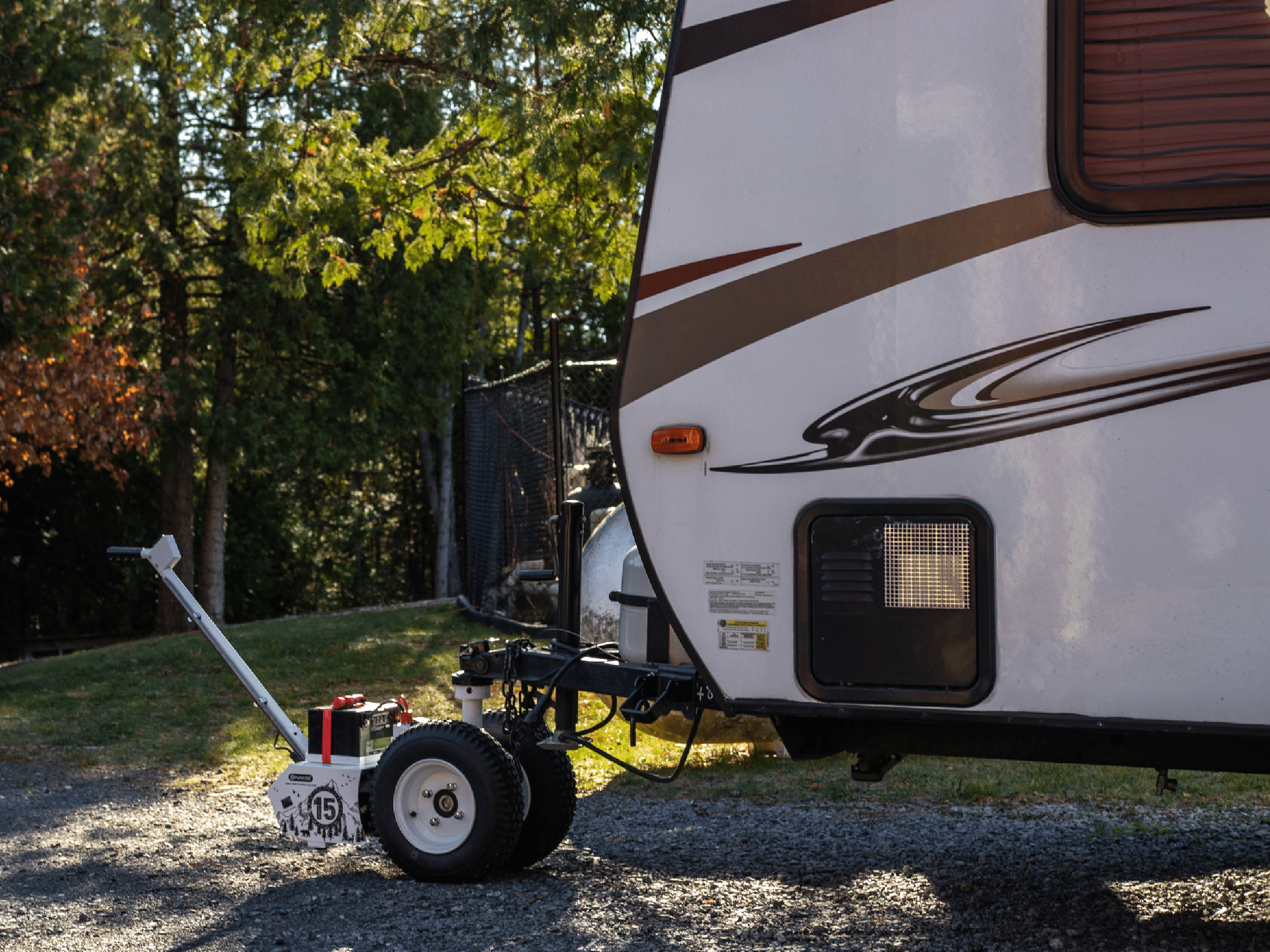
Both 2-inch and 2 5/16-inch hitch balls come included with the Force 5K, and the 20-inch ball mount height accommodates most standard trailer couplers. This covers the vast majority of consumer trailers built in the last 20 years, from utility trailers to teardrop campers to boat trailers. The dolly uses a standard StableLock ball mount design that clamps onto the coupler like a normal hitch receiver.
One well-documented incompatibility: underslung Atwood couplers, which are used on some Jayco Jay Flight travel trailers and other older Jayco models. The Parkit360 ball mount design cannot engage properly with these couplers, and etrailer specifically warns buyers of these trailers to verify coupler style before ordering. Check the underside of your trailer coupler before committing.
Setup out of the box takes 20-30 minutes for one person. The dolly ships in a 38″ x 18″ x 16″ carton weighing 123 lbs. The handle assembly bolts on with basic hand tools, the battery installs into the frame, and the charger connects to a standard household outlet. There’s no hydraulics, no fluid to add, and no software to configure. Parkit360 also sells the Force 5K with an optional 7-way plug wired to your trailer’s brake controller, which activates the trailer’s own brakes when the dolly stops — useful on any trailer with electric brakes.
Where the 5K Falls Short
The Force 5K is not the right dolly for every application, and Parkit360 is generally honest about its limits. Beyond the 6% grade ceiling already covered, the 5K has three real weaknesses buyers should understand before committing $2,185.
Weight capacity ceiling. The 5,000-lb GVWR / 900-lb tongue rating is firm, not soft. Users trying to push 5,500-6,000 lb trailers report bogging, motor strain, and sometimes actual failure to move the trailer at all. If your trailer weight is within 500 lbs of the 5K’s rating, you are shopping in the wrong Force model — the 10K exists for a reason. The etrailer team specifically directs customers with 10,000-lb trailers to the Transformer 15K rather than the Force 10K, because loaded margin matters more than rated capacity.
Freewheel mode is heavy. The 5K weighs about 120 lbs with the battery installed, and 90 lbs without. In freewheel/neutral mode, one adult can push it by hand across a flat driveway, but it’s not effortless. Moving the dolly itself around your storage area takes real work, particularly if you’re navigating from a garage to a distant parking spot.
Not for boat ramps. Parkit360 is explicit that the Force line is not designed for submerged use or steep boat ramps. The motor and battery housing are not waterproofed, and boat ramp grades routinely exceed 10-15%. Boat owners who need dolly assistance on the ramp should look at hydraulic ramp assistants, not the Force 5K.
For overlanders who need to think about total setup cost, our real cost of an overland setup guide puts the Parkit360 investment in context — a dolly is a nice-to-have, not a must-have, for most rigs.
Parkit360 Force 5K vs. Force 10K vs. Transformer 15K
Parkit360’s lineup is straightforward once you understand the tiers. The Force 5K at $2,185 handles trailers up to 5,000 lbs GVWR with 900 lbs of tongue weight. The Force 10K at $2,755 doubles the GVWR to 10,000 lbs while keeping the same 900-lb tongue rating, using stronger gearing and heavier construction — same 1.5 HP motor, same 6% grade limit. The Transformer 15K starts at $6,270 and adds dual motors, stabilizer bars, wireless remote control, and compatibility with fifth-wheel and gooseneck hitches for trailers up to 15,000 lbs, though its grade ceiling drops to 4%.
Choose the 5K if your trailer weighs under 4,500 lbs and you have flat-to-mildly-sloped terrain. Choose the 10K if you’re between 5,000 and 9,000 lbs — the extra $570 buys you meaningful margin, and the etrailer team specifically warns against running the 5K at its ceiling. Choose the Transformer 15K only if you have a fifth-wheel, gooseneck, or a trailer over 10,000 lbs. The wireless control on the Transformer is genuinely useful for one-person operation, but at roughly $3,500 more than the Force 10K, most single-trailer owners don’t need it.
One important note: Parkit360 also sells the older P360 M/L/XL models on the used market at prices around $600-$1,200. These use the same basic architecture as the current Force line but with less refined controls, smaller tires, and older battery systems. If you find a lightly-used P360 L (equivalent to the current 10K) for $800, it can be a smart budget play — but parts availability is thinner and the warranty is expired. For a broader look at electric trailer dolly options, our electric dolly buying guide compares Parkit360 against Trailer Valet, Powered Trailer Dolly by Ariens, and cheaper import brands.
Pros and Cons
Pros
- 5,000-lb GVWR and 900-lb tongue capacity handles most overland and mid-size camper trailers
- 1.5 HP motor moves 3,500-4,500 lb trailers on flat surfaces with no drama
- Standard 12V U1 battery means $60-$120 replacements at any auto parts store
- Both 2″ and 2 5/16″ hitch balls included — no aftermarket ball to source
- 6.5-inch wide tires provide real traction on concrete, asphalt, packed gravel, and firm grass
- Two-speed rocker control (30 or 60 ft/min) handles precision positioning and longer runs
- Built-in voltmeter shows battery state under load
- Canadian-built with a 2-year manufacturer warranty
- Compact 30″ x 20″ x 55″ footprint fits in a small SUV cargo area for portability
Cons
- Hard 6% grade ceiling — steeper driveways cause tire slip and motor stall
- 120-lb dolly weight makes freewheel/neutral movement labor-intensive
- Not compatible with underslung Atwood couplers (some Jayco Jay Flight models)
- Struggles on soft grass, loose gravel, mud, and sand
- Not designed for submerged use or steep boat ramps
- Trailers within 500 lbs of the 5,000-lb rating bog the motor — need the 10K instead
- $2,185 price is a meaningful premium over $900-$1,100 import alternatives
Final Verdict
The Parkit360 5K Force earns its price for overlanders, boat owners, and RV storage users whose trailer weight is between 2,000 and 4,500 lbs and whose terrain stays under 6% grade. In that operating envelope, it’s genuinely the best consumer trailer dolly on the market — better built than the sub-$1,100 imports, more capable than the hand-powered Scout 3K, and priced $570 below the Force 10K it’s often confused with. Six months of daily driveway use in typical suburban conditions will convert a skeptic.
Where the 5K is the wrong tool: heavier trailers, steep terrain, submerged use, or soft ground. Overland trailer owners parking at remote sites with loose gravel or grass should budget for track pads or plywood; boat owners who need ramp assistance should look at hydraulic solutions instead. Buyers whose trailer weight exceeds 4,500 lbs should step up to the Force 10K without hesitation — the extra $570 is far cheaper than replacing a bogged motor.
At $2,185, the Force 5K is a legitimate long-term investment. The 12V U1 battery standard means running costs are predictable, the 2-year warranty covers manufacturer defects, and the Canadian construction quality is meaningfully above imports. Divided across five to eight years of typical driveway use, you’re paying roughly $275-$435 per year to eliminate the frustration of maneuvering a trailer with a truck in tight spaces.
Final recommendation: buy the Force 5K if your trailer weight is under 4,500 lbs, your terrain is flat to mildly graded, and you park in a driveway or storage lot your tow vehicle can’t easily access. If your trailer is heavier, jump to the 10K. If your terrain is steep, no electric dolly in this price range will solve your problem — you’ll need a tow vehicle with better maneuverability or a driveway regrade.
Parkit360 Force 5K Electric Trailer Dolly | Battery Powered Trailer Mover for RV, Boat, Cargo & Utility Trailers Up to 5,000 lbs
The dolly to buy when your trailer is under 4,500 lbs and your ground is flat, firm, and awkward to back into.
- 5,000 lbs GVWR and 900 lbs tongue weight covers overland trailers, mid-size boat trailers and 21-foot campers
- Runs on a standard 12V U1 battery you can replace at any auto parts store instead of a proprietary pack
- Ships with both hitch balls, charger, voltmeter and cables, so it moves a trailer the day it arrives
- Low speed creeps at 30 ft/min for precise placement, high speed doubles to 60 ft/min for long storage-lot runs
- The 6 percent grade ceiling means it slips on steeper driveways no matter how well the trailer is weighted
- Trailers within 500 lbs of the 5,000 lb rating bog the motor, which is where the Force 10K earns its premium
Frequently Asked Questions
Is the Parkit360 5K Force worth the money?
For trailers between 2,000-4,500 lbs on flat-to-mildly-sloped terrain, yes. At $2,185, the Force 5K is meaningfully better built than sub-$1,100 import dollies and priced below the Force 10K. Divided across a realistic 5-8 year service life, that’s roughly $275-$435 per year for daily driveway convenience. If your trailer weight is within 500 lbs of the 5,000-lb rating, the Force 10K at $2,755 is the smarter buy.
What is the maximum weight capacity of the Parkit360 Force 5K?
The Parkit360 Force 5K is rated for 5,000 lbs gross vehicle weight rating (GVWR) and 900 lbs of tongue weight. Both ratings are firm — trailers approaching these limits will bog the 1.5 HP motor and consume battery faster. Weigh your trailer tongue with a bathroom scale and hitch mount before ordering; a 4,000-lb trailer with 900 lbs of tongue weight taxes the dolly harder than a 4,500-lb trailer with 600 lbs of tongue weight.
What grade can the Parkit360 5K handle?
The Parkit360 Force 5K is rated for grades up to 6%. This is a real, tested limit — reviewers and Reddit users consistently report the 5K’s tires slip and the motor stalls somewhere between 7% and 9% on inclines under load. If your driveway or storage site has a steep approach, measure the grade with a smartphone level app before ordering. No electric dolly in this price range will move a heavy trailer up a truly steep incline.
Can the Parkit360 5K move a boat trailer?
Yes, provided the boat, outboard, and trailer total under 5,000 lbs GVWR with under 900 lbs of tongue weight. Small Boats Magazine documented the 5K moving a 2,280-lb boat and trailer combo effortlessly, and Bassmaster tested it favorably on 16-foot bass boats. The 5K is not designed for submerged use or steep boat ramps — the motor and battery housing are not waterproofed, and typical ramp grades exceed the 6% limit. For ramp assistance, look at hydraulic solutions instead.
How long does the Parkit360 5K battery last on a full charge?
Under load, the 12V U1 battery delivers 45-90 minutes of run time depending on trailer weight, grade, and surface. For typical driveway use (moving a trailer 50-100 feet and positioning it), that’s dozens of parking sessions per charge. Charge time from empty to full is 6-8 hours on the included 120V wall charger. Replacement U1 batteries cost $60-$120 at any auto parts store when the original eventually fails.
Does the Parkit360 5K work with all trailer couplers?
The Force 5K works with 2-inch and 2 5/16-inch trailer balls, both of which are included in the box, and the 20-inch ball mount height accommodates most standard trailer couplers. One documented incompatibility: underslung Atwood couplers, used on some Jayco Jay Flight travel trailers and older Jayco models. Check the underside of your trailer coupler before ordering. Etrailer specifically warns buyers with these trailers to verify coupler style first.
Parkit360 Force 5K vs 10K: which should I buy?
Buy the 5K if your trailer is under 4,500 lbs and your terrain is flat to mildly sloped. Buy the 10K if your trailer is between 4,500 and 9,000 lbs — the extra $570 buys real motor margin, and etrailer specifically warns against running the 5K at its ceiling. Both models use the same 1.5 HP motor and 6% grade limit; the 10K adds heavier construction and different internal gearing for the higher capacity. Tongue weight is 900 lbs on both.
Where is the Parkit360 5K made?
The Parkit360 Force 5K is manufactured in Canada by Parkit360 Inc., a company that has been building consumer trailer dollies since 2011. Canadian manufacturing puts it in a materially different quality tier from the sub-$1,100 import dollies sold at Harbor Freight and Amazon that ship from Chinese factories. The 2-year warranty is honored by Parkit360 direct customer service.