



Quick Facts:
- Network: Rivian Adventure Network (RAN)
- Planned size: 3,500+ DC fast chargers at about 600 sites
- Coverage: US sites today; Canada planned, none open yet
- Charger output: Over 200 kW per stall
- Charge rate: Up to 150 miles of range in 20 minutes (140 at announcement)
- Access: Rivian-only at launch; nearly all sites now open to all EVs
- Power source: 100% renewable energy
- Best for: R1T, R1S, and R2 owners who travel far from interstate corridors
8 min read
In This Article
Overview: What Rivian Announced
Rivian built the Rivian Adventure Network around a clear bet: overlanders need fast charging where other networks refuse to build. The plan calls for more than 3,500 DC fast chargers at about 600 sites across the US and Canada. Rivian positioned the network for its own drivers, much as Tesla’s Supercharger network once served Tesla owners alone. Because Rivian reserved the stalls at launch, electric overlanding gained its closest thing to a private fuel system.
The announcement matters because charging access still decides where an electric truck travels. A gas rig refuels in five minutes at any rural pump. An R1T, in contrast, needs a working DC fast charger to cover the same ground. Rivian’s answer puts chargers on highway corridors first. Then the map extends toward trailheads and wilder destinations, including park gateways such as Yosemite.
Current R1T and R1S owners gain a purpose-built backbone for long routes. Prospective R2 buyers, meanwhile, get a network built ahead of demand. Compared to public CCS options, the Rivian charging network promises tighter integration. Owners get automatic plug-in billing, in-vehicle route planning, and live stall availability in the Rivian app. For overlanders, especially on remote corridors, integration means fewer dead stalls and fewer detours.
Cost details trailed the hardware details. Rivian said pricing and associated programs would follow the first site openings. Meanwhile, the newest chargers carry tap-to-pay terminals. Non-Rivian drivers pay by card, the same way they would at a gas pump.
Key Facts at a Glance
| Specification | Details |
|---|---|
| Network name | Rivian Adventure Network (RAN) |
| Planned buildout | 3,500+ DC fast chargers at about 600 sites, US and Canada |
| Size in June 2026 | 1,000+ DC fast charging ports across 148 US locations |
| Charger output | Over 200 kW per stall |
| Charge rate | 140 miles in 20 minutes at announcement; up to 150 today (R1T, R1S) |
| Connectors | CCS1 standard; NACS at 166 stalls across 50 locations |
| Access | Rivian-only at launch; nearly all sites now open to all EVs |
| Uptime | 98% across the network in 2025 |
| Companion network | 10,000+ planned Rivian Waypoints Level 2 chargers (11.5 kW) |
Network Size, Locations, and Rollout
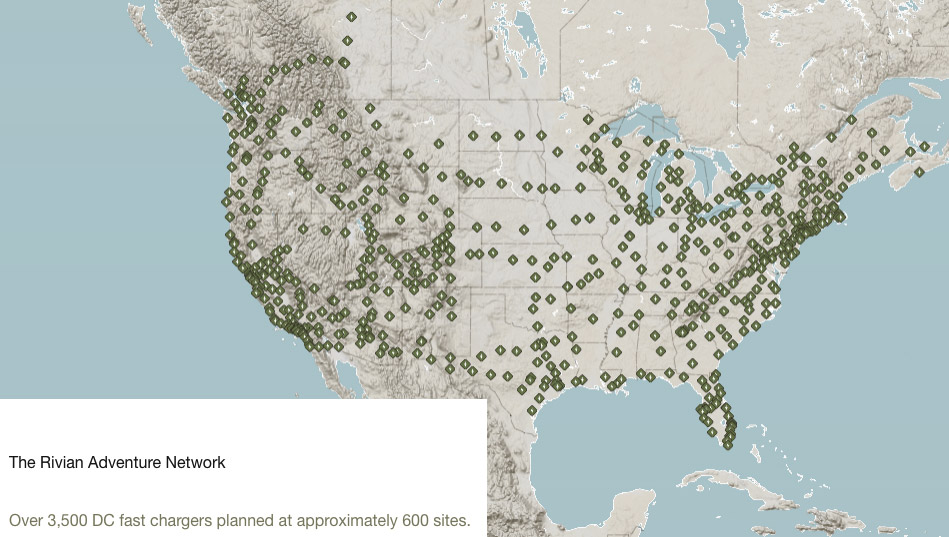
Rivian planned the buildout at more than 3,500 DC fast chargers across roughly 600 sites in the US and Canada. Sites hold multiple stalls, and most Rivian charging stations sit along highways and main roads. Locations cluster near cafes and shops because drivers want food and restrooms while they wait.
Progress has trailed the original timeline, however. The network passed 1,000 DC fast charging ports across 148 US locations in June 2026. US Department of Energy data confirms the count. Notably, four sites with 44 total stalls opened in the month before the milestone. The pace has picked back up.
Canada remains the gap. Nearly five years after launch, the network still lists no Canadian sites. Rivian’s original coverage map drew corridors on both sides of the border, although none opened in Canada. For overlanders running north into British Columbia or Alberta, third-party networks still carry the entire load.
Charger Specs and Charging Rates
Every stall delivers over 200 kW. A 20-minute stop adds up to 140 miles of range to an R1T or R1S. Specifically, Rivian’s current support page quotes an improved 150 miles in 20 minutes for the same trucks. In practice, a charge stop covers a meal break, which fits how overlanders travel anyway.
Connectors sit mid-transition. The network launched on CCS1 plugs. NACS hardware followed in July 2025, starting at the site in Joshua Tree, California. As of June 2026, NACS connectors run at 166 stalls across 50 locations. Six sites, moreover, operate on NACS exclusively.
Reliability numbers separate the network from an industry with a rough record. Rivian reports 98% uptime across 2025. The company credits in-house control of hardware, software, and maintenance. In addition, every stall runs on 100% renewable energy through wind, solar, and renewable energy certificates.
A slower sibling network rounds out the plan. Rivian Waypoints targets shopping centers, restaurants, hotels, campsites, and parks. The plan lists more than 10,000 Level 2 chargers at 11.5 kW. Unlike the DC stalls at launch, Waypoints stayed open to any EV with a J1772 plug.
Exclusivity: Who Gets to Plug In
At launch, Rivian reserved its DC fast chargers for its own drivers. The official announcement stated the stalls “will be for Rivian owners only,” with pricing to follow. Exclusive access copied Tesla’s early Supercharger playbook. Reward owners with a private refueling network, then use the loyalty to sell the next vehicle.
Permanent exclusivity was never the promise, though. Instead, Rivian framed the restriction as an initial phase. In December 2024, the company began opening sites to every EV brand. Then a retrofit program followed. By August 2025, more than 75% of locations accepted all compatible EVs.
Little of the wall remains today. Rivian says nearly every site supports all compatible EVs. The newest chargers also use taller cabinets and longer cables to reach any charge port location. For Rivian owners, the advantage now lies in integration instead of exclusion. Think plug-and-charge billing, in-car routing, and live availability before arrival.
What It Means for Overlanding Routes
Remote-area coverage, more than speed, sets this network apart from the big public players. Most public networks tend to follow traffic density into interstate corridors and metro retail. Rivian, in contrast, sites chargers near trailheads, park gateways, and backcountry corridors. One example is the Highway 395 corridor through the Sierra Nevada into Yosemite.
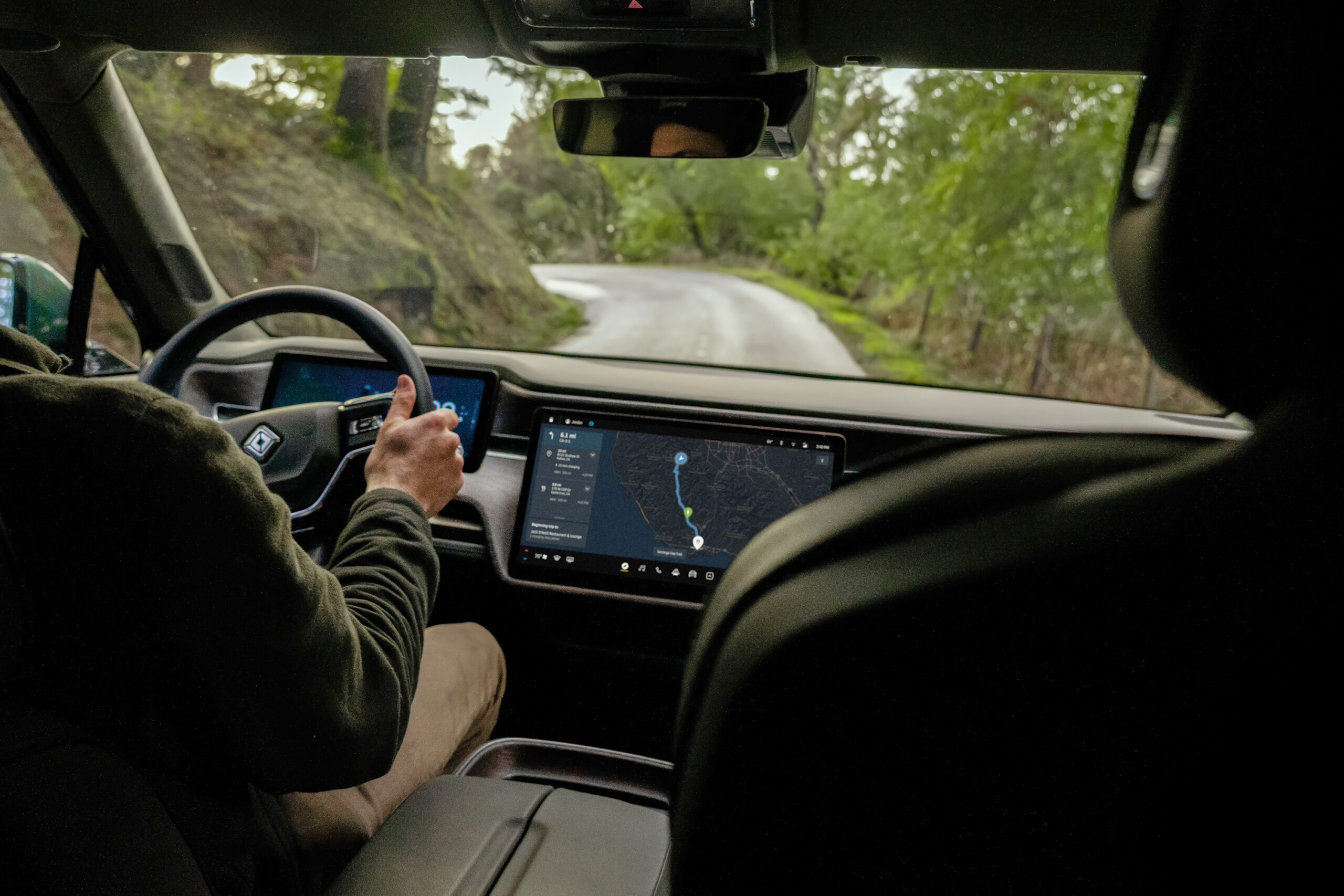
Charger locations now belong on your route sheet, the same way fuel and water stops do. When you plan an overland route, treat confirmed stalls as anchors. Then check live status before committing to a leg. The Rivian Adventure Network map shows real-time availability in the Rivian app, the in-car navigation, and Google Maps.
Coverage gaps still shape trip design. Today’s 1,000-plus ports stand against a 3,500-charger plan. On the current map, long stretches of the northern Rockies and all of Canada run thin. Still, the future of electric overlanding depends on exactly this kind of buildout. Fast chargers belong within striking distance of dirt, not only along interstates.
Will the Network Keep Up? Rivian’s 2026 Ramp and R2
Network demand tracks vehicle sales, and 2026 is on track to be Rivian’s biggest year yet. The company entered the year guiding 62,000 to 67,000 deliveries. Then Rivian raised the range to 65,000 to 70,000 on July 2 after a strong second quarter. Specifically, Q2 production reached 12,613 vehicles, with 12,194 delivered against an outlook of 9,000 to 11,000.
R2 changes the load math. Deliveries of the smaller SUV began in the second quarter. Every R2 ships NACS-native, which pushes the connector transition across the network. Also, Rivian says the underground conduit and power capacity already sit in place at most locations. As a result, new stalls deploy without heavy construction as the fleet grows.
Timing also stacks up for buyers weighing entry. For example, Rivian’s recent lease deal lowered the monthly cost of an R1 rig. In addition, R2 arrived at a lower starting price than R1. The open question is whether the Rivian charging network scales as fast as the fleet it serves.
Rivian Adventure Network vs. Tesla Superchargers
Scale favors Tesla by a wide margin. The Supercharger network offers more than 21,500 DC fast chargers across North America, compared to Rivian’s 1,000-plus ports. However, Rivian drivers with a NACS DC adapter charge on both networks. The choice therefore matters less than it did for early Tesla owners.
Siting strategy sets the two apart. Superchargers and public CCS networks chase traffic volume. Rivian instead picks locations for adventure access, including park gateways and mountain corridors. Beyond both brands, the US fast-charging pool keeps growing. The Department of Energy counted nearly 15,000 DC fast-charging locations with over 70,000 ports nationwide in early 2026.
Against public CCS players, the Rivian charging network competes on reliability and integration rather than raw count. A 98% uptime record beats an industry known for dead stalls. Plug-and-charge also removes apps and cards for Rivian drivers, and stall status shows in-car before arrival. For shoppers cross-checking trucks, our Scout vs Rivian R1T comparison weighs vehicle specs the same way this piece weighs networks.
Final Verdict
The Rivian Adventure Network gives Rivian owners the strongest brand-specific charging story outside Tesla. Its core strength sits in placement. Fast chargers aim at the places overlanders drive, backed by a 98% uptime record and full in-vehicle integration.
The trade-offs stay real. Coverage sits at 148 US locations against a 600-site plan. Canada still waits, and the exclusive-access era has ended. Consequently, Northeast owners will lean on Tesla and public networks for now, based on the current map.
Value depends on where you drive. For Southwest desert loops and Sierra corridors, the network already works as a primary backbone. In contrast, coast-to-coast flexibility leans on the NACS adapter and Tesla access. Either way, a Rivian reaches its own sites, Tesla Superchargers, and public CCS stations from a single navigation screen.
Fast charging deep in remote country favors the R1T with this network behind it. Among electric trucks, only Tesla’s Cybertruck offers a bigger factory charging network. Buyers focused on interstate travel and a lower starting price should look instead at the Ford F-150 Lightning. The Lightning pairs with public NACS networks and undercuts the R1T on price.
Rivian Adventure Network FAQ
Is the Rivian Adventure Network open to all EVs?
Mostly, yes. Rivian began opening sites to all EV brands in December 2024, then retrofitted most of the network. The company says nearly every site now supports all compatible EVs. Tap-to-pay terminals also let non-Rivian drivers skip the app entirely.
How fast does the Rivian Adventure Network charge?
Each stall delivers over 200 kW. Rivian quoted up to 140 miles of range in 20 minutes at the network’s announcement. The current support page, however, lists an improved 150 miles in 20 minutes for the R1T and R1S.
How much does it cost to charge on the Rivian Adventure Network?
Rivian announced the network with pricing and programs to follow. The company has not published one national rate since. Non-Rivian drivers pay by card at tap-to-pay terminals at the newest sites, while plug-and-charge handles billing for Rivian drivers.
Where are Rivian Adventure Network chargers located?
As of June 2026, the network counts 1,000-plus DC fast charging ports across 148 US locations. Rivian charging stations sit along highway corridors and near outdoor destinations such as Joshua Tree and Yosemite. The earliest buildout landed in Colorado and California. Check the Rivian Adventure Network map for live sites.
Do Rivian drivers get access to Tesla Superchargers?
Yes. With a NACS DC adapter, Rivian drivers reach more than 21,500 Tesla Superchargers across North America. In-car navigation also routes through Supercharger and public CCS stops alongside Rivian’s own sites.