



Quick Facts:
- Story: A Volkswagen pickup truck for the US market
- Primary source: Reuters, August 7, 2026, citing one unnamed company source
- Timing: On sale before the end of the decade
- Build location: United States, specific plant unconfirmed
- Likely basis: The Volkswagen Amarok, a Ford Ranger platform twin
- Development partner: Undecided, with Ford named as one candidate
- VW US market share: 4%
- Official comment: Volkswagen declined to comment
- Best for: Readers tracking new entrants in the midsize truck segment
8 min read
In This Article
- Inside the Volkswagen Pickup Truck Report
- Key Facts at a Glance
- The Volkswagen Amarok Explained
- Why Tariff Math Forces a US Build
- The Scout Terra Problem
- What a Volkswagen Pickup Truck Needs Off-Road
- Who Else Is Entering the US Truck Market
- The Midsize Field a Volkswagen Pickup Truck Would Enter
- Final Verdict
- Frequently Asked Questions
Inside the Volkswagen Pickup Truck Report
One anonymous company source has put a Volkswagen pickup truck back on the table for America. According to Reuters, the plan calls for a US-built truck on sale before 2030. German business daily Handelsblatt broke the story first. Volkswagen itself declined to comment on any of it.
Motive comes before personnel here. Volkswagen holds roughly 4% of the US market, and its best-selling model here is the Tiguan, not a truck. Reuters describes pickups and large SUVs as high-margin vehicles in strong US demand. Brand head Thomas Schaefer sees growth in both. Meanwhile, a management change lands alongside the product plan. Marco Schubert, previously head of sales at Audi, moves to the United States. He replaces Kjell Gruner, who departs the company.
However, the source stopped short of a product plan. Volkswagen has not decided whether to engineer the truck alone or with a partner. A decision lands in the coming weeks and months, according to the source. Reuters names Ford as one candidate, since Ford already builds the Explorer and Capri on Volkswagen’s MEB platform.
Read the hedges carefully. No source has confirmed a plant, a platform, a body style, a powertrain, or a price. Reuters mentions the Chattanooga, Tennessee, factory only as context, since ID.4 production ended there earlier this year. Coverage tying the truck to Chattanooga rests on the same context, not on a named source. Still, treat the plant as the likeliest candidate rather than a decision.
Key Facts at a Glance
Below sits the hard material behind the story. Every figure traces to a manufacturer document, a government source, or the Reuters report itself.
| Item | Details |
|---|---|
| Amarok platform | Ford T6, shared with the global Ranger |
| Amarok build site | Silverton, South Africa, assembled by Ford |
| Length and wheelbase | 210.6 in long, 128.7 in wheelbase |
| Braked towing | 7,716 lb |
| Payload | Up to 2,425 lb, closer to 2,100 lb on heavy V6 trims |
| Fording depth | 31.5 in |
| Import tariff on light trucks | 25% MFN rate, plus 25% Section 232 duties |
| US assembly offset | 3.75% of aggregate MSRP of US-built vehicles, through April 2030 |
| Last VW pickup sold here | Rabbit Pickup, out of production since 1984 |
The Volkswagen Amarok Explained
Volkswagen already sells a midsize truck almost everywhere except North America. Ford builds the current Amarok at its Silverton plant near Pretoria, South Africa, on the T6 architecture underneath the global Ranger. Reuters confirmed the platform link in its report, and the arrangement dates to the 2019 Ford and Volkswagen alliance.
Specifications favor work over comfort. The double cab stretches 210.6 inches long on a 128.7-inch wheelbase, roughly Ranger-sized. Braked towing reaches 7,716 lb across the range. Payload tops out near 2,425 lb on lighter trims. Heavy V6 versions land closer to 2,100 lb, because curb weight eats into gross vehicle mass. Fording depth measures 31.5 inches, up from 19.7 inches on the first generation.
Engines run from a 148-hp four-cylinder turbodiesel to a 298-hp 2.3-liter turbo gas four. A 247-hp 3.0-liter V6 turbodiesel tops the diesel range. Because the V6 shares an engine family with the Ford Ranger Super Duty, a US Amarok would inherit a proven parts supply. The bed runs about 63.8 inches long and 62.4 inches wide, with 48.3 inches between the wheel arches. By VW’s own figures, a Euro pallet fits crosswise.
Why Tariff Math Forces a US Build
One sentence in the Reuters report matters more than the rest: the vehicle is to be built in the US. Tariff math explains why. The United States applies a 2.5% most-favored-nation duty to imported passenger cars, but a 25% rate to imported light trucks, per the Congressional Research Service. President Johnson imposed the light-truck rate by proclamation in 1964, retaliating against European tariffs on American poultry. The industry has called it the Chicken Tax ever since.
Section 232 duties then stack on top. Since April 2025, a 25% tariff applies to vehicle imports, with exemptions for the US content of USMCA-compliant vehicles. Unless a country-specific deal says otherwise, those duties come in addition to the MFN rate. South Africa holds no US free trade agreement covering autos, so an imported Amarok would face both layers. No published arrangement changes the arithmetic.
Domestic assembly flips the incentive. Automakers building in the US apply for an offset worth 3.75% of the aggregate MSRP of their US-built vehicles, running from April 2025 through April 2030. Therefore, the assembly decision is not branding. By our math, it separates a truck landing near $35,000 from one landing near $50,000, and the segment tolerates only the first number.
The Scout Terra Problem
Here is the awkward part. Volkswagen Group already has a US-built pickup coming: the Scout Terra, assembled in Blythewood, South Carolina. Scout targets initial production in 2027 and customer deliveries in 2028, with entry pricing under $60,000. One forecasting firm expects the Terra to slip toward 2030, although Scout denies any change to its published timing.
Terra specifications read like a serious off-road truck. Scout lists a body-on-frame chassis, a solid rear axle, and standard front and rear lockers. Clearance covers 35-inch tires, 12 inches of ground clearance, and 36 inches of fording depth. Towing reaches 10,000 lb on the battery-electric version. Meanwhile, the Harvester range-extender variant halves the rating to 5,000 lb. Scout says more than 80% of reservations name the range extender.
Gruner addressed the overlap at the 2026 New York Auto Show. He called Scout and Volkswagen separate companies with separate product decisions. Still, two Group pickups in two US plants for one market invite questions about volume and cannibalization. Our breakdown of VW Group’s Scout Terra lays out its promised capability. A mainstream Volkswagen product would need to sit clearly below it on price, which pushes the argument back to hardware.
What a Volkswagen Pickup Truck Needs Off-Road
Business coverage of this story skips the part trail users care about. A Volkswagen pickup truck lives or dies on frame, axles, and payload, not on brand strategy. Three thresholds decide whether a truck works for overlanding: frame strength, payload headroom, and ground clearance. The Amarok clears the first easily, since it runs body-on-frame with a double-wishbone front end and leaf springs at the rear. Ranger-derived hardware should also mean the aftermarket already supports the geometry, from bumpers to bed racks.
Payload decides whether a rooftop tent, a bed rack, drawers, water, and two adults fit inside the ratings. Most hardshell rooftop tents run 150 to 200 lb before bedding goes in. At roughly 2,100 lb of payload on a loaded V6 trim, an Amarok absorbs one plus gear and two adults with room left. Compared to the domestic field, the 31.5-inch fording depth also stands out. Among US midsize trucks, only the Jeep Gladiator publishes a comparable figure, at about 30 inches.
Weak points show up in the details. Global Amarok trims offer a rear locker but no factory front locker. VW’s own spec sheets put ground clearance at 217 mm, roughly 8.5 inches, against 10.7 inches for a Colorado ZR2. Approach and departure angles trail purpose-built US off-road trims as well. A trail-focused version would therefore need lockers and a lift from launch, not three model years later.
Who Else Is Entering the US Truck Market
Volkswagen is late to a crowded reunion. Five other automakers have new US pickups on their public plans inside the same window. Two of them attack from below on price.
Slate and Ford Attack the Bottom on Price
Slate Auto starts deliveries of its two-seat electric truck in Q4 2026 at $24,950 plus a $1,450 destination charge, or $26,400 all in. Specifications landed at 205 miles of range from a 65-kWh LFP pack, 181 hp, 2,000 lb of towing, and 1,550 lb of payload. Ford answered on August 6, 2026, by naming its own affordable electric pickup the Fathom. Ford’s Fathom pickup starts near $28,000, comes from Louisville Assembly, and reaches customers in fall 2027.
Mitsubishi, Hyundai, and Ram Target the Middle
Mitsubishi confirmed a US-built midsize truck developed with Nissan, likely riding the next-generation body-on-frame platform arriving around 2028 under a redesigned Frontier. Our report on Mitsubishi returning to US pickups covers the Pajero revival alongside it. Hyundai has pledged a body-on-frame midsize pickup by 2030, previewed by the Boulder concept. Stellantis is expected to add a Ram Dakota in 2027, which would give the segment three new nameplates in three years.
The Midsize Field a Volkswagen Pickup Truck Would Enter
Segment numbers explain both the appeal and the risk. US midsize pickup sales hit 660,412 units in 2025, up 24.4% year over year. Total US pickup sales ran near 3.18 million. First-half 2026 volume then reached 333,533 units, up about 5.8%.
Growth is cooling fast, though. Q1 2026 rose 10.2%, while Q2 slowed to 2.0%. The Jeep Gladiator alone fell 32.9% in the second quarter. Toyota takes roughly 43% of the segment with the Tacoma by itself, which leaves six remaining nameplates splitting a shrinking pool.
Pricing sets the entry bar. For 2026, base prices run $33,895 for a Nissan Frontier and $34,290 for a Tacoma. A Chevrolet Colorado starts at $34,495, a Ford Ranger at $35,445, and a Honda Ridgeline at $42,290. A VW pickup truck arriving in 2029 or 2030 with no brand equity needs to undercut the Frontier or clearly out-specify the Ranger. Splitting the difference rarely works in this segment.
Final Verdict
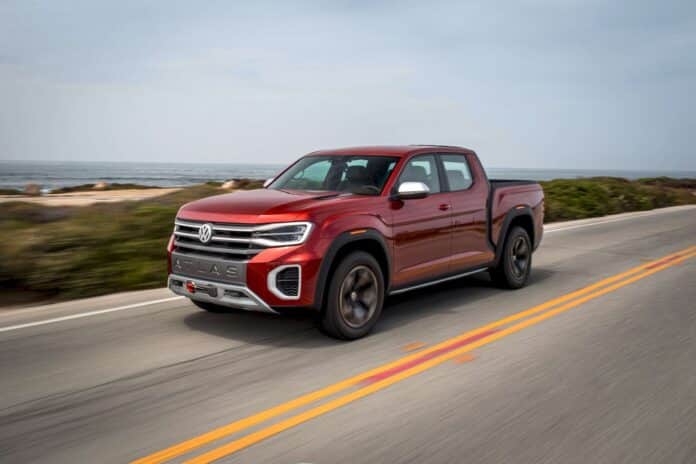
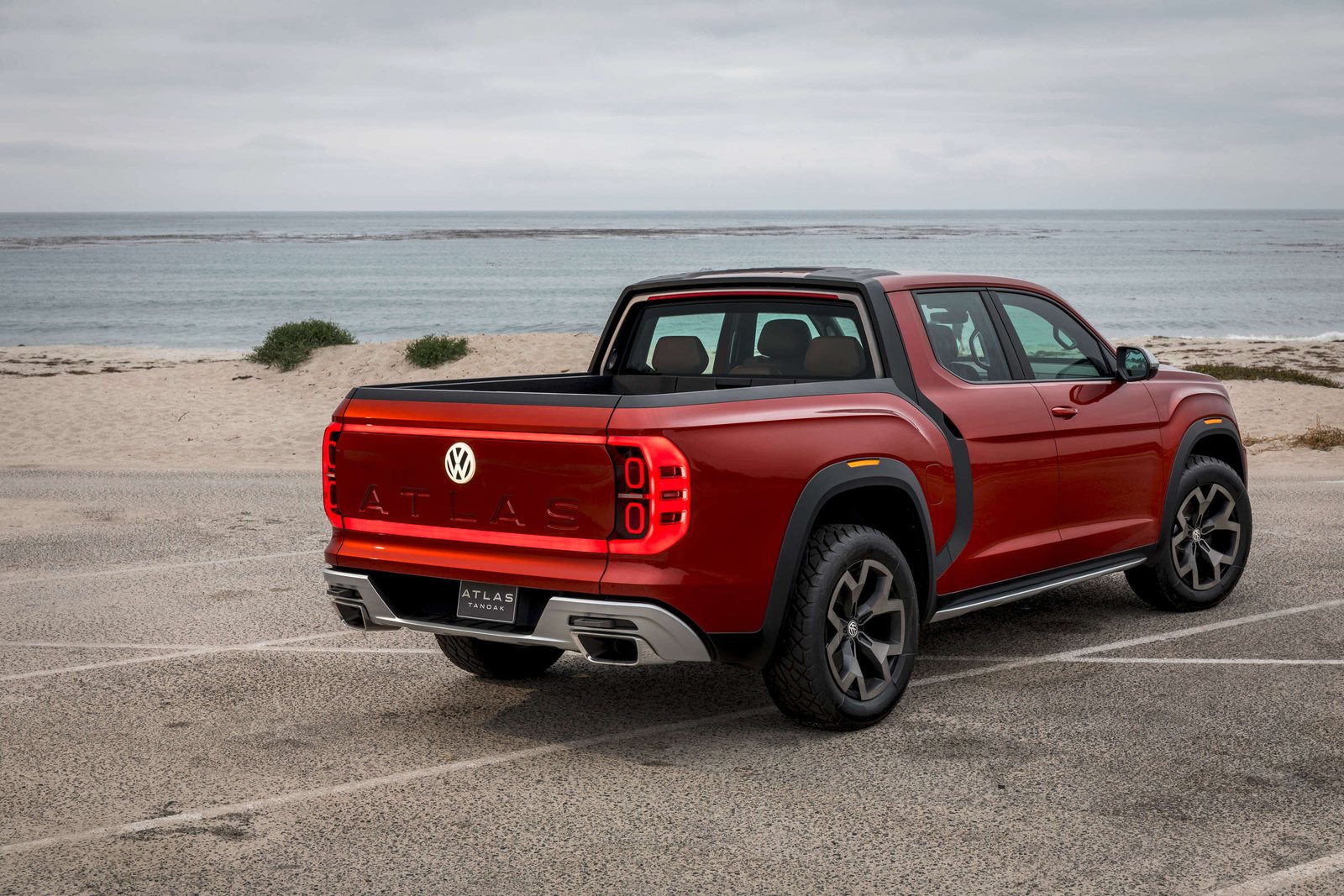
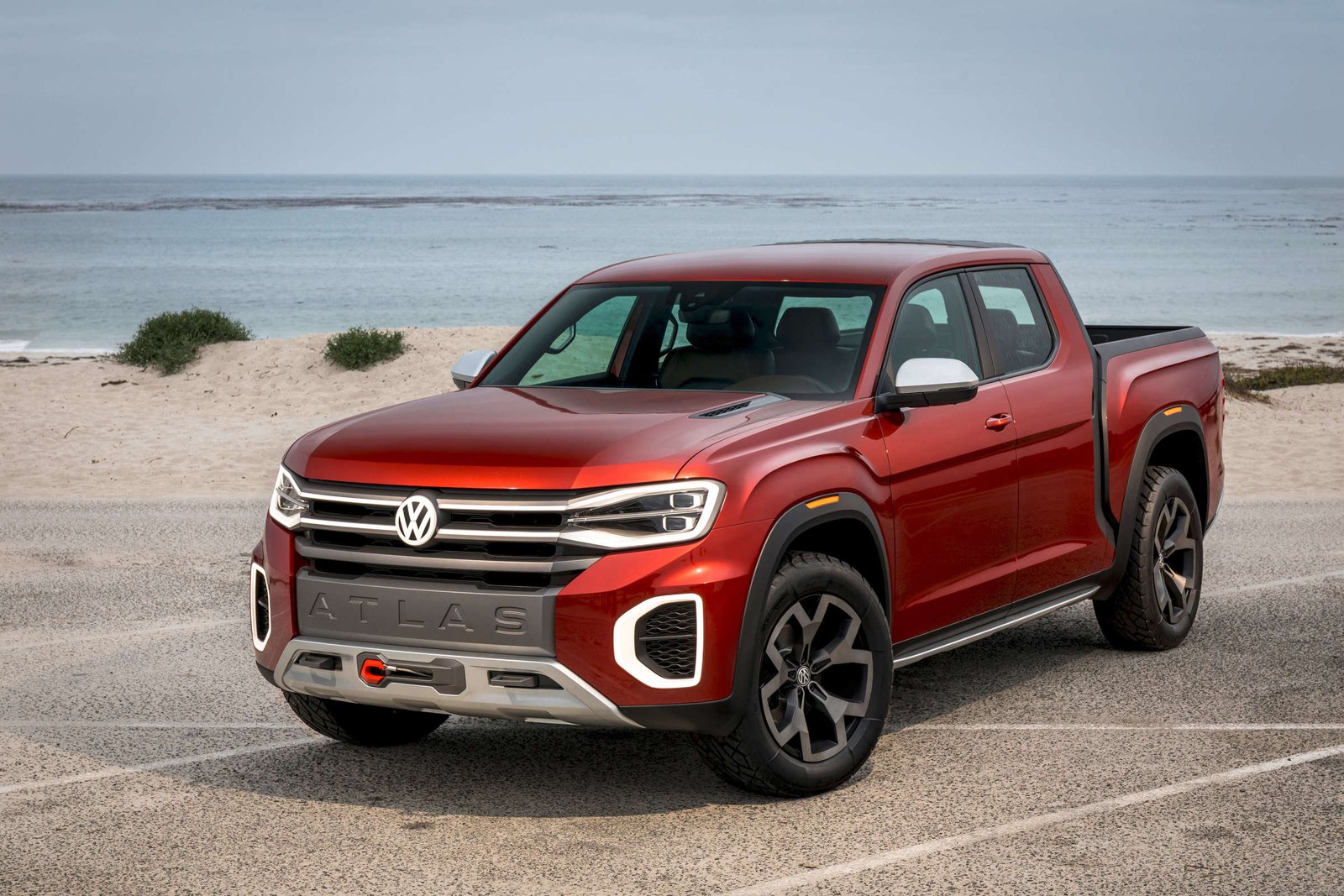
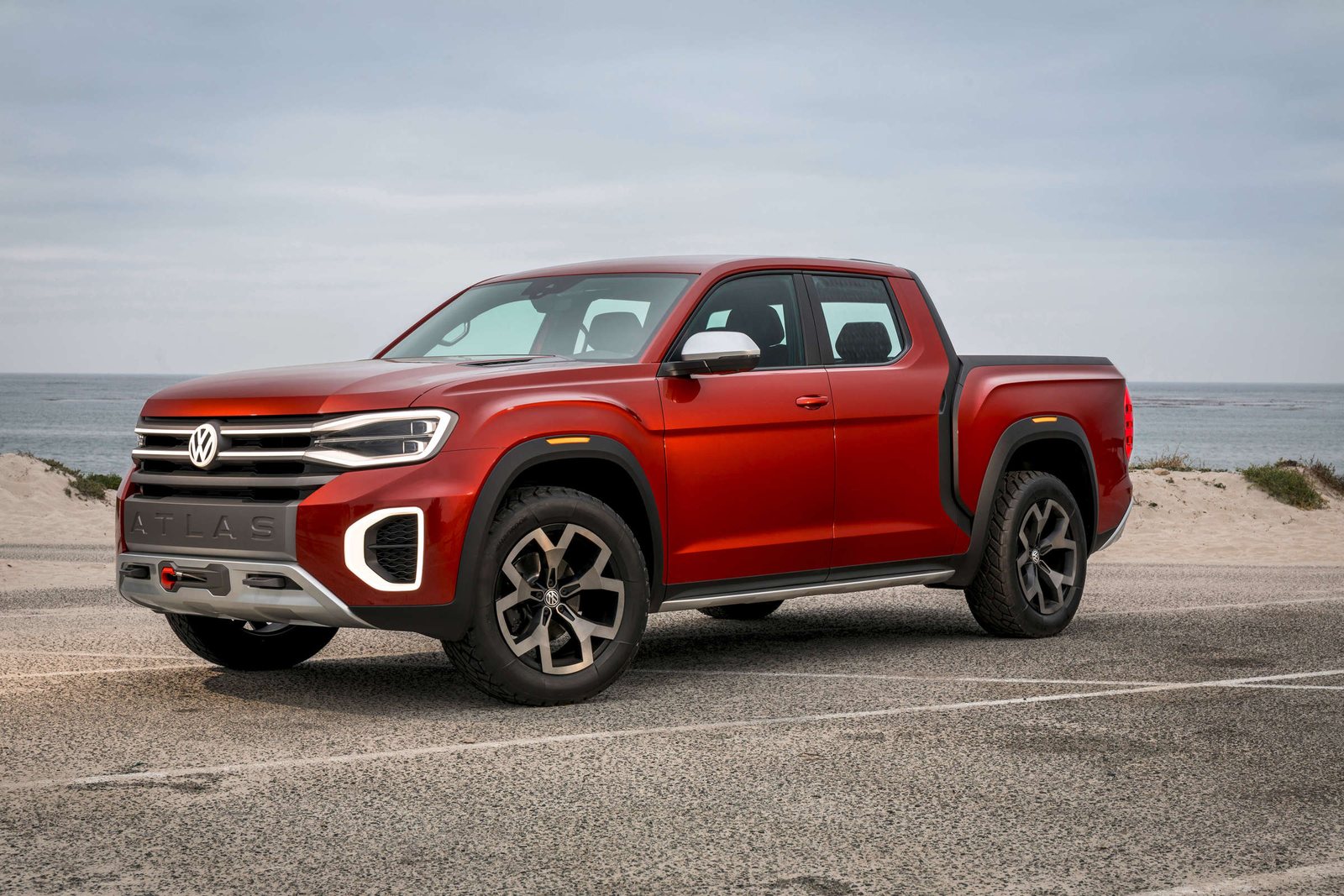
Take this report seriously, and take it slowly. One anonymous source, a leadership change, and a stated ambition do not add up to a product program. Volkswagen has teased American trucks before, including the Atlas Tanoak in 2018 and the Tarok in 2019, and neither reached a showroom.
Two signals separate this cycle from those. First, the “built in the US” language shows somebody ran the tariff math before briefing a reporter. Second, Reuters notes Ford and General Motors both raised their 2026 profit outlooks on combustion truck and SUV demand. Schaefer wants a share of it. Both point to a business case rather than a concept-car exercise.
Skepticism still belongs on the timeline. A partner decision remains open. Additionally, a body-on-frame truck needs tooling Chattanooga has never installed, since the plant has only ever built unibody vehicles. Programs like this typically need three to four years of engineering after a partner signs. Therefore, 2030 looks tight rather than conservative.
For anyone shopping now, none of this changes a buying decision. Toyota, Ford, and GM sell capable midsize trucks today, with dealer networks and parts supply behind them. Watch the partner announcement instead. A Ford tie-up would deliver a Ranger-based VW pickup truck quickly, while a solo program pushes real availability toward the 2030s.
Frequently Asked Questions
Is Volkswagen making a pickup truck for the US?
Volkswagen has confirmed nothing publicly. Reuters reported the plan on August 7, 2026. Specifically, a company source described a US-built pickup arriving before the end of the decade. Volkswagen declined to comment. Treat the plan as reported rather than official.
Will the Volkswagen Amarok be sold in America?
Not in its current imported form. Ford builds the Amarok in South Africa, and a 25% light-truck tariff plus 25% Section 232 duties would price it out of the segment. Instead, a US-assembled version derived from the same platform is the realistic path.
Where would Volkswagen build the pickup truck?
No source has confirmed a plant. Reuters mentions the Chattanooga, Tennessee, factory only as context, because ID.4 production ended there this year. Building a body-on-frame truck at a unibody plant would require substantial retooling.
Is the Amarok the same as the Ford Ranger?
They share Ford’s T6 architecture and a South African assembly plant, plus several engines including the 3.0-liter V6 turbodiesel. However, body panels, interiors, suspension tuning, and trim strategy differ. Think platform twins rather than badge engineering.
Is the Scout Terra a Volkswagen truck?
Scout Motors belongs to Volkswagen Group, so the Terra is a corporate sibling rather than a Volkswagen-badged product. Deliveries target 2028 from Blythewood, South Carolina, with pricing under $60,000. Gruner described the two brands as separate companies making separate product decisions.