



A heater sized too small leaves the van cold on the worst night of your trip. A heater sized too big cycles on and off, which builds carbon on the burner. Van heater sizing keeps you between those two failures, and it starts with one number: the BTU per hour your van needs. This guide turns the question into arithmetic you finish in five minutes, then converts the answer to kW so you read any spec sheet.
Quick Facts:
- Topic: Van heater sizing with BTU and kW
- Conversion: 1 kW equals about 3,412 BTU per hour
- Base formula: About 20 BTU per cubic foot of living space
- Poor insulation: Add 20% or more
- Typical van result: 5,000 to 13,000 BTU, or 1.5 to 3.8 kW
- Velit heater: 14,000 BTU, 4 kW, 20 to 46 watts
- Velit price: $729
- Best for: Van builders choosing a heater
7 min read
In This Guide
Van Heater Sizing Overview
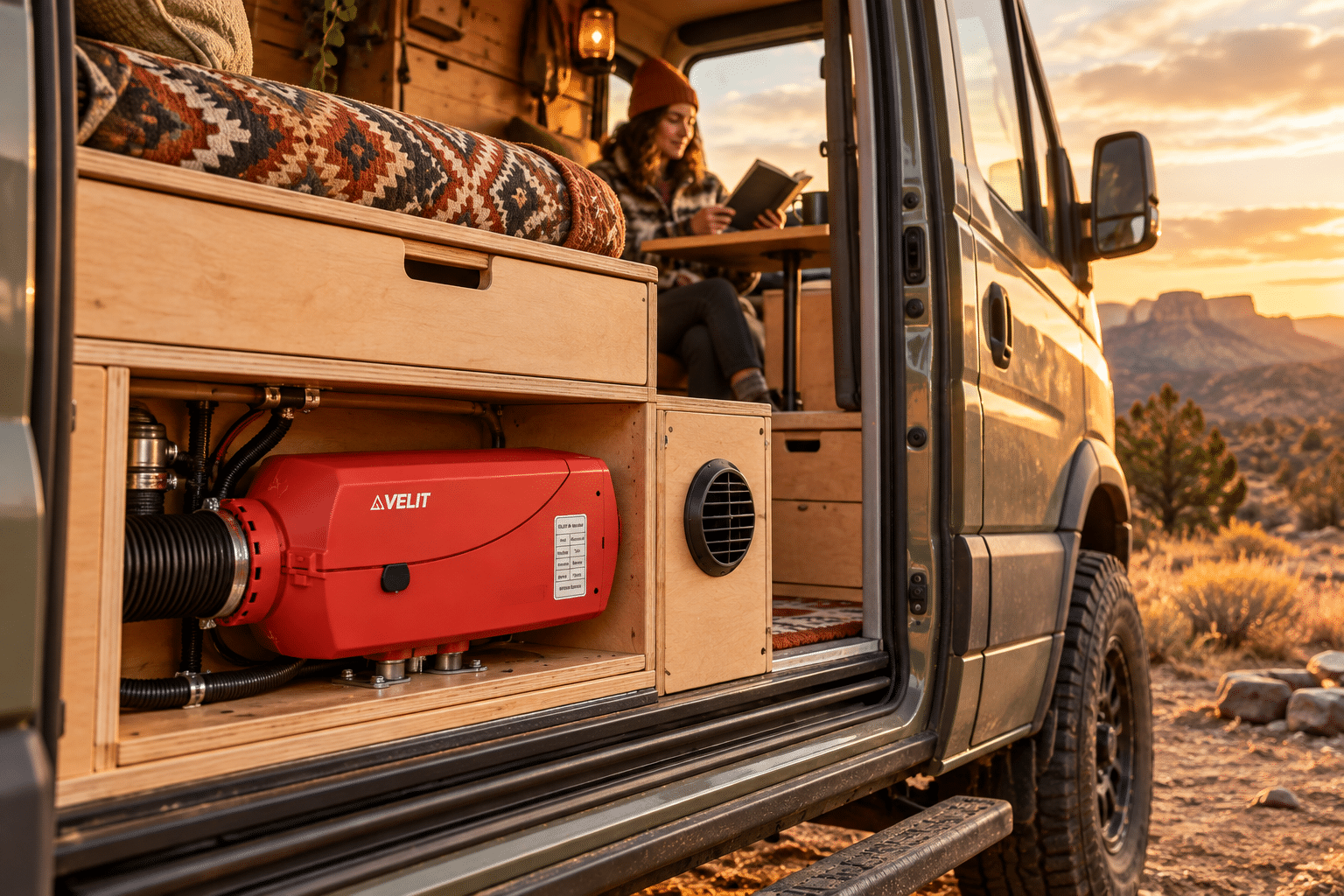
Van heater sizing is a volume problem. A heater adds heat in BTU per hour, while your van loses heat through walls, windows, and floor. Therefore, you match the heater’s output to the space and to the coldest night you expect.
BTU and kW measure the same thing. One kW equals about 3,412 BTU per hour, so a 4 kW heater delivers roughly 13,600 BTU. Spec sheets mix both units, which causes confusion. For example, Velit lists its heater as 14,000 BTU and 4,000 W, while VEVOR sells 2KW, 5KW, and 8KW diesel models.
Our Velit gasoline air heater review covers the 14,000 BTU unit in depth. In addition, the VEVOR lineup breakdown shows how the budget sizes compare.
Sizing also protects your budget. A heater matched to the van cycles less, which saves fuel and power. Therefore, the formula below pays for itself before you buy anything.
BTU to kW Conversion at a Glance
The table below lists common heater sizes with their BTU output and the space each one suits. Coverage figures for the VEVOR models come from our lineup breakdown.
| Heater Size | BTU per Hour | Typical Space |
|---|---|---|
| 2 kW | About 6,800 | Up to 107 sq ft: car cabins, teardrops |
| 4 kW (Velit) | 14,000 | Coverage not listed by Velit |
| 5 kW | About 17,000 | 161 to 215 sq ft: mid-size camper vans |
| 8 kW | About 27,300 | 215 to 269 sq ft: full-size RVs, garages |
Buy Direct From Velit
A 14,000 BTU Heater for Mid-Size Vans
The Velit air heater runs on gasoline or diesel and ships with a full install kit for $729.
Van Heater Sizing in Four Steps

Photo by Jan Kopřiva on Unsplash (license)
Step 1: Measure Your Van Volume
Multiply interior length, width, and height in feet. A 12 x 6 x 6 foot cargo van holds 432 cubic feet. Measure only the living area you plan to heat, especially if you partition the cab from the cargo box.
Use interior dimensions from your build plan, or measure after the walls and ceiling panels go in. Insulation and paneling shave inches off every dimension. Therefore, measure last, and round up when a number sits close to a whole foot.
Step 2: Apply 20 BTU per Cubic Foot
A published sizing guide applies about 20 BTU per cubic foot to moderately insulated spaces. Specifically, 432 cubic feet times 20 gives 8,640 BTU. A metric version allows about 1 kW per 10 cubic meters.
Step 3: Adjust for Insulation and Cold
Poorly insulated spaces need 20% more or higher. Tents, metal sheds, and partly converted trailers fall in this group. Next, size for the coldest night you expect. The guide defines delta T as the gap between the coldest night’s outdoor temperature and your target indoor temperature, such as a 70 degree gap between 0°F outside and 70°F inside.
Step 4: Convert BTU to kW
Divide your BTU result by 3,412. The 8,640 BTU van needs 2.5 kW. Add 20% for poor insulation and the same van needs 10,368 BTU, or 3.0 kW. Then pick the heater size at or slightly above this number.
Van Heater Sizing Examples
This table applies the four steps to three example vans. Dimensions are illustrative, not model-specific, and the math is our own.
| Interior (ft) | Cubic Feet | BTU at 20 per Cu Ft | kW | BTU With 20% Extra | kW |
|---|---|---|---|---|---|
| 10 x 5 x 5 | 250 | 5,000 | 1.5 | 6,000 | 1.8 |
| 12 x 6 x 6 | 432 | 8,640 | 2.5 | 10,368 | 3.0 |
| 14 x 6 x 6.5 | 546 | 10,920 | 3.2 | 13,104 | 3.8 |
Velit’s 14,000 BTU heater covers all three rows, including the 20% margin on the longest van. Moreover, the 14,000 BTU rating handles about 700 cubic feet at 20 BTU per cubic foot, or about 583 cubic feet with the poor-insulation margin. In contrast, the smallest van lands near 6,800 BTU, so a 2 kW unit fits it better.
Read the table row by row. First, find the row closest to your van. Then compare the plain result with the padded one, because your insulation decides which column applies. Also round up when a result lands between two outputs, since a small surplus costs less than a cold night.
Altitude and Cold Change Van Heater Sizing
Thin air reduces a burner’s output. The sizing guide notes a heater sometimes needs oversizing at altitude, with compensation helpful above about 5,000 feet. Therefore, mountain campers should size toward the upper end of their result.
Velit’s design handles part of this. A built-in barometer adjusts the air-fuel mix as elevation changes, and the manual rates the unit to 17,000 feet. Velit also tested it above 11,000 feet in Colorado. Cold works the same way, because the coldest night sets the delta T. As a result, a van comfortable at 30°F still needs a bigger margin for a 0°F trip.
Common Van Heater Sizing Mistakes
Photo by Mitchell Orr on Unsplash (license)
The first mistake is measuring the whole van when you heat only part of it. If a curtain or partition closes off the cab, subtract this volume. Smaller volume means a smaller result, so your numbers drop with it.
The second mistake is ignoring insulation. The 20 BTU figure assumes moderate insulation, and poorly insulated spaces need 20% more. Bare metal walls and partly finished conversions fall in the poorly insulated group. As a result, the 432 cubic foot van moves from 2.5 kW to 3.0 kW.
The third mistake is sizing for an average night. Instead, size for the coldest night you expect, because the coldest night sets the delta T.
Finally, many buyers confuse watts of electrical draw with watts of heat. Velit’s 20 to 46 watts describes the power the heater uses, while its 4,000 W rating describes the heat it makes. Check which one a listing means before you compare, since this tells you how much heat the listing promises.
Built for High Country
Auto Altitude Tuning, Rated to 17,000 Feet
Built-in CO sensing, Bluetooth control, and a two-year limited warranty come standard.
What Happens If the Heater Is Too Big or Too Small?
An undersized unit fails to heat the space adequately. An oversized unit cycles on and off too often, which wastes fuel and builds carbon in the burner chamber. Our VEVOR breakdown also warns frequent cycling coats the glow plug and shortens its life.
Fuel burn scales with size. VEVOR lists 0.07 to 0.17 liters per hour for its 2KW and 0.16 to 0.52 liters per hour for its 5KW. Velit’s manual lists 0.05 to 0.13 gallons per hour on gasoline, which works out to about 0.19 to 0.49 liters per hour by our conversion. Larger units also burn more at the top setting, since VEVOR’s 8KW uses 0.18 to 0.67 liters per hour. Consequently, a correctly sized heater stretches your fuel supply on long trips.
Power draw also matters. The Velit heater uses 20 to 46 watts while running, and our guide to heater power consumption explains why the startup surge deserves attention. For comparison, our VEVOR breakdown lists about 10 amps at startup for the 5KW.
Velit 4 kW vs. VEVOR 2 kW and 5 kW
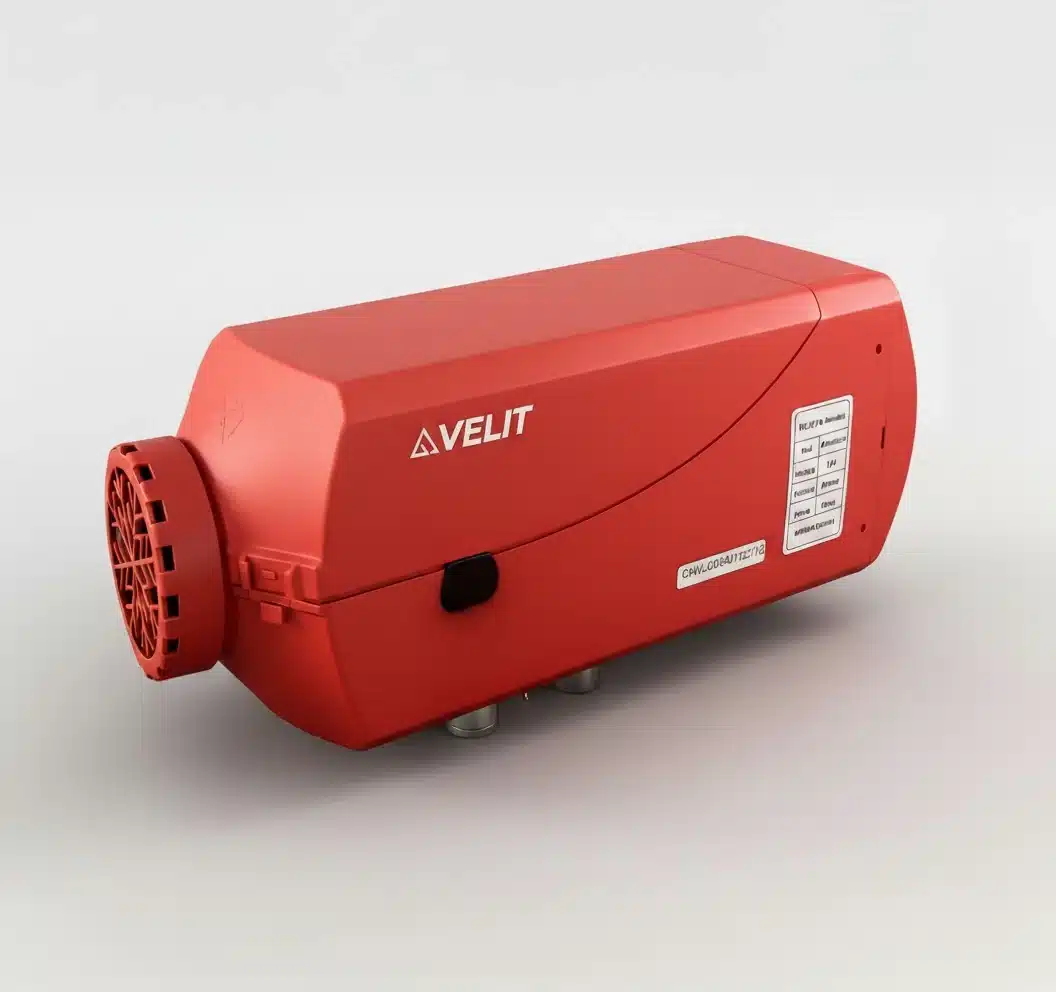
The biggest difference is where the Velit sits. At 14,000 BTU, it fills the gap between the 6,800 BTU and 17,000 BTU VEVOR sizes. Most van results from the table above land in this gap, so a 4 kW heater avoids both oversizing and shortfalls.
Choose the 2 kW size for a small van or a car cabin, and choose the 5 kW for a large van with poor insulation. Choose the Velit when your result falls between them, or when you want gasoline, built-in CO sensing, and Bluetooth control. At $729, the Velit carries a premium over budget diesel units.
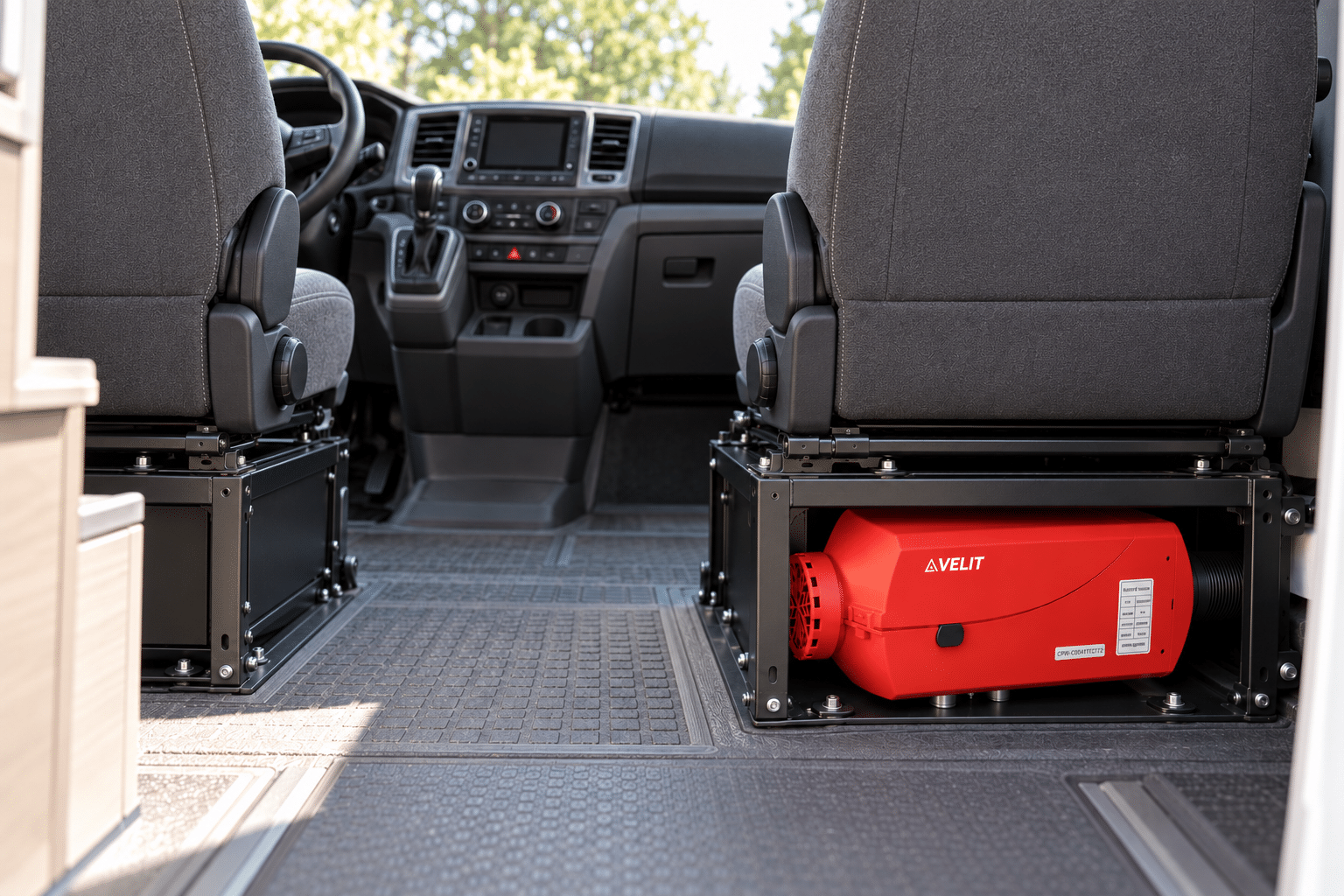
Once you pick a heater size, placement comes next. Our guide to air heater mounting layouts compares under-seat, floor, and bench installs.
Final Verdict
Most solo and couple vans land between 1.5 and 3.8 kW in the table above. A 4 kW heater covers this whole range, which makes the Velit a practical single pick. Its biggest strength is flexibility across van lengths and fuels.
Trade-offs are clear. A small, well-insulated van wastes capacity on 14,000 BTU, and a 2 kW unit suits it better. Anyone heating a bus or a large poorly insulated trailer should look at the 5 kW class instead.
On value, the formula costs nothing and protects a $729 purchase. Run your own numbers first, then match the heater to the result. This sequence shows how much heat you need before you spend anything.
We recommend measuring your living space this week and running the four steps. If your result lands between 1.5 and 3.8 kW, the Velit gasoline air heater deserves a close look. If it lands below 1.8 kW, read our diesel heater buying guide before you choose.
Ready to Buy?
Size It Right, Then Stay Warm for $729
Order the gasoline or diesel version direct from Velit, with US stock ready to ship.
FAQ
How many BTU do I need to heat a van?
Multiply your living volume in cubic feet by about 20. A 432 cubic foot van needs roughly 8,640 BTU. Add 20% or more for poor insulation.
How do I convert BTU to kW?
Divide the BTU figure by 3,412. For example, 14,000 BTU equals about 4.1 kW, which matches the Velit’s 4,000 W rating.
Is 14,000 BTU enough for a camper van?
For most vans, yes. At 20 BTU per cubic foot, 14,000 BTU covers about 700 cubic feet. With a 20% margin for poor insulation, it covers about 583 cubic feet.
Is a bigger heater always better?
No. An oversized unit cycles on and off too often, which wastes fuel and builds carbon in the burner. Match the output to your result instead.
Does altitude change the heater size I need?
Sometimes. Thin air reduces output, so the sizing guide suggests oversizing at altitude. The Velit adjusts its air-fuel mix by barometer and is rated to 17,000 feet.
Friendly disclaimer: Our articles may contain affiliate links that support us without costing you more, and sometimes we spice things up with sponsored content—but only for products we truly stand behind!
Hero photo by Jordan Irving on Unsplash (license)