


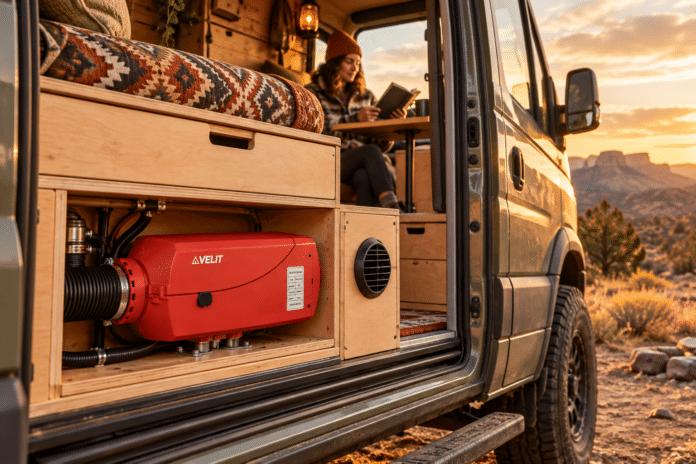

Most fuel-fired heaters on the overland market run on diesel, which leaves gas-engine vans and trucks in a bind. The Velit gasoline air heater solves this by pulling fuel from the tank you already fill at every stop. It puts out 14,000 BTU, sells for $729, and ships in a matching diesel version off the same listing.
Our team at 4WDTalk has run combustion air heaters in tents, trucks, and vans through winters for years. For this review, we worked through Velit’s full owner’s manual, its install and safety specs, and 52 verified owner reviews. We also compared the numbers against the Webasto and Planar units our readers ask about most. As a result, you get a clear picture of what this heater does well, where it falls short, and who should buy it.
Quick Facts:
- Product: Velit gasoline air heater (diesel version sold on the same listing)
- Heat output: 14,000 BTU (4 kW)
- Fuel burn: 0.05 to 0.13 gallons per hour on gasoline
- Power draw: 20 to 46 watts at 12V
- Weight: 10 lbs
- Max elevation: 17,000 ft
- Control: Bluetooth app plus smart thermostat
- Warranty: Two-year limited
- Price: $729
- Best for: Gas-engine vans, trucks, and campers
8 min read
In This Review
Velit Gasoline Air Heater Overview
The Velit gasoline air heater is a permanently installed 12V combustion van heater, and it also fits trucks and campers. It burns a small stream of fuel in a sealed chamber, then blows clean, dry air across a heat exchanger into your cabin. Exhaust leaves through a separate pipe under the vehicle, so no combustion gas enters the living space.
This heater suits one buyer above all: the owner of a gas-engine rig who wants heat without hauling a second fuel. For example, a Ford Transit, a Ram ProMaster, or a gas Sprinter owner taps the main tank and forgets about fuel cans. Diesel owners get the same benefits from the diesel variant, since both cost $729.
Velit also sells a portable, box-style heater for tents and trucks, which we covered in our best diesel heaters guide. In contrast, this model mounts inside the vehicle and stays there. Therefore, it fits builds where you want heat at the push of a button every night.
Key Specs at a Glance
| Specification | Details |
|---|---|
| Heat output | 14,000 BTU (4 kW) |
| Fuel options | Gasoline or diesel (separate variants) |
| Fuel consumption | 0.05 to 0.13 gal/h (gas); 0.05 to 0.12 gal/h (diesel) |
| Voltage | 12V rated, 11 to 16V operating range |
| Power consumption | 20 to 46 watts |
| Weight | 10 lbs |
| Dimensions | 14.6 x 5.5 x 5.9 inches |
| Operating temperature | -30°F to 75°F |
| Max elevation | 17,000 ft |
| CO shutoff | Alarm and shutdown above 800 ppm |
| Warranty | Two-year limited |
Buy Direct From Velit
Heat Your Rig Off the Fuel You Already Carry
The Velit gasoline air heater ships with a full install kit and a smart thermostat for $729.
Heat Output and Fuel Economy
At 14,000 BTU, the Velit gasoline air heater sits in the 4 kW class. For comparison, a Webasto Air Top 2000 STC tops out at 2 kW. As a result, the Velit has roughly twice the peak output, which helps in a high-roof van or a poorly insulated passenger van.
Owner reviews back this up. One buyer runs it in an 11-window passenger van and reported staying comfortable at 28°F. Another holds a van at 62°F on nights between 5°F and 35°F. Those are real-world numbers from verified reviews, not lab figures.
Overnight Fuel Burn
Fuel burn ranges from 0.05 to 0.13 gallons per hour on gasoline. Therefore, a 10-hour night on the low setting uses about half a gallon. Running at full output for 10 hours uses about 1.3 gallons. Most nights land between those two points, because the thermostat throttles the heater down once the cabin warms.
In practice, a 25-gallon van tank loses a few percent of its capacity per cold night. Also, the fuel standpipe sits at least 25mm above the tank floor, per the manual. Because of this, the heater stops drawing before your engine runs dry.
High-Altitude Performance of the Velit Heater
Altitude is where cheap heaters fail. Thin air throws off the fuel-to-air mix, which leads to smoke, carbon buildup, and shutdowns. The heater uses a built-in barometer to read elevation, then adjusts its air-fuel ratio on its own.
Velit tested the unit in Colorado above 11,000 feet, and the manual rates it to 17,000 feet. In addition, one owner swapped out a Webasto AT2000 and ran the Velit at 9,000 feet. According to his review, it ran better and quieter at 9,000 feet than the Webasto did at sea level.
This matters for Rocky Mountain travel. Many passes and trailheads in Colorado and Wyoming sit above 10,000 feet. Notably, Velit engines also power the Sparks Overland heaters, which were chosen for this same altitude strength. The heater logs an error code above 5,100 meters, so it tells you when you’re outside its range instead of choking silently.
Safety Sensors and Controls
Velit builds a carbon monoxide sensor and a flammable gas sensor into the heater itself. The CO alarm triggers above 800 ppm, and then the unit shuts off automatically. Most budget heaters leave CO detection to a separate plug-in alarm.
Even so, keep a standalone CO detector in your sleeping area. A built-in sensor watches the air near the heater, while a second detector watches the air near your head. Redundancy costs about the price of a tank of gas.
Bluetooth App and Smart Thermostat
A smart thermostat now ships standard with every unit. You set a target temperature, and the heater ramps up or down to hold it. Consequently, you avoid the hot-cold swings of heaters without a proper thermostat.
The Bluetooth app controls the heater from up to 100 feet away. For instance, you start it from bed before you get up, or from camp before you return to the van. According to one installer’s review, the app also switches the heater between gasoline and diesel modes. In addition, the controller housing is weather-sealed against water damage.
Installing the Velit Gasoline Air Heater
The install kit covers the full job, including an auxiliary fuel port connector for Sprinter, Transit, and ProMaster vans. Those three platforms have a factory port for aftermarket heaters, so you skip drilling into the tank. Other vehicles need a standpipe added to the tank, and one owner called dropping the gas tank the hardest part.
Safety note: Gasoline vapor ignites easily, and a bad exhaust run leaks carbon monoxide into the cabin. Disconnect the battery and work in open air when tapping a fuel tank. If you’re unsure about fuel or exhaust work, hire a certified installer.
Mounting and Exhaust Rules
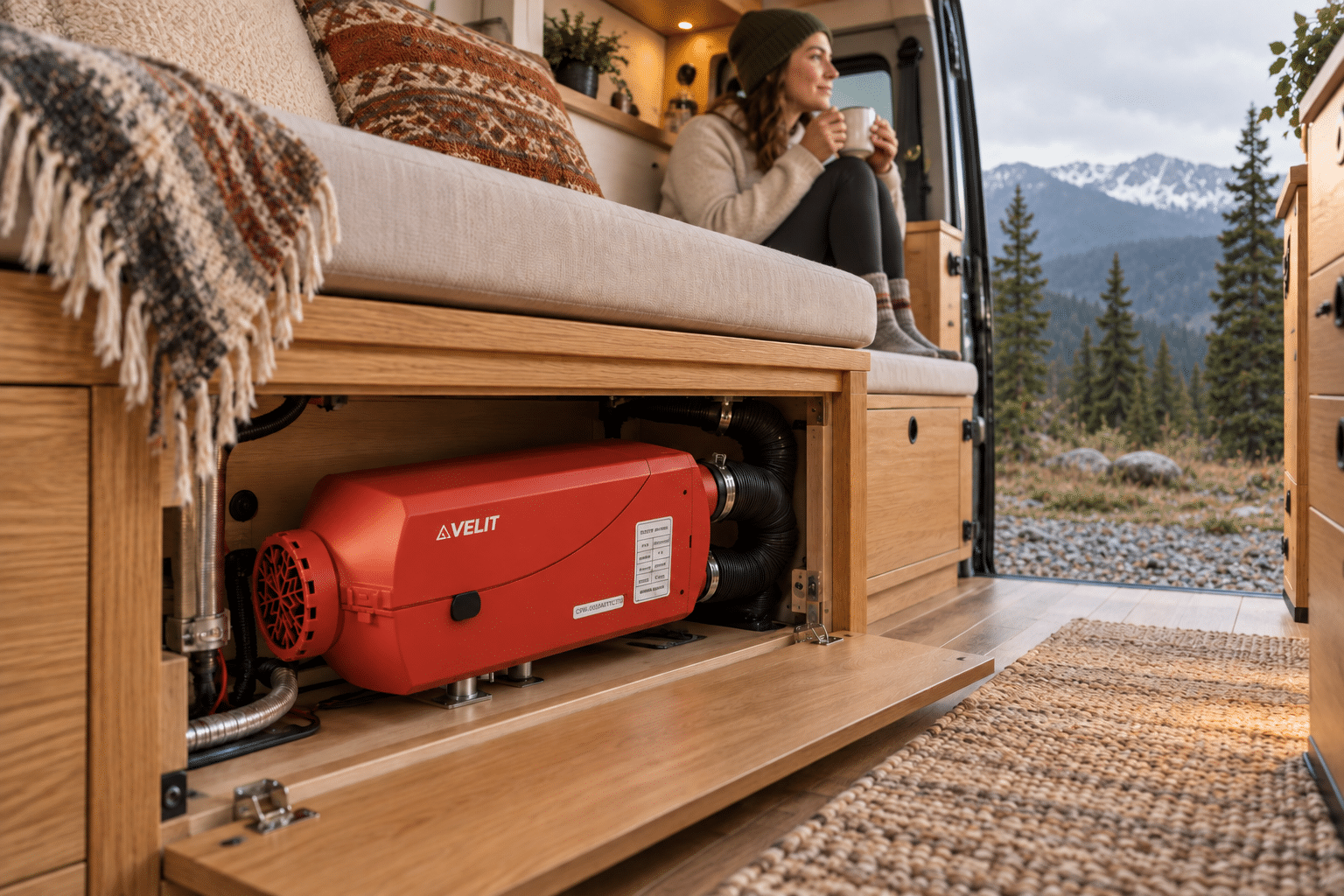
Velit’s owner’s manual sets strict rules for placement. First, the heater mounts upright with the fuel port facing the ground, never on its side. Next, the exhaust outlet must sit at least 4 feet from any door, window, or vent. Finally, the exhaust pipe must have no upward bends.
Floor panels thinner than 1.5mm need a reinforcing plate. Also, the hot air hose needs at least a 60mm inner diameter. Most builders mount the heater under the passenger seat or inside a bench to keep ducting short.
Power Draw and Maintenance
The Velit gasoline air heater draws 20 to 46 watts while running at 12V. This works out to roughly 2 to 4 amps. Over a 10-hour night at a 30-watt average, you use about 25 amp-hours, which a 100Ah lithium battery handles easily. Startup draw spikes higher while the glow plug heats, and our guide to heater power consumption explains why portable power stations sometimes fail at ignition.
Keeping the Heater Healthy
Velit recommends running the heater at least once a month for 15 minutes, even in summer. This keeps fuel moving and burns off carbon. In addition, replace the fuel filter every two years and inspect the fuel line often for leaks.
The kit includes a cleaning straw for clearing the fuel system. Velit also uses a Japanese glow plug rated for at least three times the lifespan of cheap plugs. Meanwhile, the manual lists 13 error codes, from ignition failure to low voltage, so troubleshooting starts with a clear clue.
Built for High Country
Rated to 17,000 Feet With Auto Altitude Tuning
Built-in CO and gas sensors, Bluetooth control, and a two-year warranty come standard.
Velit Gasoline Air Heater vs. Webasto Air Top 2000 STC
The Webasto Air Top 2000 STC is the best-known gasoline parking heater in the van world. Compared to the Velit, it’s smaller at 2 kW and typically costs well over $1,000 for a gasoline kit. The Velit doubles the heat output at $729 and adds Bluetooth control and built-in CO shutoff.
Webasto’s edge is its long track record and wide dealer network. If you want a local shop to install and service your van heater, Webasto has more certified installers. However, the Velit wins on altitude, price, and features for most DIY builders.
Pros
- Runs on gasoline from your main tank, so no second fuel
- 14,000 BTU output, about double a 2 kW Webasto
- Auto altitude tuning, rated to 17,000 ft
- Built-in CO shutoff above 800 ppm
- Bluetooth control from up to 100 ft
- Aux fuel port connector for Sprinter, Transit, and ProMaster
- Low 20 to 46 watt running draw
Cons
- Tank drop needed on vehicles without an aux port
- Two-year warranty is shorter than some premium brands
- Fewer certified installers than Webasto
- Gasoline variant is special order in Canada and the UK
- URL lists 17,000 BTU while the spec sheet says 14,000 BTU
Final Verdict: Is the Velit Gasoline Air Heater Worth It?
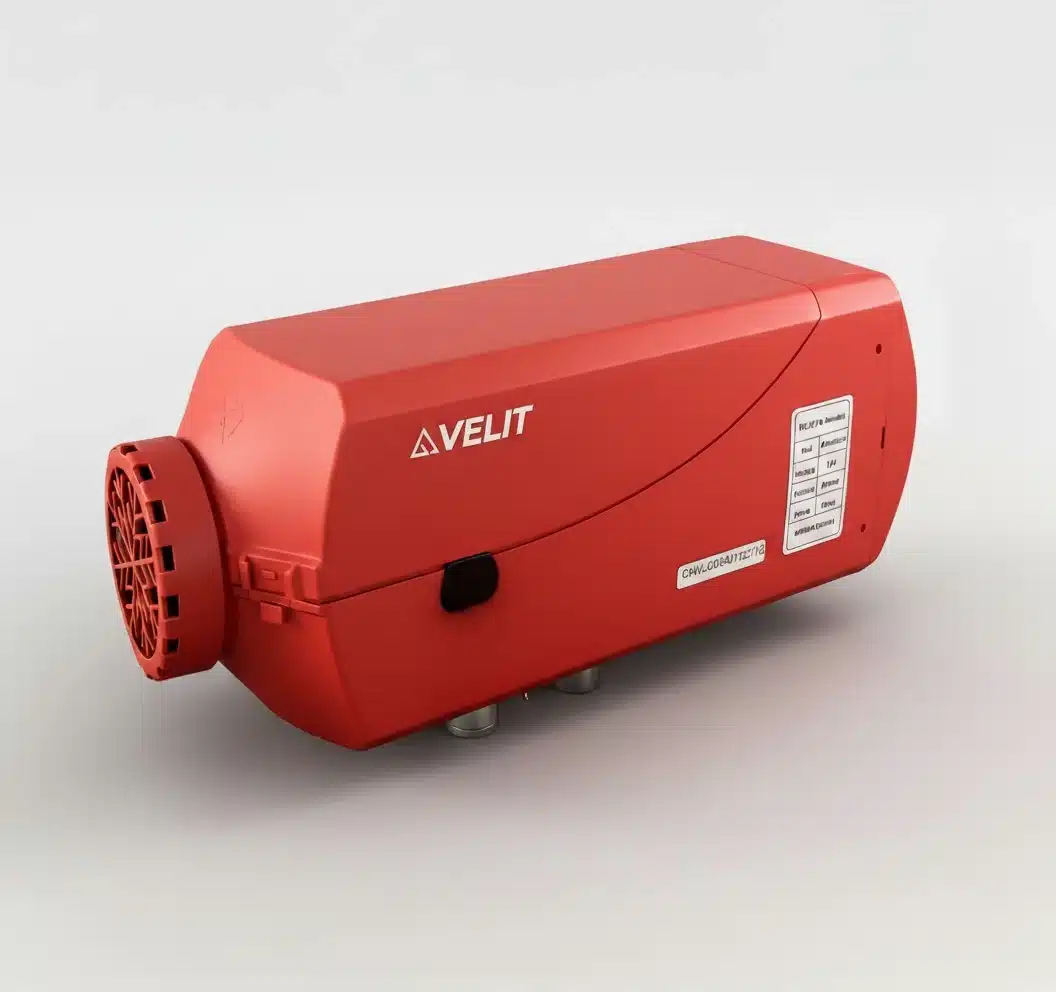
The Velit gasoline air heater is the best fit for gas-engine vans and trucks. Its biggest strength is simple: it heats your rig off the fuel you already buy, with 14,000 BTU on tap.
The trade-offs are real, though. Installing it on a vehicle without an aux fuel port means dropping the tank. Also, if you want a dealer-backed install, Webasto’s network is larger. Anyone who camps only in mild weather should look at a portable unit instead.
For value, $729 buys a heater with twice the output of a 2 kW Webasto and built-in safety sensors. Owner reviews sit at 73% five-star across 52 ratings, and several praise Velit’s support on warranty swaps.
We recommend the Velit gasoline air heater for gas-powered Transit, ProMaster, and Sprinter builds, especially for high-altitude travel.
Ready to Buy?
Stay Warm This Winter for $729
Order the gasoline or diesel version direct from Velit, with US stock ready to ship.
FAQ
Is the Velit heater 14,000 or 17,000 BTU?
The heater is rated at 14,000 BTU, or 4 kW. The product URL still says 17,000 BTU, but the spec sheet and manual both list 14,000 BTU.
How much gas does the Velit gasoline air heater use?
It burns 0.05 to 0.13 gallons per hour on gasoline. A full night typically uses between half a gallon and 1.3 gallons, depending on the thermostat setting and outside temperature.
Does the Velit heater work at high altitude?
Yes. A built-in barometer adjusts the air-fuel mix as elevation changes. Velit tested it above 11,000 feet in Colorado and rates it to 17,000 feet.
Is a gasoline parking heater safe to run overnight?
A properly installed unit vents exhaust outside the vehicle. The Velit also shuts off if CO passes 800 ppm. Still, add a standalone CO detector near where you sleep.
Do I need to drop my gas tank to install it?
Not on a Sprinter, Transit, or ProMaster, since the kit includes a connector for their auxiliary fuel port. Other vehicles typically need a standpipe installed in the tank, which often means dropping it.
Heads up: Clicking on our affiliate links and exploring our sponsored content helps us at no extra cost to you, and we only recommend gear we’re absolutely crazy about!