


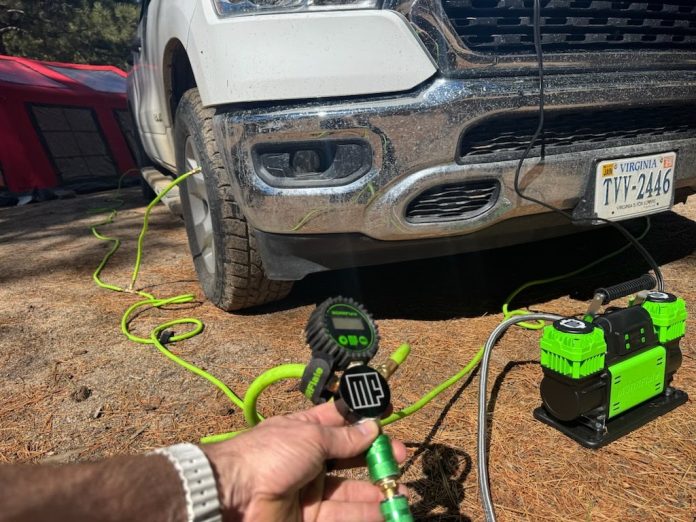

There’s a moment every off-roader knows well. You pull off the dirt, hop out to air up, and suddenly the easy part of the day is over. It’s dusty, the fittings are hot, your knees are in the gravel, and the vehicle next to you is still on tire one while you’re already mentally unpacking the cooler.
That familiar routine—one tire, one gauge check, repeat—feels like it should be faster by now. The truth is, it can be. A multi-tire air system fundamentally changes tire inflation by letting physics work for you instead of against you.
Pressure equalization isn’t a nice-to-have detail—it’s a force of nature anytime air shares space or pathways. When you inflate four tires independently, you also inherit four independent pressure variables. On pavement, the difference may be minor. On a trail, it can shift steering behavior, traction balance, compressor workload, and how quickly you actually hit your intended PSI.
Multi-tire air systems solve this by creating a shared inflation pathway, allowing pressures to balance in real time while unlocking the airflow capacity modern compressors can actually deliver. And when you add a high-output compressor like the MORRFlate TenSix PSI Pro Gen 2, the system works at a level that finally matches the pace of off-road travel.
Table of Contents
- Pressure Equalization in a Multi-Tire Air System
- CFM, PSI, and Multi-Tire Air System Airflow Math
- How Multi-Tire Air Systems Improve Vehicle Handling
- Traction Gains and Stability from a Multi-Tire Air System
- Heat, Workload, and Duty Cycle in a Multi-Tire Air System
- Real-World Use of a Multi-Tire Air System on the Trail
- FAQ
Pressure Equalization in a Multi-Tire Air System
Equalization is the core concept that makes a multi-tire air system smarter than the old single-fill approach. When air flows into a shared manifold or quad-hose setup, pressure seeks equilibrium across all connected chambers. In practical terms, that means your tires inflate and balance at the same time. There’s no waiting for one to finish before the next begins adjusting.
On the MORRFlate 4-tire kit, this equalization happens while the compressor pushes air continuously, meaning each tire reaches your target PSI at nearly the same moment. The MORRFlate TenSix PSI Pro Gen 2 works beautifully here because its push-to-connect universal coupler supports consistent airflow, its aluminum heat sinks manage temperature during equalization, and its purge valve lets you safely release internal pressure when the job is done—critical when fittings are hot and you’re packing up fast.
What many off-roaders miss is that independent tire inflation creates hidden delays even after the compressor shuts off. Air redistributes inside each tire as the carcass relaxes, the valve core re-seats, and internal pressure stabilizes. That can mean adding or bleeding air multiple times to correct PSI drift. A multi-tire air system prevents that extra work by equalizing before you ever check a gauge. When I first started using quad-hose kits, the biggest surprise wasn’t just speed—it was the lack of second-guessing. I’d disconnect, wait 60 seconds, and all four tires would read nearly identical PSI. That kind of repeatability builds trust fast.
A multi-tire air system also reduces pressure migration imbalances caused by uneven weight transfer during inflation. When one tire fills faster or reads higher pressure earlier, it can temporarily carry more load, subtly shifting the suspension geometry until the other three catch up. Multi-tire air systems keep suspension loads balanced throughout tire inflation, which helps protect the compressor and the vehicle at the same time. It sounds technical, but on the trail it simply feels smoother, faster, and far less fiddly.
CFM, PSI, and Multi-Tire Air System Airflow Math

Airflow ratings like 10.6 CFM only make sense when you inflate more than one tire at a time. A Schrader valve opening at trail pressures typically only accepts about 1.8–2 CFM at 20 PSI, and less than 1 CFM near 0 PSI. That means even a 6.2 CFM compressor can only use 2–3 CFM per tire when filling independently, creating back pressure inside the compressor head. Multi-tire air systems aggregate the total valve orifice area by inflating four tires at once, letting the system absorb 8–12 CFM of usable airflow without backlog. That’s exactly the airflow range the MORRFlate TenSix PSI Pro Gen 2 was engineered to deliver, and why its 80% duty cycle rating matters—it can run 45 minutes on, 10 off, supporting 6–8 vehicles per cycle without overheating, which means you’re not pausing inflation time because the compressor needs to cool down.
CFM influences inflation time most at lower pressures. Near 0–20 PSI, a compressor’s ability to move volume determines how quickly the tire chambers pressurize. PSI matters more as pressures climb, especially past 30 PSI where flow resistance increases and compressor headroom is required to maintain speed. A multi-tire air system handles both sides of the equation—volume and resistance—by reducing flow bottlenecks at the stem and balancing PSI continuously through the manifold. The MORRFlate TenSix PSI Pro Gen 2 works across that entire range with Auto Mode (10–120 PSI) for hands-free tire inflation, and Manual Mode (1–150 PSI) for topping off trailers or mixed-use setups. Its dual-cylinder architecture keeps airflow strong even at 30 PSI (6.5 CFM), meaning inflation time stays short whether you’re running 33s or 40s.
Another overlooked part of CFM math is system efficiency. Air doesn’t compress the same when restricted through long or undersized hoses. Multi-tire air systems reduce line resistance by distributing flow through parallel paths instead of one long single-tire hose. When you pair that with aluminum cylinders, proper heat sinking, and a coupler that supports industrial, auto, or Aro 1/4″ fittings, you get more usable CFM delivered to the tire chambers. Tire inflation finally works at the rate the compressor was built for, not the rate the valve stem limits it to.
How Multi-Tire Air Systems Improve Vehicle Handling

A multi-tire air system doesn’t change your intended PSI, but it absolutely changes how your vehicle behaves once you hit it. Balanced pressures reduce steering pull caused by uneven tire chambers. Even a 3 PSI difference side-to-side can feel like alignment drift when you air up after a long trail day. A multi-tire air system keeps pressures equal during tire inflation, which means steering feels predictable as soon as you’re back on pavement.
Suspension loads also stay balanced through tire inflation. When independent fills create pressure lag, one tire temporarily carries more load, shifting ride height until the other three catch up. A multi-tire air system prevents that, which keeps your compressor working against lower combined resistance and protects your suspension geometry in the process.
Brake stability improves too. Uneven tire chambers change contact patch shape, which subtly changes braking bias across corners. Balanced PSI keeps braking forces uniform. It’s one of those details you don’t notice until it’s gone, and then you realize you never want to inflate independently again.
Traction Gains and Stability from a Multi-Tire Air System

Traction balance is where multi-tire air systems really earn their keep. When pressures equalize during tire inflation, each tire carries a similar contact patch shape. That matters on washboard climbs, side-hill sand, snow, and decomposed granite where one soft tire can break traction early and trigger stability control corrections you don’t actually need.
Cornering stability improves because lateral grip thresholds become uniform. On group trips, I’ve watched vehicles fight traction control on one soft rear tire while the others hook cleanly. A multi-tire air system equalizes all four tire chambers so grip thresholds stay matched, which means you move more consistently through loose turns.
Stability at highway speed benefits too. Larger tire sizes hold more internal volume, which means small PSI imbalances have larger effects on effective spring rate. Multi-tire air systems constrain that internal volume into a balanced state during tire inflation, meaning your first highway miles after the trail don’t feel like a pressure experiment.
Heat, Workload, and Duty Cycle in a Multi-Tire Air System

Heat is the tax every high-output compressor pays, but duty cycle determines whether you can afford it. A multi-tire air system lowers internal compressor pressure stagnation by letting air move continuously into the tire chambers instead of piling up behind flow restrictions. That keeps head pressures lower while tire inflation is happening, which lowers thermal stress on piston rings, seals, and compressor heads.
Duty cycle ratings matter more as tire sizes grow. The MORRFlate TenSix PSI Pro Gen 2 carries a true 80% duty cycle at 0 PSI (45 minutes on, 10 minutes off), which supports 6–8 vehicles per cycle even in desert heat. The Gen2 upgrades—aluminum cylinders, stainless steel outlet hose, and properly sized aluminum heat sinks—exist specifically to make duty cycle sustainable under real trail conditions.
Thermal cutoff switches protect duty cycle by preventing runaway heat soak. The purge valve also helps you reset the system safely before storing, preventing residual pressure from cooking seals while the compressor is packed away. If you’ve ever disconnected a compressor without gloves, you know why heat management is part of the air-up strategy too. Wear the gloves. It’s not marketing, it’s self-defense.
Real-World Use of a Multi-Tire Air System on the Trail

Multi-tire air systems change tire inflation timing enough that your checklist can finally include “relax for a second.” I’ve aired up 35″ tires in sub-5 minutes using a MORRFlate quad-hose kit and watched the compressor run without complaint in snow, desert, and coastal humidity. The MORRFlate TenSix PSI Pro Gen 2 supports that entire workflow because it was engineered to deliver usable airflow into a parallel multi-tire air system without internal backlog.
The portability matters too. At 14x7x9″, it fits under a truck seat or in a trailer tub. The noise level (70–75 dB at 1 foot) means you can talk to your friends without shouting over it. And the bag pockets actually fit the stuff you bring, which is more than you can say for most “included” bags.
The best part? Predictability. Tire inflation stops being a guessing game and starts being a repeatable process you can time, trust, and plan around. And that makes every part of the trip better—from the air-down at the trailhead to the air-up before the drive home.
FAQ
Why does a multi-tire air system reduce inflation time?
It aggregates valve orifice area and fills in parallel, eliminating back pressure and flow bottlenecks that limit single-tire fills.
How many times should tire size be checked after airing up?
Once after 60–90 seconds of stabilization is enough if equalization happened during tire inflation.
Do multi-tire air systems change optimal PSI?
No, they change how cleanly you reach the PSI you already intended to run.
Are multi-tire air systems worth it for 33-inch tires?
Yes, but the timing benefit increases significantly as tire size grows beyond 35 inches.
Can the MORRFlate TenSix PSI Pro Gen 2 support mixed tire sizes?
Yes. Auto and Manual PSI modes let it scale across sizes, but parallel hoses still help pressures balance evenly.
Heads up: Clicking on our affiliate links and exploring our sponsored content helps us at no extra cost to you, and we only recommend gear we’re absolutely crazy about!