


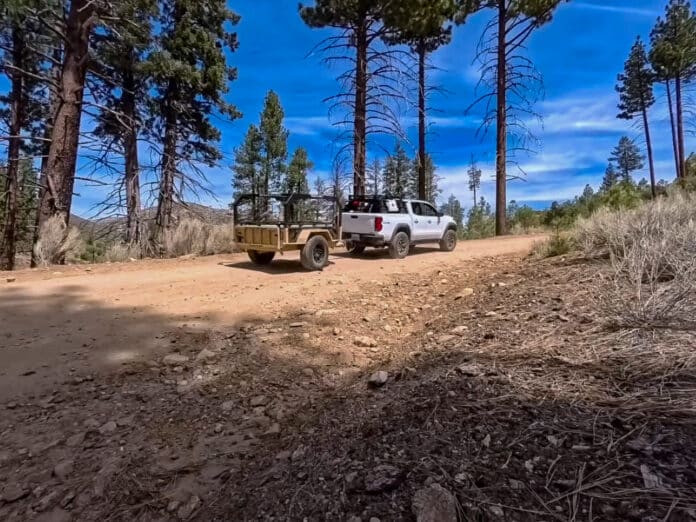

I’ve spent decades camping and overlanding across the American West, and I’ve helped plenty of newcomers navigate the budget overland trailer market. California mountains, Arizona deserts, and technical trails that punish cheap equipment fast are all familiar territory. Still, one thing the overland community talks around but rarely says plainly: most capable trailers are expensive. Genuinely expensive, in fact. Start researching your first off-road trailer and you’ll find the average capable rig costs $15,000 to $45,000 before options. For most shoppers, that sticker shock hits fast. For someone who already has a serious tow vehicle and quality recovery gear, that sticker shock is real.
When I walked the Slack Wagon overland trailer with Mark Cecil, one of the brothers who built it, my first instinct was to look for the compromises. Still, a capable utility trailer starting at $5,999 sounds too good. After spending time with it and putting it through its paces, I found the trade-offs. They’re much smaller than you’d expect at this price, however. This overland trailer buying guide covers exactly what to look for when you’re shopping for a budget overland trailer. I’ll use the Slack Wagon as a real-world benchmark throughout.
Quick Facts:
- Topic: How to choose a budget overland trailer
- Featured Trailer: Big Slack Off Road Slack Wagon
- Starting Price: $5,999
- GVWR: 3,000 lbs
- Payload: ~2,000 lbs (varies by options)
- Suspension: 3,500 lb Timbren axleless with electric brakes
- Bed Length: 6.5 ft (48.5-inch interior width)
- Warranty: 3-year structural
- Best for: Budget-conscious overlanders who want serious off-road capability without a $15K+ price tag
9 min read
In This Guide
- Why Budget Trailers Deserve a Serious Look
- Slack Wagon Key Specs at a Glance
- Suspension: The Most Important Spec You’ll Research
- Payload and GVWR: What the Numbers Mean in Practice
- Build Quality: What to Inspect Before You Buy
- Modularity: How the Slack Wagon Grows With You
- Slack Wagon vs. DIY Build: Which Makes More Sense?
- Pros and Cons
- Final Verdict
- Frequently Asked Questions
Why Budget Trailers Deserve a Serious Look
Knowing how to choose a budget overland trailer starts with letting go of the idea that lower price equals lower capability. The overland trailer market has matured enough that small manufacturers are now producing genuinely capable rigs. Direct-to-consumer brands built by real-world off-roaders skip the retail markup of larger companies. Big Slack Off Road is a perfect example. Brothers Mark and Matthew Cecil built the company because they’d pushed every trailer they’d owned to the point of failure. Nothing on the market held up the way it should. That motivation produced a trailer built from the ground up for people who use them hard.
For first-time buyers, the key is knowing which specifications matter on the trail. Some specs are marketing noise. Most buyers focus on price first and suspension last. That’s backwards, though. Specifically, suspension determines whether your gear arrives intact. It also determines whether your tow vehicle handles predictably on rough terrain and whether the trailer frame survives repeated abuse. Price matters, of course, even so. Still, a $6,000 trailer with proper suspension will outperform a $9,000 trailer with a standard leaf-spring axle on technical terrain every time.
Overlanders on a budget also tend to over-prioritize enclosed sleeping space. A utility-style trailer like the Slack Wagon trades sleeping quarters for massive payload capacity and a flat, configurable bed. For overlanders who already run a rooftop tent or ground tent, that swap makes a lot of sense. You get 2,000 lbs of payload and a 6.5-foot bed to carry fuel, water, recovery gear, a fridge, tools, and firewood instead of a cramped interior you’ll use six nights a year.
Slack Wagon Key Specs at a Glance
| Specification | Details |
|---|---|
| Starting Price | $5,999 |
| GVWR | 3,000 lbs |
| Empty Weight | ~900 lbs (varies by options) |
| Payload Capacity | ~2,000 lbs |
| Suspension | 3,500 lb Timbren axleless with electric brakes |
| Bed Length | 6.5 ft |
| Interior Bed Width | 48.5 inches |
| Overall Width | 74 inches fender to fender |
| Front Platform | 30-inch tapered front platform for accessories or spare tire |
| Recovery Points | 4 recovery/tie-down points on underside |
| Powder Coat | Custom color available via Columbia Coatings |
| Warranty | 3-year structural |
| Manufacturer | Big Slack Off Road, western Kentucky |
Buy Direct From Big Slack Off Road
The Slack Wagon Starts at $5,999
A custom build sheet, location-specific shipping quote, and a 3-year structural warranty are included with every order.
Suspension: The Most Important Spec You’ll Research

When I walk a trailer at a show, suspension is the first thing I check. It’s also the spec most budget trailers cut corners on, and it’s where the savings tend to bite you later. Standard leaf-spring axles work fine on smooth dirt and gravel. However, they transfer shock directly to the frame on rocky terrain, and they give you zero independent wheel movement. When one wheel drops into a rut, the opposite wheel lifts, which means reduced traction, increased frame stress, and gear that arrives beaten up.
The Slack Wagon runs a 3,500 lb Timbren axleless suspension system with electric brakes. Timbren’s axleless design eliminates the through-axle entirely. Instead, each wheel moves independently on its own control arm, cushioned by rubber Aeon springs with no traditional shock absorber required. On trail, the trailer tracks far more smoothly behind your rig. Also, each side responds to its own terrain independently. I’ve towed trailers with leaf springs through Wyoming washboard roads and the vibration is constant and punishing. The Timbren setup absorbs those hits without transmitting them down the frame.
Electric Brakes at This Price Point
Electric brakes on a sub-$6,000 trailer are worth calling out specifically. Many trailers in this price range skip brakes entirely or include surge brakes, which are reactive rather than active. Electric brakes respond to your tow vehicle’s brake controller in real time, which shortens stopping distances on steep terrain. If you’re towing on technical descents, including mountain passes or canyon trails common across the West, electric brakes are a safety feature, not a luxury. The Slack Wagon includes them standard.
Payload and GVWR: What the Numbers Mean in Practice

GVWR is the gross vehicle weight rating: the maximum the trailer is designed to handle including its own weight. The Slack Wagon’s GVWR is 3,000 lbs. With an empty weight starting at roughly 900 lbs, you get about 2,000 lbs of usable payload. Many budget trailers in the $6,000–$8,000 range carry only 1,200–1,500 lbs of payload. They’re heavier at baseline because of steel construction or enclosed bodies. The Slack Wagon’s open utility design keeps the empty weight low, which pushes that payload number up.
Two thousand pounds of payload is also genuinely useful for overlanding. A loaded 40-quart fridge runs about 45 lbs. That 5-gallon fuel can adds another 37 lbs. Your rooftop tent (if you’re mounting one) adds 100–150 lbs. Recovery gear, tools, cooking equipment, water, and firewood for a week-long trip adds up fast. You’re still well within the Slack Wagon’s capacity with room to spare. Also, the Timbren 3,500 lb suspension rating exceeds the 3,000 lb GVWR, which means the suspension isn’t working at its limit even at full load. That margin matters for long-term durability.
Build Quality: What to Inspect Before You Buy
Budget doesn’t have to mean poor construction, but you do have to know what to look for. On any trailer under $10,000, I check the welds first. Good welds are consistent, full-penetration, and clean, with no gaps, no porosity, and no signs of repair welds over failed ones. The Slack Wagon’s powder coat goes on after fabrication. Columbia Coatings’ finish resists chipping and corrosion that eats cheaper trailer finishes within a season or two.
Next, check the floor. The Slack Wagon uses a Trex composite floor on equipped models, which resists rot, moisture, and UV degradation better than wood. Standard wood floors on budget trailers absorb moisture, swell, and fail within a few years of heavy use. A composite or steel floor adds cost but removes a recurring maintenance headache. Also look at the hitch connection. The Slack Wagon is available with a lock-and-roll hitch. This allows full articulation without binding on uneven terrain. It matters most when your tow vehicle and trailer are on different slope planes on a shelf road.
Modularity: How the Slack Wagon Grows With You
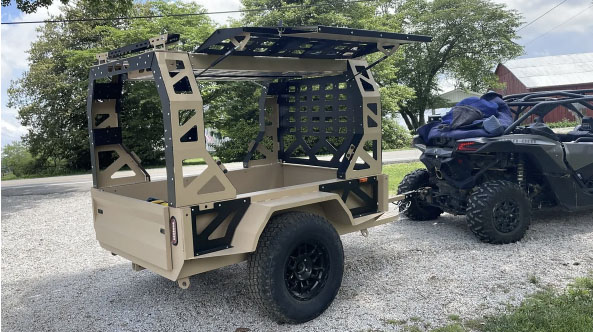
One underrated quality in a budget overland trailer is the ability to add capability over time. Specifically, you don’t need to configure everything at once. The Slack Wagon is built around a modular system. For example, its 30-inch front platform accepts custom attachments, including a spare tire mount, fuel cans, or a cargo basket. Roof rack options (18-inch racks on equipped models) add overhead storage for lightweight gear like sleeping pads, tents, or firewood. Big Slack’s new batwing rack system, released in 2025, extends that storage further with a swing-out design that doesn’t compromise bed access.
For buyers on a tight budget, this modular approach is practical. You keep the upfront cost at $5,999 and add accessories as funds allow. You’re not locked into a complete build on day one. You start with a capable base of heavy suspension, electric brakes, solid frame, and generous payload. Then add the accessories that match how your overlanding style evolves. The four recovery and tie-down points on the underside additionally give you anchor options for customizing load management as your kit grows. Big Slack works up a custom build sheet with every order, so the configuration is specific to how you plan to use it.
Save on Your Build
Meet Big Slack at a Show for $500 Off
Order at any event where Big Slack Off Road appears and get $500 off your Slack Wagon build. Local pickup also available to skip shipping costs.
Slack Wagon vs. DIY Build: Which Makes More Sense?
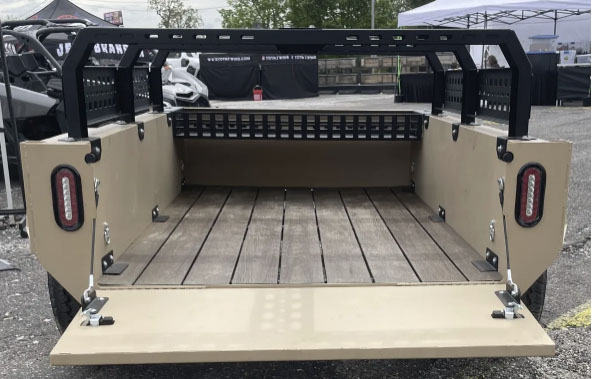
A common alternative to buying an affordable overland trailer is building one from scratch. The DIY route using a Harbor Freight trailer frame as a base comes in under $3,000. Also, you get full control over every component. However, the trade-offs are significant. Building a trailer that handles technical terrain safely requires fabrication skill, access to proper welding equipment, and significant time. Typically 200 to 400 hours for a competent first build. In practice, most DIY builders either finish 18 months behind schedule or leave a partially built frame in the garage.
The Slack Wagon at $5,999 gives you a professionally fabricated frame with a 3-year structural warranty. Timbren suspension comes already dialed in, electric brakes wired and ready, and the powder coat color is your choice. The warranty alone has real value. A failed weld on a DIY build is your problem to fix, and Timbren suspension is not cheap to diagnose and repair without experience. For overlanders who want weekends on the trail rather than in the shop, the math favors buying a purpose-built trailer. Specifically, a manufacturer who has tested that design in the field removes a lot of risk. The Slack Wagon’s 2,000 lb payload also exceeds what most first-time DIY builds achieve. Weight management is harder to optimize without experience.
Pros and Cons
Pros
- Starts at $5,999, one of the lowest entry prices for Timbren-suspended, electric-braked trailers
- 3,500 lb Timbren axleless suspension with independent wheel movement handles technical terrain well
- ~2,000 lbs of usable payload, which is above average for this price range
- 3-year structural warranty from a manufacturer that stands behind the build
- Modular front platform and batwing rack system allow incremental upgrades over time
- Custom powder coat color via Columbia Coatings adds durability and personalization
- $500 off at shows; local pickup option eliminates shipping costs
Cons
- No enclosed sleeping or kitchen area; buyers needing a camper must add a tent or RTT separately
- Order process is custom/build-to-order, so lead times are longer than in-stock options
- Small manufacturer means limited dealer network; most buyers deal directly
- Utility trailer format won’t suit overlanders who prioritize comfort and interior living space
Final Verdict
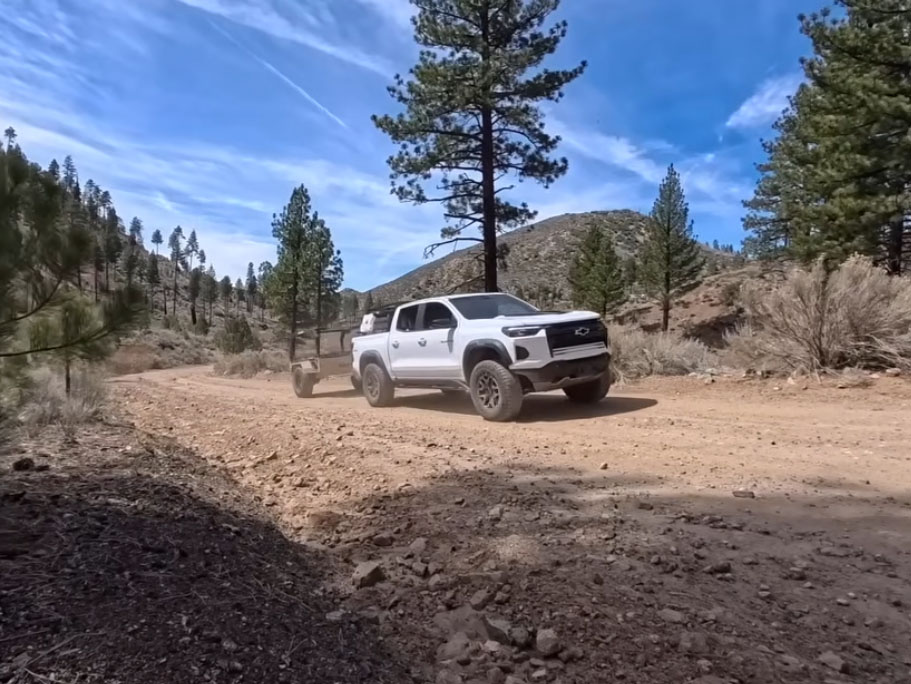
The Slack Wagon is the right trailer for overlanders who want real off-road capability at a price that doesn’t require financing. The Timbren axleless suspension and electric brakes separate it from most trailers in this price bracket. Those two features are typically found on trailers costing $10,000 or more. With roughly 2,000 lbs of payload, a 6.5-foot bed, and a modular design that grows with your kit, the Slack Wagon covers the practical needs of serious weekend overlanders. Longer-haul trips are equally well served.
The trade-off is shelter. If you need an enclosed camper with a bed, kitchen, and battery system built in, the Slack Wagon isn’t designed for that. It’s a utility trailer built for hauling gear, not sleeping in. That’s not a flaw. It’s a deliberate design choice that keeps the weight low, the payload high, and the price below $6,000. Overlanders who already run a rooftop tent on their Jeep, Tacoma, or Gladiator get far more total capability by pairing it with a Slack Wagon. That combination beats a single enclosed trailer at the same total budget.
On value, the 3-year structural warranty and custom build sheet process push the Slack Wagon ahead of most options in the sub-$8,000 category. You’re buying from a family operation that built this trailer because they needed it to survive real terrain abuse. That motivation shows in the spec choices. The suspension is overbuilt relative to the GVWR. Powder coat is a professional Columbia Coatings finish, not a rattle-can job. Recovery points are integrated into the frame, not bolted on as an afterthought.
Shopping for a capable, affordable overland trailer without needing sleeping quarters built in? The Slack Wagon is the strongest buy in this price range. For buyers who want to compare, the Smittybilt Scout Trailer runs around $8,800. It uses a simpler suspension setup and carries less payload. At $5,999, the Slack Wagon delivers more where it matters most on the trail.
Ready to Buy?
Check Today’s Price on the Slack Wagon
Every order includes a custom build sheet, a location-specific shipping quote, and a 3-year structural warranty. Local pickup available.
Frequently Asked Questions
What is the cheapest overland trailer worth buying that’s still capable off-road?
The Slack Wagon from Big Slack Off Road starts at $5,999. It includes a 3,500 lb Timbren axleless suspension system and electric brakes, both features typically found on trailers costing $10,000 or more. The Slack Wagon is one of the strongest budget overland trailer options at this price point. Few alternatives skip suspension quality at that price.
How much does a good overland trailer cost?
A capable overland trailer typically runs $6,000 to $20,000, with enclosed camper trailers often exceeding $30,000 when fully equipped. The price is largely determined by suspension type, GVWR, enclosed vs. open utility format, and manufacturer reputation. Open utility trailers like the Slack Wagon represent the lower end of that range while still delivering quality suspension and payload capacity.
Is the Slack Wagon good for off-road use?
Yes. The Slack Wagon runs a 3,500 lb Timbren axleless suspension with electric brakes, which allows each wheel to move independently over uneven terrain. This setup outperforms standard leaf-spring axles on rocky trails, washboard dirt roads, and technical two-track. The trailer also includes four recovery and tie-down points on the underside and a 30-inch front platform for spare tire or accessory mounting.
What suspension should I look for in a budget overland trailer?
Timbren axleless suspension is the best suspension system currently available for off-road trailers in the budget price range. Each wheel moves independently using rubber Aeon springs, which means no through-axle to snag on terrain and better articulation over obstacles. Torsion axles are also a decent middle-ground option. Leaf springs are the most common on budget trailers but offer the least articulation and transfer more shock to your load and frame.
Is the Slack Wagon compatible with a mid-size truck or Jeep?
The Slack Wagon fits well within the towing capacity of mid-size trucks. The Toyota Tacoma rates at 6,500–7,700 lbs, and the Gladiator Rubicon rates at 7,650 lbs, both well above the Slack Wagon’s 3,000 lb GVWR. Most capable mid-size trucks and body-on-frame SUVs handle the Slack Wagon easily, even at full payload.
How does the Slack Wagon compare to a DIY overland trailer build?
A DIY build using a Harbor Freight trailer base costs less upfront, often under $3,000 for materials. However, it requires significant fabrication time (200 to 400 hours for a first build), welding skill, and access to proper tools. The Slack Wagon at $5,999 provides a professionally welded frame, Timbren suspension already installed and tuned, electric brakes, and a 3-year structural warranty. For overlanders who value trail time over shop time, the Slack Wagon typically makes more practical sense than a first-time DIY build.
Heads up: Clicking on our affiliate links and exploring our sponsored content helps us at no extra cost to you, and we only recommend gear we’re absolutely crazy about!