


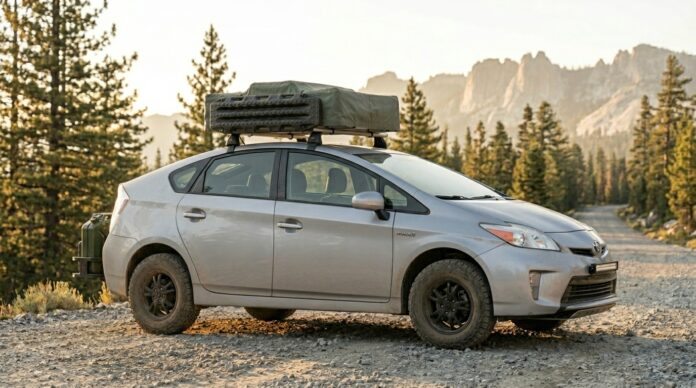

Quick Facts:
- Subject: Lifted Prius off-road build (Prius Offroad kit)
- Lift height: 1.5 inches at all four corners
- Ground clearance: ~5.1 in stock, ~6.6 in lifted
- Towing: no factory rating; aftermarket hitch rated ~1,500 lbs
- Fuel economy: 40-50 MPG, 500+ mi range on an ~11-gallon tank
- Roof load: ~165 lbs factory rating on most generations
- All-in cost: under $14,000 (used Prius plus about $2,000 in mods)
- Best for: budget overlanders reaching gravel trailheads, not rock crawlers
9 min read
In This Guide
- Why Overlanders Are Buying In
- Key Specs at a Glance
- How the Off-Road Prius Trend Started
- Prius Lift Kit: What 1.5 Inches Buys You
- The Tire Tax: Where the Build Gets Real
- Who a Lifted Prius Build Suits Best
- What a Lifted Prius Build Costs
- Lifted Prius vs. the Budget Overland Field
- Lifted Prius Pros and Cons (No Filter)
- Final Verdict
- Frequently Asked Questions
Lifted Prius Off-Road Build: Why Overlanders Are Buying In
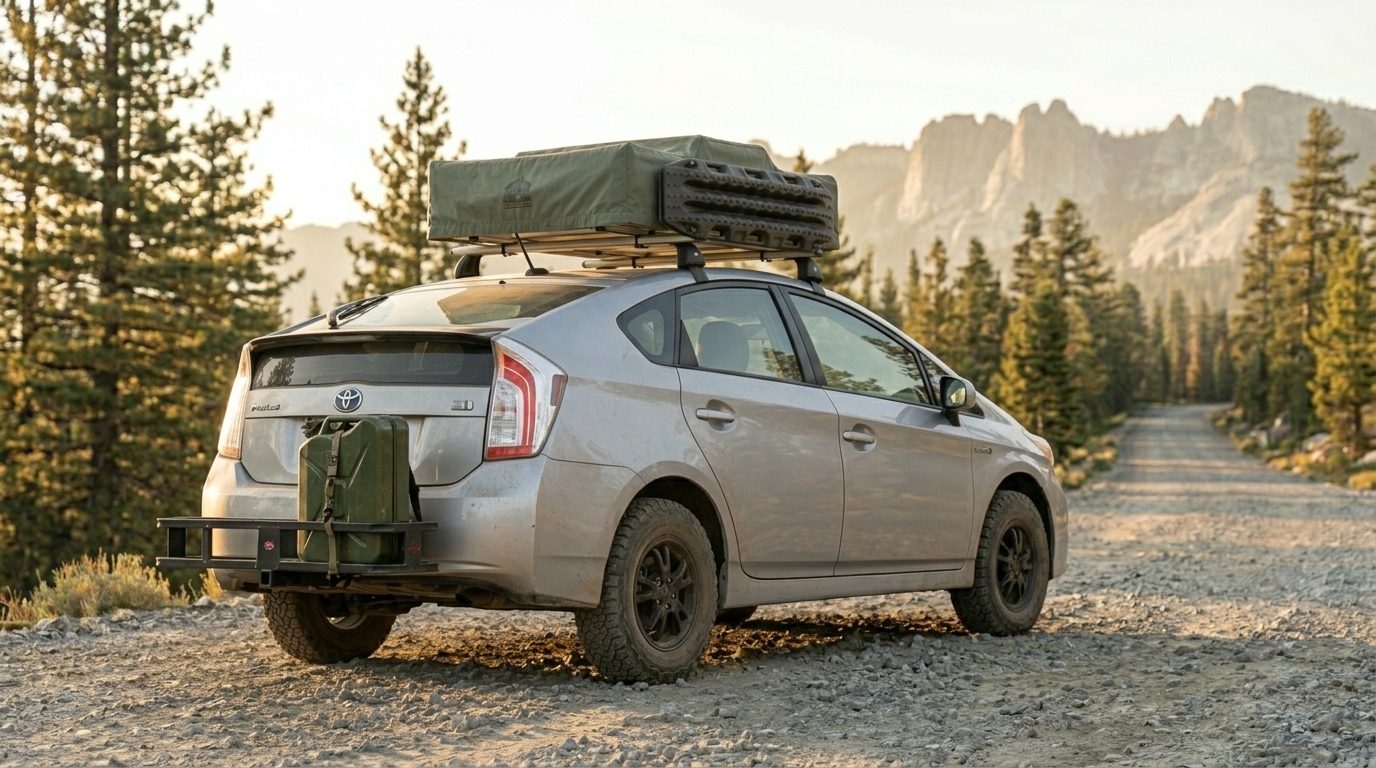
A lifted Prius sounds like a punchline. However, the build has earned a real spot in the budget overlanding conversation, and the math is harder to laugh off than you would expect. I traded in a Jeep Gladiator, I daily-drive a 2025 Chevy Colorado ZR2, and I rent Ford Bronco Badlands rigs for Big Bear weekends. So believe me, my instinct was to roll my eyes too.
Then I ran the numbers. Specifically, for the overlander who wants gravel-road access on a commuter budget, the appeal is obvious. You keep a paid-off, reliable car. Meanwhile, you add enough clearance and gear capacity to reach most trailheads.
This guide takes a buyer-decision angle. First, we cover what the build delivers. Next, we set honest limits. Finally, we answer the only question worth asking: should you build one, or spend your money elsewhere? If you are weighing this against a dedicated truck, our overlanding on a budget guide pairs well with this piece.
Key Specs at a Glance
For context, here are the core numbers for a typical Prius Offroad build, drawn from the company’s published kit specs and real owner reports.
| Specification | Details |
|---|---|
| Lift height | 1.5 in via spacers at all four corners |
| Ground clearance | ~5.1 in stock to ~6.6 in lifted |
| Towing capacity | No factory rating; aftermarket hitch ~1,500 lbs |
| Roof load rating | ~165 lbs factory on most generations |
| Fuel economy | 40-50 MPG; 500+ mi on a ~11-gallon tank |
| Kit fitment | Prius generations 2 through 5 |
| Available mods | lift, roof rack, skid plates, hitch, light mounts |
| All-in cost | under $14,000 used Prius plus mods |
How the Off-Road Prius Trend Started
The off-road Prius did not start as a marketing gimmick. It started with a custody schedule. Eric, founder of Prius Offroad, came from serious hardware. He built pre-runners for the Baja 1000 and drove a Cummins-powered Dodge on 40-inch tires.
A cross-state custody situation then forced nearly 800 miles of weekend driving. So he bought a third-gen Prius for the fuel savings, and naturally started modifying it. “I applied the same knowledge and built myself a little lift kit,” Eric told The Autopian.
Word spread fast. Strangers flagged him down at gas stations and left notes on his windshield asking for the same setup. Within six months, he had 40 phone numbers from interested owners. As a result, a personal fix turned into a real business selling lift kits, roof racks, skid plates, hitches, and light mounts for Prius generations 2 through 5.
Prius Lift Kit: What 1.5 Inches Buys You
The Prius lift kit raises the car 1.5 inches with spacers at all four corners. Notably, the figure was not pulled from thin air. Eric tested 3-inch and 2-inch lifts first, yet both put unacceptable strain on the Prius’s suspension geometry.
Therefore 1.5 inches became the engineering sweet spot. It adds meaningful clearance for mild off-road use without wrecking reliability or handling. A stock Prius sits at roughly 5.1 inches. The lifted version clears closer to 6.6 inches, which changes what gravel and washboard roads do to your underbody.
The rear kit swaps spacers for heavy-duty springs to fight squat when you load gear. A roof rack opens the same carry options you expect on a trail rig, within a factory roof rating near 165 lbs. For comparison, the Honda CR-V carries the same 165-lb rating, while older Mazda CX-5 models stopped at 100 lbs.
Skid Plates Earn Their Keep
The low-hanging hybrid battery pack is the Prius weak point on rough terrain. Prius Offroad sells skid plates built to armor the undercarriage on rocky or rutted trails. For a light-duty build, this is the most important upgrade after the lift itself, because one sharp rock into the battery tray ends your weekend fast.
The Tire Tax: Where the Build Gets Real
Here is the honest trade-off behind every Prius build: tires. All-terrain rubber and hybrid fuel economy fight each other. Eric is blunt about it. Moving from low-rolling-resistance OEM tires to a proper AT tire costs roughly 10 MPG from the added rolling mass.
His advice for most buyers is simple. Run the lift on stock tires first, then upgrade rubber only if your terrain demands it. Notably, about 95% of his customers only want maintained gravel roads to a campground, not technical wheeling. For them, the lift alone does the job.
The aerodynamic penalty at the 1.5-inch height stays minimal, so the lift itself barely touches your mileage. For overlanders pushing rougher ground, the smart move is sizing up minimally and choosing the lightest AT option you find.
Who a Lifted Prius Build Suits Best
Eric pegs roughly 5% of his customers as hardcore off-roaders. The other 95% are outdoor people who want to leave pavement for a campsite, a trailhead, or a mountain bike drop without buying a second vehicle. A lifted Prius fits the second group cleanly.
The overlanding community has argued for years about whether you need a dedicated rig or whether a capable street vehicle handles 80% of real-world use. Honestly, my Bronco Badlands rentals confirm the point. Most of my Big Bear miles are graded forest roads any careful driver survives in a crossover.
If you already park a reliable Prius, the build keeps your costs flat while opening the gate to the 80%. For readers comparing platforms, our best overland vehicles guide shows where a featherweight car sits next to heavier iron.
What a Lifted Prius Build Costs
This is where Prius overlanding gets persuasive. A full Prius Offroad setup with lift, roof rack, skid plate, hitch, and light mounts runs around $2,000 in parts. A clean third-gen Prius sells for $8,000 to $12,000 in today’s used market.
Add it up and you land under $14,000 for a reliable rig returning 45+ MPG on the highway. Compare those numbers to the entry price for a used 4Runner, a Tacoma, or even a base Bronco Sport right now. Comparable used trucks in clean condition still cost thousands more before a single mod.
Range seals the argument for some buyers. A lifted Prius covers 500+ miles between fill-ups on a single ~11-gallon tank. Most purpose-built off-road vehicles never approach those numbers without a long-range fuel system. To stretch a low-payload platform further, our guide to build a lightweight overlanding setup keeps your gear list honest.
Lifted Prius vs. the Budget Overland Field
The Prius loses on ground clearance and towing. It loses on traction too, since most trims send power to the front wheels with no low range. Still, on cost-per-mile, highway range, and all-in budget, it competes with vehicles marketed as adventure-ready.
| Vehicle | Clearance | Towing | MPG | All-in cost |
|---|---|---|---|---|
| Lifted Prius (Gen 3+) | ~6.6 in | ~1,500 lbs (aftermarket) | 40-50 | ~$10-14k |
| Subaru Outback (stock) | 8.7 in | 3,500 lbs | 26-33 | ~$18k used |
| RAV4 Hybrid (stock) | 8.1 in | 1,750 lbs | 38-41 | ~$24k used |
| Used 3rd-Gen 4Runner | ~9.0 in | 5,000 lbs | 16-19 | ~$25-35k |
So the choice splits by mission. For technical trails, towing, and serious payload, the 4Runner or Outback wins easily. For cheap miles, fuel range, and gravel-road access, the lifted Prius punches above its sticker. Hybrid-curious readers should also see our take on electric and hybrid off-road vehicles before deciding.
Lifted Prius Pros and Cons (No Filter)
We promised straight talk, so here it is with the jokes intact. Specifically, every line below carries a real number underneath the punchline.
Pros
- Sips fuel like it owes you money: 40-50 MPG and 500+ miles on a ~11-gallon tank.
- Cheaper than your buddy’s wheels and tires: a full build lands under $14,000 all-in.
- The reliability of a kitchen appliance: Toyota hybrids routinely cross 200,000 miles.
- Gas-station celebrity status: Eric collected 40 buyer phone numbers in six months.
- Finally clears the washboard: 5.1 inches becomes 6.6 inches with the kit.
- Hauls gear without a second mortgage: ~165-lb roof rack plus an aftermarket hitch carrier.
- Stealth-camp mode: it looks like a commuter and sleeps like a rig.
Cons
- Ground clearance of a determined corgi: 6.6 inches still trails a Tacoma badly.
- The tire tax is brutal: proper AT rubber costs you roughly 10 MPG.
- No low range, no locker, no AWD on most trims: front-wheel physics still rule.
- Your overland buddies will roast you forever: pack thick skin for camp.
- The battery pack hangs low: skip the skid plate and trail rash finds it.
- Payload is a polite suggestion: load it like a featherweight or pay later.
Final Verdict
A lifted Prius makes sense for one specific buyer: the budget overlander who already owns the car and wants gravel-road access without a second payment. Its biggest strength is cost-per-mile. Few budget overland options match 40-plus MPG and a 500-mile range for under $14,000 all-in.
The trade-offs are equally real. With 6.6 inches of clearance, no low range, and a low payload ceiling, this build never replaces a proper 4×4 on technical ground. If your weekends involve rock gardens, deep ruts, or heavy towing, look elsewhere and spend the money on capability.
On value, though, the build is hard to argue against for its intended mission. You get Toyota hybrid reliability, real gear capacity, and trailhead access for the price of the lift kit alone. For most outdoor people, the setup covers the 80% of trips they take.
My recommendation is honest. Build the Prius if your trails are graded forest roads and your priority is range and cost. Buy a used 4Runner or a budget-friendly off-road truck instead if you need true capability, and our budget-friendly off-road vehicles roundup is the next read either way.
Frequently Asked Questions
Is lifting a Prius a good idea?
For light-duty overlanding, yes. A 1.5-inch lift adds clearance for gravel and forest roads while keeping reliability intact. For rock crawling or heavy towing, no. The lifted Prius lacks low range, AWD on most trims, and the payload a real trail rig needs.
How much does a Prius lift kit and build cost?
A full Prius Offroad setup with lift, roof rack, skid plate, hitch, and light mounts runs around $2,000 in parts. Add a used third-gen Prius at $8,000 to $12,000, and your all-in total stays under $14,000.
Do you need all-terrain tires on a lifted Prius?
Most owners do not. AT rubber costs roughly 10 MPG, so the builder recommends running stock tires first. Add lightweight AT tires only if your terrain genuinely demands the extra grip.
Which Prius generation works best for an off-road build?
Prius Offroad fits generations 2 through 5, and the third generation is the popular starting point. It offers strong used-market value and proven reliability, which makes it a low-risk base for Prius overlanding.
How many miles will a Prius last?
Toyota hybrid drivetrains routinely pass 200,000 miles with basic maintenance, and many reach 300,000. Such durability is a core reason owners build their existing Prius rather than buy a thirstier truck.
Where do you find a lifted Prius for sale?
A handful of specialty shops occasionally list pre-built lifted examples if you would rather skip the wrench time, though inventory stays thin. Building your own off-road Prius from a clean used car still costs less and lets you spec the exact mods you want.